Gravity Curves Worksheet
Physics Handout Universal Gravitation & Graphical Modeling
Gravity Curves Worksheet
Part 1: Functional Relationships in Newton's Law of Gravitation
Name:
Date: Period:
Governing Mathematical Law
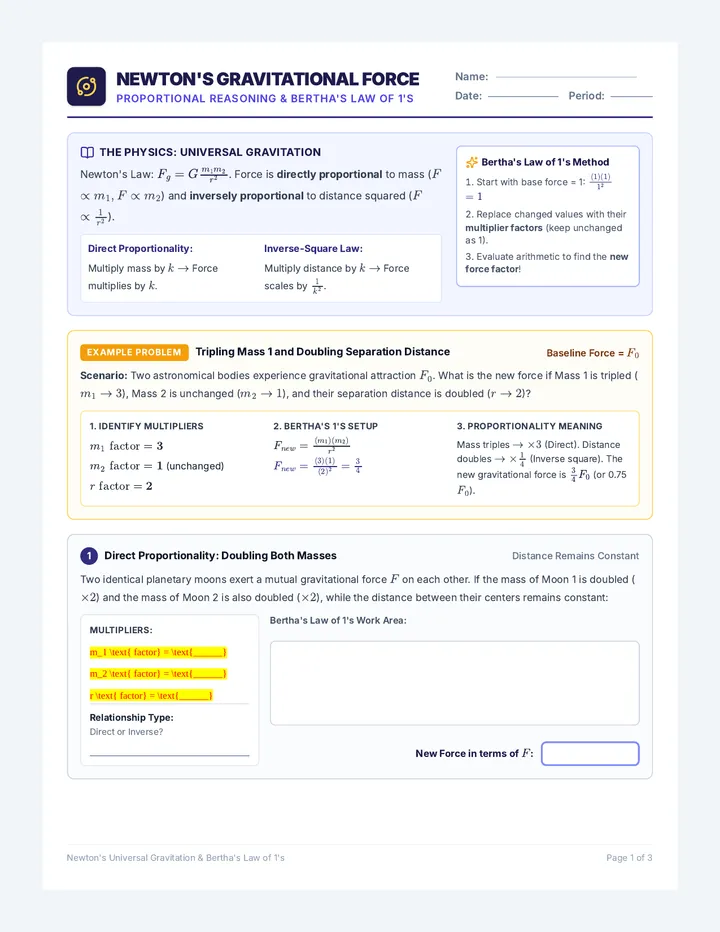
Newton's Law of Universal Gravitation: \( F_g = G \frac{m_1 m_2}{r^2} \)
\( G = 6.674 \times 10^{-11} \text{ N}\cdot\text{m}^2/\text{kg}^2 \)
Section 1: Comparative Functional Graphs
Analyze the mathematical geometry of each plotted relationship
Graph 1: \( F \) vs. \( m \) Direct Linear
Mass (\(m\)) \(F_g\) 0 \(m_0\) \(2m_0\) \(F_0\) \(2F_0\)
Proportionality: \( F_g \propto m \)
• Straight line through the origin
• Doubling mass doubles force (\( 2 \times F_0 \))
• Constant slope: \( \text{slope} = \frac{G m_2}{r^2} \)
Graph 2: \( F \) vs. \( r \) Inverse Square
Distance (\(r\)) \(F_g\) 0 \(r_0\) \(2r_0\) \(F_0\) \(\frac{1}{4}F_0\)
Proportionality: \( F_g \propto \frac{1}{r^2} \)
• Steep decay asymptotic to axes
• Doubling distance cuts force to \(\frac{1}{4}F_0\)
• Tripling distance cuts force to \(\frac{1}{9}F_0\)
Graph 3: \( F \) vs. \( r^2 \) Inverse (\(1/x\))
Dist.\(^2\) (\(r^2\)) \(F_g\) 0 \(r_0^2\) \(2r_0^2\) \(F_0\) \(\frac{1}{2}F_0\)
Proportionality: \( F_g \propto \frac{1}{u} \) (\(u = r^2\))
• Form of \( y = \frac{k}{x} \) (inverse hyperbola)
• Doubling \( r^2 \) cuts force in half (\(\frac{1}{2}F_0\))
• Less steep near origin than Graph 2
Section 2: Comparative Analysis Matrix
Synthesize graph characteristics into the reference table below
Analytical Feature
Graph 1: \( F \) vs. \( m \)
Graph 2: \( F \) vs. \( r \)
Graph 3: \( F \) vs. \( r^2 \)
Horizontal Variable
Mass \( m \) (kg)
Distance \( r \) (m)
Distance squared \( r^2 \) (m\(^2\))
Mathematical Curve
Linear (through origin)
Inverse-square curve
Inverse hyperbola (\(y \propto 1/x\))
Effect if horizontal value doubles:
How to linearize this relation:
Already linear (constant slope)
Reference these graphs and your completed table to answer the multiple-choice questions on Page 2.
Page 1 of 2
Concept Evaluation Quantitative Graphical Reasoning
Part 2: Multiple Choice Concept Check
Gravity Curves Worksheet
Page 2 of 2
Directions: Use Graph 1, Graph 2, and Graph 3 from Page 1 to answer Questions 1–3. Select your answer and provide your brief physical reasoning in the blank box.
1
A satellite is relocated from an orbital distance \( r_0 \) to a higher orbit at \( 2r_0 \). According to Graph 2 (\( F \) vs. \( r \)), what is the new gravitational force relative to its initial force \( F_0 \)?
A The force doubles to \( 2F_0 \) because distance increased.
B The force decreases to \( \frac{1}{2}F_0 \) due to an inverse relationship.
C The force decreases to \( \frac{1}{4}F_0 \) due to the inverse-square law.
D The force remains unchanged at \( F_0 \) because mass is constant.
Justification / Graph Reference:
2
Compare Graph 2 (\( F \) vs. \( r \)) and Graph 3 (\( F \) vs. \( r^2 \)). Why does the curve in Graph 2 drop significantly more steeply near small values of the horizontal variable than Graph 3?
A Graph 2 plots against \( r \) where \( F \propto \frac{1}{r^2} \), whereas Graph 3 plots against \( r^2 \) yielding a \( \frac{1}{x} \) hyperbola.
B Graph 2 represents attractive forces, while Graph 3 represents repulsive gravitational fields.
C Graph 2 assumes both masses are doubling simultaneously, while Graph 3 holds mass constant.
D Graph 3 is a straight line through the origin, meaning its slope does not change.
Justification / Graph Reference:
3
Physicists often "linearize" curves to find constants from slopes. Which variable should be plotted on the horizontal axis to transform the curved distance data of Graph 2 into a straight line through the origin like Graph 1?
A Plotting \( F \) vs. \( \sqrt{r} \) (the square root of separation distance)
B Plotting \( F \) vs. \( \frac{1}{r^2} \) (the inverse square of separation distance)
C Plotting \( F \) vs. \( r^2 \) (the square of distance, as shown in Graph 3)
D Plotting \( F \) vs. \( \frac{1}{r} \) (the inverse of separation distance)
Justification / Graph Reference:
Synthesis Challenge: Physical Meaning of Slope
If you construct the linearized plot of \( F \) vs. \( \frac{1}{r^2} \) identified in Question 3, what expression represents the slope of that line in terms of \( G, m_1, \) and \( m_2 \)?
Rubric: 4 pts per question (2 pts selection + 2 pts physical justification) + 3 pts synthesis.
Total Score: / 15