Lenny.com
Explore
Create
ActivitiesNewMathEnglish Language ArtsScience & EngineeringSocial StudiesGlobal LanguagesHealth & Physical EducationSpecial EducationCounseling & Life SkillsArts & CreativityESL
Lenny.com
Lenny.com
Explore
Create
ActivitiesNewMathEnglish Language ArtsScience & EngineeringSocial StudiesGlobal LanguagesHealth & Physical EducationSpecial EducationCounseling & Life SkillsArts & CreativityESL
Lenny.com
Lenny.com

Solutions

Lenny for EducatorsLenny for SchoolsLenny for Districts

Product

ExploreSign inCreateSupportAbout

Resources

Getting startedMTSS Acceleration Program

© 2026 Lenny Learning Inc.

TermsPrivacyAccessibility
LinkedInInstagramX
Lenny

The Thirteen Colonies

Regional development of New England, Middle, and Southern settlements through economic, social, and political lenses. Examines colonial governance, trade patterns, and escalating tensions with the British Crown.

Social StudiesSocial Studies PracticesLocation WordsMapsOrder EventsChronology and CausationEvaluating SourcesHistorical ThinkingGeography, Humans, & the EnvironmentAmerican Symbols and LandmarksCitiesStatesState CapitalsRegions of the United StatesGeographic SkillsPhysical GeographyHuman GeographyRegional GeographyGeography of AfricaGeography of AsiaGeography of EuropeGeography of OceaniaGeography of the AmericasSociety and Environment of EuropeSociety and Environment of AsiaSociety and Environment of The AmericasSociety and Environment of the Middle EastSociety and Environment of AfricaHistoryPrehistoryComparing Ancient River CivilizationsAncient MesopotamiaAncient Egypt and KushAncient South AsiaEarly ChinaGreeceRome and the Byzantine EmpireAncient World HistoryNative Peoples of North AmericaNative Peoples of Mesoamerica and South AmericaAfrican EmpiresMedieval AsiaMedieval EuropeThe Silk RoadMedieval HistoryIslamic EmpiresWorld ReligionsRenaissance PeriodAge of ExplorationThe Thirteen ColoniesThe American RevolutionUS History Early RepublicFounding of the United StatesUS History AntebellumUS Civil WarReconstruction PeriodThe Gilded AgeUS ImperialismWorld ImperialismWorld War IUS History 1920sGreat DepressionWorld War IIThe Cold WarUS History 1950-60sUS History 1960s-70sWorld History 20th CenturyContemporary US HistoryContemporary World HistoryHolidaysCivics and GovernmentCitizenshipGovernment FoundationsThe ConstitutionUS ConstitutionExecutive BranchLegislative BranchJudicial BranchState and LocalPolitical ParticipationPublic PolicyPolitical SystemsPower and AuthoritySocial MovementsDefining DevianceTheories of DevianceCrime and Criminal JusticeEconomicsBasic Economic PrinciplesSupply and DemandWhat is MoneyEconomic FundamentalsMicroeconomicsMacroeconomicsBanking and FinanceEconomic SystemsGlobal EconomicsCorporations and PowerThe Changing WorkplaceUnemployment and LaborClass and InequalitySocial MobilityGlobal InequalityPsychologyHistory of PsychologyPsychology as a ScienceBrain and Nervous SystemNeuroscience and BehaviorGenetics and BehaviorSleep and ConsciousnessSensory ProcessesPerceptual OrganizationClassical ConditioningOperant ConditioningObservational LearningCognitive LearningMemory ProcessesThinking and Problem SolvingLanguage and CognitionTheories of MotivationStress and CopingPrenatal and Infant DevelopmentChildhood DevelopmentAdolescent DevelopmentAdulthood and AgingSelf and IdentitySocial CognitionSocial InfluenceAttraction and RelationshipsGroup BehaviorPrejudice and DiscriminationAnxiety and Mood DisordersClinical PsychologyForensic PsychologyPhilosophy & EthicsIntroduction to PhilosophyMajor Philosophers & IdeasMind and Body ProblemFree Will vs DeterminismEthics & MoralityReligion & PhilosophyPolitical Philosophy

Videos

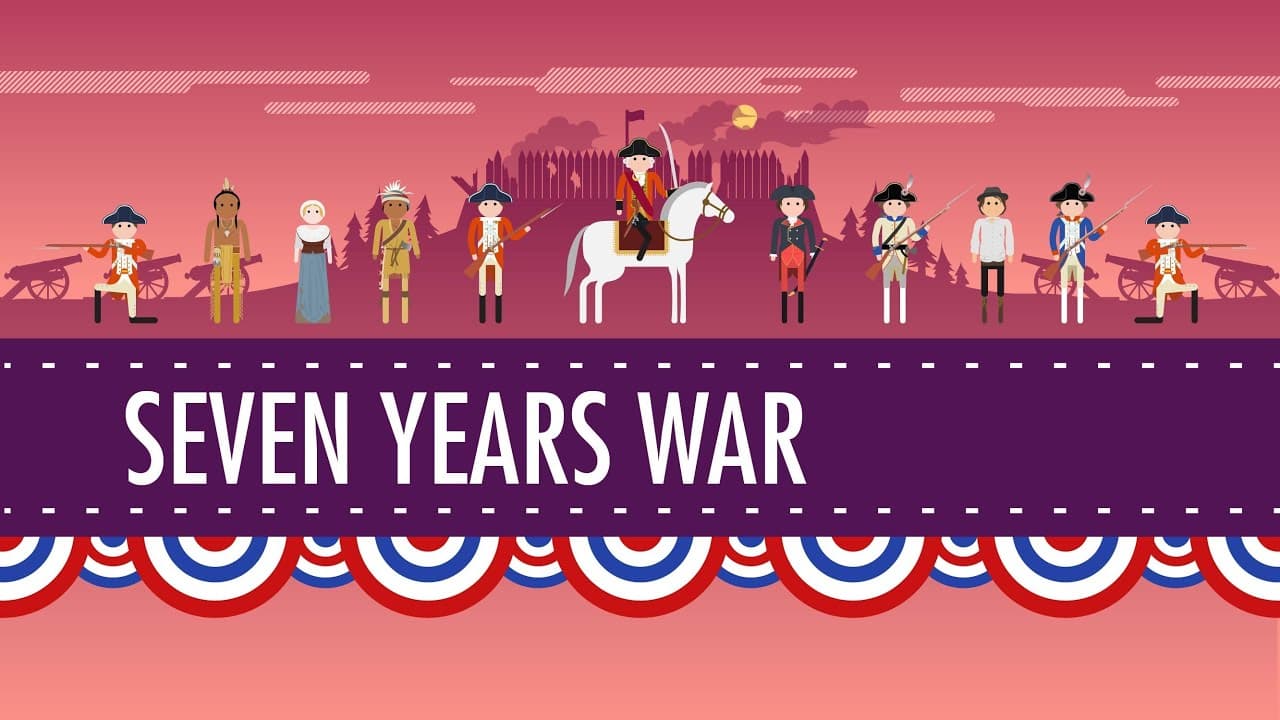
How the Seven Years War Led to the American Revolution

How the Seven Years War Led to the American Revolution

In this fast-paced and engaging episode of Crash Course US History, John Green explores the global conflict known as the Seven Years War (or the French and Indian War) and its pivotal role in setting the stage for the American Revolution. The video moves beyond simple dates and battles to examine the complex economic and social forces at play, specifically focusing on the economic theory of mercantilism and how the colonial drive for land and resources sparked a global conflagration.

CrashCourseCrashCourse

10mins 40s

The Story of the Declaration of Independence

The Story of the Declaration of Independence

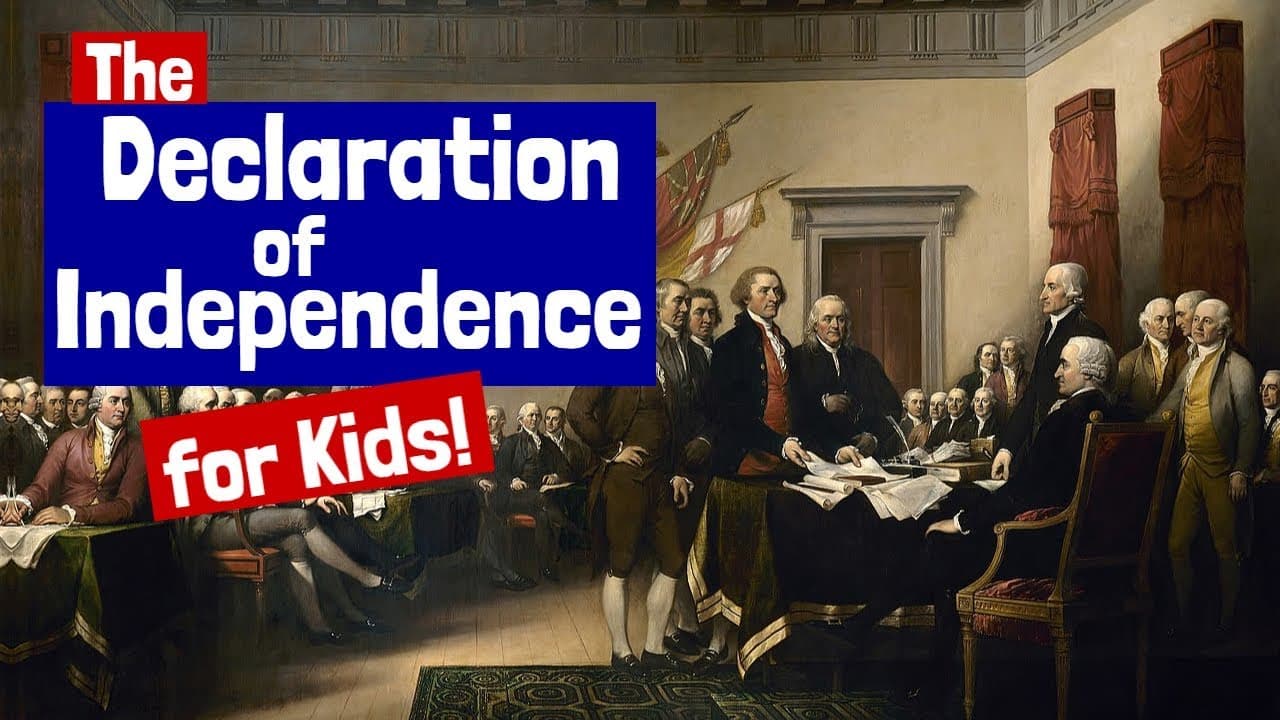
This engaging animated video provides a kid-friendly history of the Declaration of Independence, explaining its origins, purpose, and enduring legacy. It takes students on a journey from the National Archives Museum where the document is stored today back to 1776. The narration clearly outlines the context of the thirteen colonies, the conflict with Great Britain, and the decision to become a free nation. It highlights key figures like Thomas Jefferson and John Hancock, and explains significant locations like Independence Hall. Key historical themes explored include the Revolutionary War, the role of the Second Continental Congress, and the drafting process involving the "Committee of Five." The video clarifies important dates, distinguishing between when the document was presented (June 28), voted on (July 4), and signed. It also breaks down the document's original, much longer title and offers a close-up look at John Hancock's famous signature. For the classroom, this video serves as an excellent introduction to American Civics and History. It makes abstract historical events concrete by using clear visuals and approachable language. Teachers can use it to spark discussions about what it means to be independent, the risks the signers took, and the meaning behind the famous words "Life, Liberty and the pursuit of Happiness," which are read aloud at the end of the video.
Homeschool PopHomeschool Pop

7mins 45s

How Slavery Was Created: The Legal Evolution in the Colonies

How Slavery Was Created: The Legal Evolution in the Colonies

This educational video from Crash Course Black American History provides a nuanced examination of how the institution of slavery took root and evolved in the American colonies. It moves beyond simple dates to explore the economic motivations behind slavery, specifically the concept of mercantilism and the desire to minimize production costs. The video details the transition from using indentured servants to the systemic enslavement of Africans, highlighting the specific legal and social shifts that codified slavery into law based on race.

CrashCourseCrashCourse

10mins 55s

How Religion in America Evolved Through History

How Religion in America Evolved Through History

This educational video provides a comprehensive overview of the evolution of the religious landscape in the United States, tracing its roots from a predominantly Protestant colonial society to a diverse modern nation. The narrator uses relatable analogies to explain complex social dynamics before diving into key historical periods, specifically focusing on how the Great Awakening reinforced early Christian dominance and how subsequent waves of immigration introduced Catholicism, Judaism, and Eastern philosophies to the American cultural fabric. Key themes explored include the tension between the constitutional promise of religious freedom (the Free Exercise Clause) and the historical reality of discrimination faced by minority groups. The video presents case studies on Jewish immigrants fleeing antisemitism and Chinese immigrants arriving during the Gold Rush, highlighting both their contributions and the systemic barriers they encountered, such as the Immigration Act of 1924. It defines important concepts like "religious revival," "secularism," and "antisemitism" within their historical contexts. For educators, this video serves as an excellent resource for U.S. History and Civics units. It connects abstract constitutional rights to concrete historical events, allowing students to analyze demographic shifts and discuss the social impacts of immigration. The video features built-in pause points for document analysis activities, making it a ready-to-use tool for teaching about the First Amendment, the history of immigration policy, and the value of cultural diversity.

Miacademy & MiaPrep Learning ChannelMiacademy & MiaPrep Learning Channel

11mins 56s

Exploring Colonial America: Quakers, Rebellion, and Women's Roles

Exploring Colonial America: Quakers, Rebellion, and Women's Roles

In this installment of Crash Course US History, John Green explores the complex landscape of the American colonies beyond the typical stories of Jamestown and Plymouth. The video delves into the diverse origins of colonies like New Amsterdam (later New York) and Pennsylvania, highlighting the role of the Dutch and Quakers in shaping early American commerce and religious tolerance. It also examines the darker aspects of colonial expansion, including the 'Walking Purchase' fraud against the Lenape Indians and the establishment of a slavery-based economy in South Carolina.

CrashCourseCrashCourse

11mins 38s

How European Settlers Colonized North America

How European Settlers Colonized North America

This educational video provides a comprehensive overview of the early European colonization of the territory that would become the United States. It traces the timeline from Spanish settlements in the 1500s, through French exploration, to the establishment of permanent English colonies. The narrative focuses on key historical moments including the founding of St. Augustine, the struggles of Jamestown, the arrival of the Pilgrims at Plymouth, and the eventual formation of the 13 original colonies.

Miacademy & MiaPrep Learning ChannelMiacademy & MiaPrep Learning Channel

5mins 34s

Materials

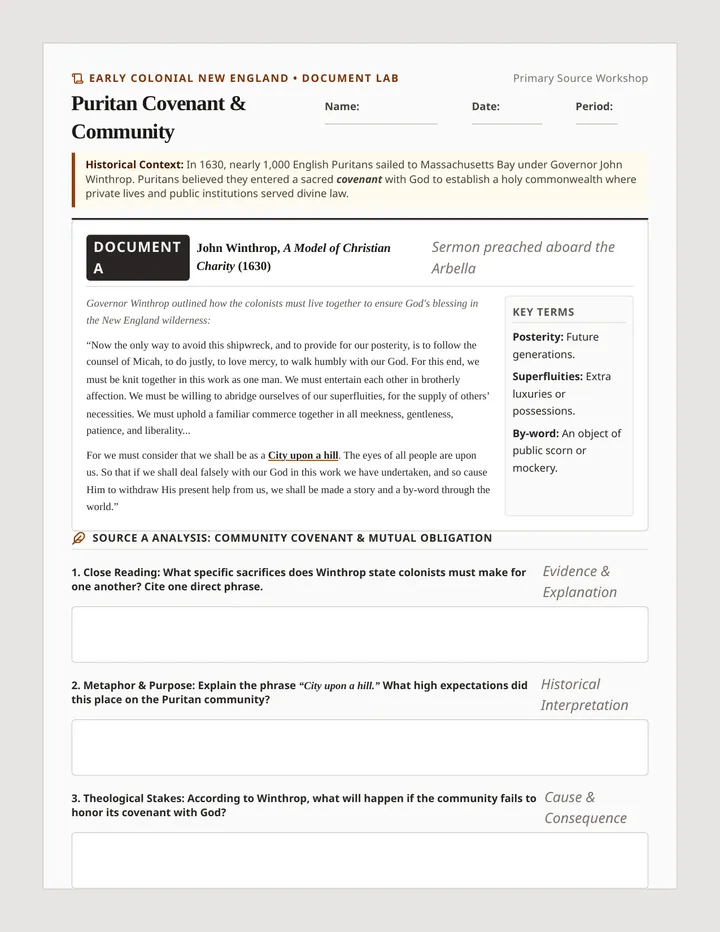
Puritan Covenant Source Analysis Worksheet

Puritan Covenant Source Analysis Worksheet

A two-page primary source analysis worksheet exploring early colonial New England through John Winthrop's 'A Model of Christian Charity' and Anne Bradstreet's personal devotional poetry. Students examine religious doctrines, covenant theology, communal expectations, and individual piety using guided text-dependent questions and evidence collection spaces.

SS

Shannon Slygh

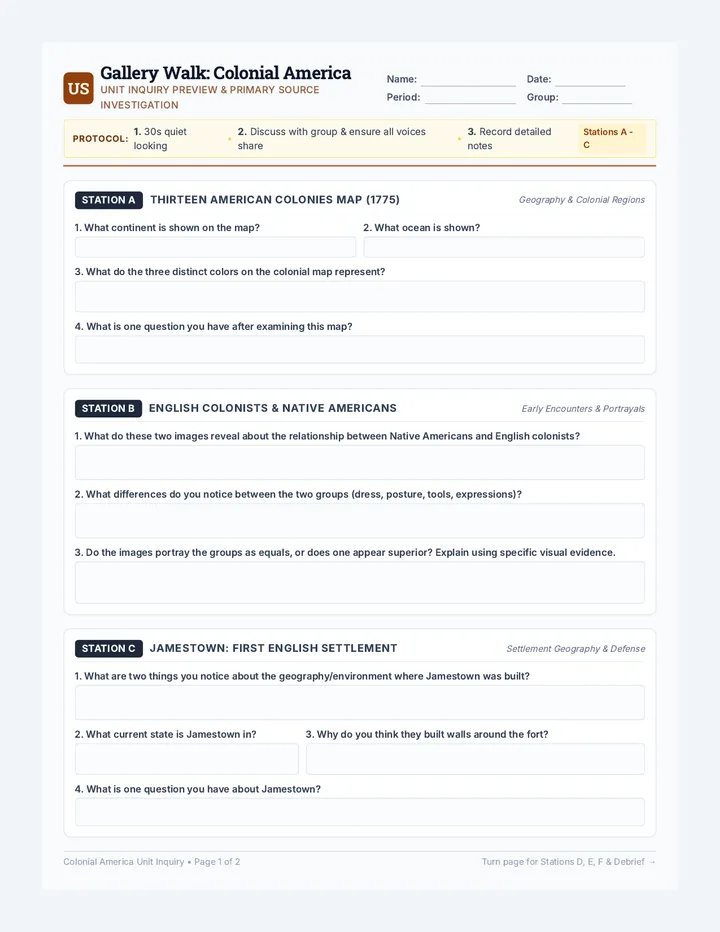
Colonial America Gallery Walk Worksheet

Colonial America Gallery Walk Worksheet

A two-page student-facing gallery walk worksheet examining Colonial America across six stations. Guides students through map analysis, cross-cultural encounters, Jamestown settlement geography, New England town structures, colonial economies, and changing relationships over time.

TP

Tytiana Payne

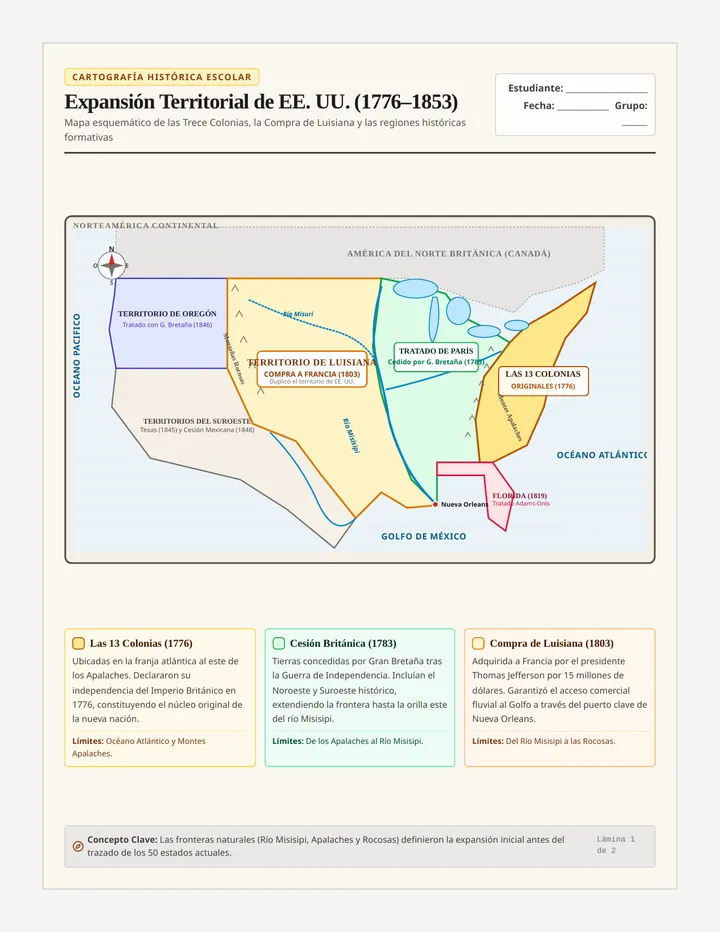
Expansion Territorial Mapa Didactico

Expansion Territorial Mapa Didactico

Mapa histórico esquemático de Estados Unidos que ilustra las Trece Colonias, el Territorio de Luisiana y las etapas clave de la expansión territorial temprana sin fronteras estatales modernas. Incluye una lámina de referencia cartográfica detallada y una ficha pedagógica de análisis y comprensión histórica.

CS

Carlos Santos

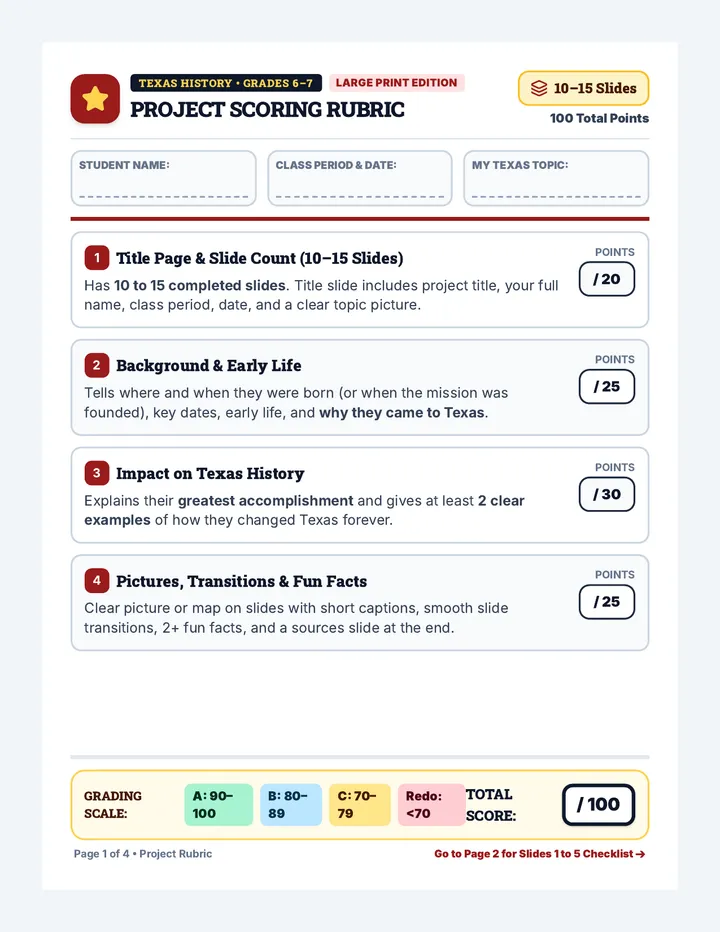
Texas Legends Slideshow Rubric

Texas Legends Slideshow Rubric

A 4-page true large-print, accommodated rubric and slide-by-slide checklist (16pt+ body text and large checkboxes) for 6th and 7th grade students creating a 10–15 slide Texas History presentation.

LR

Linda Rector

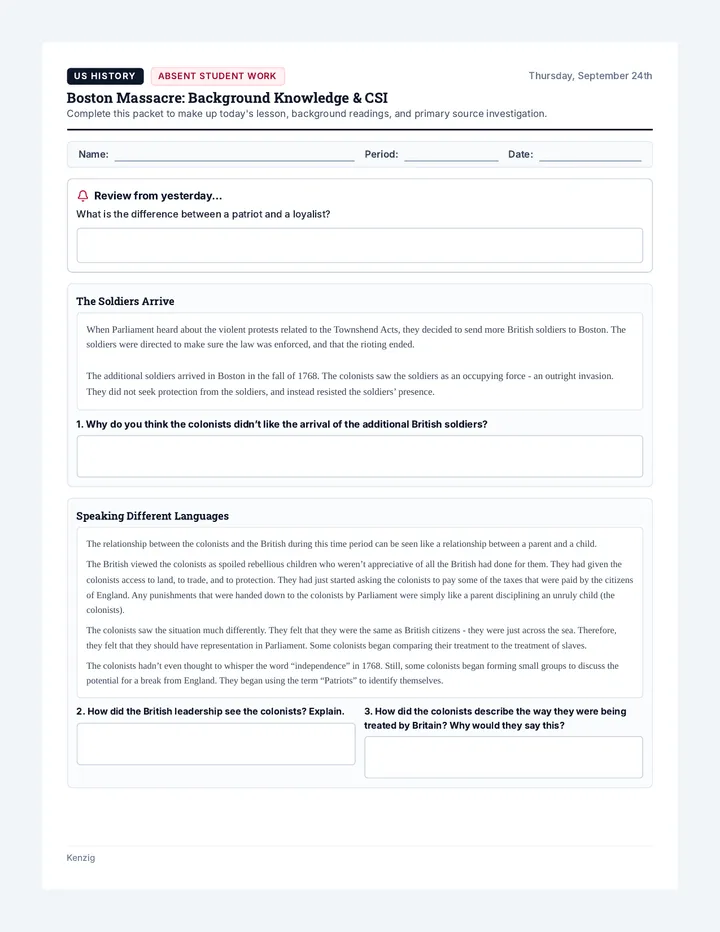
Boston Massacre Absent Worksheet

Boston Massacre Absent Worksheet

A printable 3-page absent student packet featuring the exact verbatim readings, questions, and Source E primary source testimony from the classroom slideshow, formatted with ample handwriting space for middle school students.

KK

Kayla Kenzig

Enduring Issues Colonial Worksheet

Enduring Issues Colonial Worksheet

A 2-page scaffolded 7th-grade social studies worksheet introducing three enduring issues (Power and Authority, Justice and Law, and Conflict) through colonial-era events. Features a reference toolkit with vocabulary, a guided 'We Do' class modeling activity on the Boston Massacre with an evidence chart, three independent 'You Do' historical scenarios, a higher-level extension challenge, and a formative exit ticket.

AN

Austin Nowak

Sequences

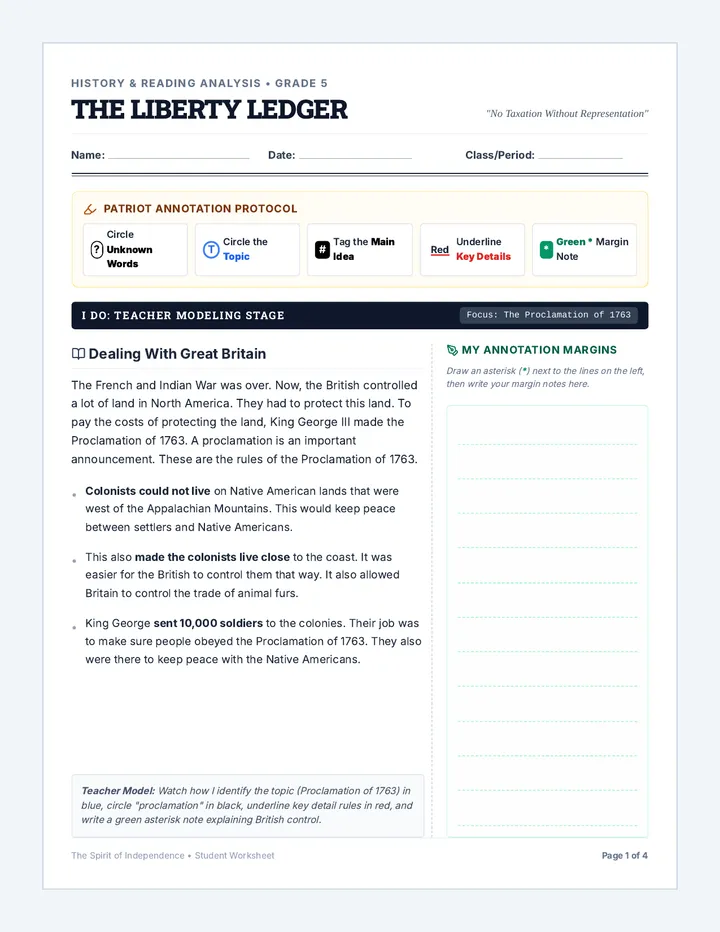
Liberty Ledger Annotation Worksheet

Spirit of Independence

A fifth-grade social studies and active reading unit exploring the growing friction between Great Britain and the American colonies, focusing on the causes, consequences, and motivated actions that led to the American Revolution.

MN

Monica Nava

7
Thirteen Friends Worksheet

Democratic Foundations

A series of lessons exploring the foundational documents and processes of the United States government, from the birth of the nation to the creation of modern laws.

SB

Stephanie Bizeur

40
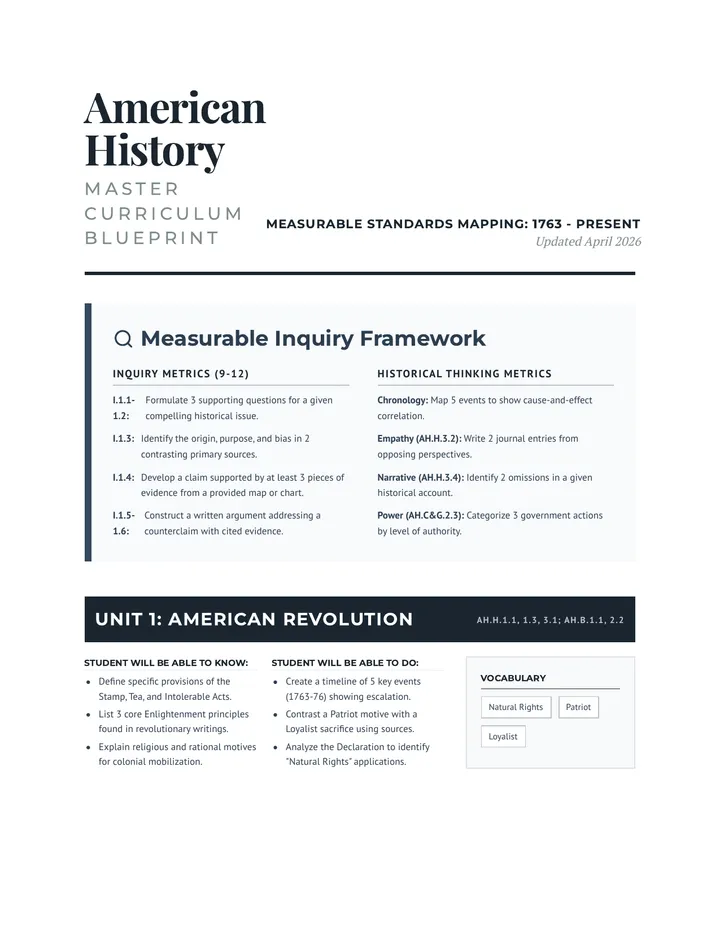
Curriculum Blueprint Document v2

History Horizon Sequence

A comprehensive high school curriculum plan for American History, covering 13 units from the American Revolution to the modern era, aligned with North Carolina Social Studies standards.

AK

Amity Kea

21
Tax and Tea Teacher Guide

Road to Revolution

A 5-day history and English Language Arts sequence exploring the accelerating events and intellectual currents that led to the American Revolution. Students scaffold their summative assessment—an open letter from a Second Continental Congress delegate—by documenting crown abuses, analyzing Enlightenment concepts, and drafting arguments daily.

AN

Ashleigh Nash

10
Urban Explorers Teacher Guide

Urban Explorers Northeast Landmarks

A multi-day social studies unit for 5th grade students with low literacy, focusing on historical landmarks in Boston and New York City. Students explore the concept of landmarks through visual-heavy instruction, mapping activities, and historical facts about the Northeast.

A

amy_oshea

12
Foundations Comprehension Quiz

The American Ledger USH Remediation

A 25-day intensive remediation program for 11th Grade US History students, focusing on the Cold War, Civil Rights, Vietnam, the Reagan Era, and contemporary history. Each day features a 'Ledger' reader with embedded annotations and a review worksheet, aligned with Texas TEKS standards.

CE

Chelsea Elliott

62

Lessons

History Sprint Pacing Guide

STAAR History Sprint

A comprehensive pacing guide and activity resource designed to cover the remaining 11th Grade US History TEKS before the STAAR test on April 16th. This lesson provides a day-by-day calendar for A/B block schedules and high-engagement activities for each remaining historical era.

BB

Bridgette Burdick

51
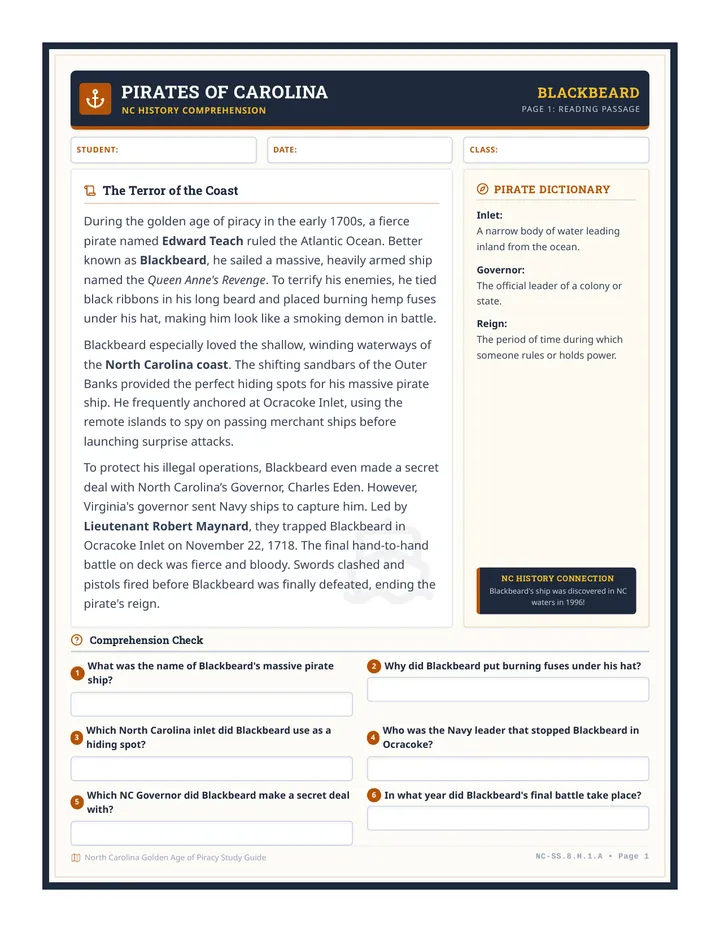
Blackbeard Legends Worksheet A

Pirates of Carolina

This lesson features differentiated reading comprehension worksheets about Blackbeard the Pirate along the North Carolina coast. Tailored for middle school special education students, it provides 2nd-grade and 5th-grade level texts in visually identical layouts to preserve student dignity.

KS

Kathleen Suther

11
Massachusetts Milestones Slideshow

New England Chronicles

An expansive journey through the history of New England, divided into state-by-state volumes. This series provides middle school students with 180 daily historical warm-ups, exploring major milestones from pre-colonial times to modern innovations.

SF

Steven Flint

6
Compromise Conundrum Activity Signs

Compromise Conundrum

A 45-minute stand-alone lesson centered on the Constitutional Convention's debate over representation and the Three-Fifths Compromise. It includes chunked reading for accessibility, a high-engagement 'Four Corners' activity, and a graphic organizer assessment designed for formal observation alignment with the Danielson Framework.

SA

Senta Agnello-Shelton

11
Colonial Caper Slides

Colonial Case Files

An immersive investigative experience where students solve the 'Case of the Missing Charter' by exploring the regional differences, economy, and daily life of the 13 original colonies.

S

sheenad

5
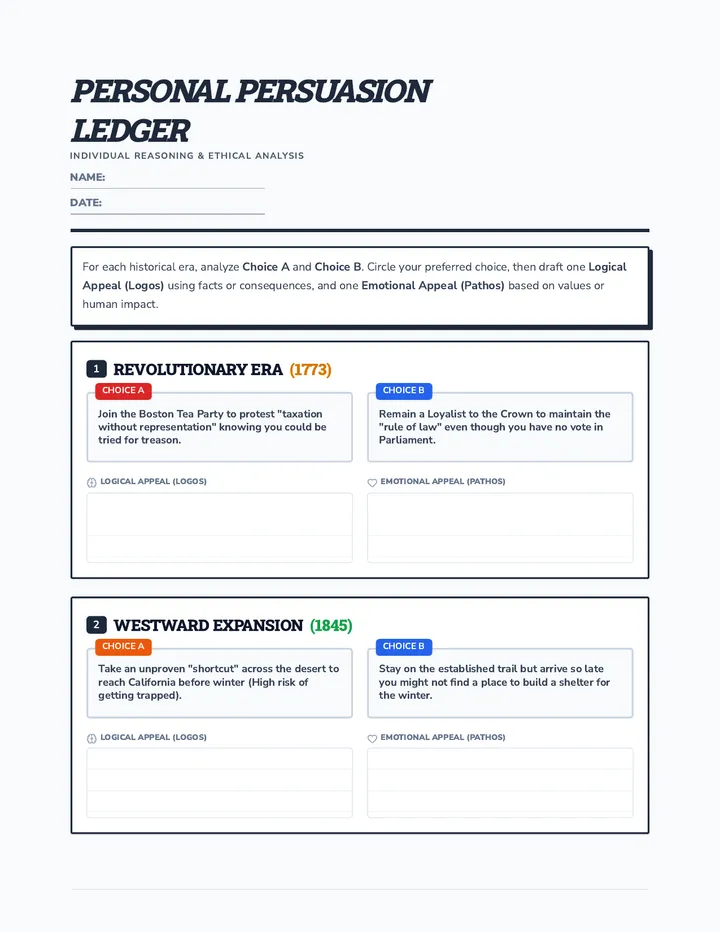
Personal Persuasion Ledger Worksheet

Hard History Choices

A middle school American History and Ethics lesson where students use 'Would You Rather' scenarios to practice logical and emotional appeals. Students work individually to form arguments before engaging in group debates to reach a consensus.

DC

Dennis Cronin

4