Lenny.com
Explore
Create
ActivitiesNewMathEnglish Language ArtsScience & EngineeringSocial StudiesGlobal LanguagesHealth & Physical EducationSpecial EducationCounseling & Life SkillsArts & CreativityESL
Lenny.com
Lenny.com
Explore
Create
ActivitiesNewMathEnglish Language ArtsScience & EngineeringSocial StudiesGlobal LanguagesHealth & Physical EducationSpecial EducationCounseling & Life SkillsArts & CreativityESL
Lenny.com
Lenny.com

Solutions

Lenny for EducatorsLenny for SchoolsLenny for Districts

Product

ExploreSign inCreateSupportAbout

Resources

Getting startedMTSS Acceleration Program

Newsletters

School Funding Newsletter

© 2026 Lenny Learning Inc.

TermsPrivacyAccessibility
LinkedInInstagramX
Lenny

The Gilded Age

Rapid industrial expansion, urbanization, and political corruption in post-Civil War America. Analyzes the contrast between massive corporate wealth and the burgeoning labor movements and social inequality.

Social StudiesSocial Studies PracticesLocation WordsMapsOrder EventsChronology and CausationEvaluating SourcesHistorical ThinkingGeography, Humans, & the EnvironmentAmerican Symbols and LandmarksCitiesStatesState CapitalsRegions of the United StatesGeographic SkillsPhysical GeographyHuman GeographyRegional GeographyGeography of AfricaGeography of AsiaGeography of EuropeGeography of OceaniaGeography of the AmericasSociety and Environment of EuropeSociety and Environment of AsiaSociety and Environment of The AmericasSociety and Environment of the Middle EastSociety and Environment of AfricaHistoryPrehistoryComparing Ancient River CivilizationsAncient MesopotamiaAncient Egypt and KushAncient South AsiaEarly ChinaGreeceRome and the Byzantine EmpireAncient World HistoryNative Peoples of North AmericaNative Peoples of Mesoamerica and South AmericaAfrican EmpiresMedieval AsiaMedieval EuropeThe Silk RoadMedieval HistoryIslamic EmpiresWorld ReligionsRenaissance PeriodAge of ExplorationThe Thirteen ColoniesThe American RevolutionUS History Early RepublicFounding of the United StatesUS History AntebellumUS Civil WarReconstruction PeriodThe Gilded AgeUS ImperialismWorld ImperialismWorld War IUS History 1920sGreat DepressionWorld War IIThe Cold WarUS History 1950-60sUS History 1960s-70sWorld History 20th CenturyContemporary US HistoryContemporary World HistoryHolidaysCivics and GovernmentCitizenshipGovernment FoundationsThe ConstitutionUS ConstitutionExecutive BranchLegislative BranchJudicial BranchState and LocalPolitical ParticipationPublic PolicyPolitical SystemsPower and AuthoritySocial MovementsDefining DevianceTheories of DevianceCrime and Criminal JusticeEconomicsBasic Economic PrinciplesSupply and DemandWhat is MoneyEconomic FundamentalsMicroeconomicsMacroeconomicsBanking and FinanceEconomic SystemsGlobal EconomicsCorporations and PowerThe Changing WorkplaceUnemployment and LaborClass and InequalitySocial MobilityGlobal InequalityPsychologyHistory of PsychologyPsychology as a ScienceBrain and Nervous SystemNeuroscience and BehaviorGenetics and BehaviorSleep and ConsciousnessSensory ProcessesPerceptual OrganizationClassical ConditioningOperant ConditioningObservational LearningCognitive LearningMemory ProcessesThinking and Problem SolvingLanguage and CognitionTheories of MotivationStress and CopingPrenatal and Infant DevelopmentChildhood DevelopmentAdolescent DevelopmentAdulthood and AgingSelf and IdentitySocial CognitionSocial InfluenceAttraction and RelationshipsGroup BehaviorPrejudice and DiscriminationAnxiety and Mood DisordersClinical PsychologyForensic PsychologyPhilosophy & EthicsIntroduction to PhilosophyMajor Philosophers & IdeasMind and Body ProblemFree Will vs DeterminismEthics & MoralityReligion & PhilosophyPolitical Philosophy

Videos

Comparing Primary and Secondary Historical Sources

Comparing Primary and Secondary Historical Sources

This educational video uses the 1893 Chicago World's Fair as a case study to explain the critical difference between primary and secondary sources in historical analysis. The narrator breaks down definitions of each source type before presenting concrete examples: a first-hand letter written by a fair attendee in 1893 (primary) and a modern National Park Service article about the fair (secondary). Through this comparison, viewers learn how to distinguish between direct observation and retrospective analysis. The video explores key themes of historical perspective, bias, and the construction of historical narratives. It specifically highlights how primary sources capture immediate, subjective experiences (like the spectacle of the Egyptian exhibit), while secondary sources provide broader context and critical analysis that may be unavailable to contemporary witnesses (such as the structural sexism faced by women organizers). The video uses a Venn diagram to visually map out where these accounts overlap and diverge. For educators, this resource is an excellent tool for teaching historical thinking skills and source evaluation. It moves beyond simple definitions to demonstrate *how* historians use different sources to build a complete picture of the past. The video includes a built-in pause for student reflection and concludes with a powerful metaphor about history being a "conversation between the past and the present," helping students understand that history is an evolving interpretation rather than a static set of facts.

Khan AcademyKhan Academy

5mins 1s

A Virtual Field Trip to Yellowstone National Park

A Virtual Field Trip to Yellowstone National Park

Take students on an immersive virtual field trip to Yellowstone, the world's first national park. This video provides a comprehensive overview of the park's history, geography, and stunning natural features, explaining that it was established by the US Congress in 1872 and spans across Wyoming, Montana, and Idaho. The narration effectively situates the park geographically while highlighting its immense size of nearly 9,000 square kilometers.

Next Generation ScienceNext Generation Science

2mins 42s

How Monopolies Form and Impact the Economy

How Monopolies Form and Impact the Economy

This educational video uses a relatable grocery store analogy to explain the economic concept of monopolies. It breaks down complex business structures into digestible examples, starting with the basic definition of a monopoly as a single seller with no competition. The video details the specific mechanisms of how monopolies form, specifically distinguishing between horizontal integration (buying competitors) and vertical integration (owning the supply chain), while also introducing the historical concept of "trusts." The content presents a balanced view of the economic impact of monopolies by exploring both the arguments for and against them. It outlines potential benefits such as price stability, economies of scale, and technological investment, while contrasting these with significant drawbacks like price gouging, supply manipulation, and poor product quality. The narrator uses the recurring example of apple prices to make these abstract economic theories concrete for students. For educators, this video serves as an excellent foundational resource for units on Economics or U.S. History (specifically the Industrial Revolution and Gilded Age). It simplifies high-level vocabulary and concepts, making it easy to bridge into deeper discussions about antitrust laws, historical figures like Rockefeller and Carnegie, or modern-day debates about big tech companies. The clear definitions and visual diagrams provide strong scaffolding for visual learners.

Miacademy & MiaPrep Learning ChannelMiacademy & MiaPrep Learning Channel

8mins 27s

Deconstructing the Wild West: Myth vs. Reality

Deconstructing the Wild West: Myth vs. Reality

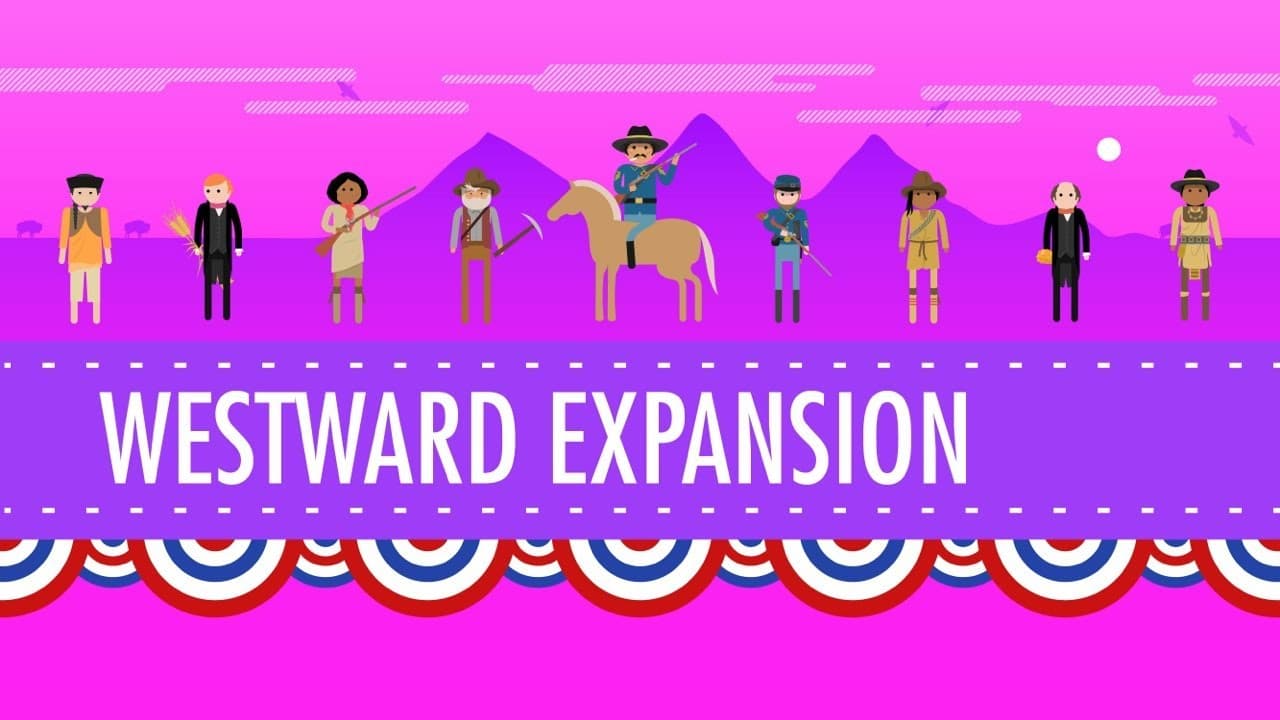
In this episode of Crash Course US History, John Green explores the complex history of Westward Expansion in the late 19th century, deconstructing the romanticized myths of the "Wild West." He challenges the popular narrative of rugged individualism by highlighting the essential role of the federal government, railroads, and industrial capitalism in settling the frontier. The video examines Frederick Jackson Turner's "Frontier Thesis" and contrasts it with the reality of diverse settlers, including families, immigrants, and corporations, who relied heavily on government subsidies and military intervention. A significant portion of the video is dedicated to the tragic impact of expansion on Native American populations. It details the systematic removal of indigenous people, the destruction of the buffalo, the Indian Wars, and the shift from physical warfare to cultural assimilation policies like the Dawes Act and boarding schools. The lesson emphasizes that the "taming" of the West was not just a story of adventure, but one of displacement, cultural genocide, and economic consolidation. For educators, this video serves as an excellent tool for teaching AP US History or high school social studies. It connects the concept of the frontier to broader themes of industrialization and global markets, showing how Western farming and ranching were actually early forms of agribusiness. By connecting the cowboy myth to the reality of meatpacking industries and railroads, the video helps students understand the economic systems that underpinned American growth and encourages critical thinking about national mythology.

CrashCourseCrashCourse

12mins 44s

Who Can Become a Citizen? The History of U.S. Naturalization

Who Can Become a Citizen? The History of U.S. Naturalization

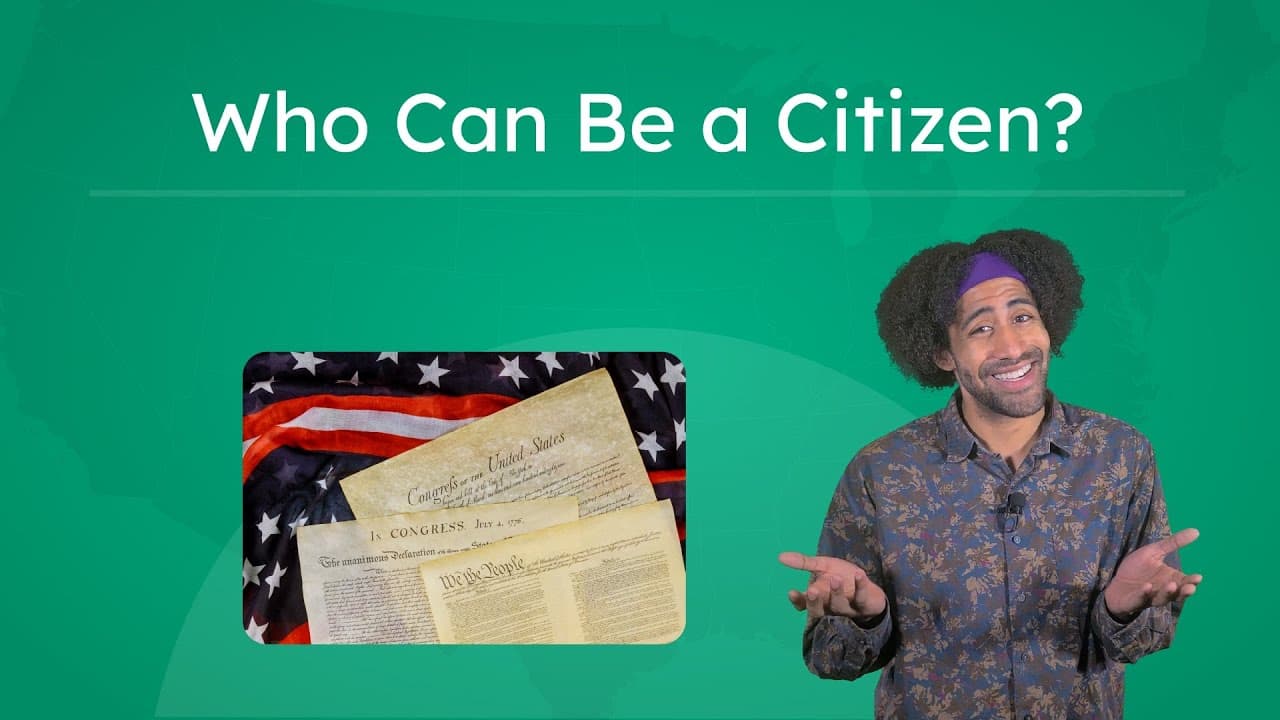
This educational video provides a comprehensive historical overview of United States citizenship, distinguishing it from immigration and exploring the legal frameworks that have defined who belongs in America. It begins by transporting viewers to Ellis Island in 1906 to set the scene, then clarifies the distinction between residency and citizenship. The narrator breaks down the three primary methods of acquiring citizenship: *jus sanguinis* (right of blood), *jus soli* (right of soil/birthright), and naturalization, explaining the legal origins and implications of each. The content dives deep into the historical barriers and challenges to citizenship faced by marginalized groups. It details the significance of the 14th Amendment and examines specific challenges to birthright citizenship, such as the Chinese Exclusion Act and the case of Wong Kim Ark, as well as the exclusion of Indigenous peoples until the Indian Citizenship Act of 1924. The video also critically examines the naturalization process for immigrants, highlighting how racial pseudoscience (like phrenology), fluctuating residency requirements, and arbitrary "good moral character" clauses were historically used to restrict access to citizenship. This resource is highly valuable for Civics and U.S. History classrooms as it helps students understand the evolving definition of "American." It directly addresses hard history, such as the use of pseudoscience to justify racism in policy-making and the specific exclusion of Chinese and Indigenous people. The video includes built-in pause points for reflection and note-taking, making it an interactive tool for exploring concepts of inclusion, exclusion, and the rights associated with citizenship.

Miacademy & MiaPrep Learning ChannelMiacademy & MiaPrep Learning Channel

11mins

Push, Pull, and Policy: The History of US Immigration

Push, Pull, and Policy: The History of US Immigration

This educational video provides a comprehensive historical overview of United States immigration and citizenship policies from the Early Republic through the mid-20th century. The narrator guides viewers through five distinct eras, examining how the definition of who belongs in America has evolved over time. The video begins with the etymology of the word "immigrate" and moves through key legislative milestones, including the Naturalization Act of 1790, the Chinese Exclusion Act of 1882, and the implementation of the quota system. The content explores complex themes such as push and pull factors for migration, the rise of industrialization, and the social backlashes known as nativism and xenophobia. It candidly discusses sensitive historical topics like the eugenics movement and how pseudoscientific racism influenced government policy, specifically through the biased Dillingham Commission. The video also highlights the contributions of immigrants to American culture and economy, balancing the narrative of restriction with one of opportunity and growth. For educators, this resource serves as an excellent anchor for units on US History, Civics, or Human Geography. It breaks down dense historical concepts into digestible segments using visual aids, primary source imagery, and clear definitions of academic vocabulary. The video encourages critical thinking about how historical definitions of race, ethnicity, and nationality were constructed and used to shape the demographics of the United States, providing a necessary context for understanding modern immigration debates.
Miacademy & MiaPrep Learning ChannelMiacademy & MiaPrep Learning Channel

11mins 56s

Materials

Gilded Shark Peer Rubric

Gilded Shark Peer Rubric

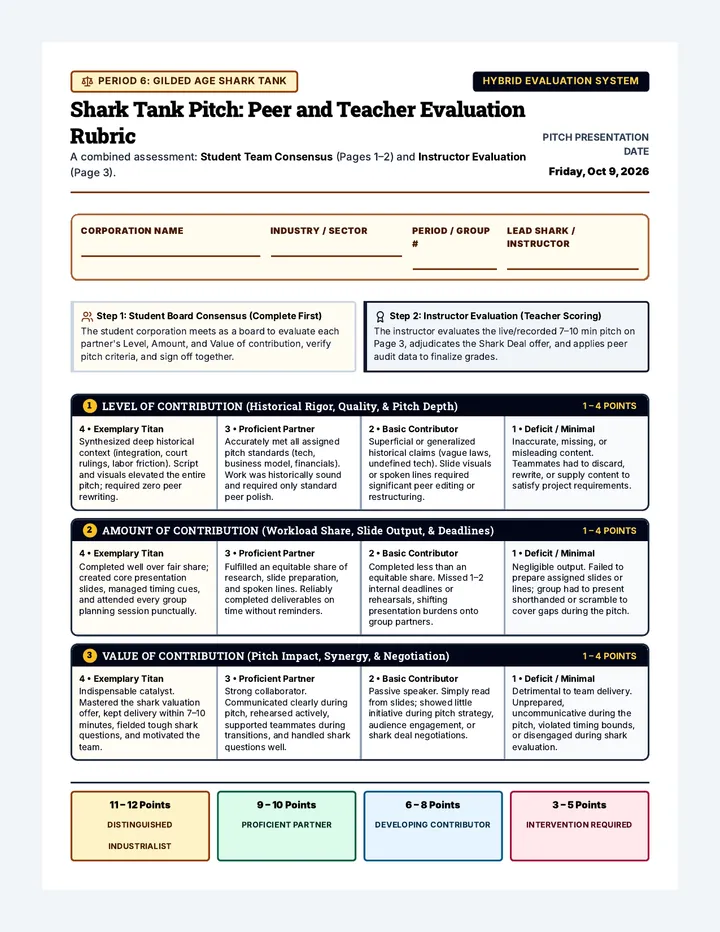
A print-optimized 3-page hybrid peer and teacher evaluation rubric for the Gilded Age Shark Tank pitch. Features evenly balanced column widths across all instructor performance tiers, dark high-contrast typography, and defined, crisp grid lines engineered specifically for physical printing and handwriting.

JG

Joshua Griffith

Industrial Titans Study Guide

Industrial Titans Study Guide

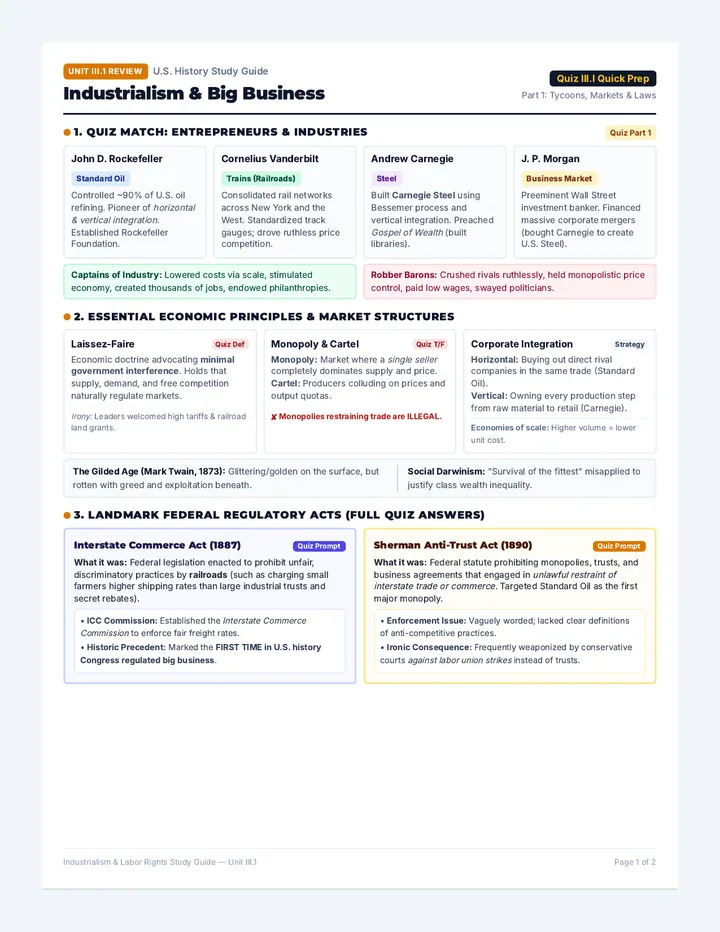
A streamlined, high-yield two-page study guide for Quiz III.I on Industrialism and Labor Rights. Features entrepreneur matching profiles, economic concepts, antitrust acts, union history, the Pullman Strike, and model quiz answers formatted to fit perfectly within printable page boundaries.

AI

Allison Ingraham

Empire In Ink Slides

Empire In Ink Slides

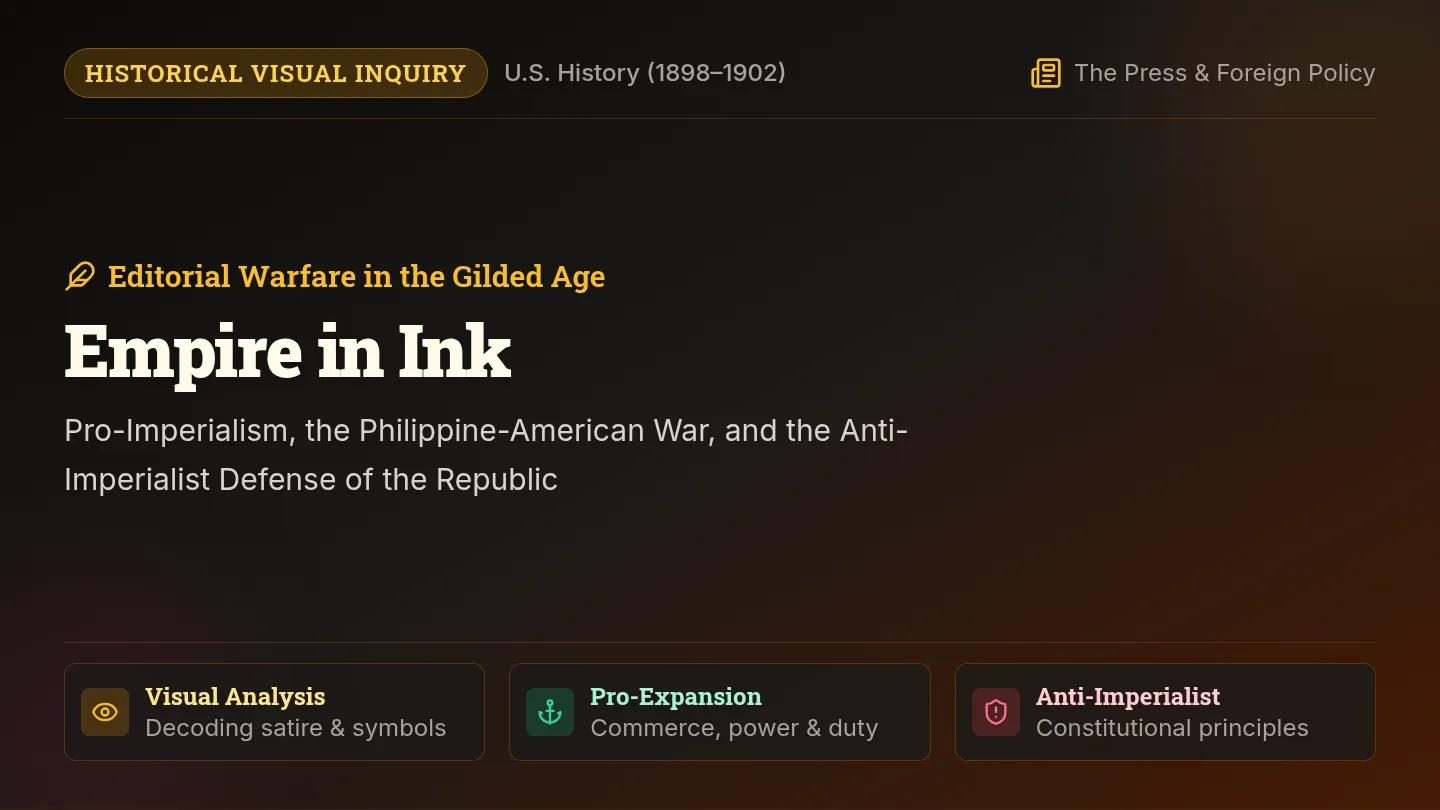
A comprehensive 9-slide visual analysis presentation exploring the intense political cartoon war over American overseas expansion, the Philippine-American War, and the constitutional battle led by the Anti-Imperialist League. Features core visual decoding strategies, paired primary source cartoon breakdowns, and comparative debate frameworks.

JM

Julia Maturo

Industrial Ledger Rubric

Industrial Ledger Rubric

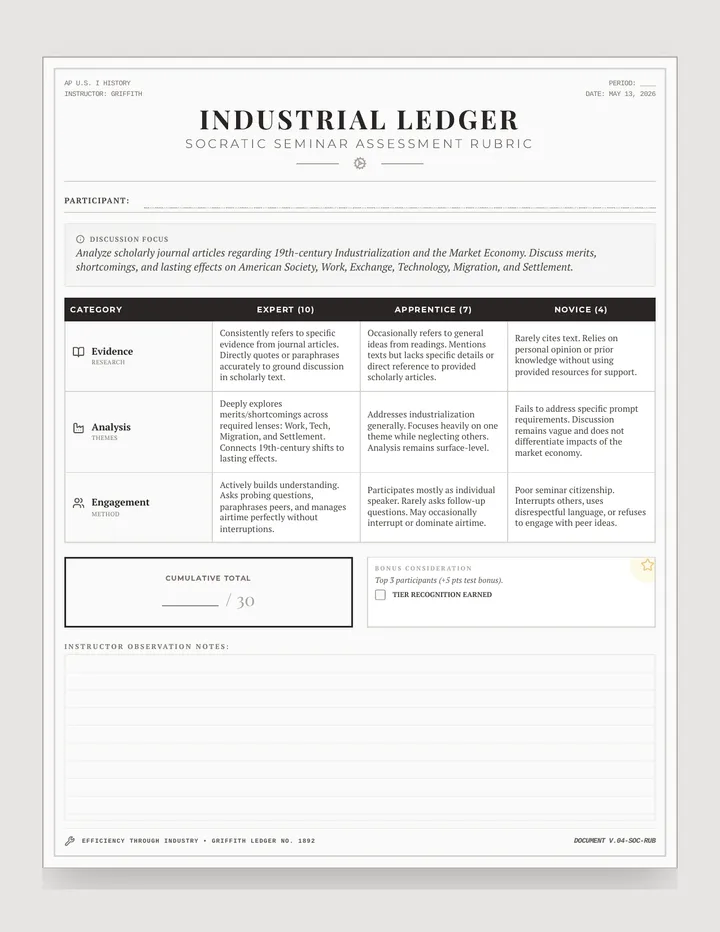
A professional 30-point Socratic Seminar rubric for AP US History, themed as a 19th-century industrial ledger. It evaluates textual evidence, thematic analysis of industrialization, and seminar facilitation across three performance levels.

JG

Joshua Griffith

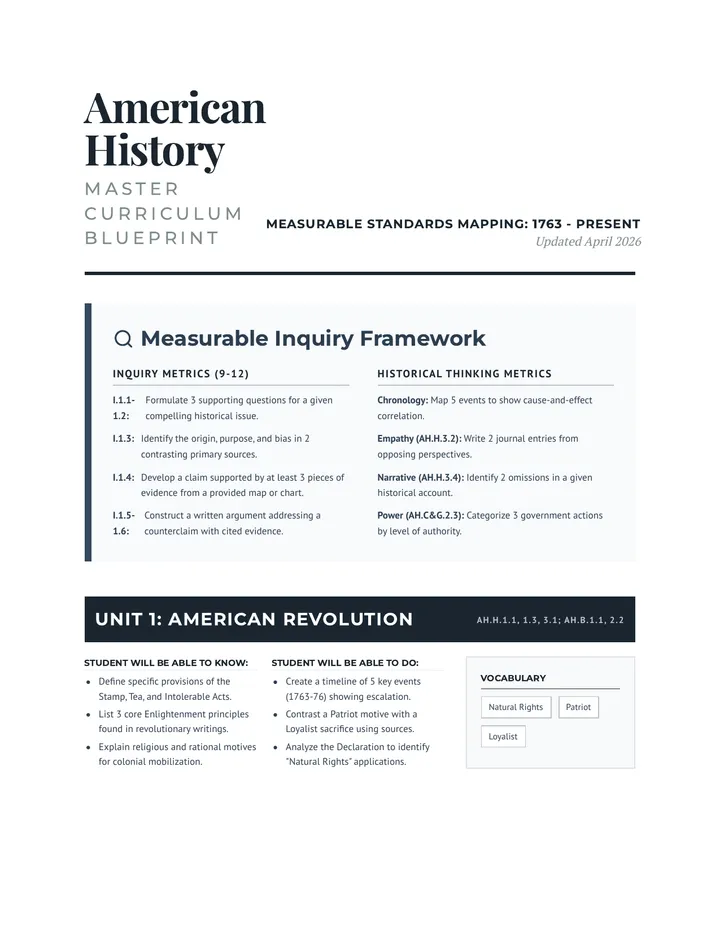
History Blueprint Scope and Sequence

History Blueprint Scope and Sequence

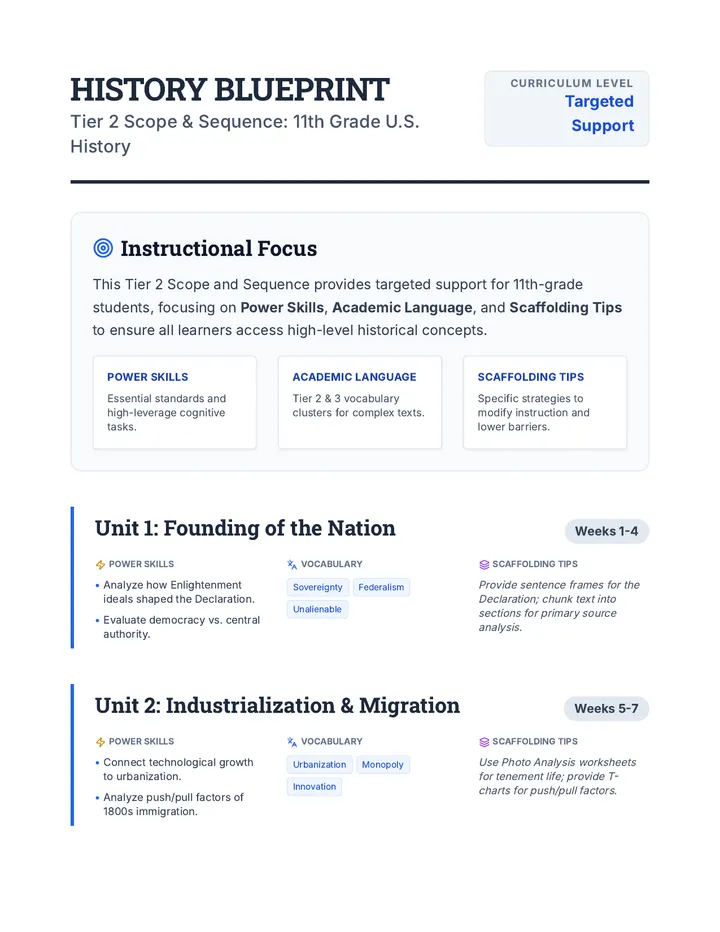
An updated Tier 2 Scope and Sequence for 11th Grade U.S. History, now including specific scaffolding tips for each unit alongside power skills and academic vocabulary. The layout is optimized for teacher reference with instructional strategies tailored for targeted support.

D

dfleisch

Era Evolution Study Guide

Era Evolution Study Guide

A landscape-format study guide covering key terms from the Gilded Age and Progressive Era. Each term includes a definition, a representative icon, and a dedicated space for student notes. Optimized for printing with 6 terms per page. Final version with improved contrast and consistent labeling.

JR

Juan Ronco

Sequences

Invention Boom Slides

Modern Era Odyssey

A 13-day journey through modern American history, from the Industrial Revolution to the present day, focusing on key historical figures and major conflicts as outlined in the 5th Grade TEKS. Each lesson is designed for a quick 30-minute block, integrating multimedia and primary source analysis.

CH

Courtney Holdren

49
Reconstruction Reckoning Worksheet

Modern America

A comprehensive journey through United States history from the aftermath of the Civil War to the contemporary era, exploring the social, political, and economic shifts that shaped the modern nation.

DP

Darren Polamalu

18
Gilded Age II Standards Key

Modern America Mastery

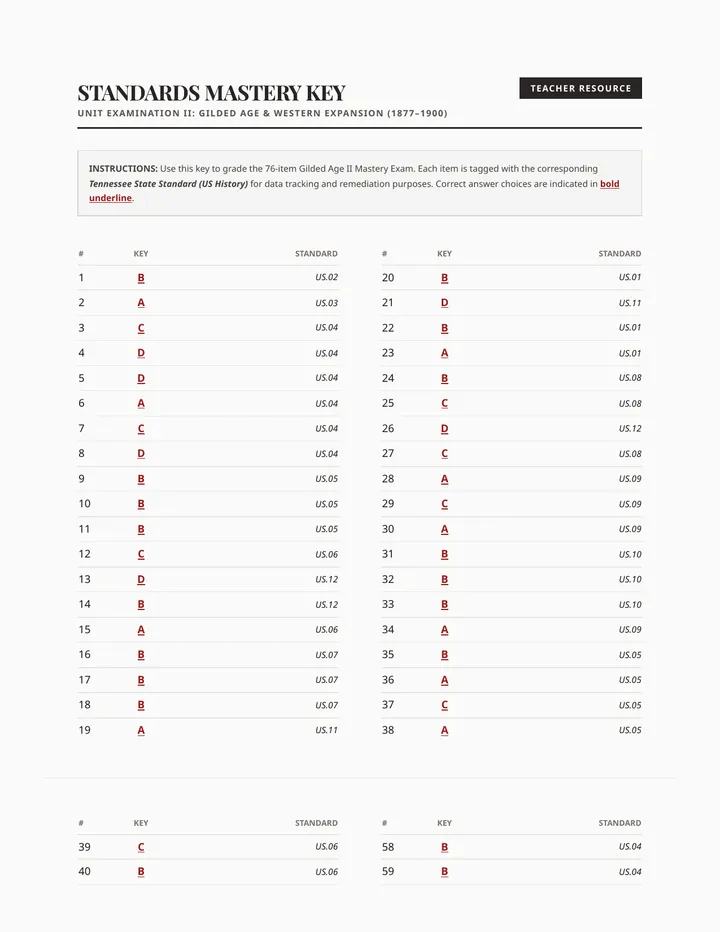
A comprehensive curriculum sequence covering late 19th and early 20th-century American history, focusing on economic transformation, Western expansion, global imperialism, and the impact of the Great War.

A

Andrew

29
Great Debate Intro Slides

The Great Debate

A three-lesson unit designed for ESL newcomers with minimal English proficiency, focusing on Dudley Randall's poem 'Booker T. and W.E.B.' and preparing them for a standardized assessment on author's purpose and language.

ML

Miguel Liendo Navarro

14
Gilded Age WICOR Handout

History Hustle

A comprehensive US History EOC review sequence designed for AVID classrooms, utilizing WICOR strategies to master key eras from the Gilded Age through modern turning points.

ES

Erin Sims

15
Curriculum Blueprint Document v2

History Horizon Sequence

A comprehensive high school curriculum plan for American History, covering 13 units from the American Revolution to the modern era, aligned with North Carolina Social Studies standards.

AK

Amity Kea

21

Lessons

History Sprint Pacing Guide

STAAR History Sprint

A comprehensive pacing guide and activity resource designed to cover the remaining 11th Grade US History TEKS before the STAAR test on April 16th. This lesson provides a day-by-day calendar for A/B block schedules and high-engagement activities for each remaining historical era.

BB

Bridgette Burdick

51
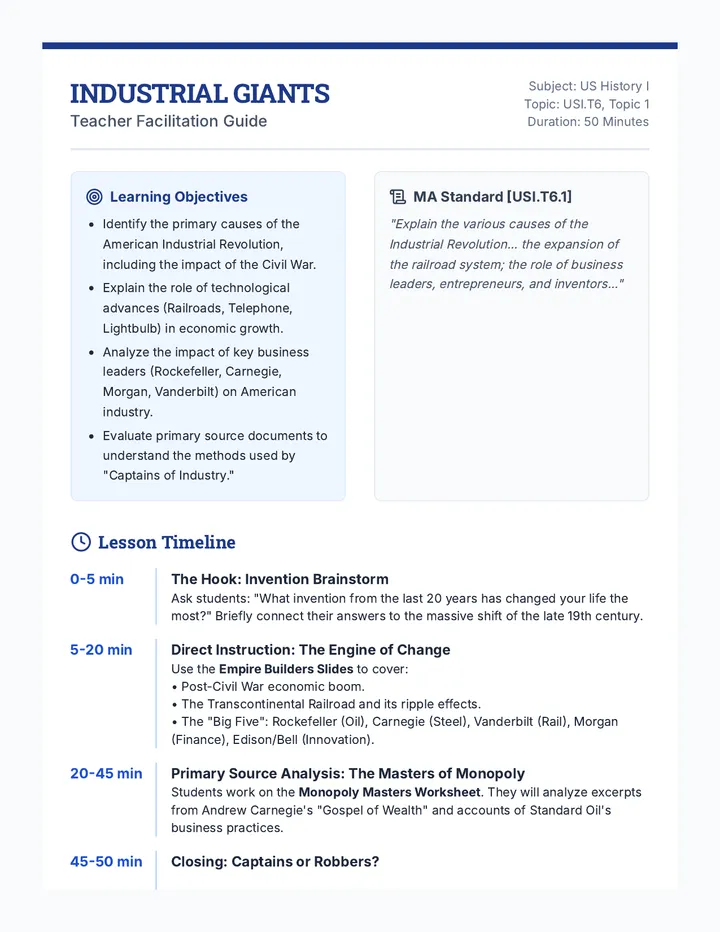
Industrial Giants Lesson Plan

Industrial Giants

An introductory lesson on the American Industrial Revolution, focusing on technological advances, the expansion of railroads, and the rise of industrial giants like Rockefeller, Carnegie, and Morgan. Students analyze primary sources to understand the shift from agrarian to industrial society.

TA

Trey Attanasio

4
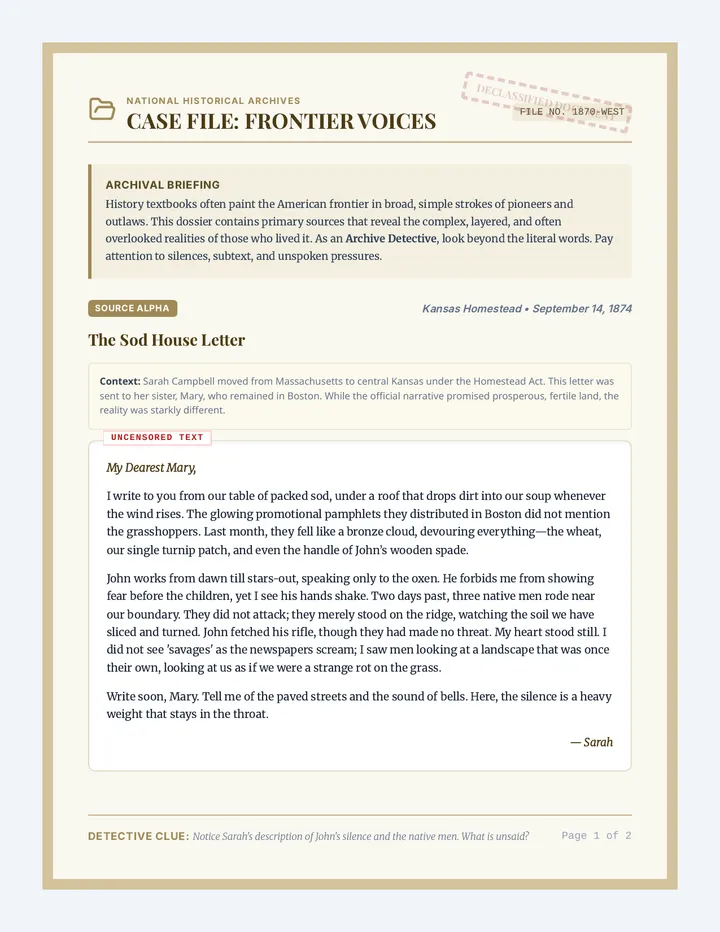
Frontier Dossier Reading

Archive Detectives

A comprehensive history lesson where high school students analyze primary source letters and journals from the American frontier. They uncover overlooked perspectives, evaluate historical context, and build advanced critical thinking skills.

A

anna.rhea

5
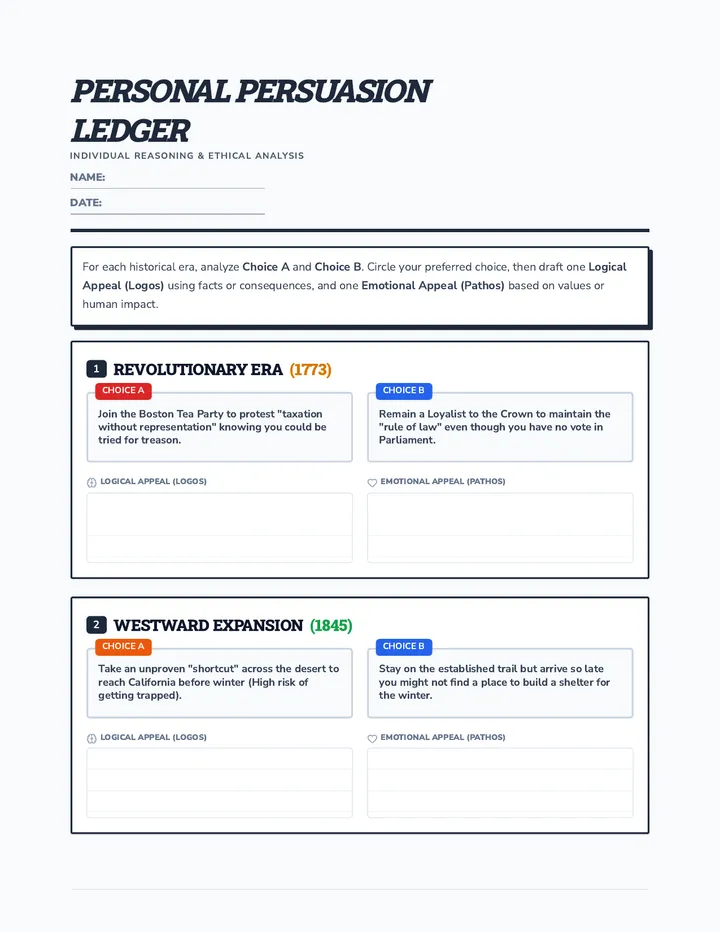
Personal Persuasion Ledger Worksheet

Hard History Choices

A middle school American History and Ethics lesson where students use 'Would You Rather' scenarios to practice logical and emotional appeals. Students work individually to form arguments before engaging in group debates to reach a consensus.

DC

Dennis Cronin

4
Era Review Challenge Practice Sheet

Era Review Challenge

A quick review lesson designed to prepare students for US History STAAR assessments, focusing on four key eras: Imperialism, the Roaring 20s, the Great Depression, and WWII.

BB

Bridgette Burdick

14
Separate but Equal Reading

Equality on Trial

A deep dive into the landmark Plessy v. Ferguson case, exploring the legal arguments, the "separate but equal" doctrine, and Justice Harlan's famous dissent. Students will analyze the long-term impact of this ruling on American society.

M

matthew.hoard

12