Lenny.com
Explore
Create
ActivitiesNewMathEnglish Language ArtsScience & EngineeringSocial StudiesGlobal LanguagesHealth & Physical EducationSpecial EducationCounseling & Life SkillsArts & CreativityESL
Lenny.com
Lenny.com
Explore
Create
ActivitiesNewMathEnglish Language ArtsScience & EngineeringSocial StudiesGlobal LanguagesHealth & Physical EducationSpecial EducationCounseling & Life SkillsArts & CreativityESL
Lenny.com
Social StudiesSocial Studies PracticesLocation WordsMapsOrder EventsChronology and CausationEvaluating SourcesHistorical ThinkingGeography, Humans, & the EnvironmentAmerican Symbols and LandmarksCitiesStatesState CapitalsRegions of the United StatesGeographic SkillsPhysical GeographyHuman GeographyRegional GeographyGeography of AfricaGeography of AsiaGeography of EuropeGeography of OceaniaGeography of the AmericasSociety and Environment of EuropeSociety and Environment of AsiaSociety and Environment of The AmericasSociety and Environment of the Middle EastSociety and Environment of AfricaHistoryPrehistoryComparing Ancient River CivilizationsAncient MesopotamiaAncient Egypt and KushAncient South AsiaEarly ChinaGreeceRome and the Byzantine EmpireAncient World HistoryNative Peoples of North AmericaNative Peoples of Mesoamerica and South AmericaAfrican EmpiresMedieval AsiaMedieval EuropeThe Silk RoadMedieval HistoryIslamic EmpiresWorld ReligionsRenaissance PeriodAge of ExplorationThe Thirteen ColoniesThe American RevolutionUS History Early RepublicFounding of the United StatesUS History AntebellumUS Civil WarReconstruction PeriodThe Gilded AgeUS ImperialismWorld ImperialismWorld War IUS History 1920sGreat DepressionWorld War IIThe Cold WarUS History 1950-60sUS History 1960s-70sWorld History 20th CenturyContemporary US HistoryContemporary World HistoryHolidaysCivics and GovernmentCitizenshipGovernment FoundationsThe ConstitutionUS ConstitutionExecutive BranchLegislative BranchJudicial BranchState and LocalPolitical ParticipationPublic PolicyPolitical SystemsPower and AuthoritySocial MovementsDefining DevianceTheories of DevianceCrime and Criminal JusticeEconomicsBasic Economic PrinciplesSupply and DemandWhat is MoneyEconomic FundamentalsMicroeconomicsMacroeconomicsBanking and FinanceEconomic SystemsGlobal EconomicsCorporations and PowerThe Changing WorkplaceUnemployment and LaborClass and InequalitySocial MobilityGlobal InequalityPsychologyHistory of PsychologyPsychology as a ScienceBrain and Nervous SystemNeuroscience and BehaviorGenetics and BehaviorSleep and ConsciousnessSensory ProcessesPerceptual OrganizationClassical ConditioningOperant ConditioningObservational LearningCognitive LearningMemory ProcessesThinking and Problem SolvingLanguage and CognitionTheories of MotivationStress and CopingPrenatal and Infant DevelopmentChildhood DevelopmentAdolescent DevelopmentAdulthood and AgingSelf and IdentitySocial CognitionSocial InfluenceAttraction and RelationshipsGroup BehaviorPrejudice and DiscriminationAnxiety and Mood DisordersClinical PsychologyForensic PsychologyPhilosophy & EthicsIntroduction to PhilosophyMajor Philosophers & IdeasMind and Body ProblemFree Will vs DeterminismEthics & MoralityReligion & PhilosophyPolitical Philosophy
Lenny.com

Solutions

Lenny for EducatorsLenny for SchoolsLenny for Districts

Product

ExploreSign inCreateSupportAbout

Resources

Getting startedMTSS Acceleration Program

Newsletters

School Funding Newsletter

© 2026 Lenny Learning Inc.

TermsPrivacyAccessibility
LinkedInInstagramX
Lenny

Renaissance Period

Humanism, artistic techniques like linear perspective, and the revival of classical Greek and Roman philosophy. Examines the impact of the printing press on literacy and the cultural shifts spanning the 14th to 17th centuries.

Videos

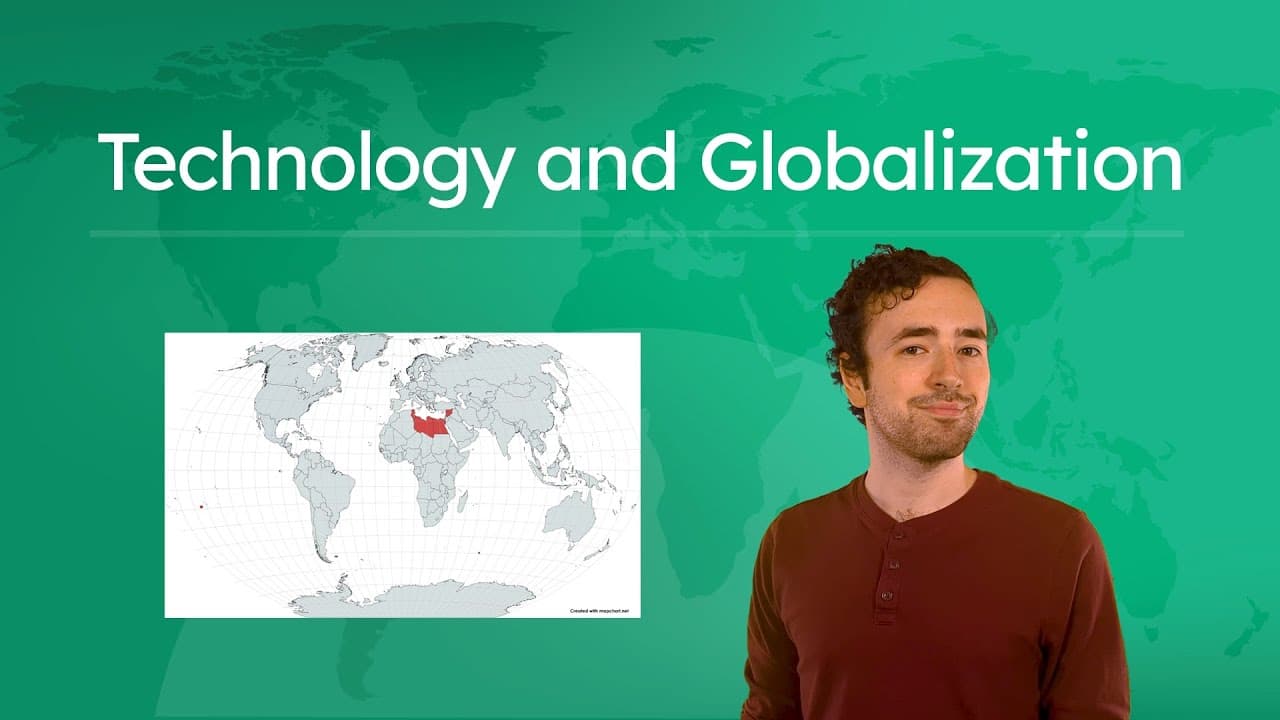
From the Wheel to the Web: How Technology Drives Globalization

From the Wheel to the Web: How Technology Drives Globalization

This video provides an engaging historical overview of how technology has driven globalization from ancient times to the present day. Hosted by an energetic narrator, the lesson breaks down technological progress into three main eras: early tools of connection like the wheel and compass, the "Age of Acceleration" featuring the telephone and airplane, and the modern Digital Web. Through these stages, the video illustrates how inventions have progressively shrunk the world, facilitating the rapid exchange of goods, people, and ideas. Key themes include the concept of globalization, cultural diffusion, and the societal impact of mass communication. The video uses specific historical examples—such as the Protestant Reformation fueled by the printing press and the Arab Spring organized via social media—to show how technology doesn't just change how we communicate, but fundamental aspects of culture, politics, and daily life. It also touches on modern concepts like global supply chains and the digital divide. For educators, this video is an excellent tool for Social Studies, Geography, and History classrooms. It effectively bridges the gap between ancient history and students' digital lives, making abstract concepts like "cultural diffusion" concrete through relatable examples like sushi and K-pop. The clear segmentation of the video allows teachers to pause and focus on specific technologies, while the built-in discussion questions provide ready-made opportunities for checking understanding and critical thinking.

Miacademy & MiaPrep Learning ChannelMiacademy & MiaPrep Learning Channel

11mins 12s

The Protestant Reformation: Luther, Politics, and the Printing Press

The Protestant Reformation: Luther, Politics, and the Printing Press

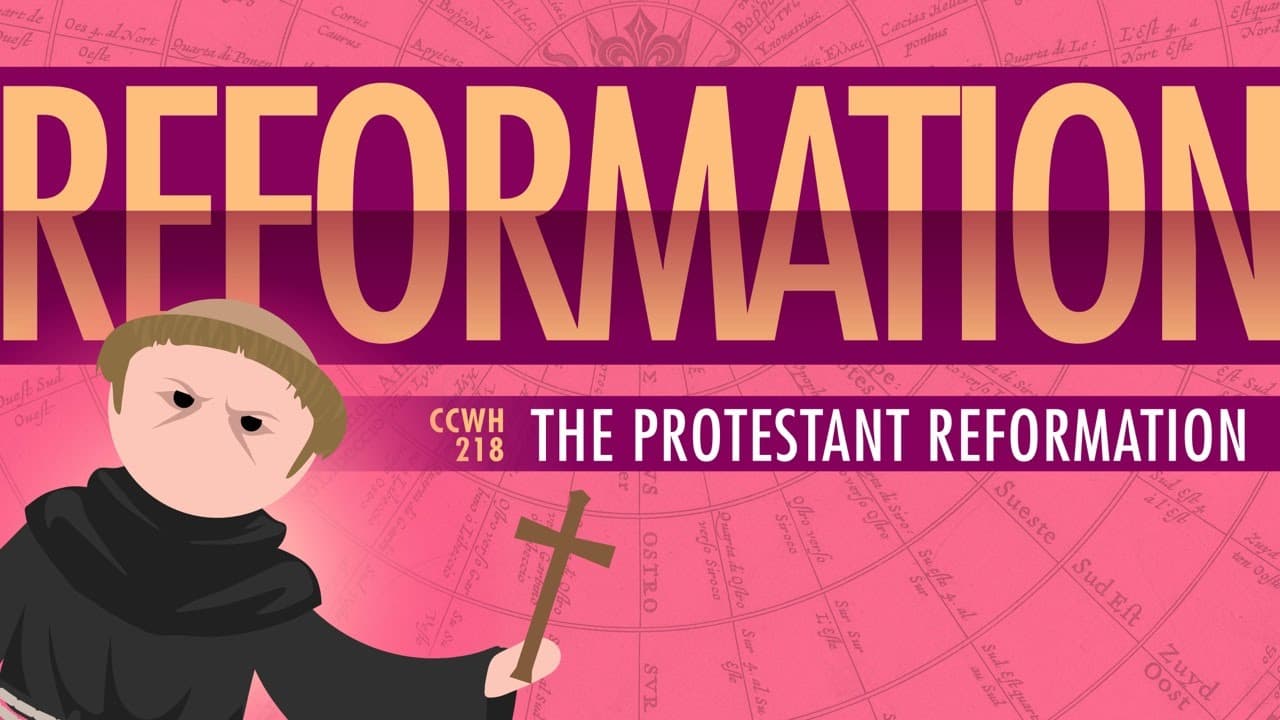
In this fast-paced and engaging episode of Crash Course World History, John Green explores the Protestant Reformation, a pivotal moment in European history that fundamentally shifted religious and political power. The video details how a monk named Martin Luther, armed with new ideas about faith and the aid of the printing press, challenged the immense authority of the Catholic Church. It explains the theological disputes over indulgences and salvation that spiraled into a revolution, creating new denominations and permanently fragmenting Western Christendom. Beyond the theology, the video delves into the political and social dimensions of the Reformation. It highlights how monarchs and princes, such as Albert of Prussia, used the movement to seize Church wealth and consolidate their own power. The narrative also covers the unintended consequences of Luther’s ideas, such as the violent German Peasants' Revolt, which Luther condemned, illustrating the tension between spiritual liberty and social order. For educators, this video serves as an excellent synthesizer of complex historical threads, linking religious belief, technological innovation, and political opportunism. It provides opportunities to discuss how ideas spread, the difference between religious and political revolutions, and the lasting legacy of 'protest' and 'reform' in modern civil rights movements.
CrashCourseCrashCourse

15mins 7s

Women of the Enlightenment: Salons, Coffeehouses, and Satire

Women of the Enlightenment: Salons, Coffeehouses, and Satire

This educational video explores the paradoxical role of women during the Enlightenment, highlighting how they utilized salons and coffeehouses to influence intellectual discourse despite being largely excluded from formal education and political power. The host, Brian, begins with a satirical introduction to demonstrate the chauvinistic attitudes of the 18th century before revealing the reality: that women were pivotal in facilitating the exchange of revolutionary ideas. The video distinguishes between French Salons (private gatherings in homes) and English Coffeehouses (public meeting places), explaining how these venues allowed social classes to mix and ideas to flourish.

Miacademy & MiaPrep Learning ChannelMiacademy & MiaPrep Learning Channel

10mins 48s

The Northern Renaissance: Books, Politics, and Radical Ideas

The Northern Renaissance: Books, Politics, and Radical Ideas

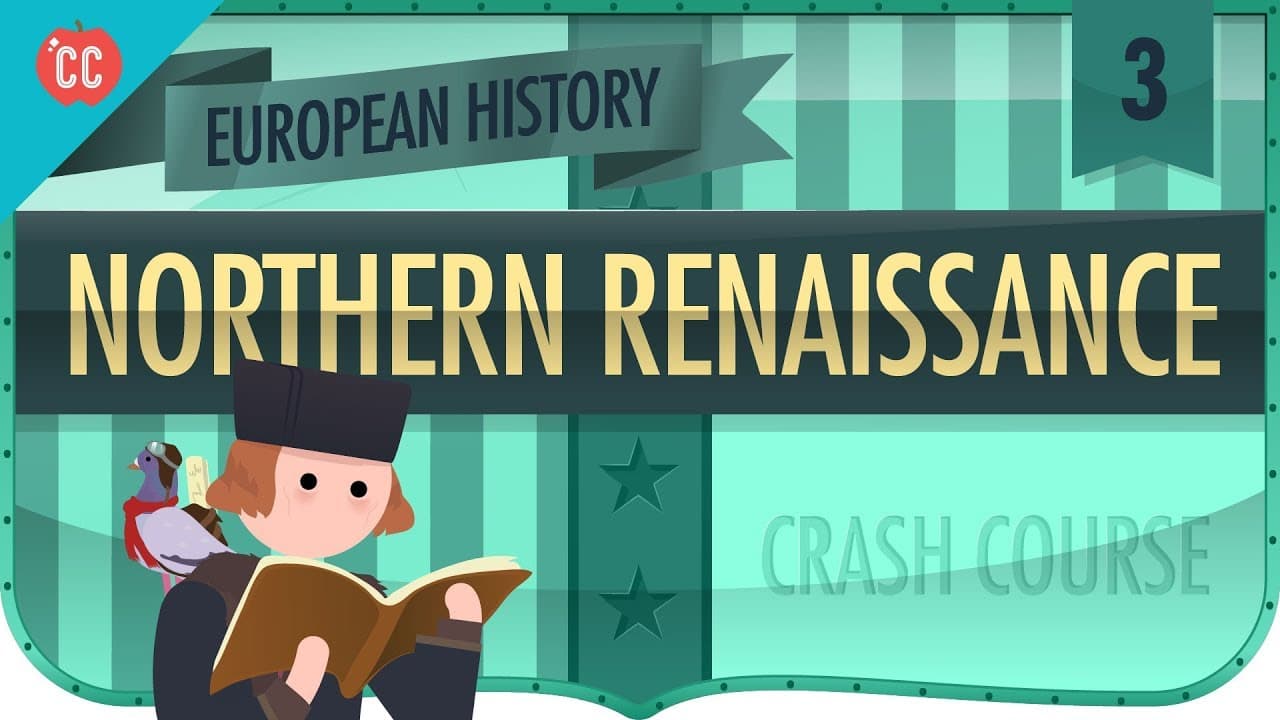
This educational video explores the spread of Renaissance ideas from Italy to Northern Europe, examining how the movement transformed as it crossed the Alps. It begins by identifying the printing press as the technological catalyst that democratized knowledge, allowing ideas to travel faster and reach wider audiences than ever before. The narrative then delves into how Northern Humanists adapted Italian concepts to fit their own cultural and religious contexts, often focusing more on religious reform and social ethics than the aesthetic glorification of the individual seen in Italy. The content profiles four pivotal thinkers who shaped Western political and social thought: Desiderius Erasmus, the "Prince of the Humanists" who advocated for a middle path of religious reform; Niccolò Machiavelli, whose treatise "The Prince" established modern political realism; Thomas More, whose "Utopia" imagined an idealistic communal society; and Christine de Pizan, an early feminist who challenged the misogyny of her time. Through these figures, the video illustrates the tension between idealism and realism that defined the era. For the classroom, this video serves as an excellent bridge between the artistic Renaissance and the political/religious upheavals of the Reformation. It provides rich opportunities to discuss the impact of media technology on society, debate the ethics of political power (is it better to be loved or feared?), and analyze how historical context shapes philosophical outlooks. The video effectively demonstrates how the Renaissance was not a monolith but a diverse movement with conflicting values and visions for the future.

CrashCourseCrashCourse

14mins 2s

How Renaissance Art and Literature Changed the World

How Renaissance Art and Literature Changed the World

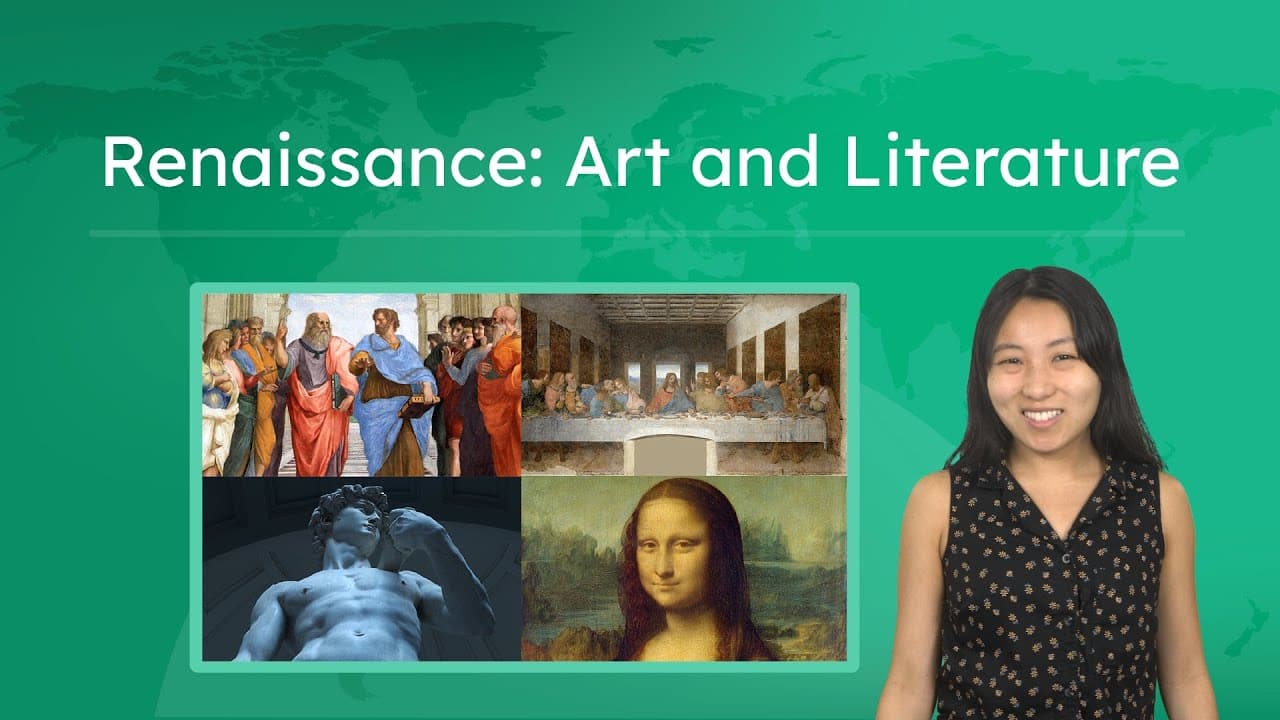
This educational video takes students on a journey through a virtual museum to explore the profound cultural shifts of the Renaissance. It contrasts the art and literature of the Middle Ages—characterized by religious themes and flat, stylized figures—with the explosion of Realism, Humanism, and Individualism during the Renaissance. Through detailed analyses of masterpieces by Leonardo da Vinci, Michelangelo, and Raphael, the video demonstrates how artists used techniques like linear perspective and shading to celebrate the human form and experience. The video also examines the literary revolution led by figures like Dante Alighieri and William Shakespeare. It highlights the shift from Latin to vernacular languages, making literature accessible to the common person, and the move toward exploring complex human emotions and everyday experiences rather than just religious doctrine. Key concepts such as Secularism—the separation of institutions from religious beliefs—are defined and applied to show how society began questioning authority and valuing individual potential. Ideal for World History and Art History classes, this video serves as an engaging multimedia text. It helps students visualize abstract historical concepts through famous works of art. Teachers can use this video to anchor discussions on how cultural values are reflected in art, the importance of the printing press and vernacular language in spreading ideas, and the lasting impact of Renaissance thinking on modern views of human potential and individuality.

Miacademy & MiaPrep Learning ChannelMiacademy & MiaPrep Learning Channel

12mins

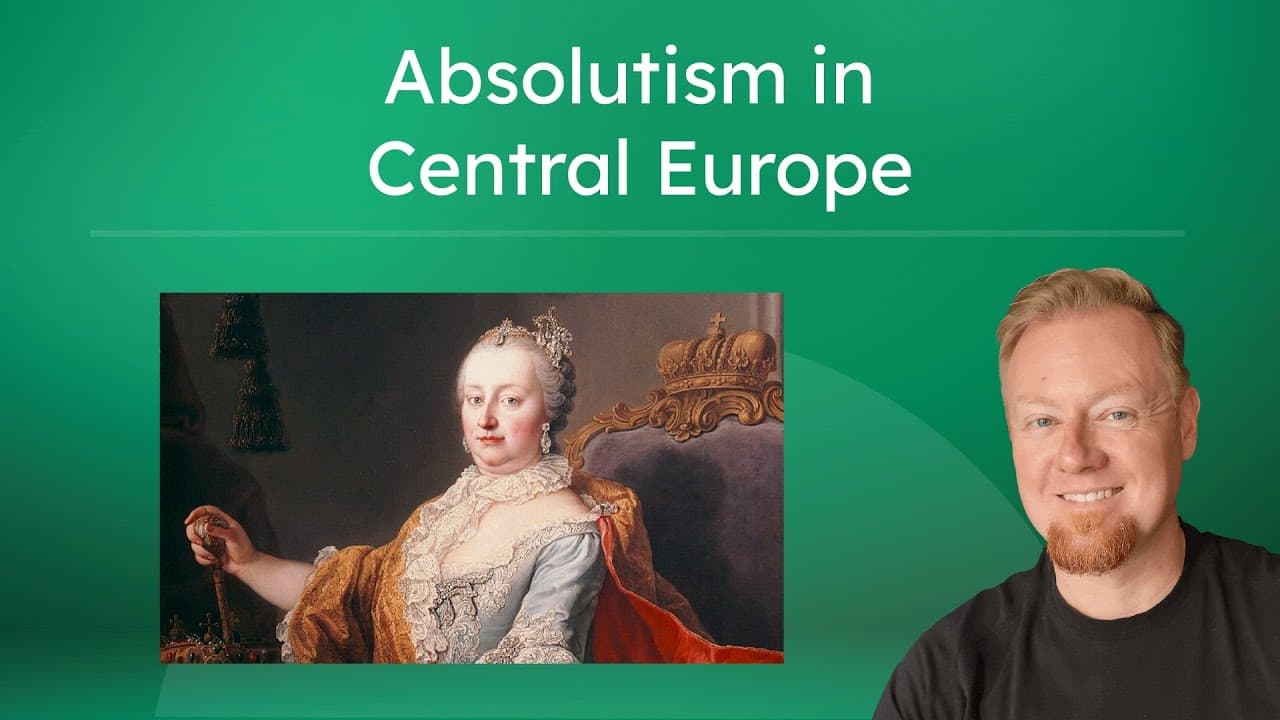
The Rise of Austria and Prussia: Absolutism in Central Europe

The Rise of Austria and Prussia: Absolutism in Central Europe

This video explores the dramatic rise of two Central European powers, Austria and Prussia, in the wake of the Thirty Years' War. It details the shift from medieval feudalism to modern absolutism, explaining how devastation and power vacuums paved the way for strong, centralized monarchies. The narrative contrasts the militaristic rise of the Hohenzollern dynasty in Prussia with the dynastic challenges and reforms of the Habsburgs in Austria under Maria Theresa. Key historical themes include the concept of Absolutism versus Enlightened Absolutism, the role of militarism in state-building, and the geopolitical rivalries that shaped modern Europe. The video specifically covers critical events such as the Pragmatic Sanction, the War of the Austrian Succession, and the Seven Years' War, illustrating how personal rivalries between rulers like Frederick the Great and Maria Theresa escalated into global conflicts. For educators, this resource serves as an excellent case study in comparative government and political history. It breaks down complex dynastic politics into understandable narratives using maps, humor, and clear definitions. Teachers can use this video to discuss the impact of individual leadership styles on national development, the changing role of women in power, and the historical roots of German dualism.

Miacademy & MiaPrep Learning ChannelMiacademy & MiaPrep Learning Channel

11mins 55s

Materials

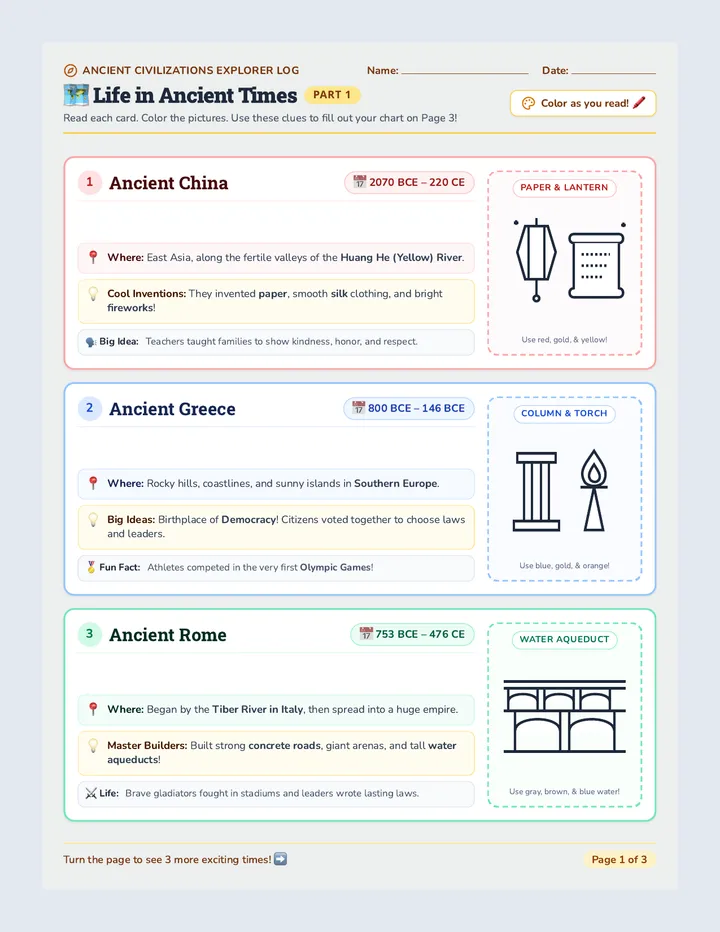
Ancient World Explorer Graphic Organizer

Ancient World Explorer Graphic Organizer

An accessible, highly visual 3-page ancient civilizations comparison activity designed for a 7th grade student reading at a 2nd grade level. Revised to eliminate awkward vertical gaps on the reading pages by expanding the cards with larger text, kid-friendly vocabulary callouts, and spacious coloring illustrations.

KC

Kasie Costopulos

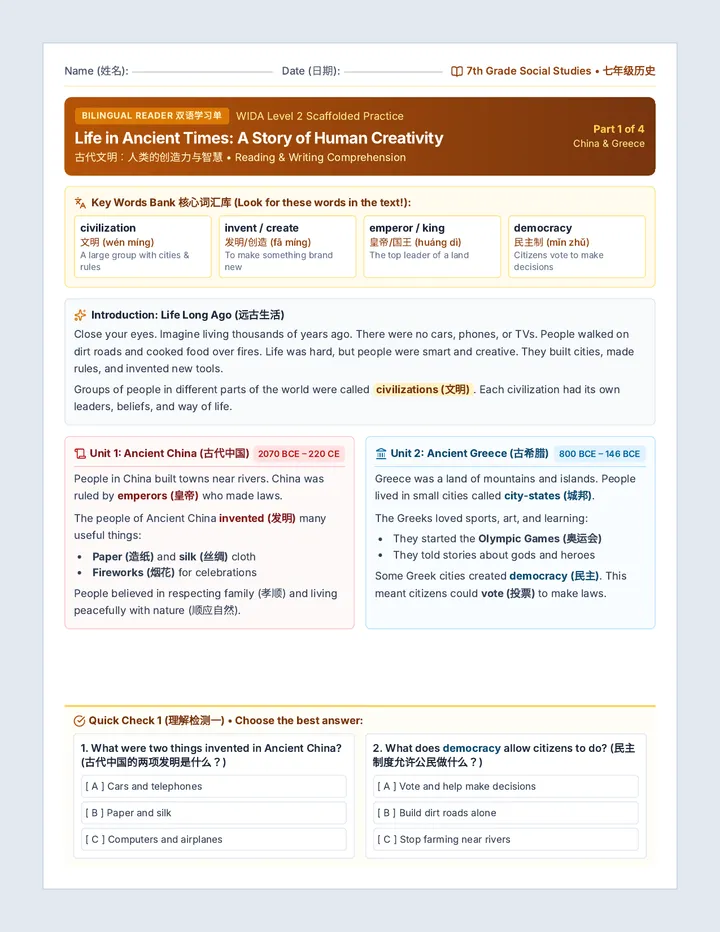
Ancient Creativity Comprehension Packet

Ancient Creativity Comprehension Packet

A 4-page scaffolded reading and writing comprehension packet for 7th-grade social studies, tailored for a Chinese-speaking WIDA Level 2 English learner. Includes bilingual vocabulary glossaries (English, Simplified Chinese, and Pinyin), chunked passages, visual icons, comprehension checks, and guided sentence-frame writing exercises.

KC

Kasie Costopulos

Renaissance Genius Worksheet

Renaissance Genius Worksheet

A comprehensive two-page Renaissance review worksheet covering key historical figures, influential patrons, humanist philosophy, artistic innovations, and cultural achievements with matching, vocabulary application, and analytical short answers.

MM

Michele Magee

Sequences

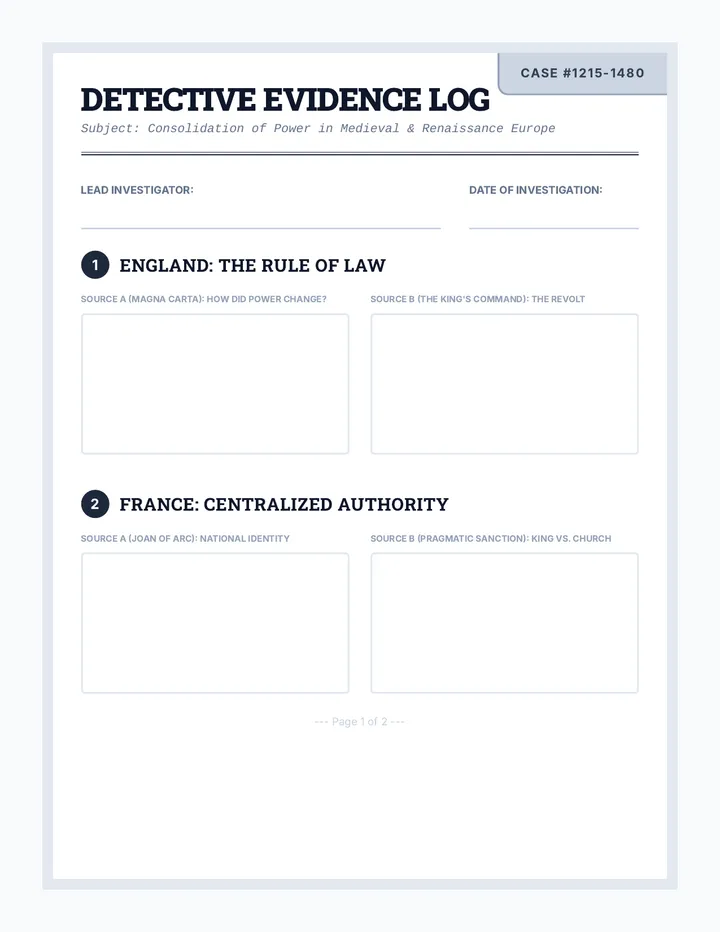
Detective Evidence Log Worksheet

Nation State Detectives

A comprehensive middle school history unit where students act as 'history detectives' to investigate the rise of nation-states in England, France, Spain, and Russia through primary source analysis.

HO

Helen O'Keefe

11
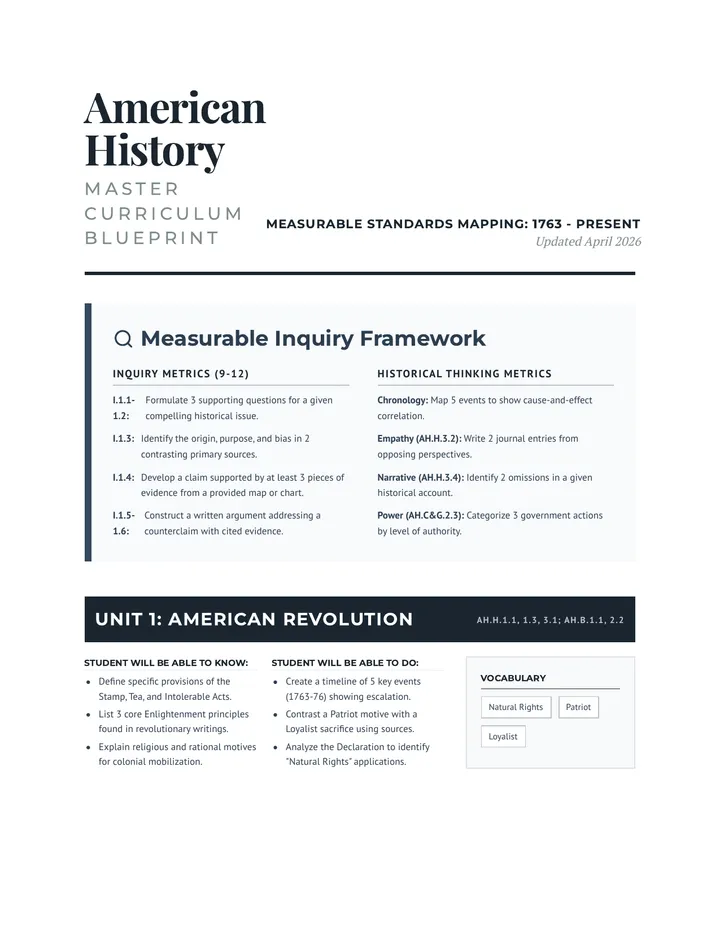
Curriculum Blueprint Document v2

History Horizon Sequence

A comprehensive high school curriculum plan for American History, covering 13 units from the American Revolution to the modern era, aligned with North Carolina Social Studies standards.

AK

Amity Kea

21
Blueprint Prep Slides

Regents Blueprint Series

An intensive review series for the Modern World History NYS Regents exam, structured as high-speed 30-minute 'blueprint' sessions focusing on key units and test-taking strategies.

J

james.shaw

18
Modern Era Slides

Global History Blueprint

A comprehensive review series covering the New York State Modern World History Regents curriculum, focusing on Units 1 through 9.

J

james.shaw

4
Worldview Shift Slides

Renaissance Humanism and Secular Thought

This sequence explores the intellectual transformation of Europe from the Middle Ages to the Renaissance, focusing on the emergence of humanism and its impact on culture, education, and religion. Students analyze primary sources from Petrarch, Erasmus, and Castiglione to understand how shifting views on human potential reshaped society.

15
Plague Path Slides

Medieval Metamorphosis

This sequence explores the transformative period from the Black Death to the Renaissance. Students will analyze how a global crisis reshaped European society, leading to the decline of feudalism, the rise of towns and guilds, and the birth of modern art and commerce.

15

Lessons

Crown and Covenant Teacher Guide

Crown and Covenant

A pre-reading lesson on the Divine Right of Kings and European Absolutism, preparing 10th-grade students with crucial background knowledge through a close reading of King James I and Louis XIV.

T

timothy.nixon

8
Chronicle Study Guide Student

Modern Era Mastery

A comprehensive review and assessment package covering World History from the Enlightenment through the Cold War, aligned with state standards.

AH

Ashley Hopf

16
Explorer Epochs Wall Chart

Early World Explorers

A comprehensive lesson on early world exploration from 300 BCE to 1500 CE, focusing on the geographical, cultural, and religious impacts of key explorers across different continents.

J

jcasey

14
Revolutionary Comparison Slides

Revolutionary Face Off

A comprehensive 10th-grade history lesson comparing the French and American Revolutions, focusing on Enlightenment ideals, leadership, and long-term global impact through slides, primary sources, and structured comparison.

KB

Kenneth Brown

8
Renaissance Roadmap Teacher Guide

Renaissance Ripples

A comprehensive 70-minute lesson for 7th graders focusing on how the Renaissance transformed European art, science, and thought, moving society away from the Middle Ages.

HO

Helen O'Keefe

4
Village Transformation Worksheet

Urban Revolution

Analyze the shift from agrarian village to industrial center using the Urban Game simulation. Students will apply the CER framework to evaluate the impact of industrialization on community structure and quality of life.

KB

Kenneth Brown

2