Lenny.com
Explore
Create
ActivitiesNewMathEnglish Language ArtsScience & EngineeringSocial StudiesGlobal LanguagesHealth & Physical EducationSpecial EducationCounseling & Life SkillsArts & CreativityESL
Lenny.com
Lenny.com
Explore
Create
ActivitiesNewMathEnglish Language ArtsScience & EngineeringSocial StudiesGlobal LanguagesHealth & Physical EducationSpecial EducationCounseling & Life SkillsArts & CreativityESL
Lenny.com
Social StudiesSocial Studies PracticesLocation WordsMapsOrder EventsChronology and CausationEvaluating SourcesHistorical ThinkingGeography, Humans, & the EnvironmentAmerican Symbols and LandmarksCitiesStatesState CapitalsRegions of the United StatesGeographic SkillsPhysical GeographyHuman GeographyRegional GeographyGeography of AfricaGeography of AsiaGeography of EuropeGeography of OceaniaGeography of the AmericasSociety and Environment of EuropeSociety and Environment of AsiaSociety and Environment of The AmericasSociety and Environment of the Middle EastSociety and Environment of AfricaHistoryPrehistoryComparing Ancient River CivilizationsAncient MesopotamiaAncient Egypt and KushAncient South AsiaEarly ChinaGreeceRome and the Byzantine EmpireAncient World HistoryNative Peoples of North AmericaNative Peoples of Mesoamerica and South AmericaAfrican EmpiresMedieval AsiaMedieval EuropeThe Silk RoadMedieval HistoryIslamic EmpiresWorld ReligionsRenaissance PeriodAge of ExplorationThe Thirteen ColoniesThe American RevolutionUS History Early RepublicFounding of the United StatesUS History AntebellumUS Civil WarReconstruction PeriodThe Gilded AgeUS ImperialismWorld ImperialismWorld War IUS History 1920sGreat DepressionWorld War IIThe Cold WarUS History 1950-60sUS History 1960s-70sWorld History 20th CenturyContemporary US HistoryContemporary World HistoryHolidaysCivics and GovernmentCitizenshipGovernment FoundationsThe ConstitutionUS ConstitutionExecutive BranchLegislative BranchJudicial BranchState and LocalPolitical ParticipationPublic PolicyPolitical SystemsPower and AuthoritySocial MovementsDefining DevianceTheories of DevianceCrime and Criminal JusticeEconomicsBasic Economic PrinciplesSupply and DemandWhat is MoneyEconomic FundamentalsMicroeconomicsMacroeconomicsBanking and FinanceEconomic SystemsGlobal EconomicsCorporations and PowerThe Changing WorkplaceUnemployment and LaborClass and InequalitySocial MobilityGlobal InequalityPsychologyHistory of PsychologyPsychology as a ScienceBrain and Nervous SystemNeuroscience and BehaviorGenetics and BehaviorSleep and ConsciousnessSensory ProcessesPerceptual OrganizationClassical ConditioningOperant ConditioningObservational LearningCognitive LearningMemory ProcessesThinking and Problem SolvingLanguage and CognitionTheories of MotivationStress and CopingPrenatal and Infant DevelopmentChildhood DevelopmentAdolescent DevelopmentAdulthood and AgingSelf and IdentitySocial CognitionSocial InfluenceAttraction and RelationshipsGroup BehaviorPrejudice and DiscriminationAnxiety and Mood DisordersClinical PsychologyForensic PsychologyPhilosophy & EthicsIntroduction to PhilosophyMajor Philosophers & IdeasMind and Body ProblemFree Will vs DeterminismEthics & MoralityReligion & PhilosophyPolitical Philosophy

Contemporary World History

Geopolitical developments from 1945 to the present including the Cold War, decolonization, and regional conflicts. Analyzes the impact of globalization, technological shifts, and international organizations on modern society.

Lenny.com

Solutions

Lenny for EducatorsLenny for SchoolsLenny for Districts

Product

ExploreSign inCreateSupportAbout

Resources

Getting startedMTSS Acceleration Program

© 2026 Lenny Learning Inc.

TermsPrivacyAccessibility
LinkedInInstagramX
Lenny

Videos

Mapping Europe: Physical Landscapes and Cultural Regions

Mapping Europe: Physical Landscapes and Cultural Regions

This educational video provides a comprehensive overview of Europe's regional geography, moving beyond simple political borders to explore "perceptual regions" defined by physical landscapes, history, and culture. The narrator, Brian, guides viewers through two main frameworks for understanding the continent: first by physical features like the Northern European Plain and Alpine Mountains, and then by cultural groupings such as Western, Eastern, and Central Europe. The video uses maps and historical context to explain why certain countries are grouped together, touching on the impact of the Cold War, the Roman Empire, and physical glaciation. Key themes include the distinction between physical and cultural geography, the lingering effects of the Cold War on European identity, and the specific characteristics of regions like Scandinavia, the Balkans, and the "Benelux" countries. It connects modern economic realities—such as the wealth of Western Europe or the tech industry in Northern Europe—to historical events and geographical advantages. The video also introduces important geographical terminology like "Balkanization," "uplands," and "breadbasket." For educators, this video serves as an excellent anchor for units on World Geography or European History. It helps students visualize abstract concepts like "perceptual regions" through clear map animations and concrete examples. Teachers can use the segment on the origin of "Bluetooth" to engage students with history, or leverage the discussion on the Iron Curtain to introduce geopolitical divides. It encourages critical thinking about how we categorize nations and how history shapes our mental maps of the world.

Miacademy & MiaPrep Learning ChannelMiacademy & MiaPrep Learning Channel

11mins 47s

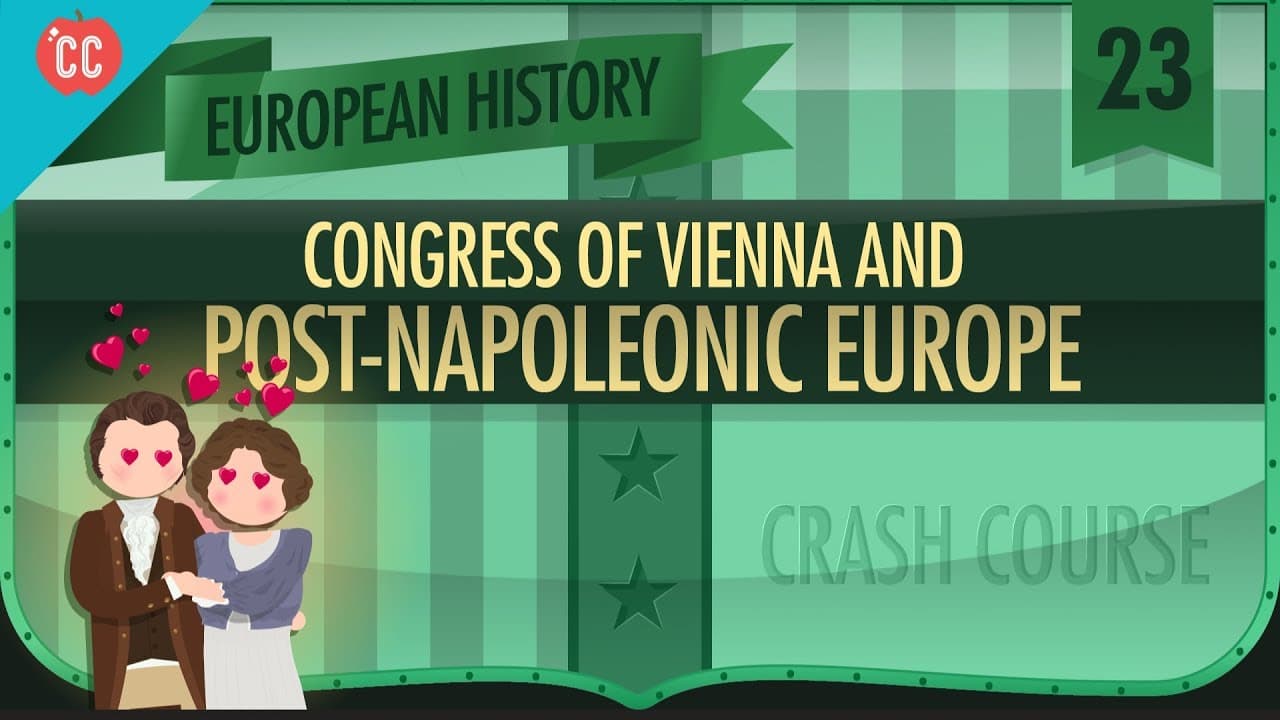
Restoring Order After Napoleon: The Congress of Vienna

Restoring Order After Napoleon: The Congress of Vienna

This educational video from Crash Course European History explores the aftermath of the French Revolution and the Napoleonic Wars, focusing on the Congress of Vienna in 1815. Host John Green explains how major European powers—Britain, Prussia, Russia, Austria, and a defeated France—convened to redraw the map of Europe and restore the "old order" of monarchy and aristocracy. The video details the political maneuvering of key figures like Klemens von Metternich and Charles Maurice de Talleyrand, illustrating how they established a "Balance of Power" intended to prevent future massive conflicts and check the expansion of nations like Russia. The video also delves deeply into the ideological and cultural shifts of the time. It contrasts the conservative political backlash, championed by thinkers like Edmund Burke who valued tradition and stability, against the lingering revolutionary spirit. Significant attention is given to the rise of Romanticism as a cultural reaction against Enlightenment rationality. Through examples in literature (Mary Shelley, Alexander Pushkin) and art, the video highlights how the era began to prioritize emotion, nature, and the past over reason and industrialization. For educators, this video serves as an excellent bridge between the age of revolutions and the modern era. It provides crucial context for understanding 19th-century geopolitics, the concept of the "Concert of Europe," and the tension between conservative institutions and rising liberal/nationalist movements. The juxtaposition of political history with art and literature offers interdisciplinary opportunities to discuss how cultural movements reflect and react to political realities, making it highly valuable for World History, European History, and Humanities curriculums.

CrashCourseCrashCourse

14mins 1s

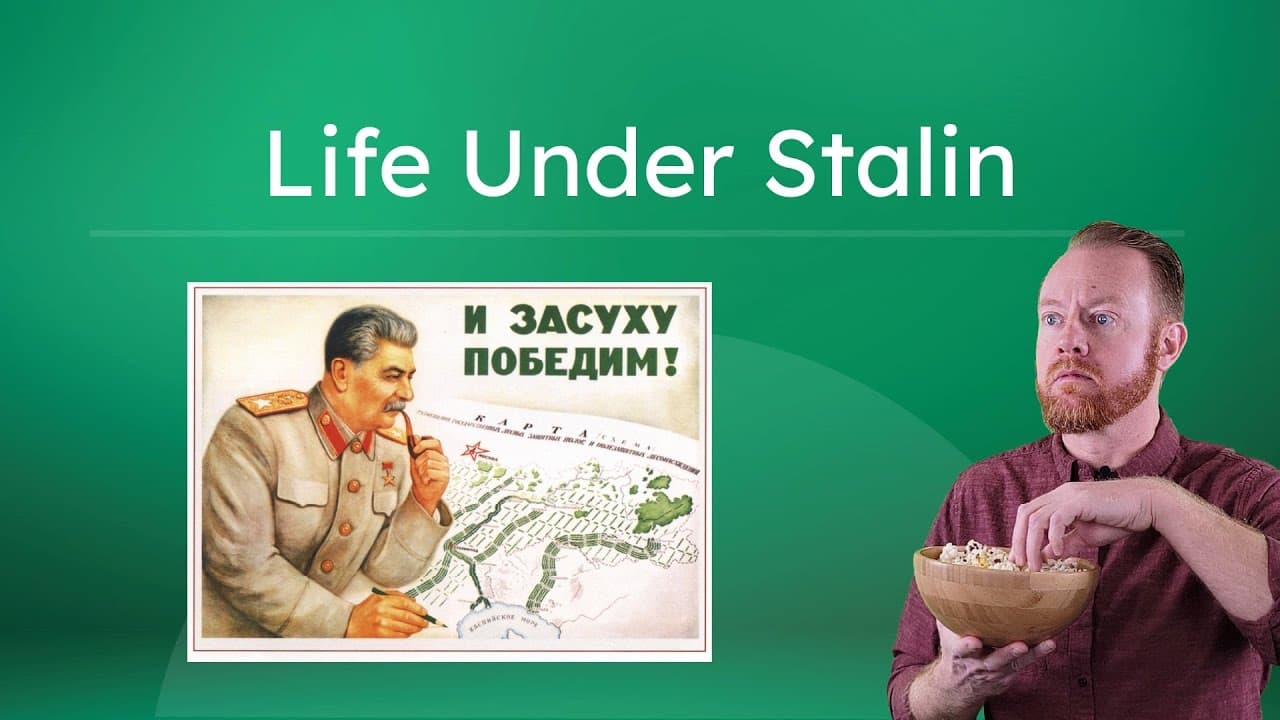
Life Under Stalin: Terror and Totalitarianism in the Soviet Union

Life Under Stalin: Terror and Totalitarianism in the Soviet Union

This educational video provides an in-depth exploration of life in the Soviet Union under Joseph Stalin's totalitarian rule. Using a mix of narration, historical photography, and clear definitions, the video explains how Stalin consolidated power after Lenin's death and transformed Russia into a police state. It covers the mechanisms of control used by the regime, including the secret police (NKVD), the Great Purge, the Gulag system, and the suppression of religion and free speech. The video also details Stalin's economic policies, specifically the command economy, Five-Year Plans, and the forced collectivization of agriculture. It highlights the stark contrast between the regime's propaganda of progress and the grim reality of famine, shortages, and the loss of millions of lives. The role of women in the workforce and the indoctrination of youth through the education system are also examined. This resource is highly valuable for World History classrooms as it breaks down complex political concepts like totalitarianism, command economies, and personality cults into accessible segments. It encourages critical thinking about the human cost of rapid industrialization and the dangers of unchecked government power. The video includes built-in pause points with guiding questions, making it an excellent tool for structured classroom discussions or independent study.

Miacademy & MiaPrep Learning ChannelMiacademy & MiaPrep Learning Channel

11mins 30s

How Mexico Won Independence From Spain

How Mexico Won Independence From Spain

This engaging educational video provides a comprehensive overview of the Mexican War of Independence, tracing its roots from the Spanish conquest of the Aztec Empire to the final establishment of an independent Mexican nation. It explores the complex social and political factors that fueled the revolution, specifically focusing on the rigid caste system of New Spain that created deep resentment among Criollos, Mestizos, and Indigenous populations. The narrative follows key figures like Miguel Hidalgo, José María Morelos, and Agustín de Iturbide, explaining their unique roles in the struggle for freedom. The video delves into key themes such as colonialism, social stratification, and the influence of Enlightenment ideas on revolutionary movements. It breaks down the specific grievances of different social classes—from the land-dispossessed Indigenous peoples to the politically sidelined Criollos—helping students understand that revolutions are often driven by a convergence of different motivations. The video also clarifies common historical misconceptions, such as the difference between Mexico's Independence Day and Cinco de Mayo. For educators, this resource serves as an excellent anchor for units on Latin American history, world revolutions, or social justice. It connects historical events to broader questions about identity and justice, asking students to consider how personal experiences shape political ideology. The visual aids, including maps and social hierarchy pyramids, make complex sociopolitical structures accessible, while the narrative pacing keeps students engaged with the dramatic arc of the war.

Miacademy & MiaPrep Learning ChannelMiacademy & MiaPrep Learning Channel

11mins 12s

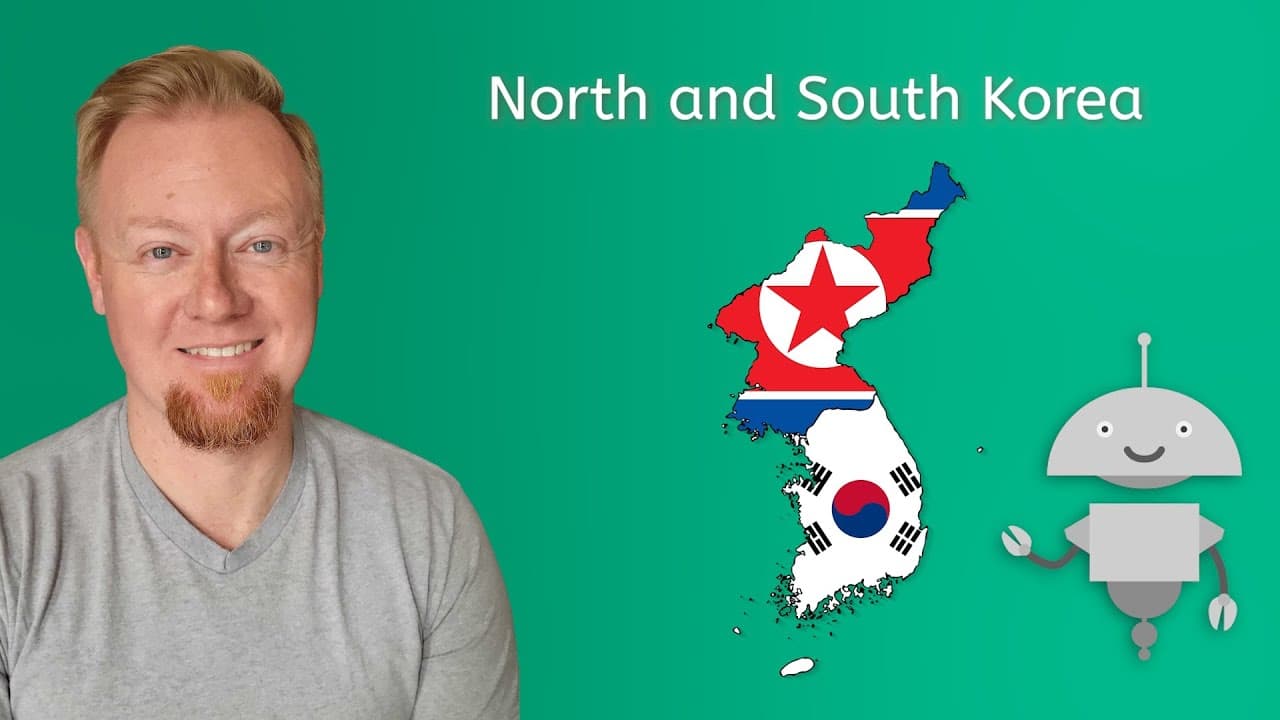
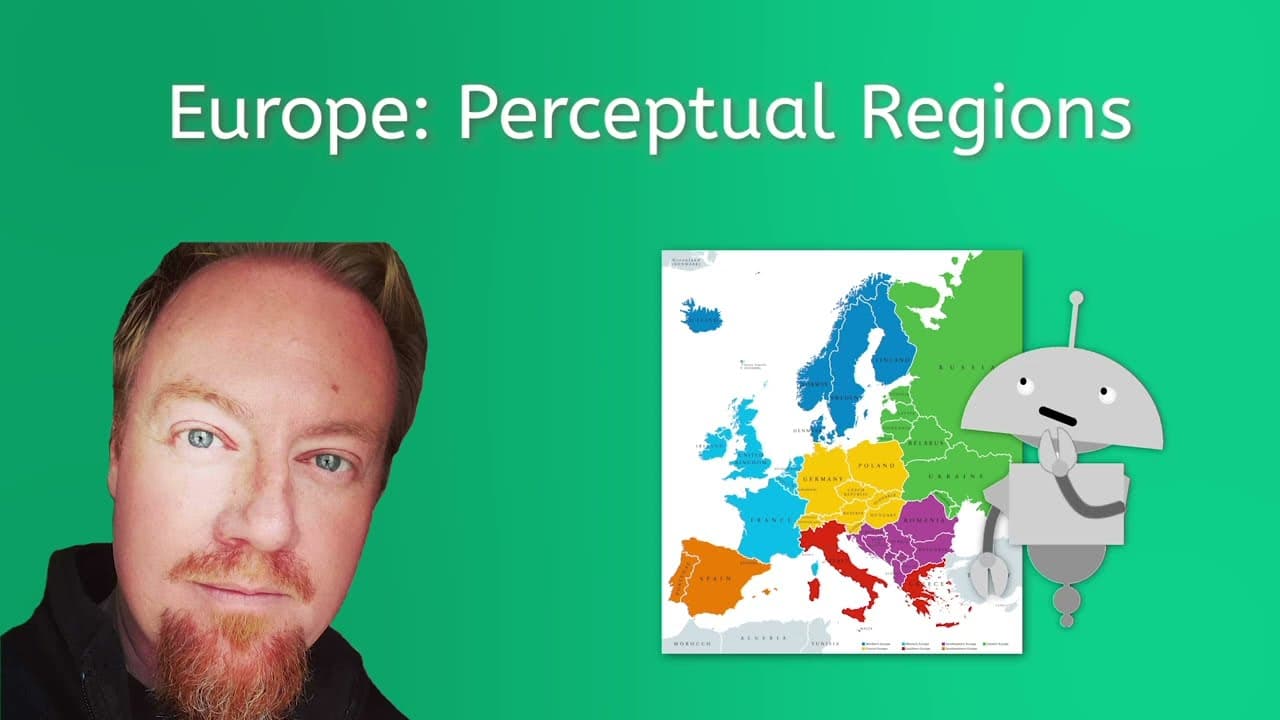
Comparing North and South Korea: A Geographic and Political Analysis

Comparing North and South Korea: A Geographic and Political Analysis

This educational video provides a comprehensive comparative analysis of North and South Korea, exploring how a single peninsula inhabited by a homogenous ethnic group evolved into two vastly different nations. The video begins with a historical hook about the origins of Taekwondo before diving into a structured geographic and sociopolitical breakdown. It covers the physical geography, climate differences, population demographics, and the historical events leading to the division along the 38th parallel following World War II and the Korean War. Key themes include the sharp contrast between the two nations' political and economic systems. The video examines North Korea's isolationist, military-focused communist dictatorship under the Kim family, highlighting issues like famine and nuclear armament. In contrast, it details South Korea's transformation into a democratic "Asian Tiger" economy, focusing on its technological advancements, educational systems, and high standard of living. The video also touches on demographic challenges faced by both nations, such as declining birth rates, though for different reasons. This resource is highly valuable for social studies classrooms as a case study in comparative politics and economic geography. It encourages critical thinking by asking students to complete a Venn diagram throughout the viewing, identifying similarities (ethnicity, history, geography) and differences (government, economy, lifestyle). The video's clear structure, use of maps and population pyramids, and built-in pause points for reflection make it an excellent tool for teaching about the Korean Peninsula, the Cold War's legacy, and different systems of government.
Miacademy & MiaPrep Learning ChannelMiacademy & MiaPrep Learning Channel

12mins 23s

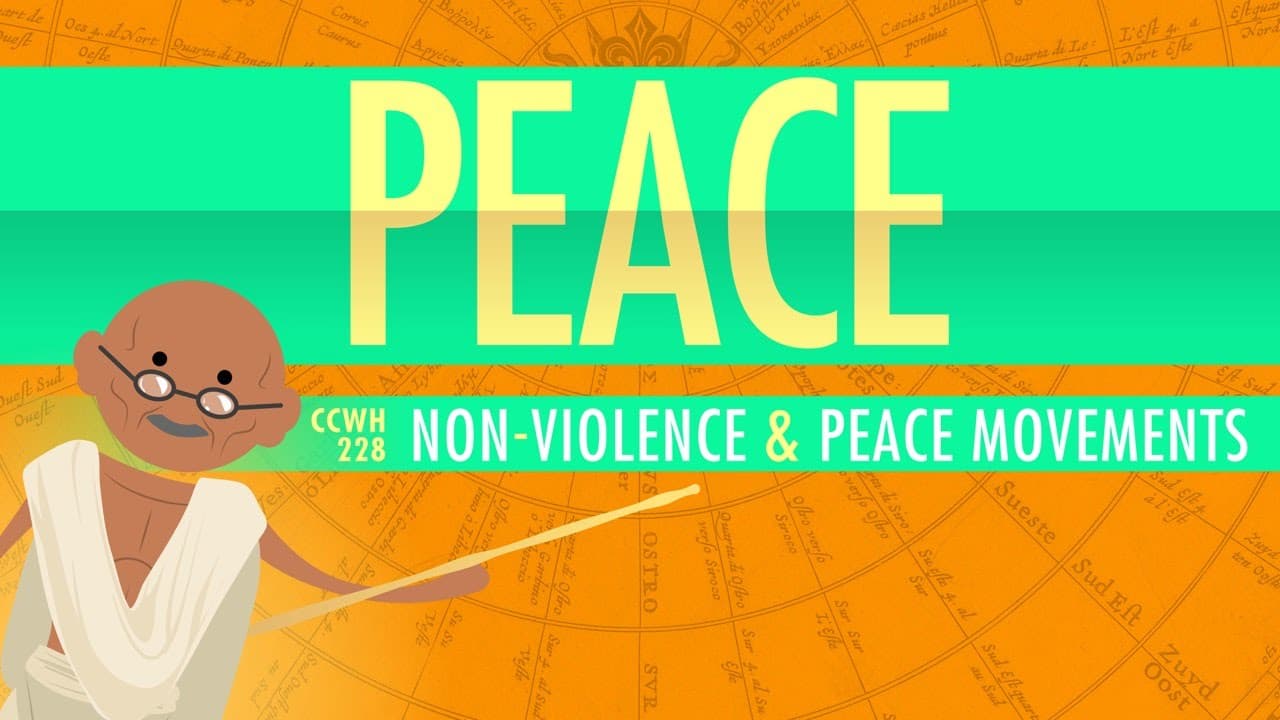
The Global History of Non-Violent Resistance

The Global History of Non-Violent Resistance

This installment of Crash Course World History reframes the narrative of the 20th century, moving beyond the traditional focus on World Wars and genocide to explore the parallel rise of global non-violent resistance movements. John Green argues that while the century was undeniably violent, it also birthed a sophisticated, interconnected web of peace movements that spanned continents. The video traces the intellectual lineage of non-violence, connecting Leo Tolstoy's Christian anarchism to Mahatma Gandhi's Satyagraha, and demonstrating how these ideas flowed back to the West to influence the American Civil Rights Movement and anti-war activists. The video provides a comparative historical analysis of various non-violent struggles, including the Indian independence movement, anti-colonial efforts in Vietnam and Egypt, the Rosenstrasse protest in Nazi Germany, and the Prague Spring in Czechoslovakia. It highlights key concepts like 'ahimsa' (non-injury) and 'satyagraha' (truth-force) and examines the strategic logic behind civil disobedience. Significant attention is given to the cross-pollination of ideas, showing how activists like Bayard Rustin and Martin Luther King Jr. adapted Gandhian tactics for the American context. For educators, this resource serves as an excellent tool for teaching the global interconnectedness of historical events and political philosophies. It challenges students to analyze the efficacy of non-violence as a political tool against varying degrees of oppression. The video is particularly useful for units on the 20th century, human rights, decolonization, and civics, offering concrete case studies that allow for rich comparative analysis and discussion about the nature of power and resistance.

CrashCourseCrashCourse

12mins 49s

Materials

Central American Freedom Reading Worksheet

Central American Freedom Reading Worksheet

A Grade 8-9 dual-language reading and multiple-choice worksheet covering Central American Independence Day (September 15, 1821). Features a 4-paragraph parallel English and Spanish text alongside 6 standards-aligned bilingual multiple choice questions assessing key historical concepts, leaders, and civic traditions.

GJ

Gerardo Jimenez Ramirez

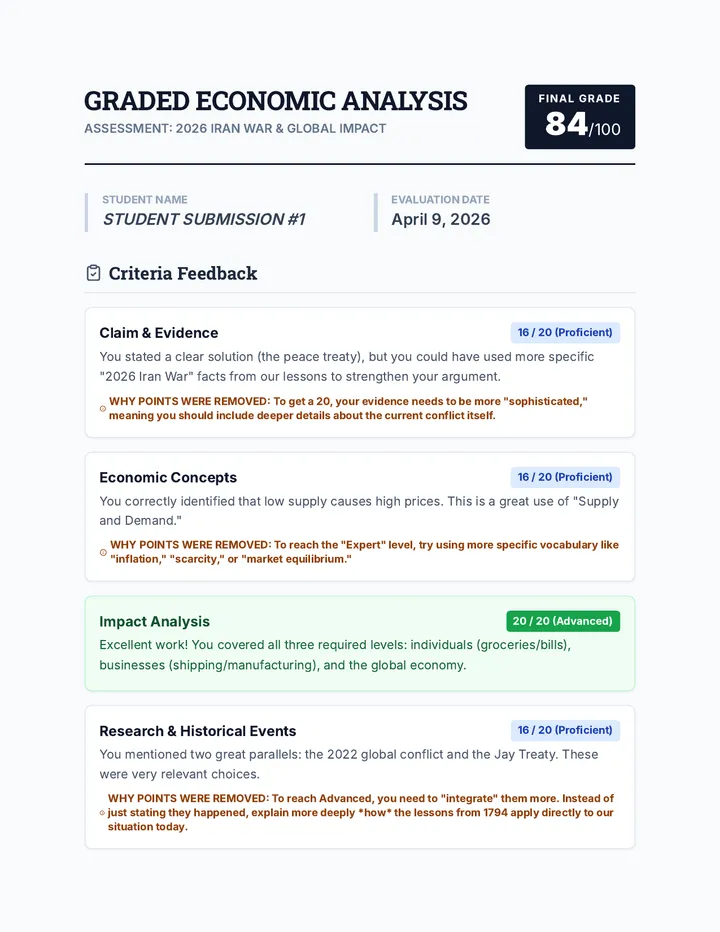
Graded Energy Analysis Report

Graded Energy Analysis Report

A detailed feedback report for a student's essay on the 2026 energy crisis, featuring a clear points breakdown, specific reasons for score deductions, and encouraging instructor notes based on a provided rubric.

SB

Shanna Brady

Crisis Analysis Grade Report

Crisis Analysis Grade Report

A detailed grade report based on the Energy Crisis Rubric, featuring a breakdown of scores and clear, constructive feedback for the student's essay.

SB

Shanna Brady

Energy Crisis Grade Sheet

Energy Crisis Grade Sheet

A graded evaluation report for an essay on the 2026 Iran War energy crisis, providing a detailed point-by-point breakdown and clear feedback based on the provided rubric.

SB

Shanna Brady

Sequences

Conflict Cards Activity

Century Crossroads

A comprehensive assessment sequence covering the pivotal moments of 20th-century US history, from the build-up to World War II through the height of the Cold War and the diverse Civil Rights movements.

AH

Ashley Hopf

16
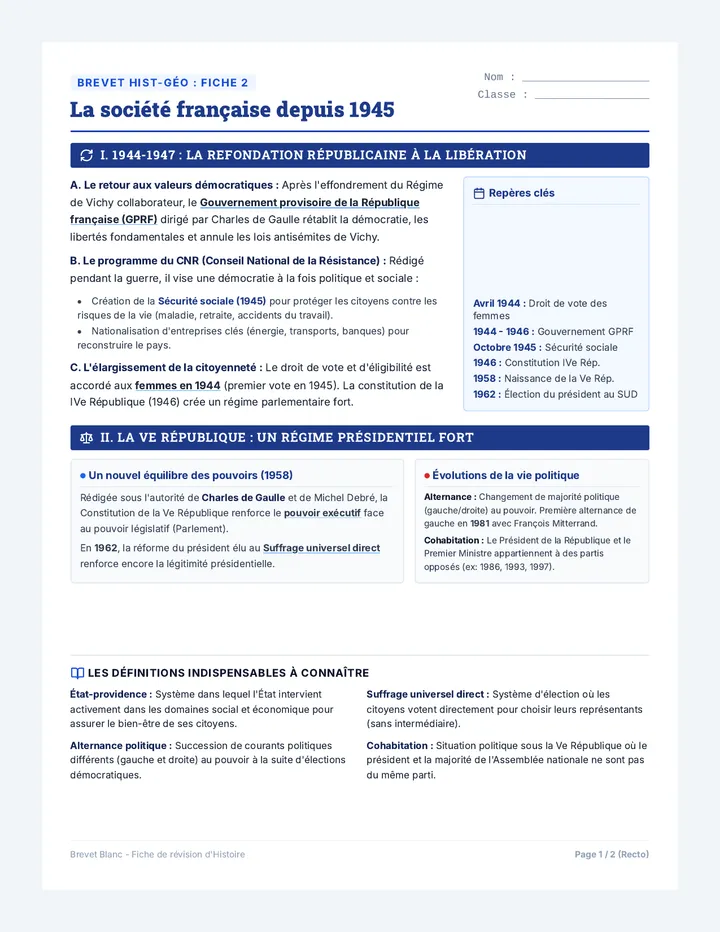
Societe Francaise Depuis 1945 Fiche

Brevet Fiches : Hist-Géo, EMC & Physique-Chimie

Une collection complète de fiches de révision classiques (recto-verso A4) très ciblées pour préparer les élèves de Troisième aux épreuves d'Histoire, de Géographie, d'EMC et de Physique-Chimie du DNB. Chaque fiche traite d'une leçon précise des programmes officiels.

MW

Myriam Wb

16
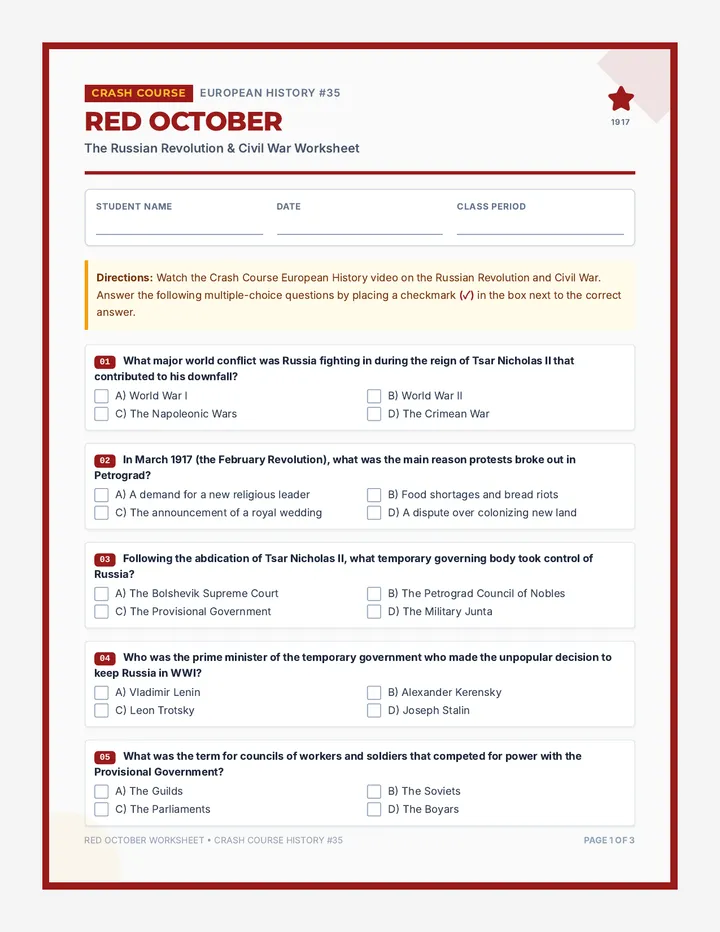
Red October Worksheet

Red Star Rising

A comprehensive history sequence focusing on 20th-century communist revolutions in Russia and China. This sequence uses Crash Course videos, detailed worksheets, complete answer keys, and accessible vocabulary flashcards to explore the collapse of old empires and the rise of communist states.

J

james.shaw

9
Curriculum Blueprint Document v2

History Horizon Sequence

A comprehensive high school curriculum plan for American History, covering 13 units from the American Revolution to the modern era, aligned with North Carolina Social Studies standards.

AK

Amity Kea

21
Foundations Comprehension Quiz

The American Ledger USH Remediation

A 25-day intensive remediation program for 11th Grade US History students, focusing on the Cold War, Civil Rights, Vietnam, the Reagan Era, and contemporary history. Each day features a 'Ledger' reader with embedded annotations and a review worksheet, aligned with Texas TEKS standards.

CE

Chelsea Elliott

62
WWII Origins Study Packet

Chronicle Case Files

An 8-day US History remediation packet covering WWII, the Cold War, Civil Rights, and Vietnam, designed for 11th-grade students preparing for STAAR testing. Each day includes intensive reading with embedded vocabulary, active annotation guides, and a skill-based review worksheet.

CE

Chelsea Elliott

19

Lessons

History Sprint Pacing Guide

STAAR History Sprint

A comprehensive pacing guide and activity resource designed to cover the remaining 11th Grade US History TEKS before the STAAR test on April 16th. This lesson provides a day-by-day calendar for A/B block schedules and high-engagement activities for each remaining historical era.

BB

Bridgette Burdick

51
Modern Era Reader Part 1

The Modern Ledger

A comprehensive exploration of the 1990s through the modern day, covering technological shifts, political milestones, military conflicts, and cultural evolution in the United States.

CE

Chelsea Elliott

20
Jersey Creator Activity

World Stage Kickoff

A 45-minute lesson for 10th-grade ELL students exploring the history and global impact of the FIFA World Cup through reading, narrative analysis, and creative design.

KB

Kathleen Basoco

5
Asia Expedition Teacher Guide

Asia Expedition Stations微

A four-station rotation activity exploring the geography, culture, and innovations of Asia. Students investigate literary themes, analyze historical conflicts and migrations, map technological impacts, and play a geography-themed speaking game.

JR

Jessica Ross

6
Freedom Struggles Unit Assessment

Freedom Struggles

A comprehensive lesson exploring the divergent paths to independence in India and Vietnam, examining non-violent resistance, armed struggle, and the influence of Cold War ideologies.

AH

Ashley Hopf

8
Conflict Debrief Guide

Price of Conflict

A comprehensive 45-minute exploration into the multifaceted impacts of armed conflict, covering human, economic, social, and environmental costs that persist long after the fighting stops.

KJ

Katia Jones

4