Lenny.com
Explore
Create
ActivitiesNewMathEnglish Language ArtsScience & EngineeringSocial StudiesGlobal LanguagesHealth & Physical EducationSpecial EducationCounseling & Life SkillsArts & CreativityESL
Lenny.com
Lenny.com
Explore
Create
ActivitiesNewMathEnglish Language ArtsScience & EngineeringSocial StudiesGlobal LanguagesHealth & Physical EducationSpecial EducationCounseling & Life SkillsArts & CreativityESL
Lenny.com
Lenny.com

Solutions

Lenny for EducatorsLenny for SchoolsLenny for Districts

Product

ExploreSign inCreateSupportAbout

Resources

Getting startedMTSS Acceleration Program

Newsletters

School Funding Newsletter

© 2026 Lenny Learning Inc.

TermsPrivacyAccessibility
LinkedInInstagramX
Lenny

Comparing Ancient River Civilizations

Comparative analysis of the Fertile Crescent, Nile, Indus, and Yellow River valleys focusing on geographic impact and social hierarchies. Examines shared characteristics such as irrigation, centralized government, and early writing systems.

Social StudiesSocial Studies PracticesLocation WordsMapsOrder EventsChronology and CausationEvaluating SourcesHistorical ThinkingGeography, Humans, & the EnvironmentAmerican Symbols and LandmarksCitiesStatesState CapitalsRegions of the United StatesGeographic SkillsPhysical GeographyHuman GeographyRegional GeographyGeography of AfricaGeography of AsiaGeography of EuropeGeography of OceaniaGeography of the AmericasSociety and Environment of EuropeSociety and Environment of AsiaSociety and Environment of The AmericasSociety and Environment of the Middle EastSociety and Environment of AfricaHistoryPrehistoryComparing Ancient River CivilizationsAncient MesopotamiaAncient Egypt and KushAncient South AsiaEarly ChinaGreeceRome and the Byzantine EmpireAncient World HistoryNative Peoples of North AmericaNative Peoples of Mesoamerica and South AmericaAfrican EmpiresMedieval AsiaMedieval EuropeThe Silk RoadMedieval HistoryIslamic EmpiresWorld ReligionsRenaissance PeriodAge of ExplorationThe Thirteen ColoniesThe American RevolutionUS History Early RepublicFounding of the United StatesUS History AntebellumUS Civil WarReconstruction PeriodThe Gilded AgeUS ImperialismWorld ImperialismWorld War IUS History 1920sGreat DepressionWorld War IIThe Cold WarUS History 1950-60sUS History 1960s-70sWorld History 20th CenturyContemporary US HistoryContemporary World HistoryHolidaysCivics and GovernmentCitizenshipGovernment FoundationsThe ConstitutionUS ConstitutionExecutive BranchLegislative BranchJudicial BranchState and LocalPolitical ParticipationPublic PolicyPolitical SystemsPower and AuthoritySocial MovementsDefining DevianceTheories of DevianceCrime and Criminal JusticeEconomicsBasic Economic PrinciplesSupply and DemandWhat is MoneyEconomic FundamentalsMicroeconomicsMacroeconomicsBanking and FinanceEconomic SystemsGlobal EconomicsCorporations and PowerThe Changing WorkplaceUnemployment and LaborClass and InequalitySocial MobilityGlobal InequalityPsychologyHistory of PsychologyPsychology as a ScienceBrain and Nervous SystemNeuroscience and BehaviorGenetics and BehaviorSleep and ConsciousnessSensory ProcessesPerceptual OrganizationClassical ConditioningOperant ConditioningObservational LearningCognitive LearningMemory ProcessesThinking and Problem SolvingLanguage and CognitionTheories of MotivationStress and CopingPrenatal and Infant DevelopmentChildhood DevelopmentAdolescent DevelopmentAdulthood and AgingSelf and IdentitySocial CognitionSocial InfluenceAttraction and RelationshipsGroup BehaviorPrejudice and DiscriminationAnxiety and Mood DisordersClinical PsychologyForensic PsychologyPhilosophy & EthicsIntroduction to PhilosophyMajor Philosophers & IdeasMind and Body ProblemFree Will vs DeterminismEthics & MoralityReligion & PhilosophyPolitical Philosophy

Videos

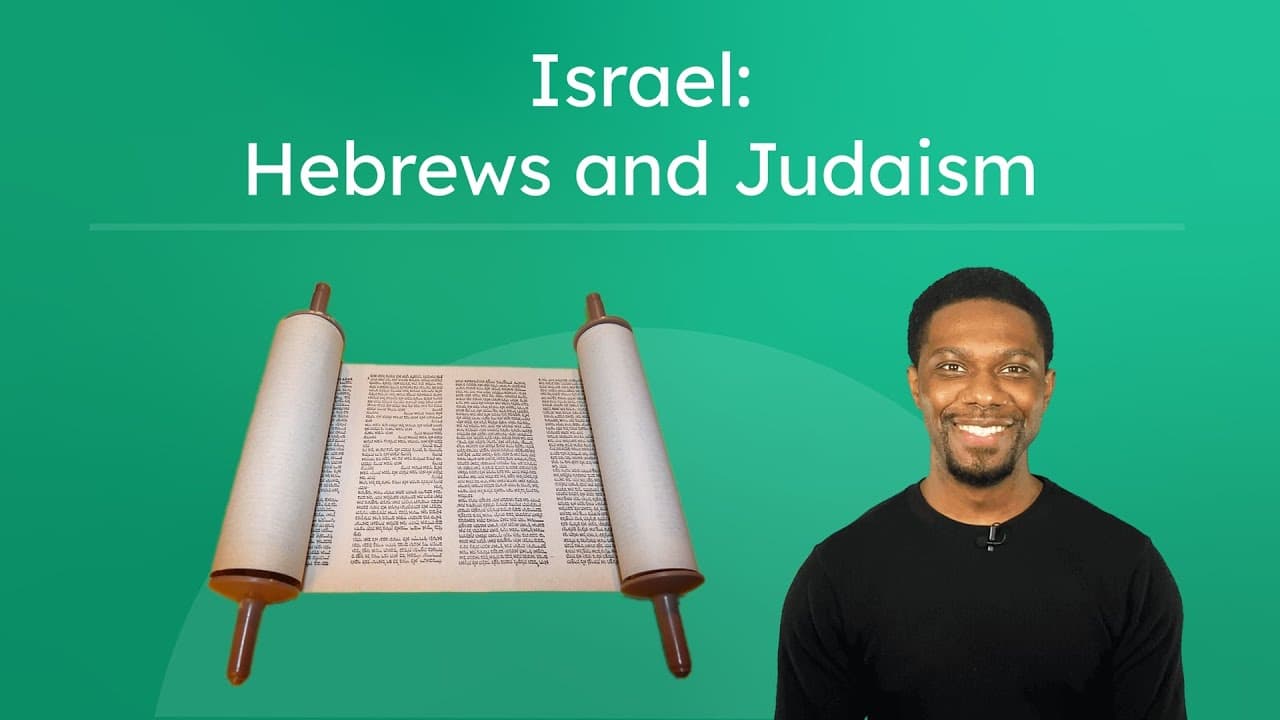
Understanding the Roots and Beliefs of Judaism

Understanding the Roots and Beliefs of Judaism

This engaging video lesson explores the origins, core beliefs, and enduring legacy of Judaism, one of the world's oldest monotheistic religions. Through a mix of humor, historical art, and clear comparative charts, the host breaks down complex theological concepts like the Covenant, the Torah, and the shift from ancient polytheism to monotheism. Students will learn how Judaism established unique moral codes and practices that differed significantly from surrounding ancient civilizations like Egypt and Mesopotamia.

Miacademy & MiaPrep Learning ChannelMiacademy & MiaPrep Learning Channel

10mins 26s

How Humans Harnessed Energy to Build Civilization

How Humans Harnessed Energy to Build Civilization

Hosted by Stan Muller, this episode of Crash Course World History explores the fundamental history of human energy consumption based on Alfred Crosby's book "Children of the Sun." The video traces humanity's journey from relying solely on muscle power to mastering fire, domesticating plants and animals, and eventually unlocking the massive energy stores within fossil fuels. It explains how these advancements allowed for civilization building, from the pyramids to modern metropolises, while emphasizing that almost all energy sources ultimately originate from the sun. The video covers key historical turning points including the Agricultural Revolution, the Industrial Revolution, and the modern reliance on electricity and the internal combustion engine. It provides a balanced look at different fuel sources—wood, coal, oil, and nuclear power—analyzing their efficiency, historical impact, and downsides. Significant attention is given to the exponential increase in energy usage since 1850 and the geopolitical and environmental consequences of this shift. For educators, this resource bridges the gap between science and history, demonstrating how physical laws (thermodynamics) shape human progress. It is an excellent tool for discussing the Anthropocene, the trade-offs of technological advancement, and the complex challenge of sustainability. The video sets up discussions on climate change, resource management, and the future of energy, making it highly relevant for both social studies and environmental science curriculums.
CrashCourseCrashCourse

7mins 21s

Exploring Africa: Geography, History, and Culture

Exploring Africa: Geography, History, and Culture

This comprehensive educational video provides a detailed overview of the African continent, structured into four main sections: physical characteristics, history, people and culture, and economic structures. Hosted by Taylor, the video begins with an engaging safari skit before diving into a structured lesson that uses maps, images, and statistics to paint a broad picture of the diverse continent. It covers major geographical features like the Sahara, the Nile, and the Great Rift Valley, while also addressing the rich history of civilizations from Ancient Egypt to the Kingdom of Mali. The narrative addresses complex topics such as the origins of humanity, the impact of the transatlantic slave trade, European colonization, and the challenges of modern independence. It connects historical events—like the drawing of colonial borders—to current issues such as political conflict and economic struggles. The video highlights the contrast between Africa's immense natural wealth in resources like gold and diamonds versus its economic challenges, including low GDP per capita and infrastructure issues. Ideally suited for middle and high school social studies classrooms, this resource serves as an excellent introduction to African geography and history. It encourages active learning by prompting students to use a physical map to locate features and engages critical thinking with questions about the legacy of colonialism and future economic prospects. Teachers can use this video to launch units on world geography, discuss the effects of imperialism, or analyze global economic disparities.

Miacademy & MiaPrep Learning ChannelMiacademy & MiaPrep Learning Channel

15mins 37s

How the Indus Valley Civilization Rose and Fell

How the Indus Valley Civilization Rose and Fell

This engaging episode of Crash Course World History explores the Indus Valley Civilization, one of the largest and most mysterious ancient societies in human history. Host John Green guides viewers through the rise and fall of this Bronze Age culture, examining its sophisticated urban planning, extensive trade networks, and the puzzling lack of weapons or evidence of warfare. The video also tackles the broader historical concept of what defines a "civilization" and the inherent biases in how historians classify different human societies. Key themes include the relationship between geography and settlement, specifically the importance of reliable river flooding for agriculture; the role of archaeology in reconstructing history without decipherable written records; and the comparison of social structures across different ancient cultures. The video highlights specific artifacts like the famous animal seals and architectural marvels like the Great Bath of Mohenjo-Daro to illustrate the uniqueness of the Indus Valley people. For the classroom, this video is an excellent resource for introducing Ancient River Valley Civilizations or units on archaeology and historical inquiry. It models critical thinking by questioning established historical narratives—such as the definition of "barbarian"—and demonstrating how historians form theories based on physical evidence. The fast-paced, humorous delivery helps make complex anthropological concepts accessible and relevant to high school students.

CrashCourseCrashCourse

9mins 35s

How Geography Shapes Global Food Security

How Geography Shapes Global Food Security

This educational video explores the complex field of agricultural geography, examining why food insecurity persists in a world that produces enough calories to feed everyone. Host Alizé Carrère guides viewers through the intricate web of historical, political, economic, and environmental factors that determine who has access to food. The narrative moves from local examples of farming to global systems, explaining how colonialism, the Columbian Exchange, and various agricultural revolutions have shaped our modern food landscape. The video covers critical themes including the distinction between subsistence and commercial farming, the shift from polyculture to monoculture, and the impact of the Green Revolution. It delves into the geography of hunger, explaining concepts like food deserts and the difference between food availability and food access. Significant attention is paid to how historical events, such as the triangular trade and colonization, disrupted indigenous food systems and established export-oriented economies that still influence global food distribution today. For educators, this resource serves as a powerful tool to connect geography, history, and economics. It moves beyond simple definitions to show students the systems thinking required to understand global challenges. The video provides excellent opportunities for classroom discussions on food justice, the environmental impacts of industrial agriculture, and the importance of biodiversity. It is particularly useful for units on human geography, economic development, and sustainability.

CrashCourseCrashCourse

11mins 32s

Why the Bronze Age Civilizations Collapsed

Why the Bronze Age Civilizations Collapsed

In this episode of Crash Course World History, John Green explores the mysterious collapse of the Bronze Age civilizations in the Eastern Mediterranean around 1200 BCE. The video challenges the traditional narrative of separate, isolated civilizations by demonstrating how Egypt, the Hittites, the Mycenaeans, and others formed a highly interconnected international system defined by trade, diplomacy, and war. It examines the evidence for this interdependence, including the famous Uluburun shipwreck and the Amarna Letters.

CrashCourseCrashCourse

12mins 58s

Materials

River Cradle Slides

River Cradle Slides

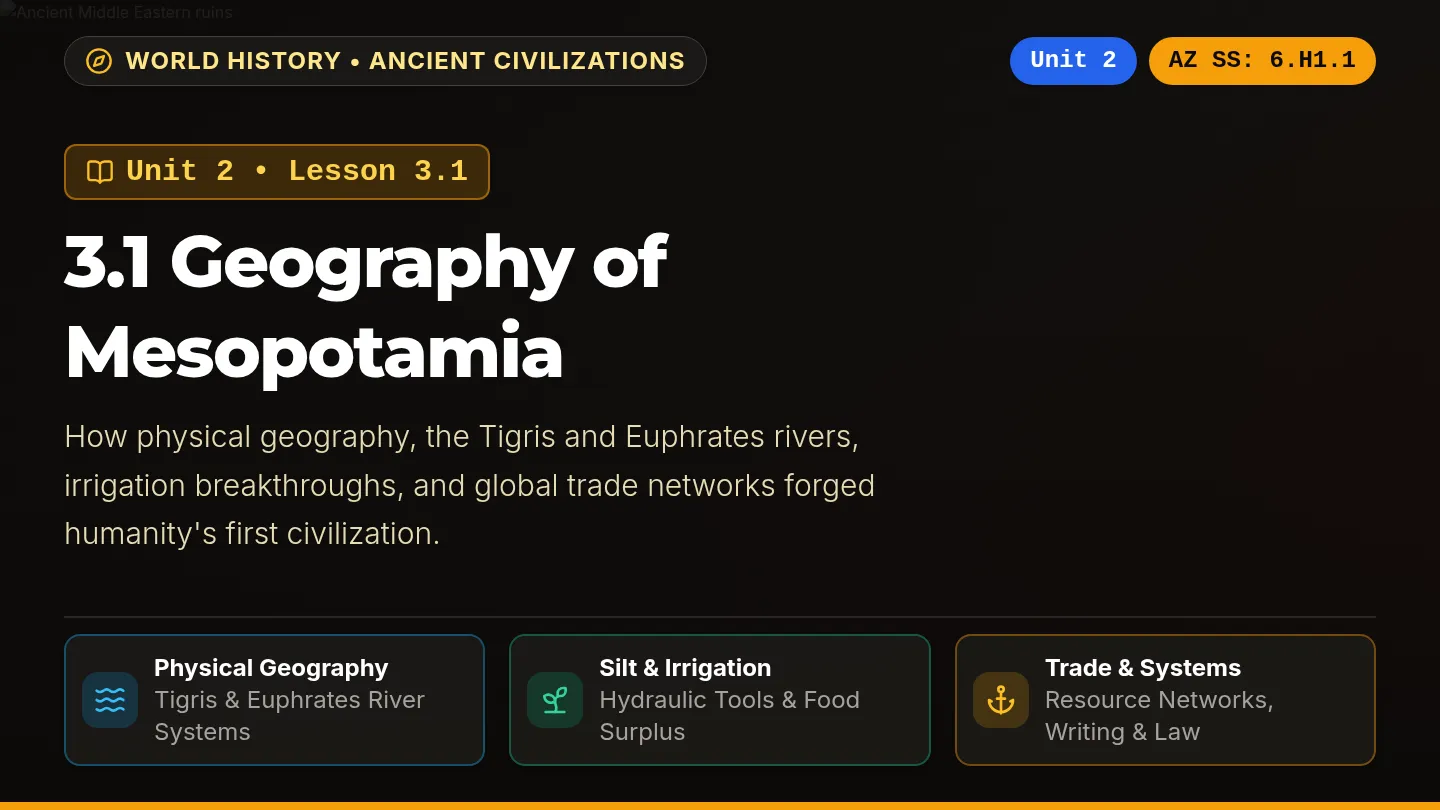
A dark-themed, visually vibrant classroom slide deck labeled Unit 2: Lesson 3.1 Geography of Mesopotamia, aligned with Arizona History and Social Science standards on every slide, featuring rich photography, high-contrast color-coded cards, and interactive review prompts.

SZ

Sandra Zoerhoff

Pocket Vocab Lab Activity Templates

Pocket Vocab Lab Activity Templates

A printable horizontal mini-composition notebook interactive vocabulary toolkit for Ohio 6th Grade Social Studies. Features wide horizontal inserts for dual-coding icon vaults, relational analogy engines, geographic semantic webs, and historical context decoders with cut lines and glue tabs.

MG

Mary Grose

River Civilizations Adapted Packet

River Civilizations Adapted Packet

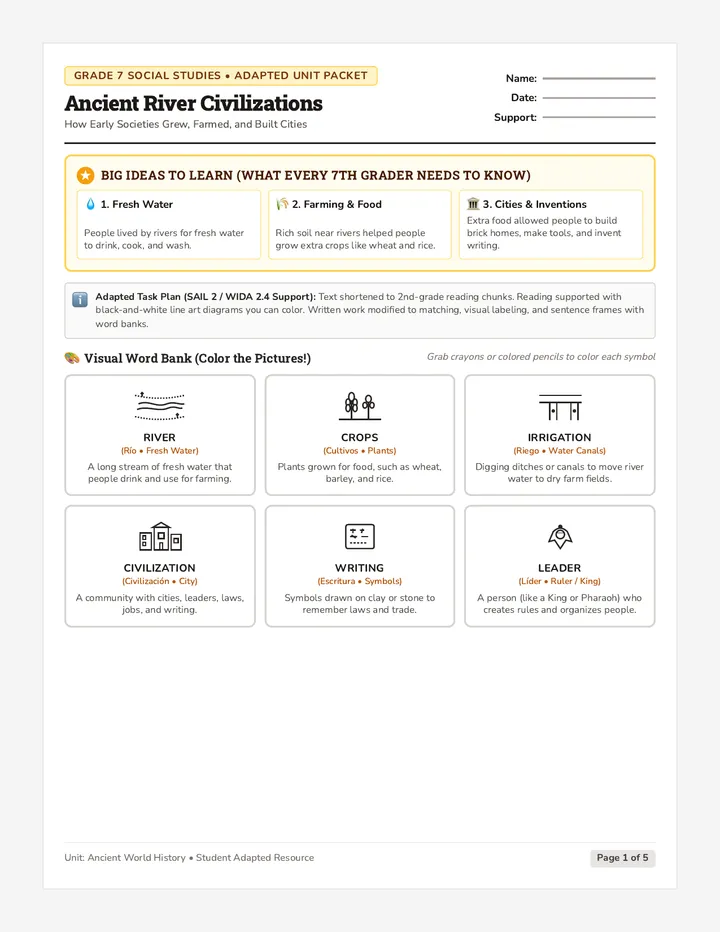
A 5-page adapted student learning packet on ancient river civilizations tailored for a 7th-grade English learner in a SAIL 2 inclusion model (WIDA 2.4). Features simplified chunked text, black-and-white line art illustrations ready for coloring, visual vocabulary cards, an organizer matrix, sentence frames, and a creative draw-and-label culminating task.

CQ

Colleen Quinn

Nile Lifeline Worksheet

Nile Lifeline Worksheet

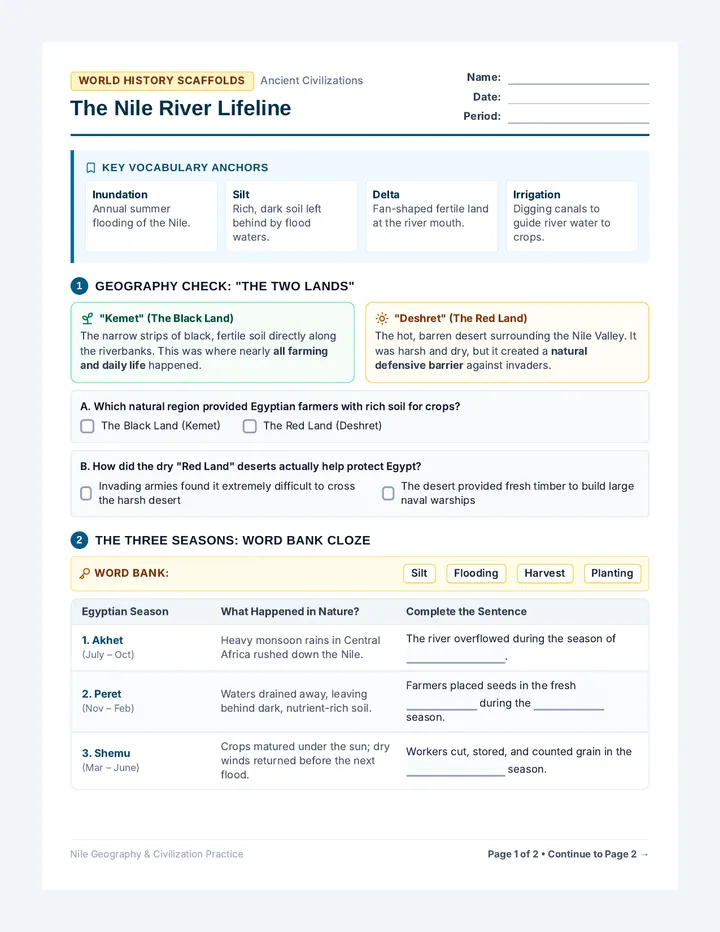
A structured two-page worksheet on ancient Egyptian Nile River geography designed for high school students with learning disabilities, featuring clear vocabulary anchors, visual chunking, cause-and-effect organizers, and sentence starters.

N

natachapaarris@gmail.com

Asian Civilizations Review Worksheet

Asian Civilizations Review Worksheet

A two-page structured review worksheet designed to help students write complete-sentence answers for a test on early Indian and Chinese civilizations. Includes categorized word banks, question-specific sentence starters, handwriting-ready ruled response areas, and a self-assessment sentence quality checklist.

FT

Faith Timberman

Civilizations Standard Unpacking Guide

Civilizations Standard Unpacking Guide

A comprehensive 3-page Teacher Unpacking Guide for Arizona Social Studies Practice Standard 6.SP1.1, focused on scale and perspective within Mesopotamia, ancient Egypt, and the Indus Valley. It includes standard deconstruction, 3-tier vertical articulation, detailed learning targets, evidence of learning, classroom anchor case studies, and a rigorous, topic-specific mastery rubric for educators.

SZ

Sandra Zoerhoff

Sequences

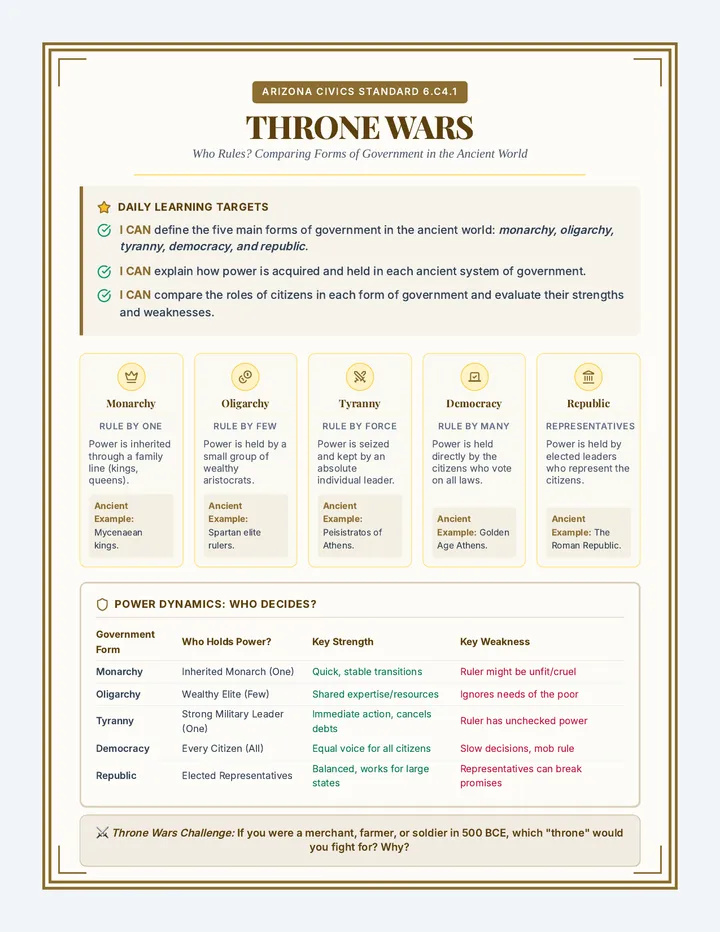
Throne Wars Anchor Chart

Rise of Civilization

A comprehensive 6th-grade social studies unit exploring the trajectory of human history, from nomadic hunter-gatherers and the cognitive evolution of early humans, to the agricultural revolution, and finally the development of structured ancient governments.

SZ

Sandy Zoerhoff

10
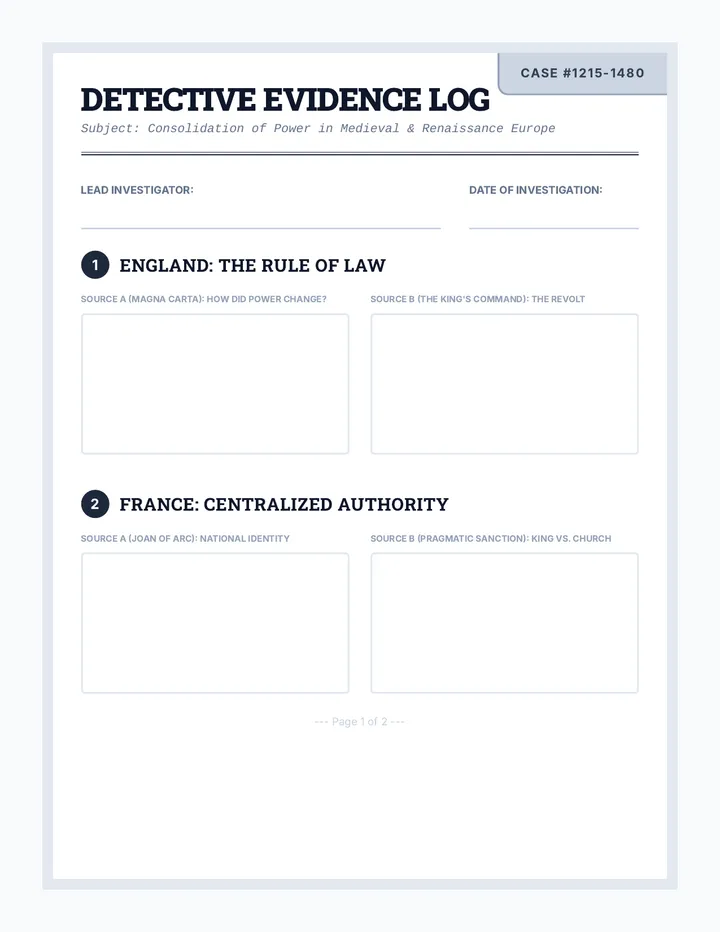
Detective Evidence Log Worksheet

Nation State Detectives

A comprehensive middle school history unit where students act as 'history detectives' to investigate the rise of nation-states in England, France, Spain, and Russia through primary source analysis.

HO

Helen O'Keefe

11
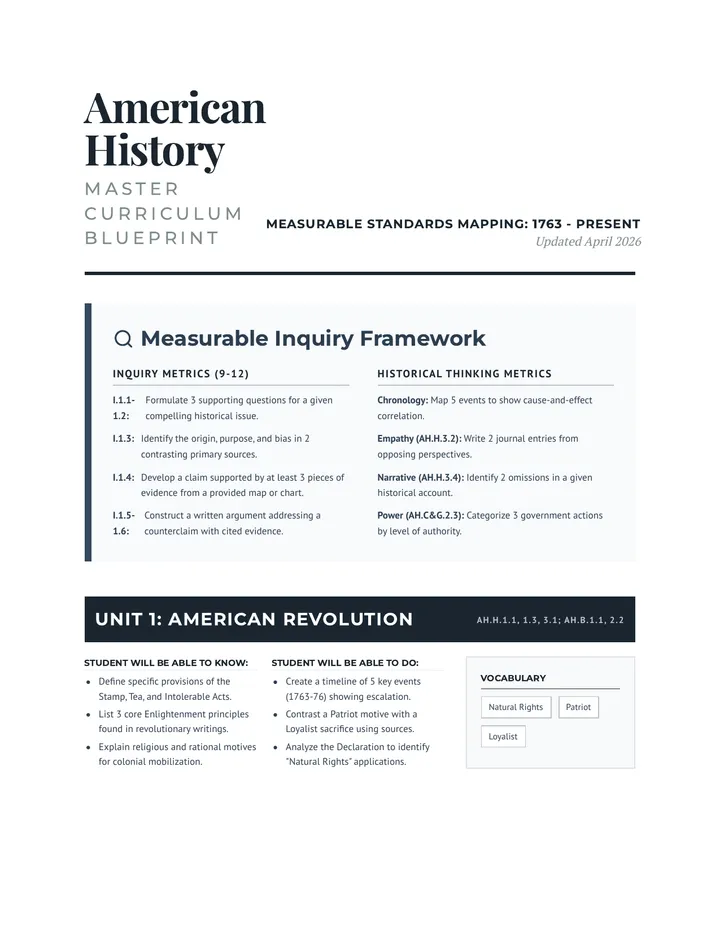
Curriculum Blueprint Document v2

History Horizon Sequence

A comprehensive high school curriculum plan for American History, covering 13 units from the American Revolution to the modern era, aligned with North Carolina Social Studies standards.

AK

Amity Kea

21
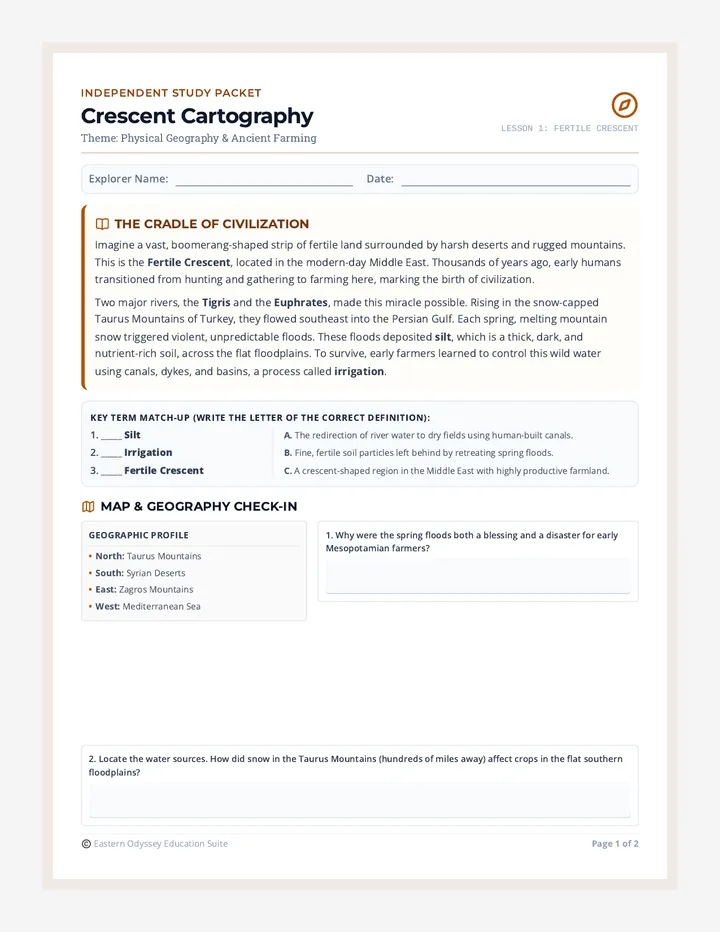
Crescent Cartography Student Packet

Eastern Odyssey Sub Packets

A sequence of 5 highly engaging, self-guided emergency sub plans for 6th-grade Eastern Hemisphere Social Studies, focusing on Ancient Egypt, Mesopotamia, the Fertile Crescent, Monsoon Asia, and Japan's island geography. Each sub plan includes a student packet and a teacher guide.

T

tpayne

10
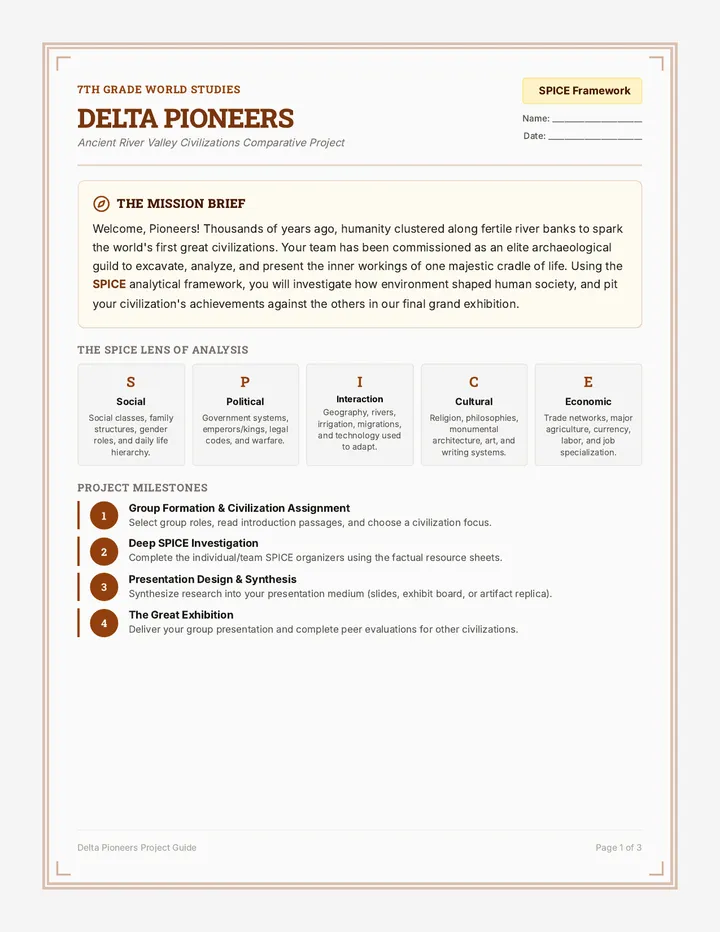
Pioneer Portfolio Project Guide

River Kingdoms

An immersive historical sequence guiding 7th-grade students through the excavation, comparison, and long-term legacy of the world's four primary river valley civilizations using the SPICE framework.

NE

Nicole Elder

9
Africa Geography and Trade Worksheet

Ancient Empires and Innovations

A weekly unit sequence exploring the physical geography of Africa, the trans-Saharan gold-salt trade, and the major technological and cultural innovations of ancient Sumer. Tailored with high-support, high-rigor scaffolds designed for SPED students.

AG

Amina Gueye

5

Lessons

Explorer Epochs Wall Chart

Early World Explorers

A comprehensive lesson on early world exploration from 300 BCE to 1500 CE, focusing on the geographical, cultural, and religious impacts of key explorers across different continents.

J

jcasey

14
Royal Decree Assessment Upgrade

Cradle of Civilization

A comprehensive lesson on the rise of Mesopotamian civilization, covering geography, irrigation, the development of city-states, writing systems, and the formation of the world's first empires.

J

jedriend

9
Time Cartographers Slides

Time Cartographers

An 80-minute sixth-grade lesson on understanding, building, and interpreting historical timelines, teaching BCE/CE, BC/AD, Circa, and Chronological Order, focusing on Mesopotamia, Egypt, the Indus Valley, and global history.

AA

Adam Amster

4
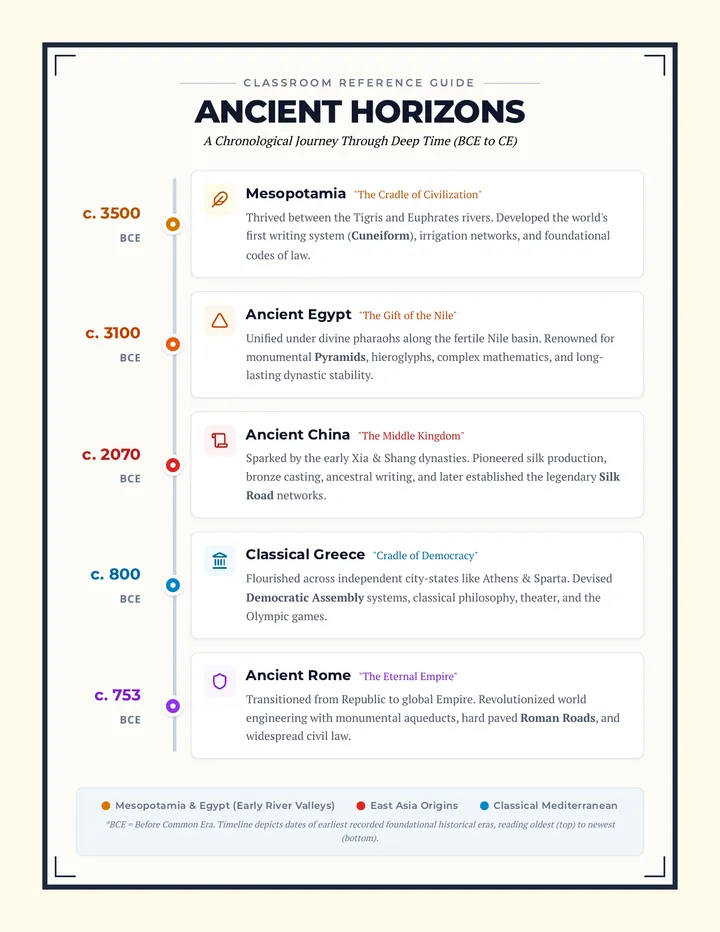
Ancient Horizons Timeline Poster

Ancient Civilizations Timeline

A lesson package designed to introduce the chronology of five fundamental ancient civilizations. It includes a high-impact master reference poster and printable large-scale timeline cards for classroom display.

SZ

Sandra Zoerhoff

2
Standards Anchor Charts Posters

Standard Explorers

A classroom-ready unit of high-impact visual standard anchor charts for 6th grade Social Studies. Includes Illustrated 'I Can' statement cards for Civics, Geography, and History.

SZ

Sandra Zoerhoff

2
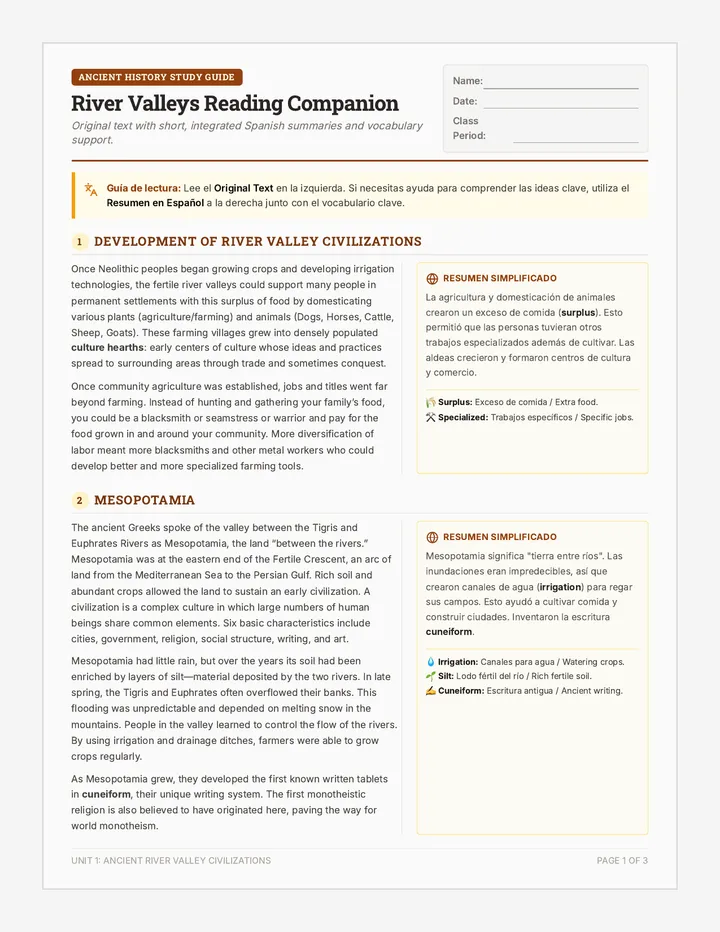
Civilizations Reading Companion

River Valley Civilizations

A comprehensive history lesson focusing on the development of the four major ancient river valley civilizations, featuring differentiated text and scaffolded reading supports for ESL students.

JO

Jacob Obannon

1