Roosevelt Parks Packet Name:
Date:
5th Grade Social Studies •
Wilderness Preserved
How Teddy Roosevelt & the Government Worked Together to Save National Parks
Inside This Guide: p. 1 The Problem p. 2 Teamwork & Timeline p. 3 Primary Sources p. 4 Quiz & Civic Action
The Problem: Disappearing Wild Places
In the late 1800s, America was growing fast. New railroads, factories, and towns popped up across the country. To build these things, companies cut down giant forests, dug mines, and hunted wildlife. Many people worried that America's natural resources —like trees, clean water, and wild animals—would soon run out.
When Theodore "Teddy" Roosevelt became president in 1901, he wanted to solve this problem. As a young man, he had lived on a ranch and loved exploring the outdoors. He knew that one person could not save America's wilderness alone. It would take a strong partnership between citizens, scientists, and the U.S. government.
In 1903, Roosevelt went camping in Yosemite with a nature writer named John Muir . Sitting by the campfire, Muir showed Roosevelt why giant sequoia trees needed protection. Roosevelt promised to lead a nationwide effort for conservation so future generations could enjoy these wild places too.
Fast Fact
Before 1900, the U.S. only had 5 national parks , including Yellowstone (1872) and Yosemite (1890).
By working with Congress and conservation leaders, Roosevelt helped protect 230 million acres —an area almost as big as Texas and California combined!
Text Feature: Sidebar
Bolded Vocabulary Words
Natural Resources
Materials from nature—like trees, water, and minerals—that people use.
Partnership
People or groups working together as a team to solve a shared problem.
Conservation
Protecting and caring for nature so it is not wasted or destroyed.
Quick Check: Pause & Reflect
1. What problem was happening to America's natural resources in the late 1800s?
2. How did John Muir and Teddy Roosevelt start a partnership in 1903?
Wilderness Preserved Page 2 • Teamwork & Timeline
How the Government Worked Together to Protect Land
Normally, creating a national park takes a long time because Congress —the branch of government that makes laws—has to debate and vote on every park. Sometimes, land was in danger of being cut down or mined before a vote could finish.
To solve this problem, Congress and President Roosevelt teamed up! In 1906, Congress passed a new law called the Antiquities Act . This law gave the president the power to use executive action —an official order—to quickly protect special places as a national monument .
Roosevelt used this teamwork tool 18 times, starting with Devils Tower in Wyoming and later protecting the Grand Canyon. He also worked with Gifford Pinchot , head of the new U.S. Forest Service, to care for 150 national forests and 51 bird reserves. Together, the government turned many protected lands into national parks for everyone to enjoy.
Diagram: Teamwork in Action
1. Citizens Speak Up
Writers like John Muir and everyday people ask leaders to save wild places.
2. Congress Passes a Law
Congress passes the Antiquities Act (1906) to help protect landmarks fast.
3. President & Agencies Act
Roosevelt & the Forest Service protect 18 monuments and 150 forests.
Timeline: Teddy Roosevelt's Conservation Team (1901–1909)
1903
Roosevelt camps in Yosemite with John Muir.
1905
U.S. Forest Service begins with Gifford Pinchot.
1906
Congress passes the Antiquities Act; Devils Tower protected.
1908
Roosevelt protects the Grand Canyon as a monument.
Teamwork Tracker: Who Helped Solve the Problem?
Team Member
How Did They Help Protect America's Wild Places?
John Muir & Citizens
Congress (Lawmakers)
Teddy Roosevelt & Gifford Pinchot
Wilderness Preserved Page 3 • Primary Sources
Voices from History: Primary Sources
Source A: Teddy Roosevelt at the Grand Canyon (1903)
"Leave it as it is. You cannot improve on it. The ages have been at work on it, and man can only mar [damage] it. What you can do is to keep it for your children, your children's children, and for all who come after you..."
Caption: Roosevelt spoke to crowds in Arizona, asking Americans to keep the Grand Canyon safe for future kids.
Source B: The Antiquities Act Passed by Congress (1906)
"The President of the United States is hereby authorized... to declare by public proclamation historic landmarks, historic and prehistoric structures, and other objects of historic or scientific interest... to be national monuments..."
Caption: Congress wrote this law so the President could quickly name special places as national monuments .
Document-Based Questions
1. In Source A, why did Roosevelt say people should "leave it as it is" for "your children's children"?
2. Look at Source B. What power did Congress give the President in the Antiquities Act?
3. How did Source A and Source B work together to save the Grand Canyon? Explain in your own words.
Wilderness Preserved Page 4 • Quiz & Civic Action
Part A: Check Your Understanding
1. Which word means "protecting and caring for nature so it is not wasted"?
A. Pollution
B. Conservation
C. Mining
D. Railroad
2. How did Congress help Teddy Roosevelt protect special places quickly?
A. By closing all railroads
B. By selling national forests
C. By passing the Antiquities Act
D. By ending all camping trips
3. Who teamed up with Roosevelt to lead the new U.S. Forest Service?
A. Gifford Pinchot
B. George Washington
C. Abraham Lincoln
D. Thomas Edison
4. What does the story of Teddy Roosevelt's parks teach us about government?
A. Only one person can solve problems.
B. Citizens cannot help the president.
C. Nature does not need any laws.
D. Leaders and citizens can team up to solve big problems.
Part B: Team Up to Protect a Special Place!
Think of a natural or historic place in your state or town that should be protected. Fill in the plan below to show how you and the government could work together!
Special Place Name & Where It Is:
How would citizens, Congress, and the President work together to protect it?
Write Your 2–3 Sentence Proclamation (Why it matters for future kids):
Roosevelt Parks Answer Key 5th Grade Teacher Guide & Answer Key
Wilderness Preserved
Suggested Lesson Pacing (45–50 Minutes)
1. Page 1 (12 min)
Preview text features (TOC, sidebar, bold words); read and complete Quick Check.
2. Page 2 (12 min)
Examine the diagram and timeline; complete the Teamwork Tracker in pairs.
3. Page 3 (10 min)
Read Primary Sources A & B with captions and answer DBQs.
4. Page 4 (12 min)
Independent quiz and "Team Up to Protect a Special Place" activity.
Page 1: Quick Check Sample Answers
1. Problem with natural resources: As railroads, factories, and towns grew, companies cut down giant forests, dug mines, and hunted wildlife, making people worry natural resources would run out.
2. John Muir & Teddy Roosevelt's 1903 partnership: They went camping in Yosemite, where Muir showed Roosevelt why giant sequoias needed protection, inspiring Roosevelt to lead a conservation effort.
Page 2: Teamwork Tracker Sample Answers
Team Member
How Did They Help Protect America's Wild Places?
John Muir & Citizens
Spoke up about disappearing forests and asked leaders to save wild places.
Congress (Lawmakers)
Passed the Antiquities Act (1906) so the president could quickly protect special landmarks as national monuments.
Teddy Roosevelt & Gifford Pinchot
Used executive action to protect 18 national monuments (like Devils Tower and Grand Canyon) and cared for 150 national forests and 51 bird reserves.
Informational Text Features Highlighted: Table of Contents (p. 1), Fast Fact Sidebar (p. 1), Bolded Vocabulary & Glossary (p. 1–2), Flowchart Diagram (p. 2), Timeline (p. 2), Captions (p. 3).
Wilderness Preserved • Teacher Key Page 2 • DBQs & Assessment
Page 3: Document-Based Questions (Sample Answers)
1. Why "leave it as it is" for "your children's children": Roosevelt believed people could only damage the Grand Canyon's natural beauty, so Americans should protect it for future kids and generations to enjoy.
2. Power Congress gave the President: Congress gave the President the power to declare historic landmarks and objects of historic or scientific interest to be national monuments by public proclamation.
3. How Source A and Source B worked together: In Source A (1903), Roosevelt saw the Grand Canyon and wanted to save it. When Congress passed the Antiquities Act in Source B (1906), it gave Roosevelt the legal tool he used in 1908 to protect the Grand Canyon as a national monument.
Page 4: Part A (Quiz) & Part B (Civic Action Look-Fors)
1. B — Conservation
2. C — By passing the Antiquities Act
3. A — Gifford Pinchot
4. D — Leaders and citizens can team up to solve big problems.
Part B: Team Up to Protect a Special Place Look-Fors
Names a specific natural or historic place in the student's state or community.
Describes a realistic role for citizens (speaking up/petitions), Congress (passing laws), and the President (issuing a proclamation).
Includes a clear 2–3 sentence proclamation explaining why the place matters for future generations.
Differentiation & Extension
Support: Have students do a "Text Feature Scavenger Hunt" before reading—circling the bolded words, sidebar, diagram, timeline, and captions.Extension (New York's Adirondacks): Have students complete Extension Station 4 in Conservation Stations Cards to explore how Roosevelt's primary New York conservation focus was protecting the forested lands of the Adirondacks as part of New York's State Forest Preserve rather than a federal national park—and compare state vs. federal teamwork in their own state!
Aligned to 5th Grade Social Studies: Civic Participation, State & Federal Conservation, and Informational Text Features.
Conservation Stations Cards Social Studies Station 1 • 12 Minutes
The Race to Save Giant Sequoias
The Problem Your Team Must Solve
It is 1907. A logging company plans to cut down a grove of 2,000-year-old sequoia trees in California next month! Making a brand-new national park through Congress usually takes years of debate. Your team must figure out how citizens, Congress, and President Teddy Roosevelt can use teamwork to save the trees before the saws arrive.
Informational Text Feature: Government Tool Kit
1. Citizens & Scientists
Can send letters, photos, and petitions to show why the natural resources are special.
2. Antiquities Act (1906)
A law passed by Congress that lets the President protect landmarks fast by executive action .
3. National Monument
A protected area named by the President that stops logging and mining right away.
Your Team's Mission (Work Together!)
Pick a role below. Each person shares their part, then write your 3-step plan together on your Recording Sheet:
Citizen / Scientist: Explain why the giant sequoias are rare natural resources and ask leaders to act fast.
Member of Congress: Explain why a regular park vote takes too long and remind the team about the Antiquities Act (1906) .
President Roosevelt: Use executive action to declare the grove a national monument and stop logging right away.
Team Check: Discuss why waiting for a regular vote won't work in time, then record all 3 steps!
Bolded Words to Use: Congress, Antiquities Act, executive action, national monument Station 1 of 3
Social Studies Station 2 • 12 Minutes
Save a Special Place Today!
The Problem Your Team Must Solve
Imagine a local river, park, or historic building in your town is getting polluted and might be paved over for a parking lot. Just like in Teddy Roosevelt's time, solving a community problem takes citizens and government leaders working together!
Informational Text Feature: How Citizens & Government Team Up
Step 1: Speak Up
Students and neighbors write letters, make posters, or speak at a town meeting.
Step 2: Make a Rule
Local lawmakers or Congress vote on a law to protect the natural resources or landmark.
Step 3: Take Action
The mayor, governor, or President signs the plan and park rangers help care for it.
Your Team's Mission (Work Together!)
Choose a real park, river, or historic place in your state or town. Pick a role below and build your plan on the Recording Sheet:
Student / Citizen: Decide how neighbors will speak up (petitions, posters, or town meetings) to show why the place matters.
Lawmaker / Congress Member: Write a rule or law that stops pollution and protects the site's natural resources .
Government Leader / Ranger: Explain how the mayor, governor, or President will sign the plan and care for the site—and help write the team slogan!
Team Check: End by writing one catchy Team Slogan explaining why this place matters for future kids!
Bolded Words to Use: natural resources, partnership, conservation Station 2 of 3
Extension Station 3 • State vs. Federal Conservation
Protecting New York's Adirondacks
The Problem Your Team Must Solve
Before becoming President, Teddy Roosevelt served as Governor of New York (1899–1900). His main New York conservation focus was protecting the wild forests and rivers of the Adirondacks . Instead of making it a federal national park, New York preserved the land inside New York's State Forest Preserve ! How does a state preserve work differently from a federal national park?
Informational Text Feature: State Forest Preserve vs. National Park
New York State Forest Preserve (Adirondacks)
Federal National Park (Grand Canyon / Yosemite)
Protected by New York State laws & voters.
Protected by Congress & the President .
Kept "forever wild" by New York's constitution so trees cannot be sold or cut down.
Managed by federal agencies (like the National Park Service) for the whole country.
Your Team's Mission (Work Together!)
Pick a role below to compare how state and federal leaders protect wild lands, then record your team's answer:
New York Citizen: Explain why clean water and forests in the Adirondacks matter to people across New York State.
New York State Lawmaker: Explain how New York's State Forest Preserve keeps the land "forever wild" without needing a federal law.
Governor Teddy Roosevelt: Show how working with New York State gave you experience in conservation before you became President!
Team Check: Name one way the Adirondacks (state preserve) is different from a federal national park!
Bolded Words to Use: Adirondacks, State Forest Preserve, conservation Extension Station 3 of 3
Stations Recording Sheet Name:
Date:
Conservation Stations Recording Sheet
Use the Grand Canyon Exemplar as your model, then solve Stations 1–3 with your team!
Station 1: The Race to Save Giant Sequoias
1. Why won't waiting for a regular national park vote work in time?
2. Your Team's 3-Step Plan (What does each role do using the Antiquities Act?):
Citizen / Scientist
Member of Congress
President Roosevelt
Station 2: Save a Special Place Today!
1. Which local or state park, river, or historic place did your team choose?
2. Your Team's 3-Step Teamwork Plan:
Student / Citizen
Lawmaker / Congress
Leader / Ranger
3. Your Team Slogan (Why this place matters for future kids):
Conservation Stations Recording Sheet Page 2 • Extension Station 3 & Reflection
Extension Station 3: Protecting New York's Adirondacks
1. How is New York's State Forest Preserve (Adirondacks) different from a federal national park?
2. How did working as Governor of New York prepare Teddy Roosevelt to protect parks as President?
Teamwork Reflection
How did working together as a team help you solve these problems better than working alone?
Bill to Law Visual Guide 5th Grade Social Studies • Visual Reference Guide
How Congress Passes a Bill Into Law
Working Together: From an Idea to an Official Act
1
An Idea Becomes a Bill
Citizens, scientists, or lawmakers spot a problem. A member of Congress writes a bill —a written plan for a new law.
2
Committee Check
A smaller team in Congress (called a committee ) studies the bill , listens to experts, and makes edits so it works well.
3
Both Parts of Congress Vote
Both the House of Representatives and the Senate debate and vote. If a majority in both groups votes YES, the bill goes to the President!
4
The President Decides
Sign It (YES): The President signs the bill, and it officially becomes a law (often called an Act )!
Veto It (NO): The President rejects the bill. Congress can still pass it if 2/3 of both groups vote YES again.
Real-World Example: The Antiquities Act of 1906
Citizens and scientists worried that ancient landmarks and forests were being destroyed. Lawmakers in Congress wrote a bill , both the House and Senate voted YES, and President Teddy Roosevelt signed it into law on June 8, 1906—giving him the power to protect 18 national monuments !
Key Lawmaking Vocabulary
Bill: A written idea for a new law.
Congress: The House & Senate that make laws.
Veto: When the President says NO to a bill.
Act / Law: A bill signed and made official.
Stations Vocabulary Glossary 5th Grade Social Studies • Informational Text Feature
Conservation Stations Glossary
Easy-to-Read Meanings for Every Bolded Word on Your Station Cards (A–Z)
How to Use a Glossary: Words are in ABC order (A–Z) . Keep this sheet at your table to look up any bolded word!
Adirondacks
Station 3
A big area of mountains, lakes, and forests in New York State. Teddy Roosevelt worked to save these woods.
Antiquities Act (1906)
Station 1
A law that lets the President quickly protect special outdoor places and landmarks as national monuments.
Congress
Stations 1, 2, 3
The part of our U.S. government that writes and votes on new laws for the whole country.
Conservation
Exemplar, St. 2, 3
Taking good care of nature—like trees, water, and animals—so it does not get ruined or used up.
Executive Action
Station 1
A fast official rule made by the President to fix a problem without waiting for a long vote.
National Monument
Station 1
A special outdoor or historic place that the President protects so no one can mine, log, or destroy it.
Natural Resources
Stations 1, 2
Useful things we get from nature, like trees, clean water, soil, and wild animals.
State Forest Preserve
Station 3
Forest land in New York State that state laws keep "forever wild." It is saved by the state, not as a U.S. national park.
Partnership / Teamwork
Exemplar, St. 1, 2
People and government leaders working together as a team to solve a big problem.
U.S. Forest Service
Exemplar
A government team that takes care of national forests, hiking trails, and wildlife.
Tip: Try using at least 2 bolded words in your team's answers on the Recording Sheet! Wilderness Preserved
Grand Canyon Exemplar Guide Model Station Exemplar • Read First Before Stations 1–3
Protecting the Grand Canyon (Example)
See how a great team reads the clues, uses bolded words, and fills out the Recording Sheet!
Step 1: Read the Problem & Clues Carefully
Exemplar Input
The Problem: Tourists want trails at the Grand Canyon, but mining companies want to dig inside it. How can the government balance conservation with letting families enjoy the land?
Primary Source Clue (1903)
"Leave it as it is... Keep it for your children, your children's children, and for all who come after you."
Partners Table
President: Protects 800,000 acres • U.S. Forest Service: Cares for trails & wildlife • Visitors: Follow rules & pack out trash
Step 2: Model Recording Sheet Answers (What Great Work Looks Like)
Exemplar Output
1. Write 2 rules your team agreed on to stop damage while letting families visit:
Rule 1: No mining or digging is allowed inside the canyon so the rocks and wildlife stay safe for conservation .
Rule 2: Families may hike on marked trails as long as they stay on the path and pack out all their trash.
Why this works: It gives 2 clear rules, uses a bolded word (conservation), and protects nature while welcoming families!
2. How will the President, U.S. Forest Service, and visitors work in partnership?
President Roosevelt: Uses the law to protect the Grand Canyon as a monument for future kids ("children's children").
U.S. Forest Service: Rangers build safe trails, post signs, and enforce the no-mining rule.
Visitors: Follow trail rules and leave no litter. Together, this partnership keeps the canyon wild and open!
Why this works: Every team role has a clear job, it quotes the Primary Source Clue, and it uses 2 bolded vocabulary words!
Your Team's 4-Step Checklist for Stations 1, 2, and Extension Station 3
1. Read Clues
Read the Problem Box and the Fact File or Table before writing.
2. Share Roles
Every teammate speaks for their role so all 3 parts are included.
3. Use Bold Words
Use at least 2 bolded words from the bottom of the Station Card.
4. Team Check
Re-read the Team Check question to make sure nothing is missing.
Exemplar Bolded Words Used: conservation, partnership, U.S. Forest Service Model Exemplar • Wilderness Preserved
Civic Teamwork Fact Sheet 5th Grade Social Studies • Scaffolded Fact Sheet
Citizens & Government: Working Together
How everyday people and leaders team up to save parks and help our towns
Word Helper (Read These Words First!)
Citizen: A person who belongs to a town, state, or country.
Partnership: Two or more groups working as a team.
Congress: The group of leaders who make U.S. laws.
Conservation: Taking good care of nature so it lasts.
1. How Do Citizens and Government Work Together?
The U.S. government does not fix big problems all by itself.
It works in a partnership with everyday citizens .
Citizens spot problems in their town or in nature and speak up.Leaders (mayors, governors, Congress , and the President ) listen and make fair laws to help.
2. Real Example: How Teamwork Saved Our National Parks
Step 1: People Spoke Up
Writers like John Muir and regular families sent letters and photos. They asked leaders to save wild forests and canyons.
Step 2: Leaders Acted
Congress passed the Antiquities Act (1906). President Teddy Roosevelt used this law to protect millions of acres fast.
Step 3: Teams Care for It
Park rangers care for trails and animals. Visitors follow park rules and pack out trash to keep nature safe.
3. Your Role as a 5th-Grade Citizen
You Can Help Now!
You do not have to wait until you are 18 to be an active citizen . Here are 4 ways you can help today:
Write or Speak Up
Write a short note to your principal or mayor about a park or rule you care about.
Learn & Share Facts
Read true facts about a problem and make a poster to teach your classmates.
Care for Shared Places
Practice conservation : stay on park trails, recycle, and pick up litter.
Listen & Team Up
Listen kindly to others' ideas and work together to solve class or town problems.
Talk About It! (Use These Sentence Starters With a Partner)
• "One way citizens and government worked together to save parks was ________________________."
• "As a 5th-grade citizen , one way I can help my community is ________________________."
Big Idea: Strong communities happen when citizens speak up and leaders listen. Wilderness Preserved
School Teamwork Exit Ticket Name:
Date:
5th Grade Social Studies • Exit Ticket
Solve a School Problem Together
Just like citizens and leaders saved national parks, you can use teamwork at school!
Look at This 5th-Grade Example First!
Model Example
1. School Problem: "No gum is allowed in school because old gum gets stuck under desks and on the floor."
2. Teamwork Solution: "Students and teachers can work as a team! Students can promise to wrap gum in paper and throw it in the trash. Teachers and the principal can let classes try a 'Gum-Clean Friday' test to see if everyone follows the rule."
Notice: Both students AND school leaders have a job in this teamwork plan!
Part 1: Identify a Problem in Your School Community
What is one problem in your school (classroom, hallway, cafeteria, or playground)?
Part 2: Propose a Teamwork Solution
How can students and school leaders (teachers, principal, or custodians) work together as a team to solve it?
Quick Self-Check: ☐ I named a school problem. ☐ My plan uses teamwork from 2+ groups!
Wilderness Preserved
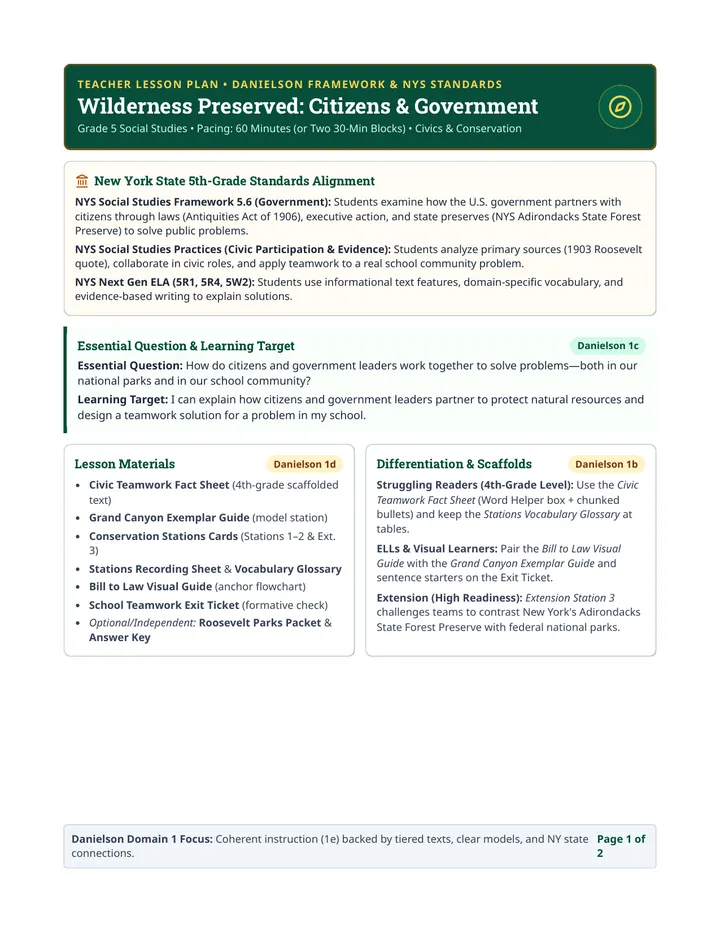
Danielson Parks Lesson Plan Teacher Lesson Plan • Danielson Framework & NYS Standards
Wilderness Preserved: Citizens & Government
Grade 5 Social Studies • Pacing: 60 Minutes (or Two 30-Min Blocks) • Civics & Conservation
New York State 5th-Grade Standards Alignment
NYS Social Studies Framework 5.6 (Government): Students examine how the U.S. government partners with citizens through laws (Antiquities Act of 1906), executive action, and state preserves (NYS Adirondacks State Forest Preserve) to solve public problems.
NYS Social Studies Practices (Civic Participation & Evidence): Students analyze primary sources (1903 Roosevelt quote), collaborate in civic roles, and apply teamwork to a real school community problem.
NYS Next Gen ELA (5R1, 5R4, 5W2): Students use informational text features, domain-specific vocabulary, and evidence-based writing to explain solutions.
Essential Question & Learning Target
Danielson 1c
Essential Question: How do citizens and government leaders work together to solve problems—both in our national parks and in our school community?
Learning Target: I can explain how citizens and government leaders partner to protect natural resources and design a teamwork solution for a problem in my school.
Lesson Materials
Danielson 1d
Civic Teamwork Fact Sheet (4th-grade scaffolded text)Grand Canyon Exemplar Guide (model station)Conservation Stations Cards (Stations 1–2 & Ext. 3)Stations Recording Sheet & Vocabulary Glossary Bill to Law Visual Guide (anchor flowchart)School Teamwork Exit Ticket (formative check)Optional/Independent: Roosevelt Parks Packet & Answer Key
Differentiation & Scaffolds
Danielson 1b
Struggling Readers (4th-Grade Level): Use the Civic Teamwork Fact Sheet (Word Helper box + chunked bullets) and keep the Stations Vocabulary Glossary at tables.
ELLs & Visual Learners: Pair the Bill to Law Visual Guide with the Grand Canyon Exemplar Guide and sentence starters on the Exit Ticket.
Extension (High Readiness): Extension Station 3 challenges teams to contrast New York's Adirondacks State Forest Preserve with federal national parks.
Danielson Domain 1 Focus: Coherent instruction (1e) backed by tiered texts, clear models, and NY state connections. Page 1 of 2
Wilderness Preserved: Danielson Lesson Plan Page 2 • Domains 2 & 3
60-Minute Instructional Sequence
Danielson 1e, 2c, 3a, 3c
1. Launch & Vocabulary Hook (8 min) — 3a/3c: Distribute the Civic Teamwork Fact Sheet . Chorally read the Word Helper box, then have partners complete one Talk About It! sentence starter aloud to activate prior knowledge.
2. Exemplar Modeling "I Do / We Do" (10 min) — 3a/2b: Project the Grand Canyon Exemplar Guide . Think aloud how the model team used the 1903 Primary Source Clue, included all 3 roles, and bolded vocabulary. Briefly reference the Bill to Law Visual Guide .
3. Collaborative Conservation Stations (25 min) — 2a/2c/3b/3c: Groups of 3 rotate through Conservation Stations Cards (Stations 1–2 + Extension Station 3 on NYS Adirondacks), recording plans on the Stations Recording Sheet . Each student takes a defined role (Citizen, Lawmaker, President/Governor).
4. Independent Exit Ticket (12 min) — 3d: Students complete the School Teamwork Exit Ticket . Review the scaffolded 5th-grade "no gum allowed" example together before students write their own school problem and teamwork plan.
5. Closure & Share-Out (5 min) — 3d/4a: Two volunteers share their school teamwork solutions. Collect Recording Sheets and Exit Tickets to identify groups needing small-group support.
High-Leverage Discussion & Questioning Prompts
Danielson 3b
Analysis: "Why couldn't Congress save the Giant Sequoias fast enough on its own without executive action?"NY Connection: "How is New York's Adirondacks State Forest Preserve different from a federal national park?"Civic Transfer: "In your school problem, what happens if students try to fix it without teachers—or teachers without students?"
Danielson Observation Look-Fors & Assessment
Domains 2 & 3
Danielson Component
Teacher Moves
Evidence of Student Mastery
2a/2b: Respect & Culture
Assigns clear station roles; praises respectful turn-taking.
All 3 teammates speak from their role; teams cite the Exemplar.
3b/3c: Discussion & Engagement
Circulates with HOTS prompts; redirects teams to Fact Files & Glossary.
Students use bolded words (conservation, Congress, partnership ) accurately.
3d: Using Assessment
Checks Recording Sheets mid-station; reviews Exit Tickets for 2+ groups.
Exit Ticket names a real school issue and assigns roles to students & leaders.
Post-Lesson Reflection (4a): Sort Exit Tickets into "Got Teamwork" vs. "Needs Role Support" for next-day mini-lesson. Page 2 of 2