Colombia Explorer Packet
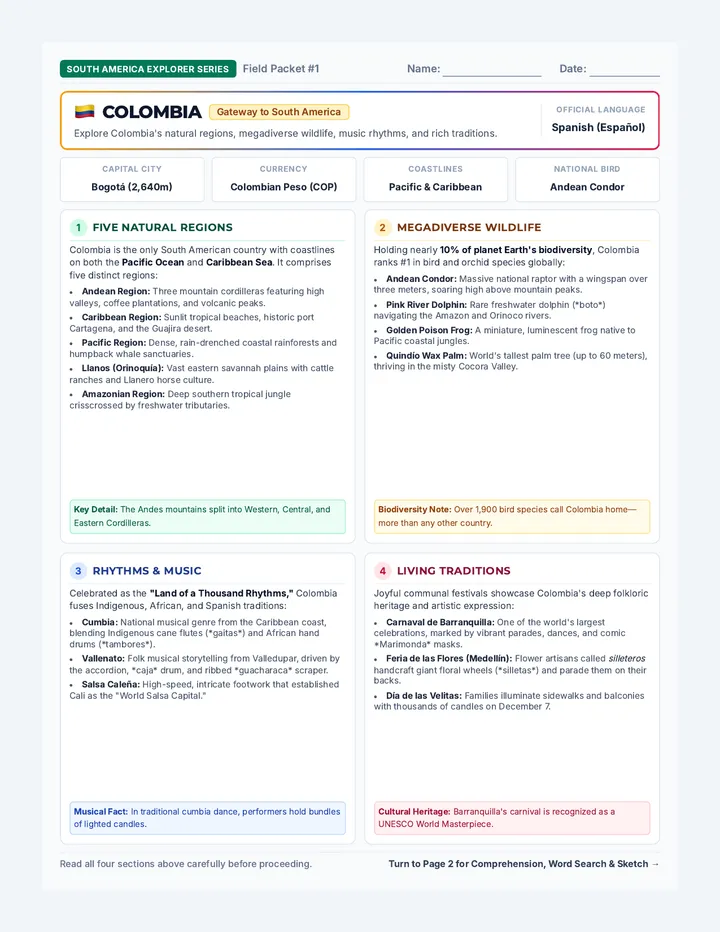
South America Explorer Series Field Packet #1
Name: Date:
🇨🇴
COLOMBIA
Gateway to South America
Explore Colombia's natural regions, megadiverse wildlife, music rhythms, and rich traditions.
Official Language Spanish (Español)
Capital City Bogotá (2,640m)
Currency Colombian Peso (COP)
Coastlines Pacific & Caribbean
National Bird Andean Condor
1
Five Natural Regions
Colombia is the only South American country with coastlines on both the Pacific Ocean and Caribbean Sea. It comprises five distinct regions:
- Andean Region: Three mountain cordilleras featuring high valleys, coffee plantations, and volcanic peaks.
- Caribbean Region: Sunlit tropical beaches, historic port Cartagena, and the Guajira desert.
- Pacific Region: Dense, rain-drenched coastal rainforests and humpback whale sanctuaries.
- Llanos (Orinoquía): Vast eastern savannah plains with cattle ranches and Llanero horse culture.
- Amazonian Region: Deep southern tropical jungle crisscrossed by freshwater tributaries.
Key Detail: The Andes mountains split into Western, Central, and Eastern Cordilleras.
2
Megadiverse Wildlife
Holding nearly 10% of planet Earth's biodiversity, Colombia ranks #1 in bird and orchid species globally:
- Andean Condor: Massive national raptor with a wingspan over three meters, soaring high above mountain peaks.
- Pink River Dolphin: Rare freshwater dolphin (*boto*) navigating the Amazon and Orinoco rivers.
- Golden Poison Frog: A miniature, luminescent frog native to Pacific coastal jungles.
- Quindío Wax Palm: World's tallest palm tree (up to 60 meters), thriving in the misty Cocora Valley.
Biodiversity Note: Over 1,900 bird species call Colombia home—more than any other country.
3
Rhythms & Music
Celebrated as the "Land of a Thousand Rhythms," Colombia fuses Indigenous, African, and Spanish traditions:
- Cumbia: National musical genre from the Caribbean coast, blending Indigenous cane flutes (*gaitas*) and African hand drums (*tambores*).
- Vallenato: Folk musical storytelling from Valledupar, driven by the accordion, *caja* drum, and ribbed *guacharaca* scraper.
- Salsa Caleña: High-speed, intricate footwork that established Cali as the "World Salsa Capital."
Musical Fact: In traditional cumbia dance, performers hold bundles of lighted candles.
4
Living Traditions
Joyful communal festivals showcase Colombia's deep folkloric heritage and artistic expression:
- Carnaval de Barranquilla: One of the world's largest celebrations, marked by vibrant parades, dances, and comic *Marimonda* masks.
- Feria de las Flores (Medellín): Flower artisans called silleteros handcraft giant floral wheels (*silletas*) and parade them on their backs.
- Día de las Velitas: Families illuminate sidewalks and balconies with thousands of candles on December 7.
Cultural Heritage: Barranquilla's carnival is recognized as a UNESCO World Masterpiece.
Read all four sections above carefully before proceeding. Turn to Page 2 for Comprehension, Word Search & Sketch →
Colombia Field Packet Student Investigation Tasks
Student:
Part 1: Text Comprehension Check
1. Which natural region of Colombia is characterized by expansive, open tropical savannah plains and cattle ranching?
A) Pacific Rainforest
B) Andean Region
C) Los Llanos (Orinoquía)
D) Caribbean Coast
2. Why is Colombia recognized as a "megadiverse" nation? Cite two specific wildlife or plant examples from the text:
3. What traditional musical style features the accordion, *caja* drum, and ribbed *guacharaca* scraper?
A) Vallenato
B) Tango
C) Salsa Caleña
D) Andean Huayno
4. What do silleteros construct and carry during Medellín's famous Feria de las Flores?
Part 2: Vocabulary Word Search
Locate the 8 Colombia-related terms hidden in the grid below (left-to-right).
B
O
G
O
T
A
M
P
Q
R
S
T
C
U
M
B
I
A
E
F
C
O
N
D
O
R
L
K
J
H
A
N
D
E
S
X
Y
Z
W
V
R
L
L
A
N
O
S
B
C
D
V
A
L
L
E
N
A
T
O
K
F
A
M
A
Z
O
N
G
H
I
J
K
L
P
A
L
M
A
M
N
T
E
R
R
A
C
O
T
A
S
M
E
D
E
L
L
I
N
X
Z
Word Bank:
□ BOGOTA □ CUMBIA □ CONDOR □ ANDES □ LLANOS □ VALLENATO □ AMAZON □ PALMA
Part 3: Draw for Comprehension
Illustrate one iconic Colombian scene (such as tall wax palms in Cocora Valley, an Andean condor in flight, or a floral silleta). Include two labeled details.
Scene depicted:
Two labeled details:
South America Explorers • Colombia Expedition Packet Completed • Verification Signature: _______________________
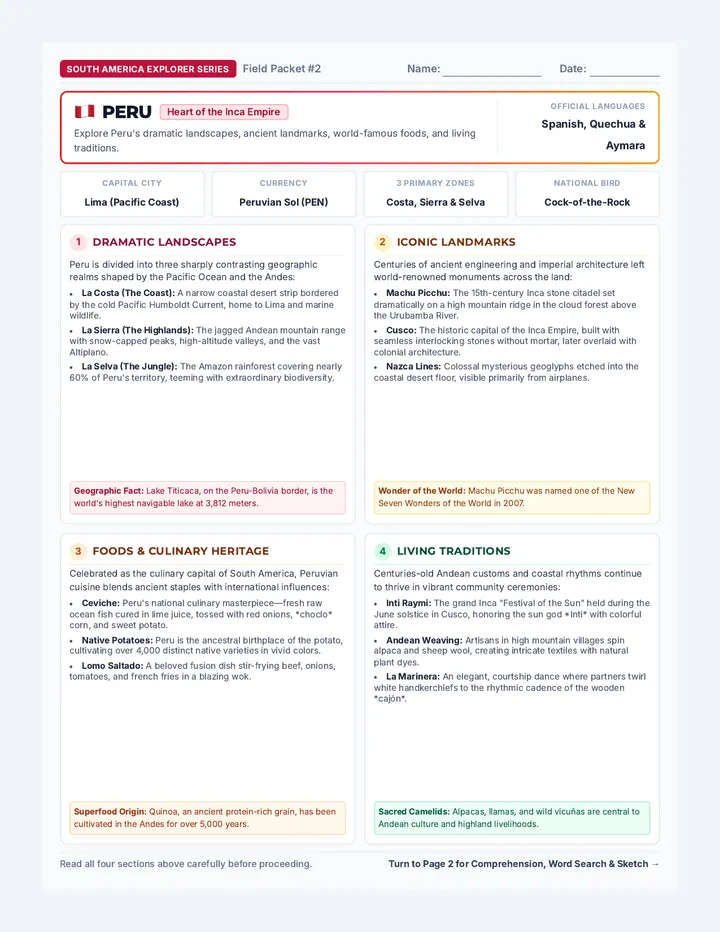
Peru Explorer Packet
South America Explorer Series Field Packet #2
Name: Date:
🇵🇪
PERU
Heart of the Inca Empire
Explore Peru's dramatic landscapes, ancient landmarks, world-famous foods, and living traditions.
Official Languages Spanish, Quechua & Aymara
Capital City Lima (Pacific Coast)
Currency Peruvian Sol (PEN)
3 Primary Zones Costa, Sierra & Selva
National Bird Cock-of-the-Rock
1
Dramatic Landscapes
Peru is divided into three sharply contrasting geographic realms shaped by the Pacific Ocean and the Andes:
- La Costa (The Coast): A narrow coastal desert strip bordered by the cold Pacific Humboldt Current, home to Lima and marine wildlife.
- La Sierra (The Highlands): The jagged Andean mountain range with snow-capped peaks, high-altitude valleys, and the vast Altiplano.
- La Selva (The Jungle): The Amazon rainforest covering nearly 60% of Peru's territory, teeming with extraordinary biodiversity.
Geographic Fact: Lake Titicaca, on the Peru-Bolivia border, is the world's highest navigable lake at 3,812 meters.
2
Iconic Landmarks
Centuries of ancient engineering and imperial architecture left world-renowned monuments across the land:
- Machu Picchu: The 15th-century Inca stone citadel set dramatically on a high mountain ridge in the cloud forest above the Urubamba River.
- Cusco: The historic capital of the Inca Empire, built with seamless interlocking stones without mortar, later overlaid with colonial architecture.
- Nazca Lines: Colossal mysterious geoglyphs etched into the coastal desert floor, visible primarily from airplanes.
Wonder of the World: Machu Picchu was named one of the New Seven Wonders of the World in 2007.
3
Foods & Culinary Heritage
Celebrated as the culinary capital of South America, Peruvian cuisine blends ancient staples with international influences:
- Ceviche: Peru's national culinary masterpiece—fresh raw ocean fish cured in lime juice, tossed with red onions, *choclo* corn, and sweet potato.
- Native Potatoes: Peru is the ancestral birthplace of the potato, cultivating over 4,000 distinct native varieties in vivid colors.
- Lomo Saltado: A beloved fusion dish stir-frying beef, onions, tomatoes, and french fries in a blazing wok.
Argentina Explorer Packet
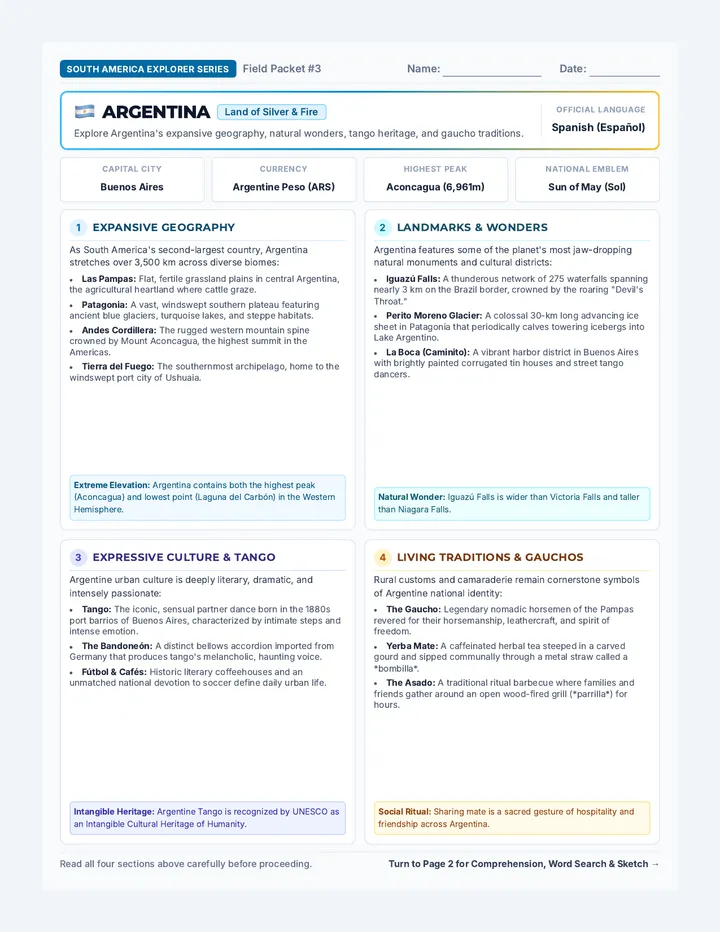
South America Explorer Series Field Packet #3
Name: Date:
🇦🇷
ARGENTINA
Land of Silver & Fire
Explore Argentina's expansive geography, natural wonders, tango heritage, and gaucho traditions.
Official Language Spanish (Español)
Capital City Buenos Aires
Currency Argentine Peso (ARS)
Highest Peak Aconcagua (6,961m)
National Emblem Sun of May (Sol)
1
Expansive Geography
As South America's second-largest country, Argentina stretches over 3,500 km across diverse biomes:
- Las Pampas: Flat, fertile grassland plains in central Argentina, the agricultural heartland where cattle graze.
- Patagonia: A vast, windswept southern plateau featuring ancient blue glaciers, turquoise lakes, and steppe habitats.
- Andes Cordillera: The rugged western mountain spine crowned by Mount Aconcagua, the highest summit in the Americas.
- Tierra del Fuego: The southernmost archipelago, home to the windswept port city of Ushuaia.
Extreme Elevation: Argentina contains both the highest peak (Aconcagua) and lowest point (Laguna del Carbón) in the Western Hemisphere.
2
Landmarks & Wonders
Argentina features some of the planet's most jaw-dropping natural monuments and cultural districts:
- Iguazú Falls: A thunderous network of 275 waterfalls spanning nearly 3 km on the Brazil border, crowned by the roaring "Devil's Throat."
- Perito Moreno Glacier: A colossal 30-km long advancing ice sheet in Patagonia that periodically calves towering icebergs into Lake Argentino.
- La Boca (Caminito): A vibrant harbor district in Buenos Aires with brightly painted corrugated tin houses and street tango dancers.
Natural Wonder: Iguazú Falls is wider than Victoria Falls and taller than Niagara Falls.
3
Expressive Culture & Tango
Argentine urban culture is deeply literary, dramatic, and intensely passionate:
- Tango: The iconic, sensual partner dance born in the 1880s port barrios of Buenos Aires, characterized by intimate steps and intense emotion.
- The Bandoneón: A distinct bellows accordion imported from Germany that produces tango's melancholic, haunting voice.
- Fútbol & Cafés: Historic literary coffeehouses and an unmatched national devotion to soccer define daily urban life.