Seed Travelers Lesson Plan
Upper Elementary Science • Lesson Plan Outline
Seed Travelers
Seed Adaptations, Dispersal Physics & Prototype Testing
Grade 5
Life Science & Engineering
55 Minutes
Learning Objective
Students will analyze how seed structures support survival and engineer, test, and collect quantitative data on prototype dispersal models to evaluate which designs maximize travel and reduce resource competition.
Standards: NGSS 5-LS1-1 (Plant Growth Needs) • 3-5-ETS1-2 (Prototype Testing)
Key Vocabulary
- Dispersal: Movement of seeds away from the parent plant.
- Resource Competition: Plants competing for light, water, and nutrients.
- Aerodynamics / Buoyancy: Air drag and floating forces acting on seeds.
- Adaptation: Inherited trait that improves survival.
Materials & Station Prep
Whole-Class & Testing Stations
- Specimens/photos: maple samara, dandelion, coconut, burdock, jewelweed
- 2 box fans + meter sticks taped to floor (Wind Station)
- 2 clear water tubs + digital stopwatches (Water Station)
- Chart paper for Class Data Table & CER Anchor Chart
Per Lab Group (3–4 Students)
- Engineering kit: index cards, tissue paper, paper clips, corks, foil, tape
- Velcro strips & felt square (Animal Fur Station)
- Seed Dispersal Data Sheet & pencils
- Safety goggles (optional for fan/elastic demos)
55-Min Pace: 1. Hook (6m) • 2. Mini-Lesson (10m) • 3. Engineering Lab (22m) • 4. CER Share-Out (10m) • 5. Exit Ticket (7m)
Instructional Outline — Part 1: Launch & Mini-Lesson (0:00–0:16)
1. Phenomenon Hook: The Crowded Oak Tree
0:00–0:06 (6 min)
Show a photo of a massive oak tree with acorns clustered directly underneath. Ask: "If 500 acorns sprout right under this tree, why will most of them die?" Students Turn & Talk, connecting survival to competition for sunlight, water, and soil space.
2. Mini-Lesson: Structure, Function & Dispersal Forces
0:06–0:16 (10 min)
Connect each dispersal mechanism to the physical forces and plant structures that make it work:
Wind
High surface area increases air drag (samara wings, pappus).
Water
Trapped air pockets & waxy coats create buoyancy.
Animals
Barbed hooks snag fur; tough seed coats survive digestion.
Mechanical
Stored elastic tension launches seeds when pods dry.
Seed Travelers (Grade 5) — Lab & Wrap-Up
0:16–0:55 (39 min)
3. Engineering & Testing Lab: Seed Dispersal Trials
0:16–0:38 (22 min)
In groups of 3–4, students choose one target dispersal method, build a prototype seed (8 min), run 3 measured trials at their testing station (10 min), and calculate their average result (4 min):
Wind Trial: Release 1m in front of box fan; measure horizontal distance (cm) across 3 trials.
Water Trial: Place prototype in water tub; time how long it floats upright (sec) without sinking.
Animal Trial: Drop onto felt square and tilt to 45°; count how many shakes until it detaches.
4. Data Share-Out & Claim-Evidence-Reasoning (CER)
0:38–0:48 (10 min)
Groups post their average trial data on the Class Data Table. Facilitate a brief discussion comparing high-performing designs: "What structural feature made the biggest difference in your data?" Guide students to synthesize how dispersal solves the crowded oak tree problem.
5. Exit Ticket & Redesign Reflection
0:48–0:55 (7 min)
Students complete a short CER Exit Ticket: (1) State a claim about which structural feature improved their seed's travel, (2) Cite one piece of trial data as evidence, and (3) Propose one redesign change for a second iteration.
Differentiation & Language Supports
Scaffolds & Multilingual Learners
Provide a CER sentence frame: "My seed traveled ___ (cm/sec) because its ___ structure increased ___." Pre-cut wing or boat templates are available at the supply table.
Extension Challenge
Challenge groups to modify their prototype to carry a heavy cargo (2 paper clips representing a large nutrient-rich seed) while still meeting the distance or float benchmark.
Formative Assessment
Check Exit Tickets for alignment between quantitative data (cm, sec, shakes) and structural reasoning. Students should connect dispersal directly to reduced competition for light and water.
Common Misconception
Students often think plants "decide" where to send their seeds. Clarify that dispersal is passive—environmental forces (wind, water, animals) interact with inherited seed structures.
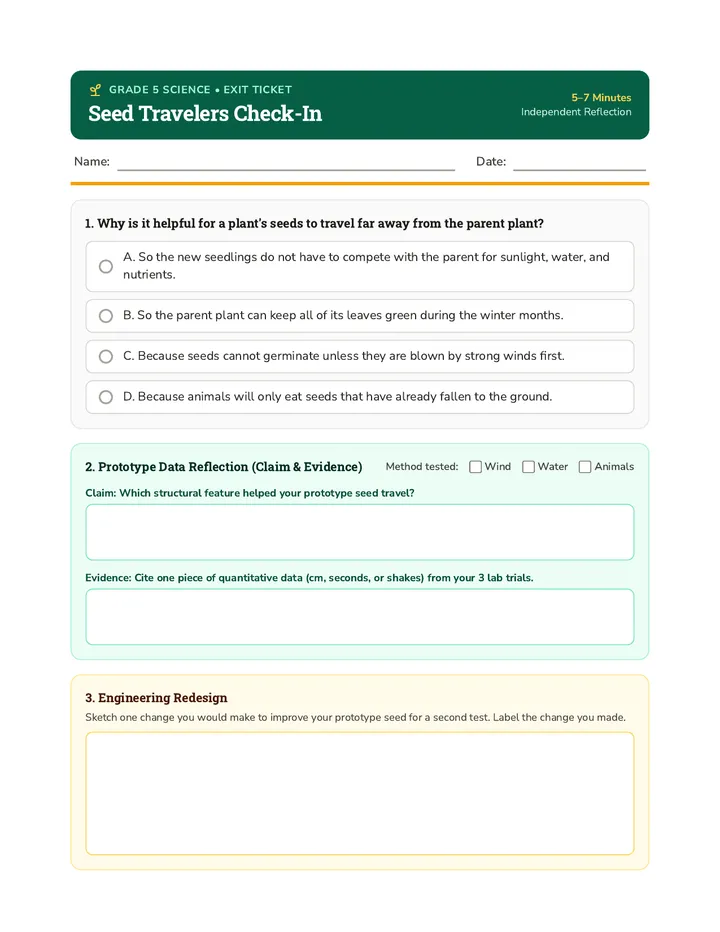
Seed Travelers Exit Ticket
Grade 5 Science • Exit Ticket
Seed Travelers Check-In
5–7 Minutes
Independent Reflection
Name:
Date:
1. Why is it helpful for a plant's seeds to travel far away from the parent plant?
A. So the new seedlings do not have to compete with the parent for sunlight, water, and nutrients.
B. So the parent plant can keep all of its leaves green during the winter months.
C. Because seeds cannot germinate unless they are blown by strong winds first.
D. Because animals will only eat seeds that have already fallen to the ground.
2. Prototype Data Reflection (Claim & Evidence)
Method tested: Wind Water Animals
Claim: Which structural feature helped your prototype seed travel?
Evidence: Cite one piece of quantitative data (cm, seconds, or shakes) from your 3 lab trials.
3. Engineering Redesign
Sketch one change you would make to improve your prototype seed for a second test. Label the change you made.