Mystery Bag Teacher Guide 15-Minute Mini-Lesson Plan • Grades K–2 & 3–5
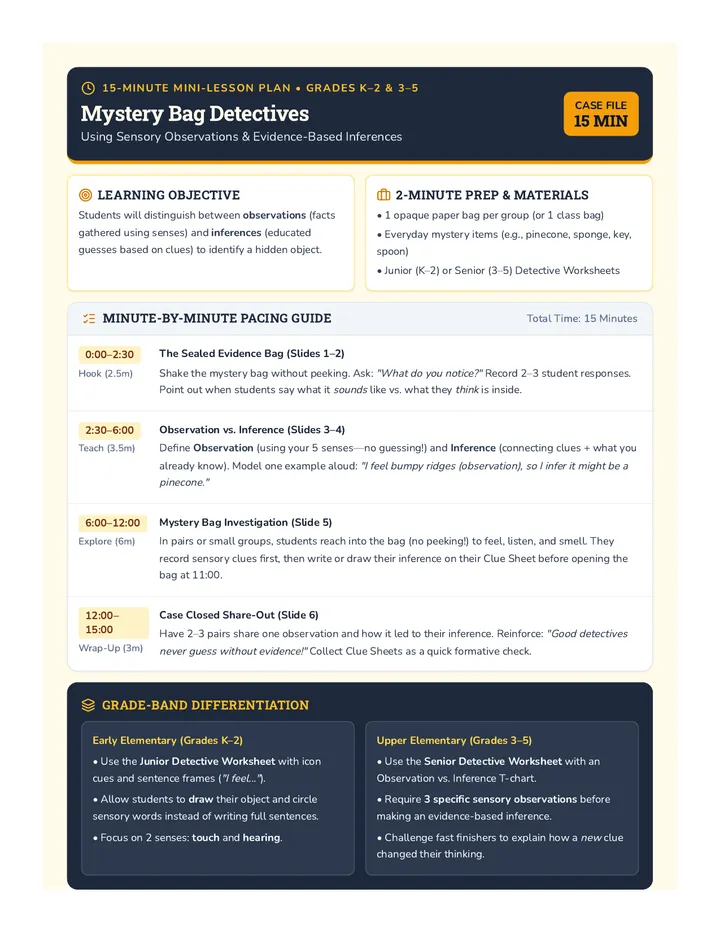
Mystery Bag Detectives
Using Sensory Observations & Evidence-Based Inferences
Case File
15 MIN
Learning Objective
Students will distinguish between observations (facts gathered using senses) and inferences (educated guesses based on clues) to identify a hidden object.
2-Minute Prep & Materials
• 1 opaque paper bag per group (or 1 class bag)
• Everyday mystery items (e.g., pinecone, sponge, key, spoon)
• Junior (K–2) or Senior (3–5) Detective Worksheets
Minute-by-Minute Pacing Guide
Total Time: 15 Minutes
0:00–2:30
Hook (2.5m)
The Sealed Evidence Bag (Slides 1–2)
Shake the mystery bag without peeking. Ask: "What do you notice?" Record 2–3 student responses. Point out when students say what it sounds like vs. what they think is inside.
2:30–6:00
Teach (3.5m)
Observation vs. Inference (Slides 3–4)
Define Observation (using your 5 senses—no guessing!) and Inference (connecting clues + what you already know). Model one example aloud: "I feel bumpy ridges (observation), so I infer it might be a pinecone."
6:00–12:00
Explore (6m)
Mystery Bag Investigation (Slide 5)
In pairs or small groups, students reach into the bag (no peeking!) to feel, listen, and smell. They record sensory clues first, then write or draw their inference on their Clue Sheet before opening the bag at 11:00.
12:00–15:00
Wrap-Up (3m)
Case Closed Share-Out (Slide 6)
Have 2–3 pairs share one observation and how it led to their inference. Reinforce: "Good detectives never guess without evidence!" Collect Clue Sheets as a quick formative check.
Grade-Band Differentiation
Early Elementary (Grades K–2)
• Use the Junior Detective Worksheet with icon cues and sentence frames ("I feel..." ).
• Allow students to draw their object and circle sensory words instead of writing full sentences.
• Focus on 2 senses: touch and hearing .
Upper Elementary (Grades 3–5)
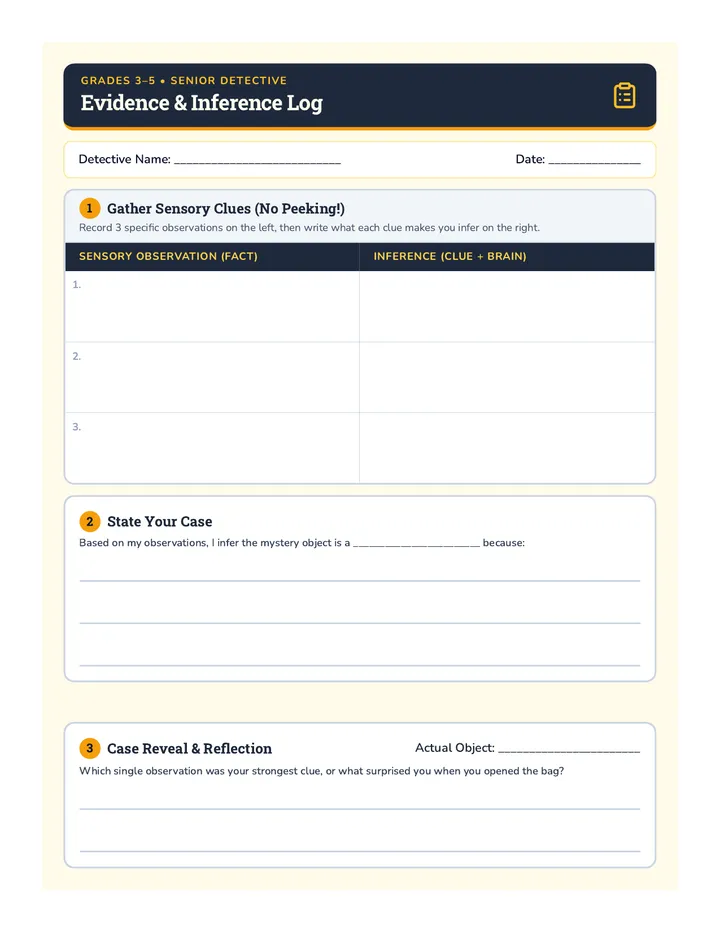
• Use the Senior Detective Worksheet with an Observation vs. Inference T-chart.
• Require 3 specific sensory observations before making an evidence-based inference.
• Challenge fast finishers to explain how a new clue changed their thinking.
Mystery Bag Slides 15-Minute Mini-Lesson
Mystery Bag Detectives
Using Clues & Observations to Solve the Case
Observe with Senses Infer with Evidence
The Sealed Evidence Bag
0:00 – 2:30
Listen Closely!
No peeking inside the bag yet.
Turn & Talk
What do you notice when the bag shakes?
“I hear _______. I think it might be _______.”
Tool #1: Observation
2:30 – 4:30
An observation is a fact you gather using your 5 senses.
Just the clues—no guessing yet!
See
Color, size
Touch
Soft, bumpy
Hear
Rattle, thud
Smell
Sweet, pine
Tool #2: Inference
4:30 – 6:00
An inference is a smart guess based on clues + what you already know.
Observation
“I feel hard, bumpy scales.”
+ Background
“Pinecones have bumpy scales.”
= Inference
“I infer it is a pinecone!”
Your Mission: Mystery Bag
6:00 – 12:00
1
Reach inside without peeking .
2
Record your observations (feel, sound, smell).
3
Write or draw your inference .
4
Wait for the signal to reveal !
Detective Rule #1
Always gather clues first before you make your guess!
Case Closed Share-Out
12:00 – 15:00
Share With the Class
“My observation was ____________, so I inferred ____________.”
Great work, detectives! Evidence + Thinking = Smart Inferences.
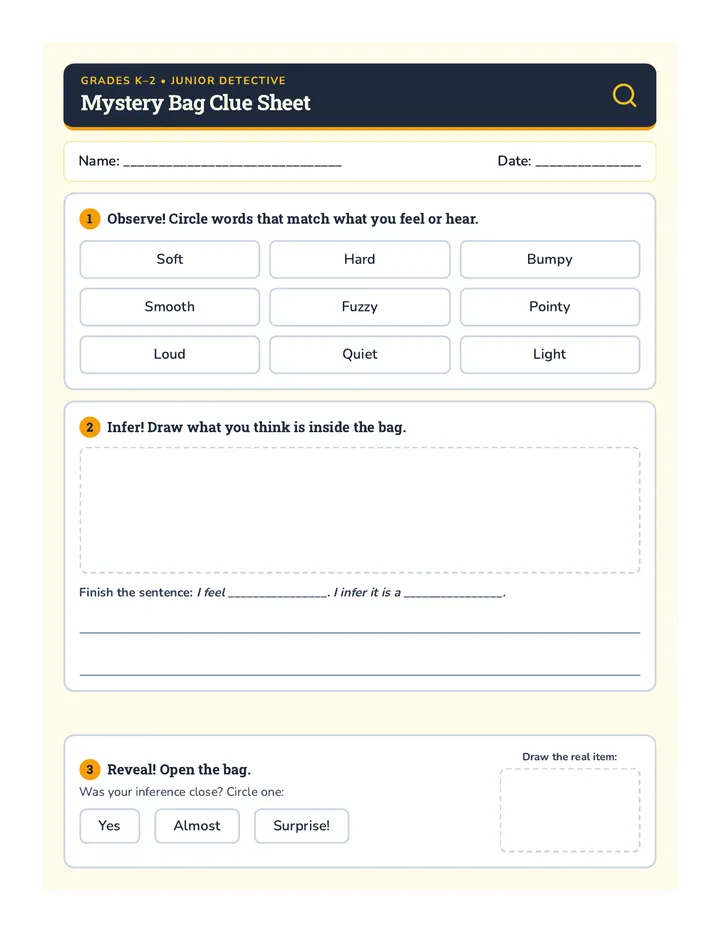
Junior Detective Worksheet Grades K–2 • Junior Detective
Mystery Bag Clue Sheet
Name: _______________________________
Date: _______________
1 Observe! Circle words that match what you feel or hear.
Soft
Hard
Bumpy
Smooth
Fuzzy
Pointy
Loud
Quiet
Light
2 Infer! Draw what you think is inside the bag.
Finish the sentence: I feel ________________. I infer it is a ________________.
3 Reveal! Open the bag.
Was your inference close? Circle one:
Yes
Almost
Surprise!
Draw the real item:
Senior Detective Worksheet Grades 3–5 • Senior Detective
Evidence & Inference Log
Detective Name: ___________________________
Date: _______________
1 Gather Sensory Clues (No Peeking!)
Record 3 specific observations on the left, then write what each clue makes you infer on the right.
Sensory Observation (Fact)
Inference (Clue + Brain)
2 State Your Case
Based on my observations, I infer the mystery object is a ________________________ because:
3 Case Reveal & Reflection
Actual Object: _______________________
Which single observation was your strongest clue, or what surprised you when you opened the bag?