Woodland Wonders Reading Passage Science Reading Grade 2 • Habitats
Name:
Date:
Life in the Forest Habitat
Learn how trees, plants, and animals share a forest home.
What Is a Forest?
A forest is a big area of land with lots of trees. Forests get plenty of rain and have rich soil. Many forests have four seasons: warm summers, cool falls, cold winters, and sunny springs. A forest has three main layers. At the very top, tall treetops make a leafy roof called the canopy . Below the canopy is the shady understory with smaller trees and bushes. At the bottom is the cool forest floor , covered in fallen leaves and soft dirt.
Forest Plants
Many kinds of plants grow in a forest. Tall trees like oaks, maples, and pines reach high up to catch the sunlight. In the shady understory, leafy bushes grow well without bright sun. Down on the forest floor, green ferns and soft moss grow on old logs and rocks. Bright wildflowers bloom in the spring. All of these plants help clean the air and give animals food and safe places to hide.
Forest Animals
Animals live in every layer of the forest! High in the canopy, owls rest in tree holes, woodpeckers tap on bark for bugs, and squirrels leap from branch to branch for acorns. On the forest floor, deer munch on leaves, while foxes and raccoons look for berries. Even tiny earthworms and beetles help the forest. They break down dead leaves to make rich soil for new plants!
Field Notes Life in the Forest Habitat
Name:
Forest Word Bank
Habitat: The natural home where a plant or animal lives.
Canopy: The high, leafy roof made by tall treetops.
Understory: The shady middle layer with smaller trees and bushes.
Forest Floor: The cool ground layer covered in leaves and soil.
Check Your Understanding
1. Which layer is the leafy roof at the very top of the forest?
Understory
Canopy
Forest floor
2. How do earthworms and beetles help the forest?
They break down dead leaves to make rich soil.
They leap from branch to branch looking for acorns.
They block the bright sun from reaching the ground.
3. Name two plants that grow in a forest.
4. Pick one forest animal from the story. Where does it live or what does it eat?
Sprout Forest Graphic Organizer Nonfiction Organizer Grade 1 • Forest Home
Name:
Date:
My Forest Fact Sheet
Draw and write what you learned about the forest!
Topic: What is this text mostly about?
Draw a Forest!
Show trees, plants, and an animal.
One Plant Fact
One Animal Fact
One New Word I Learned Canopy Clues Graphic Organizer Nonfiction Organizer Grade 2 • Habitats
Name:
Date:
Forest Habitat Fact Web
Organize the main idea, layers, and key details from the reading.
Main Idea: What is the whole passage mostly about?
The Three Forest Layers
Canopy (Top)
Understory (Middle)
Forest Floor (Bottom)
How Plants Help
How Animals Help
Key Word & Meaning
One Question I Still Have Little Acorn Reading Passage Science Reading Kindergarten • Forest Home
Name:
Date:
In the Forest
Read about the tall trees and animals in a forest!
The Forest
Look at the forest ! It has lots of tall trees. Leaves and dirt cover the ground.
Forest Plants
Big oak and pine trees reach up high. Green ferns and soft moss grow on logs.
Forest Animals
An owl naps in a tree. A squirrel hops for acorns. A deer eats green leaves.
My Page In the Forest
Name:
Forest Words
🌲
forest
🌿
fern
🦉
owl
Circle the Answer
1. What does a forest have lots of?
Tall trees
Hot sand
2. Who naps in a tree?
An owl
A seal
3. Draw a forest plant or animal:
Acorn Dots Graphic Organizer Nonfiction Organizer Kindergarten • Forest Home
Name:
Date:
My Forest Picture Web
Draw and write one word for what you learned!
This book is about:
A Forest Plant
Write its name:
A Forest Animal
Write its name:
Circle what a forest has:
Lots of tall trees
Ice and snow
Sunny Desert Reading Passage Science Reading Grade 1 • Desert Home
Name:
Date:
Life in the Desert
Read about the dry land, plants, and animals in a desert.
What Is a Desert?
A desert is a big bit of dry land. It gets very little rain. Most deserts are hot in the day and cool at night. The ground has lots of sand , dust , and rocks . Even though it is dry, many plants and animals live here!
Desert Plants
Desert plants do not need much rain. A cactus has thick green stems that hold water inside. Sharp spines keep thirsty animals away. Low shrubs have tiny leaves so they do not dry out in the hot sun. In spring, bright desert blooms open up after a rain.
Desert Animals
Desert animals have smart ways to stay cool! Lizards sit on warm rocks in the morning and hide in shade at noon. Foxes with big ears let heat out of their bodies. Snakes and ants dig holes under the sand. Owls rest inside tall cactus stems and hunt at night.
Field Notes Life in the Desert
Name:
Desert Word Bank
Desert: A dry land that gets very little rain.
Cactus: A desert plant that holds water in its stem.
Spines: Sharp needles on a cactus that keep it safe.
Shade: A cool spot out of the hot sun.
Check Your Reading
1. What is a desert like?
Dry land with very little rain
Wet land with lots of tall trees
Cold land covered in thick ice
2. Where does a cactus hold water?
In its stem
On its spines
Under a rock
3. Name one desert plant and one desert animal from the story.
4. How do some desert animals stay cool in the hot sun?
Desert Dwellers Reading Passage Science Reading Grade 2 • Habitats
Name:
Date:
Life in the Desert Habitat
Discover how plants and animals survive in a dry, sunny home.
What Is a Desert?
A desert is a dry habitat that gets very little rain all year long. Most deserts are very hot during the day, but they cool down quickly at night when the sun sets. Instead of thick soil, the ground is often covered in sand, dust, and rocks . Even though water is hard to find, many special plants and animals call the desert home!
Desert Plants
Desert plants have clever ways to save water. A cactus stores water inside its thick green stem so it can survive dry months. Its sharp spines protect it from thirsty animals. Low desert shrubs grow tiny leaves that do not lose much water in the hot sun. When spring rain finally falls, colorful wildflowers quickly bloom across the sand.
Desert Animals
Desert animals know how to beat the heat! Lizards warm up on sunny rocks in the morning and rest in cool shade at noon. Desert foxes have large ears that help release extra body heat. Snakes and ants dig underground burrows to stay cool. Meanwhile, small owls hide inside tall cactus stems during the day and hunt at night.
Field Notes Life in the Desert Habitat
Name:
Desert Word Bank
Desert: A dry habitat that gets very little rain.
Cactus: A desert plant that stores water in its thick stem.
Spines: Sharp needles that protect a cactus from animals.
Burrow: A hole or tunnel dug underground by an animal.
Check Your Understanding
1. What happens to the desert temperature at night?
It cools down quickly when the sun sets.
It gets much hotter than the daytime.
It rains heavily every single night.
2. How do desert foxes stay cool?
They hide inside tall cactus stems.
Their large ears help release extra body heat.
They drink water stored in desert shrubs.
3. Why do cactuses have sharp spines and thick stems?
4. Pick one desert animal from the passage. How does it survive in the desert?
Cactus Cubs Graphic Organizer Nonfiction Organizer Grade 1 • Desert Home
Name:
Date:
My Desert Fact Sheet
Draw and write what you learned about the desert!
Topic: What is this text mostly about?
Draw a Desert!
Show sand, a cactus, and an animal.
One Plant Fact
One Animal Fact
One New Word I Learned Desert Clues Graphic Organizer Nonfiction Organizer Grade 2 • Habitats
Name:
Date:
Desert Habitat Fact Web
Organize the main idea, weather, and survival details from the reading.
Main Idea: What is the whole passage mostly about?
Desert Weather & Land
Daytime
Nighttime
The Ground
How Plants Save Water
How Animals Stay Cool
Key Word & Meaning
One Question I Still Have Little Sand Reading Passage Science Reading Kindergarten • Desert Home
Name:
Date:
In the Desert
Read about the hot, dry desert!
The Desert
Look at the desert ! It is hot and dry. The ground has sand and rocks .
Desert Plants
A cactus grows in the sand. It is green and has sharp spines . It holds water inside.
Desert Animals
A lizard sits on a warm rock. A fox has big ears. A snake digs in the sand.
My Page In the Desert
Name:
Desert Words
🏜️
desert
🌵
cactus
🦎
lizard
Circle the Answer
1. What is the desert like?
Hot and dry
Cold and wet
2. What grows in the sand?
A cactus
A pine tree
3. Draw a desert plant or animal:
Desert Dots Graphic Organizer Nonfiction Organizer Kindergarten • Desert Home
Name:
Date:
My Desert Picture Web
Draw and write one word for what you learned!
This book is about:
A Desert Plant
Write its name:
A Desert Animal
Write its name:
Circle what the desert is like:
Hot and dry
Cold and wet
Rainforest Canopy Reading Passage Science Reading Grade 2 • Habitats
Name:
Date:
Life in the Rainforest Habitat
Explore a warm, rainy world full of tall trees and bright wildlife.
What Is a Rainforest?
A rainforest is a warm, wet habitat where it rains almost every single day! Because the air is warm and damp all year long, plants grow thick and fast. Just like other forests, a rainforest has three main layers. At the top, giant treetops form a thick, sunny canopy . Below that is the dim, shady understory . At the bottom is the dark, wet forest floor covered in fallen leaves.
Rainforest Plants
More kinds of plants grow in a rainforest than anywhere else on Earth! Giant trees stretch high into the sky to reach the sunlight. Long, woody vines wrap around tree trunks and climb upward. Colorful orchids grow right on tree branches instead of in the dirt. Down on the wet forest floor, wide ferns and leafy shrubs soak up dripping water. These plants give animals food, shelter , and fresh air.
Rainforest Animals
Animals live in every layer of the rainforest! High in the canopy, monkeys swing from branch to branch and bright toucans crack open fruit with their big beaks. In the shady understory, sticky-toed tree frogs cling to wet leaves while jaguars rest on low limbs. On the forest floor, busy ants and beetles break down dead leaves to keep the soil rich for new plants!
Field Notes Life in the Rainforest Habitat
Name:
Rainforest Word Bank
Rainforest: A warm, wet habitat where it rains almost every day.
Canopy: The high, sunny roof made by giant treetops.
Orchid: A colorful rainforest flower that grows on tree branches.
Shelter: A safe place where an animal can hide or rest.
Check Your Understanding
1. What is the weather like in a rainforest?
Warm and wet, with rain almost every day
Dry and sandy, with very little rain
Freezing cold, with snow all year long
2. Which animals live high up in the rainforest canopy?
Ants and beetles
Monkeys and toucans
Foxes and lizards
3. Name two plants that grow in a rainforest.
4. Pick one rainforest animal from the passage. Which layer does it live in and what does it do?
Rainforest Clues Graphic Organizer Nonfiction Organizer Grade 2 • Habitats
Name:
Date:
Rainforest Habitat Fact Web
Organize the main idea, layers, and wildlife details from the reading.
Main Idea: What is the whole passage mostly about?
The Three Rainforest Layers
Canopy (Top)
Understory (Middle)
Forest Floor (Bottom)
Rainforest Plants
Rainforest Animals
Key Word & Meaning
One Question I Still Have Rainy Trees Reading Passage Science Reading Grade 1 • Rainforest Home
Name:
Date:
Life in the Rainforest
Read about the warm, wet trees, plants, and animals.
What Is a Rainforest?
A rainforest is a warm, wet place with lots of trees. It rains almost every day! A rainforest has three parts. Up at the top, tall treetops make a sunny roof. In the middle is the dim shade . Down at the base is the wet ground with fallen leaves.
Rainforest Plants
Many plants grow in a rainforest. Giant trees reach up to get the sun. Long vines climb up tree trunks. Bright flowers grow right on tree limbs. Down on the wet ground, big green ferns soak up drops of rain. These plants give animals food and safe spots to hide.
Rainforest Animals
Lots of animals live in the rainforest! High in the trees, monkeys swing on branches and bright birds eat sweet fruit. In the shade, green tree frogs stick to wet leaves and big cats rest on limbs. Down on the ground, ants and bugs dig in the wet leaves.
Field Notes Life in the Rainforest
Name:
Rainforest Word Bank
Rainforest: A warm, wet place where it rains almost every day.
Vine: A long plant that climbs up tree trunks.
Fern: A green plant with wide leaves on the wet ground.
Shade: A dim spot out of the bright sun.
Check Your Reading
1. What is a rainforest like?
Warm and wet with lots of trees
Dry and sandy with very little rain
Cold and covered in thick snow
2. Where do green tree frogs stick?
To wet leaves
Under sand
On a cactus
3. Name two plants in the rainforest.
4. Pick one rainforest animal from the story. Where does it live?
Rainforest Cubs Graphic Organizer Nonfiction Organizer Grade 1 • Rainforest Home
Name:
Date:
My Rainforest Fact Sheet
Draw and write what you learned about the rainforest!
Topic: What is this text mostly about?
Draw a Rainforest!
Show tall trees, rain, and an animal.
One Plant Fact
One Animal Fact
One New Word I Learned Little Frog Reading Passage Science Reading Kindergarten • Rainforest Home
Name:
Date:
In the Rainforest
Read about the warm, wet rainforest!
The Rainforest
Look at the rainforest ! It is warm and wet. Rain falls on the tall trees.
Rainforest Plants
Big green ferns grow on the wet ground. Long vines climb up the trees. Bright flowers bloom on limbs.
Rainforest Animals
A green frog sits on a wet leaf. A monkey swings in a tree. A bird eats sweet fruit.
My Page In the Rainforest
Name:
Rainforest Words
🌧️
rainforest
🌿
fern
🐸
frog
Circle the Answer
1. What is the rainforest like?
Warm and wet
Hot and dry
2. What sits on a wet leaf?
A frog
A fox
3. Draw a rainforest plant or animal:
Raindrop Dots Graphic Organizer Nonfiction Organizer Kindergarten • Rainforest Home
Name:
Date:
My Rainforest Picture Web
Draw and write one word for what you learned!
This book is about:
A Rainforest Plant
Write its name:
A Rainforest Animal
Write its name:
Circle what the rainforest is like:
Warm and wet
Hot and dry
Little Bear Reading Passage Science Reading Kindergarten • Arctic Tundra
Name:
Date:
In the Arctic Tundra
Read about the cold, snowy tundra!
The Arctic Tundra
Look at the tundra ! It is cold and windy. Snow and ice cover the ground.
Tundra Plants
No tall trees grow here. Short moss and grass hug the rocks. Tiny flowers bloom in the summer.
Tundra Animals
A white polar bear has thick fur. A fox turns white in the snow. A seal swims in icy water.
My Page In the Arctic Tundra
Name:
Tundra Words
❄️
tundra
🌿
moss
🐻❄️
polar bear
Circle the Answer
1. What is the Arctic tundra like?
Cold and windy
Hot and sandy
2. What keeps a polar bear warm?
Thick fur
Sharp spines
3. Draw a tundra plant or animal:
Snow Dots Graphic Organizer Nonfiction Organizer Kindergarten • Arctic Tundra
Name:
Date:
My Tundra Picture Web
Draw and write one word for what you learned!
This book is about:
A Tundra Plant
Write its name:
A Tundra Animal
Write its name:
Circle what the tundra is like:
Cold and windy
Hot and sandy
Icy Tundra Reading Passage Science Reading Grade 1 • Arctic Tundra
Name:
Date:
Life in the Arctic Tundra
Read about the cold, snowy land, plants, and animals.
What Is the Arctic Tundra?
The Arctic tundra is a very cold, windy place near the top of the Earth. Snow and ice cover the land for most of the year. Under the soil, the ground stays frozen ! In the short summer, the top layer melts and makes little ponds.
Tundra Plants
Tall trees cannot grow in the frozen ground. Instead, low moss , grass , and tiny shrubs hug the rocks to stay out of the wind. In the summer, bright little wildflowers bloom fast before the snow comes back.
Tundra Animals
Animals in the tundra have smart ways to stay warm! Polar bears have thick white fur and fat under their skin. Arctic foxes grow white coats to hide in the snow. Caribou dig through snow for moss, and snowy owls hunt over the white land.
Field Notes Life in the Arctic Tundra
Name:
Tundra Word Bank
Tundra: A very cold, windy place with no tall trees.
Frozen: Turned hard as ice from the cold.
Moss: A short, soft green plant that hugs rocks.
Fur: Thick hair that keeps animals warm.
Check Your Reading
1. Why cannot tall trees grow in the tundra?
The ground underneath stays frozen
It is too hot and sandy
Monkeys eat all the leaves
2. How do Arctic foxes hide in the snow?
Grow white coats
Climb tall trees
Dig in hot sand
3. Name two plants that grow in the tundra.
4. Pick one tundra animal from the story. How does it stay warm or find food?
Tundra Cubs Graphic Organizer Nonfiction Organizer Grade 1 • Arctic Tundra
Name:
Date:
My Tundra Fact Sheet
Draw and write what you learned about the Arctic tundra!
Topic: What is this text mostly about?
Draw the Arctic Tundra!
Show snow, low plants, and an animal.
One Plant Fact
One Animal Fact
One New Word I Learned Arctic Tundra Reading Passage Science Reading Grade 2 • Habitats
Name:
Date:
Life in the Arctic Tundra
Discover how hardy plants and animals survive in a frozen habitat.
What Is the Arctic Tundra?
The Arctic tundra is a cold, treeless habitat near the North Pole. Winters are long, dark, and freezing, with strong icy winds. Deep under the surface, a layer of soil called permafrost stays frozen all year long. During the short, cool summer, the top of the ground thaws and forms shallow ponds.
Tundra Plants
Because the soil underneath stays frozen, deep tree roots cannot grow in the tundra. Instead, hardy plants like moss , lichen , and low shrubs grow close to the ground to avoid the freezing wind. Their dark leaves soak up sunlight, and tiny wildflowers bloom quickly during the brief summer.
Tundra Animals
Tundra animals have amazing ways to survive the cold! Polar bears stay warm with thick fur and a layer of fat called blubber . Arctic foxes grow white winter fur that blends into the snow for camouflage . Caribou travel in herds and dig through snow for moss, while snowy owls glide silently across the open ice.
Field Notes Life in the Arctic Tundra
Name:
Tundra Word Bank
Tundra: A cold, treeless habitat near the North Pole.
Permafrost: A layer of tundra soil that stays frozen all year.
Blubber: A thick layer of fat that keeps animals warm.
Camouflage: Colors or fur that help an animal blend in.
Check Your Understanding
1. What is permafrost?
A layer of soil under the ground that stays frozen all year
A tall tree that grows in the Arctic summer
A warm pond where polar bears take naps
2. How do tundra plants avoid the freezing wind?
Grow close to ground
Grow very tall trunks
Climb up tall trees
3. Why does an Arctic fox grow white fur in the winter?
4. Pick one tundra animal from the passage. How does it survive the cold?
Tundra Clues Graphic Organizer Nonfiction Organizer Grade 2 • Habitats
Name:
Date:
Tundra Habitat Fact Web
Organize the main idea, weather, and survival details from the reading.
Main Idea: What is the whole passage mostly about?
Tundra Weather & Land
Winter
Summer
The Ground
How Plants Survive
How Animals Stay Warm
Key Word & Meaning
One Question I Still Have Little Fish Reading Passage Science Reading Kindergarten • Ocean Home
Name:
Date:
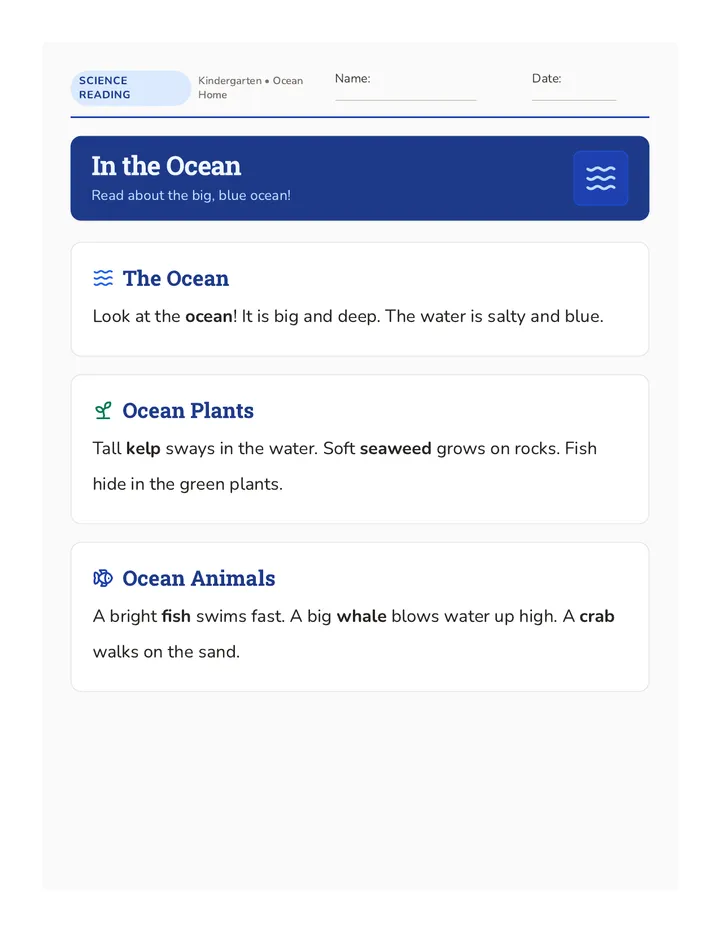
In the Ocean
Read about the big, blue ocean!
The Ocean
Look at the ocean ! It is big and deep. The water is salty and blue.
Ocean Plants
Tall kelp sways in the water. Soft seaweed grows on rocks. Fish hide in the green plants.
Ocean Animals
A bright fish swims fast. A big whale blows water up high. A crab walks on the sand.
My Page In the Ocean
Name:
Ocean Words
🌊
ocean
🌿
kelp
🐋
whale
Circle the Answer
1. What is ocean water like?
Salty and blue
Hot and dry
2. What walks on the sand?
A crab
An owl
3. Draw an ocean plant or animal:
Wave Dots Graphic Organizer Nonfiction Organizer Kindergarten • Ocean Home
Name:
Date:
My Ocean Picture Web
Draw and write one word for what you learned!
This book is about:
An Ocean Plant
Write its name:
An Ocean Animal
Write its name:
Circle what the ocean is like:
Salty and blue
Dry and sandy
Sunny Ocean Reading Passage Science Reading Grade 1 • Ocean Home
Name:
Date:
Life in the Ocean
Read about the salty water, plants, and animals in the sea.
What Is the Ocean?
The ocean is a huge body of salt water that covers most of the Earth. Near the top, the water is warm and bright from the sun. Deep down at the bottom, the water is dark and cold! Waves roll across the top of the sea every day.
Ocean Plants
Many green plants grow in the sunlit water near the top. Tall kelp grows up toward the sun like underwater trees. Soft seaweed and seagrass sway in the waves. These plants give sea animals food to eat and safe spots to hide.
Ocean Animals
Animals of all sizes live in the ocean! Bright fish and sea turtles swim through the kelp. Giant whales and playful dolphins come up to the top to breathe air. Down on the sandy floor, crabs and sea stars crawl along the rocks.
Field Notes Life in the Ocean
Name:
Ocean Word Bank
Ocean: A huge body of salt water on Earth.
Kelp: Tall ocean plants that grow like underwater trees.
Seaweed: Soft green plants that sway in ocean waves.
Whale: A giant ocean animal that breathes air.
Check Your Reading
1. What is the water like deep at the bottom of the ocean?
Dark and cold
Warm and bright
Dry and sandy
2. Why do whales and dolphins come up to the top?
To breathe air
To dig in sand
To sleep on rocks
3. Name two plants that grow in the ocean.
4. Pick one ocean animal from the story. Where does it live?
Ocean Cubs Graphic Organizer Nonfiction Organizer Grade 1 • Ocean Home
Name:
Date:
My Ocean Fact Sheet
Draw and write what you learned about the ocean!
Topic: What is this text mostly about?
Draw the Ocean!
Show kelp, waves, and a sea animal.
One Plant Fact
One Animal Fact
One New Word I Learned Ocean Depths Reading Passage Science Reading Grade 2 • Habitats
Name:
Date:
Life in the Ocean Habitat
Explore Earth's largest saltwater home, from sunlit waves to deep water.
What Is the Ocean?
The ocean is Earth's largest habitat, made of salty water that covers most of our planet. Scientists divide the ocean into zones by depth. Near the surface is the warm, bright sunlit zone . Farther down is the dim twilight zone, and at the very bottom is the freezing, pitch-dark deep ocean .
Ocean Plants
Ocean plants need sunlight to grow, so most of them live in shallow water. Giant kelp grows in tall underwater forests, stretching toward the surface. Flowing seagrass beds and colorful seaweed cling to rocks along the coast. Tiny floating plants called algae also make much of the oxygen we breathe!
Ocean Animals
Amazing creatures live in every ocean zone! Colorful fish and sea turtles swim through coral reefs and kelp forests. Whales and dolphins breathe air at the surface and dive deep for food. On the sandy ocean floor, crabs and octopuses hide among rocks, while deep-sea fish glow in the dark.
Field Notes Life in the Ocean Habitat
Name:
Ocean Word Bank
Ocean: Earth's largest habitat, filled with salty water.
Sunlit Zone: The warm, bright top layer of the ocean.
Kelp: Giant ocean plants that grow in underwater forests.
Algae: Tiny floating ocean plants that help make oxygen.
Check Your Understanding
1. Why do most ocean plants grow in shallow water?
They need sunlight to grow
They need freezing, pitch-dark water
Whales plant them near the sand
2. How do tiny algae help people and animals on land?
They make oxygen
They glow in dark
They hide crabs
3. Compare the sunlit zone to the deep ocean. How are they different?
4. Pick one ocean animal from the passage. Where does it live or what does it do?
Ocean Clues Graphic Organizer Nonfiction Organizer Grade 2 • Habitats
Name:
Date:
Ocean Habitat Fact Web
Organize the main idea, ocean zones, and sea life details from the reading.
Main Idea: What is the whole passage mostly about?
Ocean Zones
Sunlit Zone (Top)
Twilight Zone (Middle)
Deep Ocean (Bottom)
Ocean Plants
Ocean Animals
Key Word & Meaning
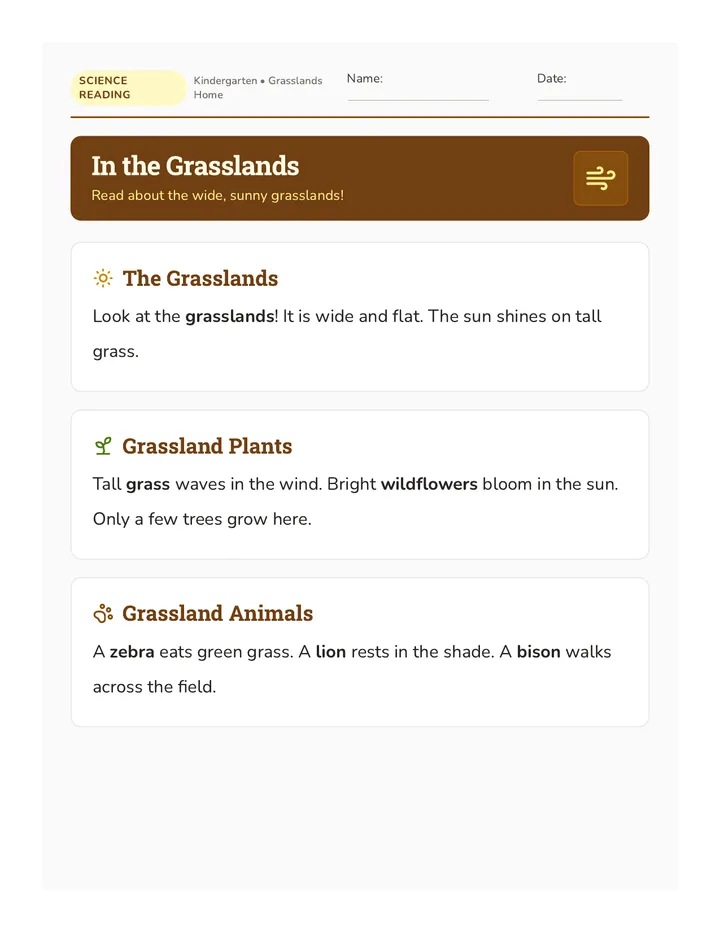
One Question I Still Have Little Lion Reading Passage Science Reading Kindergarten • Grasslands Home
Name:
Date:
In the Grasslands
Read about the wide, sunny grasslands!
The Grasslands
Look at the grasslands ! It is wide and flat. The sun shines on tall grass.
Grassland Plants
Tall grass waves in the wind. Bright wildflowers bloom in the sun. Only a few trees grow here.
Grassland Animals
A zebra eats green grass. A lion rests in the shade. A bison walks across the field.
My Page In the Grasslands
Name:
Grassland Words
🌾
grass
🦓
zebra
🦁
lion
Circle the Answer
1. What are the grasslands like?
Wide and flat
Deep and salty
2. What eats green grass?
A zebra
A whale
3. Draw a grassland plant or animal:
Grass Dots Graphic Organizer Nonfiction Organizer Kindergarten • Grasslands Home
Name:
Date:
My Grassland Picture Web
Draw and write one word for what you learned!
This book is about:
A Grassland Plant
Write its name:
A Grassland Animal
Write its name:
Circle what the grasslands have:
Wide fields of grass
Deep salty water
Sunny Grasslands Reading Passage Science Reading Grade 1 • Grasslands Home
Name:
Date:
Life in the Grasslands
Read about the wide, sunny fields, plants, and animals.
What Are Grasslands?
Grasslands are wide, flat lands covered in tall grass. They get more rain than a desert, but less rain than a forest! The wind blows across the open plains , and the sun shines bright.
Grassland Plants
Tall grasses grow thick and strong here. They have deep roots that hold onto the rich soil and find water underground. Bright wildflowers bloom in the spring and summer. Only a few scattered trees grow in the grasslands.
Grassland Animals
Many fast and grazing animals live in the grasslands! Zebras and bison travel in big groups called herds to munch on grass. Lions and cheetahs hide in the tall grass to hunt. Small prairie dogs dig underground tunnels to stay safe!
Field Notes Life in the Grasslands
Name:
Grassland Word Bank
Grasslands: Wide, flat lands covered mostly in grass.
Plains: Large areas of flat, open land.
Roots: Plant parts underground that take in water.
Herd: A big group of animals that stay together.
Check Your Reading
1. How do deep roots help grassland plants?
They hold onto soil and find water underground
They climb up tall trees to catch sun
They swim in salty ocean waves
2. How do prairie dogs stay safe?
Dig tunnels
Climb tall oaks
Swim in kelp
3. Name two animals that live in the grasslands.
4. How is a grassland different from a forest?
Grass Cubs Graphic Organizer Nonfiction Organizer Grade 1 • Grasslands Home
Name:
Date:
My Grassland Fact Sheet
Draw and write what you learned about the grasslands!
Topic: What is this text mostly about?
Draw the Grasslands!
Show tall grass, wildflowers, and an animal.
One Plant Fact
One Animal Fact
One New Word I Learned Golden Grasslands Reading Passage Science Reading Grade 2 • Habitats
Name:
Date:
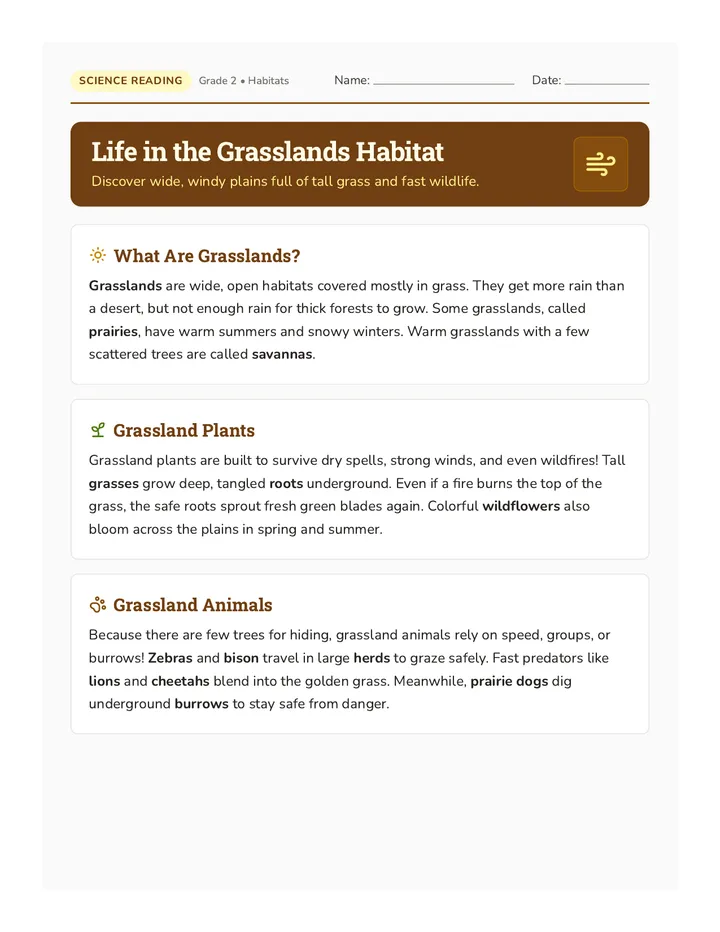
Life in the Grasslands Habitat
Discover wide, windy plains full of tall grass and fast wildlife.
What Are Grasslands?
Grasslands are wide, open habitats covered mostly in grass. They get more rain than a desert, but not enough rain for thick forests to grow. Some grasslands, called prairies , have warm summers and snowy winters. Warm grasslands with a few scattered trees are called savannas .
Grassland Plants
Grassland plants are built to survive dry spells, strong winds, and even wildfires! Tall grasses grow deep, tangled roots underground. Even if a fire burns the top of the grass, the safe roots sprout fresh green blades again. Colorful wildflowers also bloom across the plains in spring and summer.
Grassland Animals
Because there are few trees for hiding, grassland animals rely on speed, groups, or burrows! Zebras and bison travel in large herds to graze safely. Fast predators like lions and cheetahs blend into the golden grass. Meanwhile, prairie dogs dig underground burrows to stay safe from danger.
Field Notes Life in the Grasslands Habitat
Name:
Grassland Word Bank
Grasslands: Wide, open habitats covered mostly in grass.
Prairie: A grassland with warm summers and snowy winters.
Savanna: A warm grassland with a few scattered trees.
Herd: A large group of animals that travel together.
Check Your Understanding
1. Why do thick forests not grow in grasslands?
Grasslands do not get enough rain for thick forests
The ground is covered in permafrost all year
The soil is too salty for any plants to grow
2. What helps grass grow back after a wildfire?
Deep, safe roots
Sharp cactus spines
Tall shady canopies
3. How is a prairie different from a savanna?
4. Pick one grassland animal from the passage. How does it stay safe or find food?
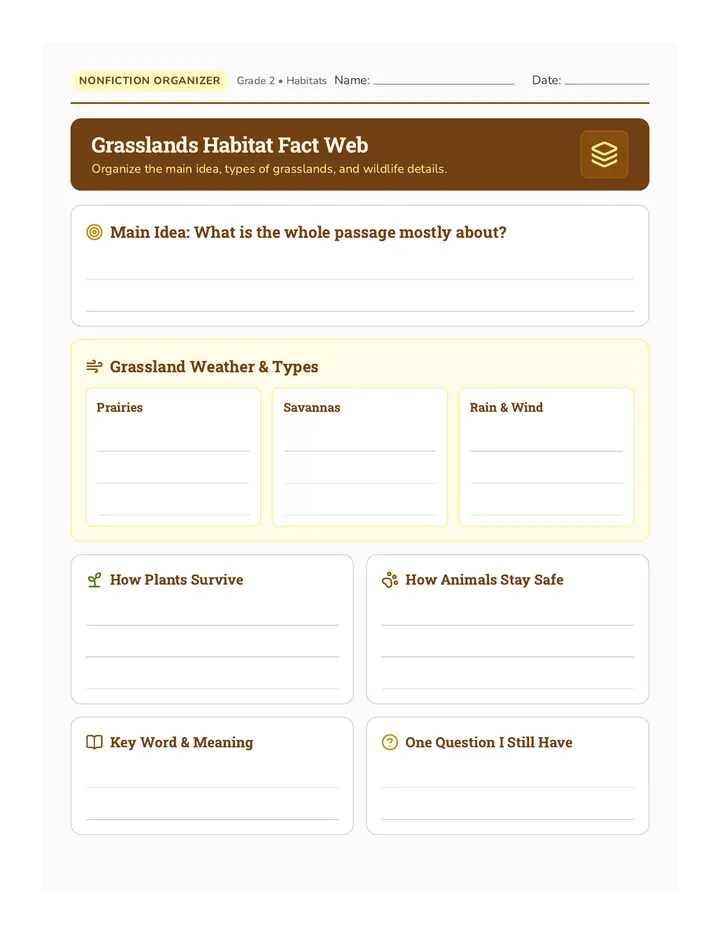
Grass Clues Graphic Organizer Nonfiction Organizer Grade 2 • Habitats
Name:
Date:
Grasslands Habitat Fact Web
Organize the main idea, types of grasslands, and wildlife details.
Main Idea: What is the whole passage mostly about?
Grassland Weather & Types
Prairies
Savannas
Rain & Wind
How Plants Survive
How Animals Stay Safe
Key Word & Meaning
One Question I Still Have