Lost in Space Slides
Science & Literacy Lesson
The Magic School Bus
Lost in Space! 🚌🪐
Exploring plot, characters, and vocabulary alongside the wonders of our Solar System.
Plot & Characters
Planet Science
Class Discussions
Before We Blast Off
Science Warm-Up
- • What planets are in our Solar System?
- • What do astronauts need to survive in space?
Story Prediction
- • Look at the title: Lost in the Solar System.
- • What problem might Ms. Frizzle’s class face?
Turn & Talk: Share one prediction with a partner!
Meet the Space Crew
Reading Skill: Character Traits
👩🏫
Ms. Frizzle
Curious, fearless, and loves hands-on adventures—even in outer space!
😰
Arnold
Cautious and worried. He always wishes he had stayed home today.
🤓
Janet
Arnold’s cousin. She boasts about knowing everything—until space surprises her!
Discuss: How do Arnold and Janet react differently when the bus leaves Earth?
Space Word Bank
Key Vocabulary
☀️ Solar System
The Sun and all the planets, moons, and space rocks that travel around it.
🔄 Orbit
The curved path a planet or moon takes as it travels around another object.
🧲 Gravity
An invisible force that pulls objects together and keeps planets in orbit.
🌫️ Atmosphere
The blanket of gases surrounding a planet, like the air we breathe on Earth.
Plot Twist: Lost in Space!
Reading Skill: Plot
1. Beginning
The planetarium is closed! Ms. Frizzle turns the school bus into a rocket ship instead.
2. Middle
The class visits the Moon, Mercury, Venus, and Mars—then enters the Asteroid Belt.
3. Big Problem
An asteroid snaps the tether line! Ms. Frizzle floats away, and the kids must find her.
Comprehension Check: Why did the kids have to use Ms. Frizzle’s lesson notes to survive?
The Inner Rocky Planets
Science + Story
🪨 Mercury
Closest to the Sun! Boiling hot by day, freezing cold by night, and covered in craters.
☁️ Venus
Hottest planet! Thick, heavy clouds trap heat like a blanket. Even hotter than Mercury!
🌍 Earth
Our home! Just the right temperature, liquid water, and breathable air.
🔴 Mars
The Red Planet! Dusty, cold, and full of giant volcanoes and deep canyons.
The Outer Giant Planets
Science + Story
🌀 Jupiter
Largest planet! A giant ball of gas with a famous storm called the Great Red Spot.
🪐 Saturn
Famous for its dazzling rings made of ice, dust, and rock chunks.
❄️ Uranus
An ice giant that spins on its side! Blue-green color from methane gas.
💨 Neptune
Deep blue, freezing cold, and blasted by the strongest winds in the Solar System.
Fun Fact: In the book, the class also visits Pluto—today scientists classify Pluto as a dwarf planet!
Why Is Earth “Just Right”?
Gravity Changes! 🦘
On the Moon, gravity is weaker—so the kids bounced super high! On huge Jupiter, gravity would pull you down hard.
Safe Atmosphere 🌬️
Without special spacesuits, humans cannot breathe on other planets. Earth’s air and distance from the Sun protect life.
Discuss: Which planet would be hardest to land on, and why?
Teamwork & Safe Return
Reading Skill: Resolution
🧭
Following the Clues
The students used their science knowledge and teamwork to steer the bus past every outer planet.
🚌
Finding Ms. Frizzle
They spotted Ms. Frizzle orbiting safely and zoomed back home to Walkerville Elementary!
Theme Question: What did Janet and Arnold learn by the end of the trip?
Activity: Postcard from Space
Write & Draw
Imagine you are on the Magic School Bus! Choose one planet and write a postcard home:
1. Planet Name
Draw a picture of what the planet looks like.
2. Science Facts
Include 2 real facts (weather, rings, or gravity).
3. Story Voice
Describe how your character felt on the trip!
“Take chances, make mistakes, and get messy!” — Ms. Frizzle 🚀 Great Job, Explorers!
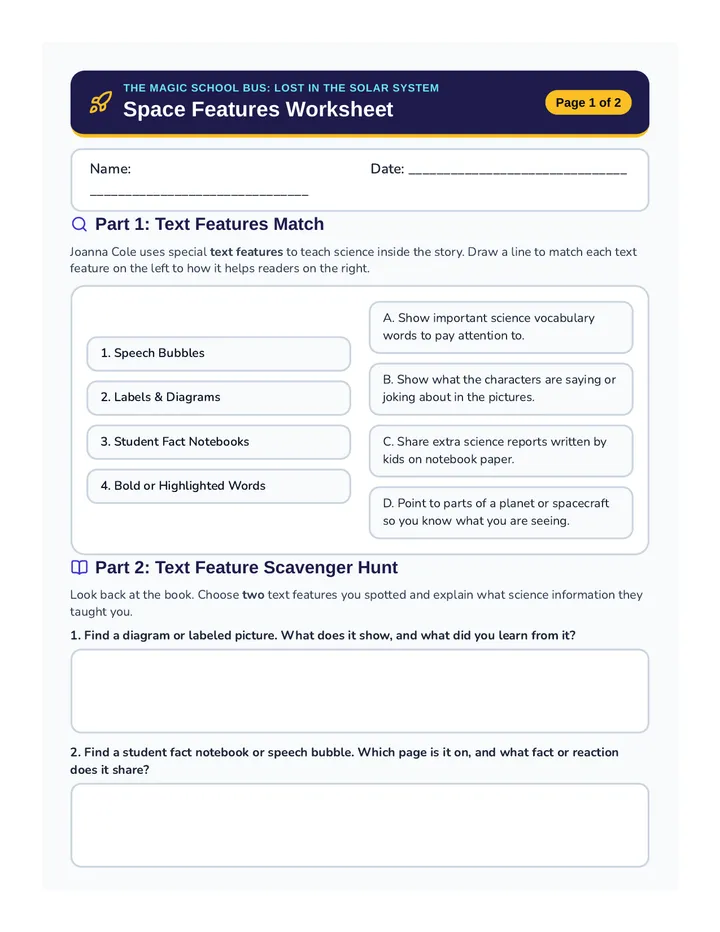
Space Features Worksheet
The Magic School Bus: Lost in the Solar System
Space Features Worksheet
Page 1 of 2
Name: _______________________________
Date: _______________________________
Part 1: Text Features Match
Joanna Cole uses special text features to teach science inside the story. Draw a line to match each text feature on the left to how it helps readers on the right.
1. Speech Bubbles
2. Labels & Diagrams
3. Student Fact Notebooks
4. Bold or Highlighted Words
A. Show important science vocabulary words to pay attention to.
B. Show what the characters are saying or joking about in the pictures.
C. Share extra science reports written by kids on notebook paper.
D. Point to parts of a planet or spacecraft so you know what you are seeing.
Part 2: Text Feature Scavenger Hunt
Look back at the book. Choose two text features you spotted and explain what science information they taught you.
1. Find a diagram or labeled picture. What does it show, and what did you learn from it?
2. Find a student fact notebook or speech bubble. Which page is it on, and what fact or reaction does it share?
Compare & Contrast Mission
Page 2 of 2
Part 3: Compare & Contrast Two Planets
Pick two planets Ms. Frizzle’s class visited (for example: Venus and Mars, or Earth and Saturn). Write their names below, then list how they are different and how they are alike.
Planet 1 Only
________________
Both Planets (Alike)
Same / Similar
Planet 2 Only
________________
Part 4: Compare & Contrast Characters
Think about Arnold and Janet (or Ms. Frizzle and Arnold). Write 2–3 sentences explaining one way they are alike and one way they are different during the trip.
Characters I am comparing: ________________________________________
Signal Words to Try: both, alike, similar, however, unlike, on the other hand