Sun Powered Lesson Plan
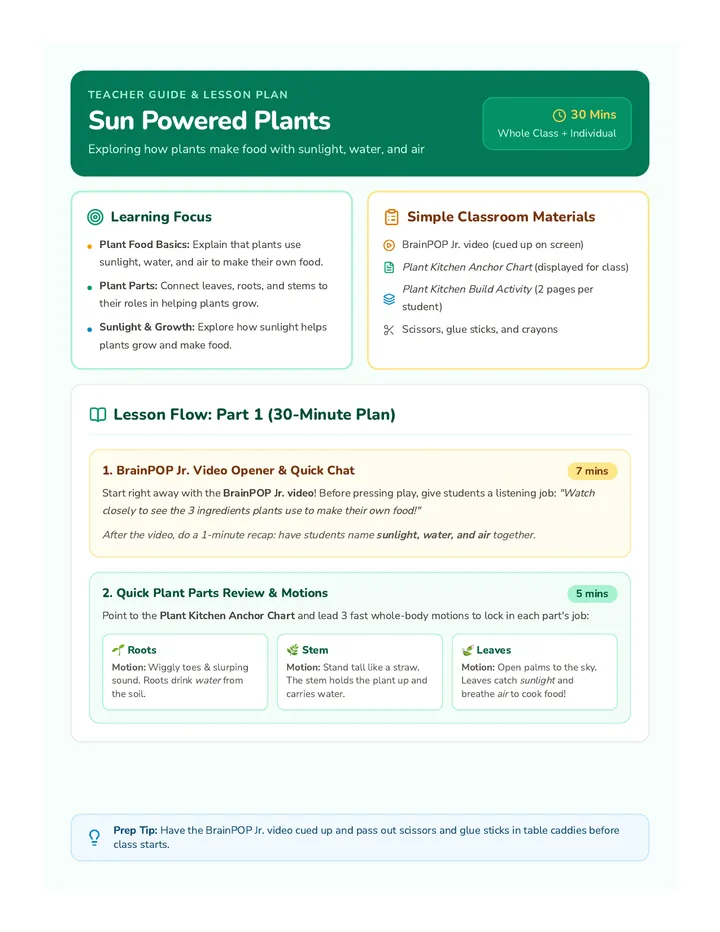
Teacher Guide & Lesson Plan
Sun Powered Plants
Exploring how plants make food with sunlight, water, and air
30 Mins
Whole Class + Individual
Learning Focus
- ● Plant Food Basics: Explain that plants use sunlight, water, and air to make their own food.
- ● Plant Parts: Connect leaves, roots, and stems to their roles in helping plants grow.
- ● Sunlight & Growth: Explore how sunlight helps plants grow and make food.
Simple Classroom Materials
- BrainPOP Jr. video (cued up on screen)
- Plant Kitchen Anchor Chart (displayed for class)
- Plant Kitchen Build Activity (2 pages per student)
- Scissors, glue sticks, and crayons
Lesson Flow: Part 1 (30-Minute Plan)
1. BrainPOP Jr. Video Opener & Quick Chat
7 mins
Start right away with the BrainPOP Jr. video! Before pressing play, give students a listening job: "Watch closely to see the 3 ingredients plants use to make their own food!"
After the video, do a 1-minute recap: have students name sunlight, water, and air together.
2. Quick Plant Parts Review & Motions
5 mins
Point to the Plant Kitchen Anchor Chart and lead 3 fast whole-body motions to lock in each part's job:
🌱 Roots
Motion: Wiggly toes & slurping sound. Roots drink water from the soil.
🌿 Stem
Motion: Stand tall like a straw. The stem holds the plant up and carries water.
🍃 Leaves
Motion: Open palms to the sky. Leaves catch sunlight and breathe air to cook food!
Prep Tip: Have the BrainPOP Jr. video cued up and pass out scissors and glue sticks in table caddies before class starts.
Lesson Flow: Part 2
3. Guided Hands-On Activity: Plant Kitchen Build
15 mins
- Hand out the Plant Kitchen Build Activity sheets (2 pages) along with scissors, glue, and crayons.
- Have students quickly color and cut out the 6 large pieces on Page 2 (Leaves, Stem, Roots, Sunlight, Water, Air).
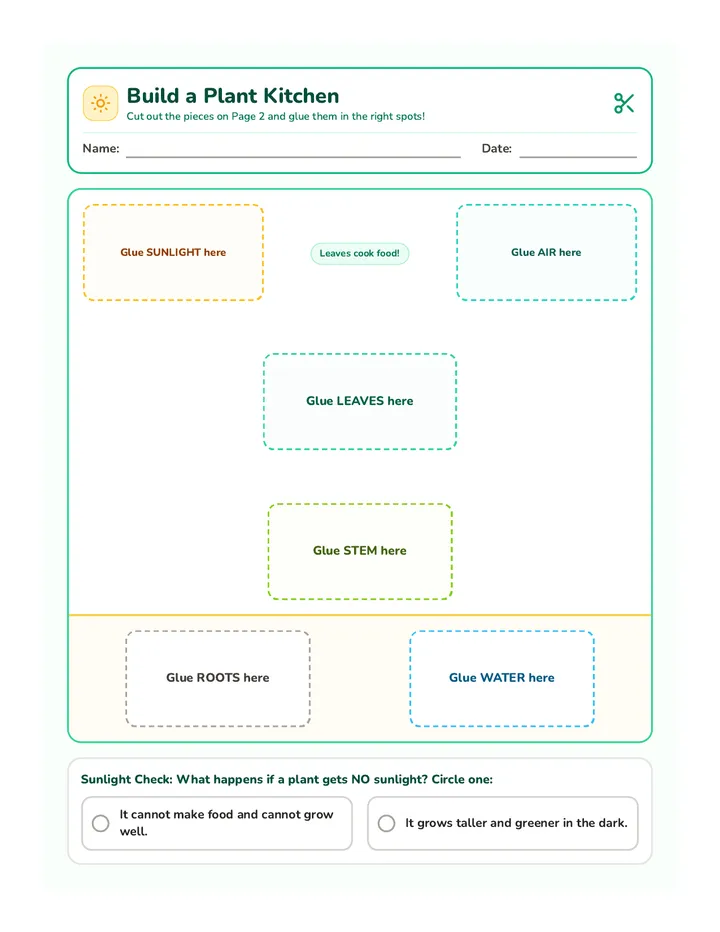
- Guide students to glue the plant parts onto the Page 1 mat from the ground up: Roots in the soil, Stem in the middle, and Leaves at the top.
- Next, glue Sunlight and Air at the top near the leaves, and Water in the soil next to the roots.
- Have students complete the Sunlight Check at the bottom of Page 1.
4. Quick Wrap-Up & Share
3 mins
Have students hold up their finished Plant Kitchen models! Ask: "Point to the part that cooks the food! What 3 things does it need?"
Scaffolds & Supports
- • Pre-cut the 6 pieces for students who need fine-motor support.
- • Read the glue-box labels aloud one at a time while students place each piece before gluing.
- • Point to the matching icons on the Anchor Chart.
Extension Idea
Early finishers can draw arrows with a green crayon showing water traveling up from the roots through the stem to the leaves, and draw a happy plant eating its food!
Activity Sheet Answer Key
Plant Kitchen Build Mat
- • Top: Sunlight (left), Air (right), Leaves (center)
- • Middle: Stem
- • Soil (Bottom): Roots (left), Water (right)
Sunlight Check
Correct choice: "It cannot make food and cannot grow well."
Sun Powered Plants • Teacher Guide
Plant Kitchen Build Activity
Build a Plant Kitchen
Cut out the pieces on Page 2 and glue them in the right spots!
Name:
Date:
Glue SUNLIGHT here
Leaves cook food!
Glue AIR here
Glue LEAVES here
Glue STEM here
Glue ROOTS here
Glue WATER here
Sunlight Check: What happens if a plant gets NO sunlight? Circle one:
It cannot make food and cannot grow well.
It grows taller and greener in the dark.
Cut-Out Pieces
Color the pictures, then cut along the dotted lines!
Leaves Catch sunlight & air to cook food
Stem Holds plant up & carries water
Roots Drink water from the soil
Sunlight Gives energy to make food
Water Pulled up from the soil
Air Breathed in by the leaves
Tip: Cut around the dotted boxes—each piece will fit right inside its matching spot on Page 1!
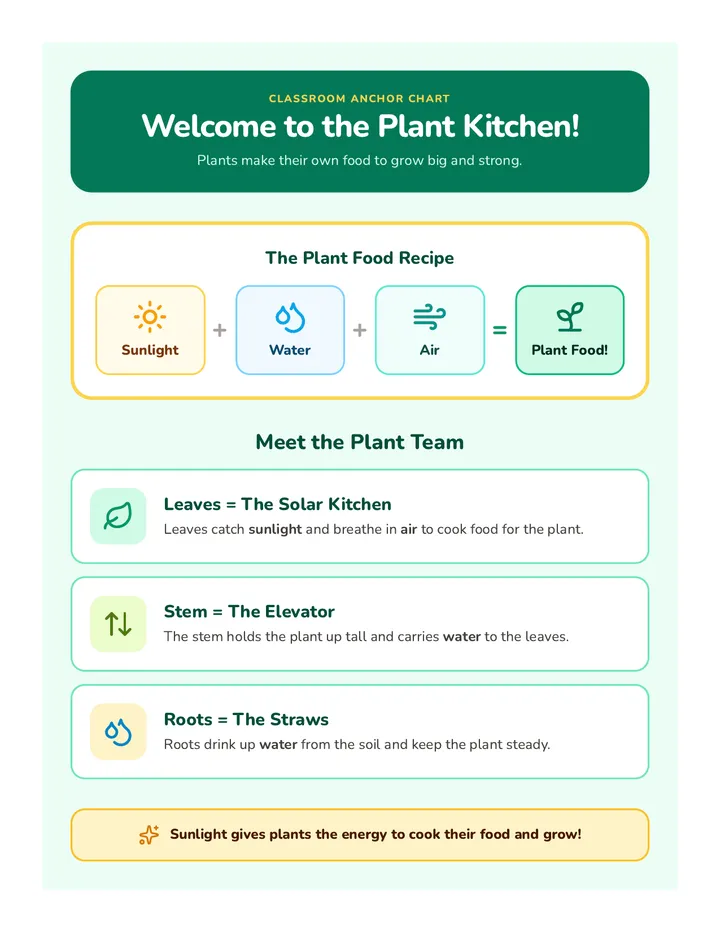
Plant Kitchen Anchor Chart
Classroom Anchor Chart
Welcome to the Plant Kitchen!
Plants make their own food to grow big and strong.
The Plant Food Recipe
Sunlight
Water
Air
=
Plant Food!
Meet the Plant Team
Leaves = The Solar Kitchen
Leaves catch sunlight and breathe in air to cook food for the plant.
Stem = The Elevator
The stem holds the plant up tall and carries water to the leaves.
Roots = The Straws
Roots drink up water from the soil and keep the plant steady.
Sunlight gives plants the energy to cook their food and grow!