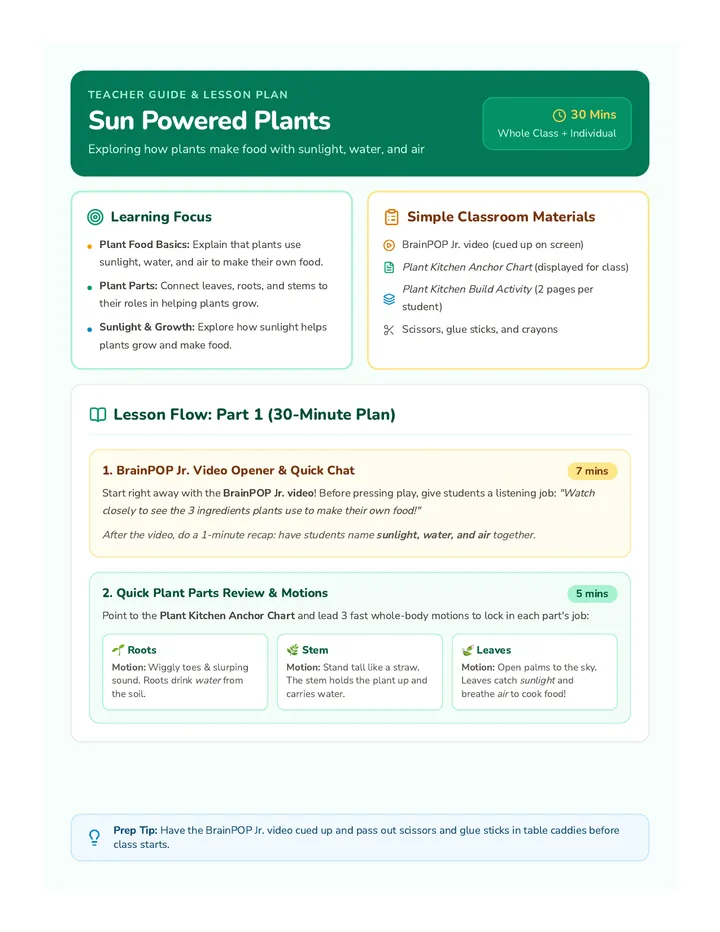
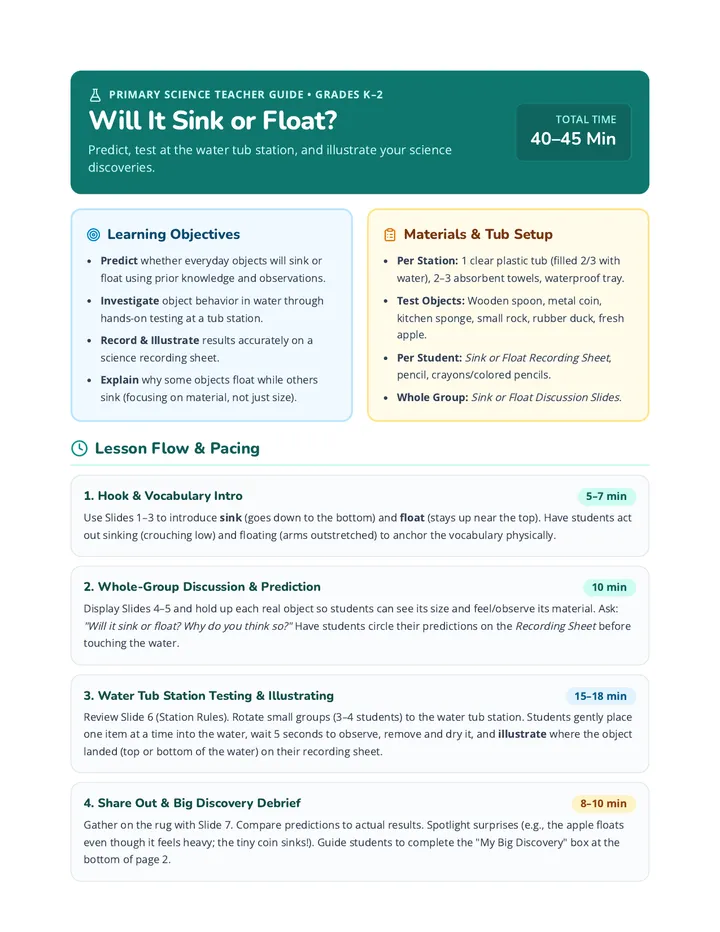
Sink or Float Lesson Plan Primary Science Teacher Guide • Grades K–2
Will It Sink or Float?
Predict, test at the water tub station, and illustrate your science discoveries.
Total Time
40–45 Min
Learning Objectives
Predict whether everyday objects will sink or float using prior knowledge and observations.Investigate object behavior in water through hands-on testing at a tub station.Record & Illustrate results accurately on a science recording sheet.Explain why some objects float while others sink (focusing on material, not just size).
Materials & Tub Setup
Per Station: 1 clear plastic tub (filled 2/3 with water), 2–3 absorbent towels, waterproof tray.Test Objects: Wooden spoon, metal coin, kitchen sponge, small rock, rubber duck, fresh apple.Per Student: Sink or Float Recording Sheet , pencil, crayons/colored pencils.Whole Group: Sink or Float Discussion Slides .
Lesson Flow & Pacing
1. Hook & Vocabulary Intro
5–7 min
Use Slides 1–3 to introduce sink (goes down to the bottom) and float (stays up near the top). Have students act out sinking (crouching low) and floating (arms outstretched) to anchor the vocabulary physically.
2. Whole-Group Discussion & Prediction
10 min
Display Slides 4–5 and hold up each real object so students can see its size and feel/observe its material. Ask: "Will it sink or float? Why do you think so?" Have students circle their predictions on the Recording Sheet before touching the water.
3. Water Tub Station Testing & Illustrating
15–18 min
Review Slide 6 (Station Rules). Rotate small groups (3–4 students) to the water tub station. Students gently place one item at a time into the water, wait 5 seconds to observe, remove and dry it, and illustrate where the object landed (top or bottom of the water) on their recording sheet.
4. Share Out & Big Discovery Debrief
8–10 min
Gather on the rug with Slide 7. Compare predictions to actual results. Spotlight surprises (e.g., the apple floats even though it feels heavy; the tiny coin sinks!). Guide students to complete the "My Big Discovery" box at the bottom of page 2.
Discussion, Misconceptions & Supports
Facilitation guide for Will It Sink or Float?
Guiding Discussion Questions
Before Testing (Predicting)
"What is this object made of (wood, metal, plastic, rock)?"
"Have you seen something like this in water before?"
"Do you think it will go to the bottom or stay on top? Why?"
After Testing (Reflecting)
"Which item surprised you the most today?"
"The coin is tiny and the apple is big—why did the coin sink while the apple floated?"
"What happened to the sponge after it sat in water?"
Quick Reference: Expected Test Results
Object
Typical Result
Science Talking Point
🥄 Wooden Spoon
Floats
Wood has tiny air pockets and is less dense than water.
🪙 Metal Coin
Sinks
Even though it is small, solid metal is packed tightly (dense).
🧽 Kitchen Sponge
Floats (at first)
Dry sponges hold air; if squeezed underwater, they absorb water!
🪨 Small Rock
Sinks
Rock material is heavy for its size and sinks right to the bottom.
🦆 Rubber Duck
Floats
Hollow inside—trapped air helps push it up on the water.
🍎 Fresh Apple
Floats
Surprise! Apples are about 25% air inside, so they bob on top.
Common Misconceptions
"Big things always sink, small things always float." Counter this directly by comparing the big floating apple to the tiny sinking coin."Changing a prediction is bad." Remind students that real scientists celebrate when a test surprises them—never erase a prediction!
Differentiation & Safety
ELL / Emerging Writers: Use gesture cues for sink/float and allow purely drawn observations in the discovery box.Extension: Challenge early finishers to test a crumpled foil ball vs. a flat foil boat.Safety: Place towels under tubs and remind students to gently place (not drop) items to prevent splashes. Sink or Float Discussion Slides Splash Lab Science
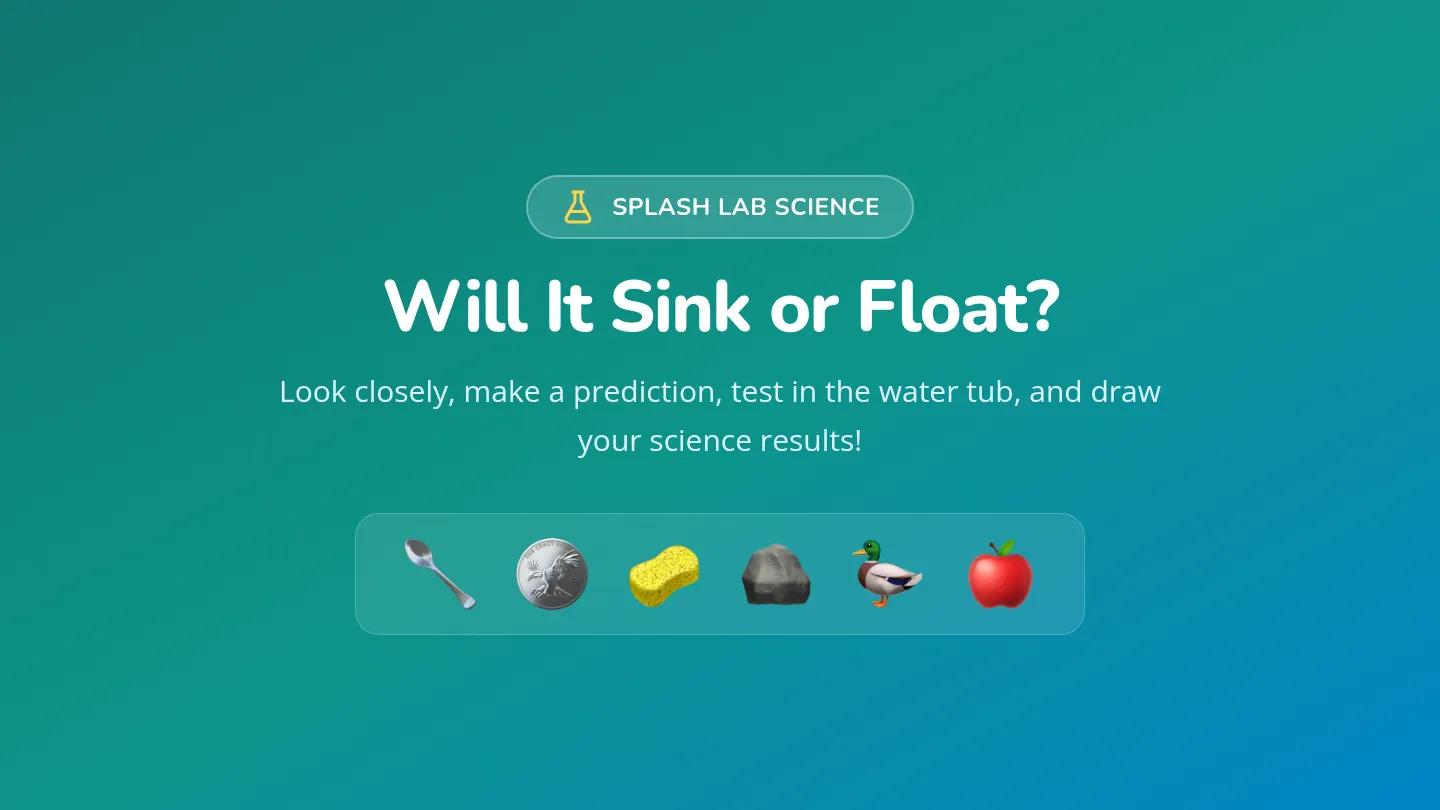
Will It Sink or Float?
Look closely, make a prediction, test in the water tub, and draw your science results!
🥄 🪙 🧽 🪨 🦆 🍎
What Do These Words Mean?
🦆
FLOAT
The object stays up on top of the water.
Top of the water ⬆️
🪨
SINK
The object drops down to the bottom of the tub.
Bottom of the tub ⬇️
How We Work Like Scientists
1
Look
See what the object is made of.
2
Predict
Circle Sink or Float and tell why.
3
Test
Place it gently in the water tub.
4
Draw
Illustrate where it landed on your sheet.
Turn & Talk: Predict Set 1
Items 1–3
🥄
Wooden Spoon
Made of smooth wood.
🪙
Metal Coin
Tiny and made of metal.
🧽
Kitchen Sponge
Soft with lots of tiny holes.
Ask a partner: “I predict it will _____ because _____.”
Turn & Talk: Predict Set 2
Items 4–6
🪨
Small Rock
Hard and solid stone.
🦆
Rubber Duck
Hollow rubber with air inside.
🍎
Fresh Apple
Feels heavy in your hand!
Circle all 6 predictions on your sheet before we test!
Water Tub Station Rules
🤲
Gentle Hands
Place one item at a time softly into the tub. No splashing!
👀
Wait & Watch
Count to 5 slowly to see if it floats on top or sinks down.
✏️
Dry & Draw
Set the wet item on the towel, then draw what you saw!
Our Big Science Discovery!
Let’s Discuss:
• Which object surprised you most?
• Why did the tiny coin sink while the big apple floated?
Key Idea
Sinking or floating isn’t just about size ! It depends on what an object is made of and if it holds air inside.
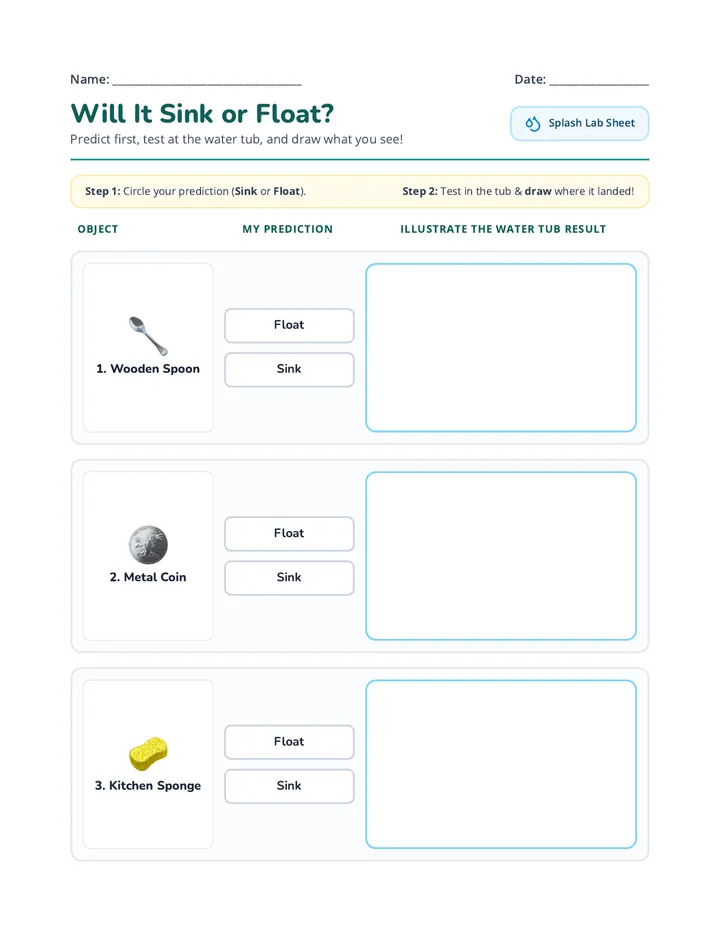
Sink or Float Recording Sheet Name: ____________________________________
Date: ___________________
Will It Sink or Float?
Predict first, test at the water tub, and draw what you see!
Splash Lab Sheet
Step 1: Circle your prediction (Sink or Float ). Step 2: Test in the tub & draw where it landed!
Object
My Prediction
Illustrate the Water Tub Result
🥄
1. Wooden Spoon
Float
Sink
🪙
2. Metal Coin
Float
Sink
🧽
3. Kitchen Sponge
Float
Sink
Object
My Prediction
Illustrate the Water Tub Result
🪨
4. Small Rock
Float
Sink
🦆
5. Rubber Duck
Float
Sink
🍎
6. Fresh Apple
Float
Sink
My Big Discovery
Draw or write about one object that surprised you!