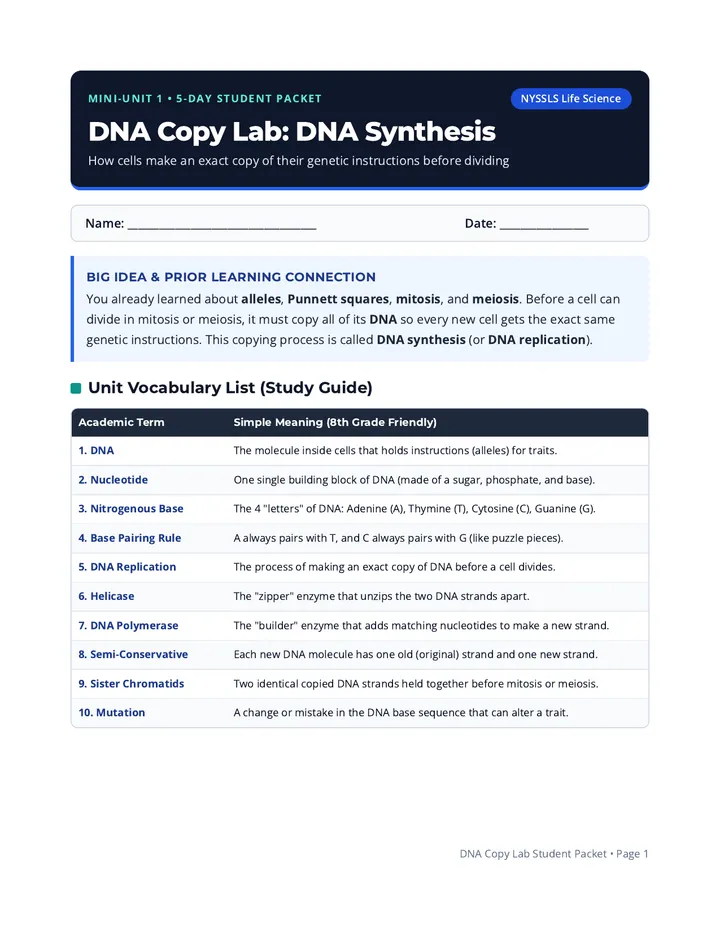
Element Detectives Worksheet (11/30) 8th Grade Physical Science • 90-Minute Block
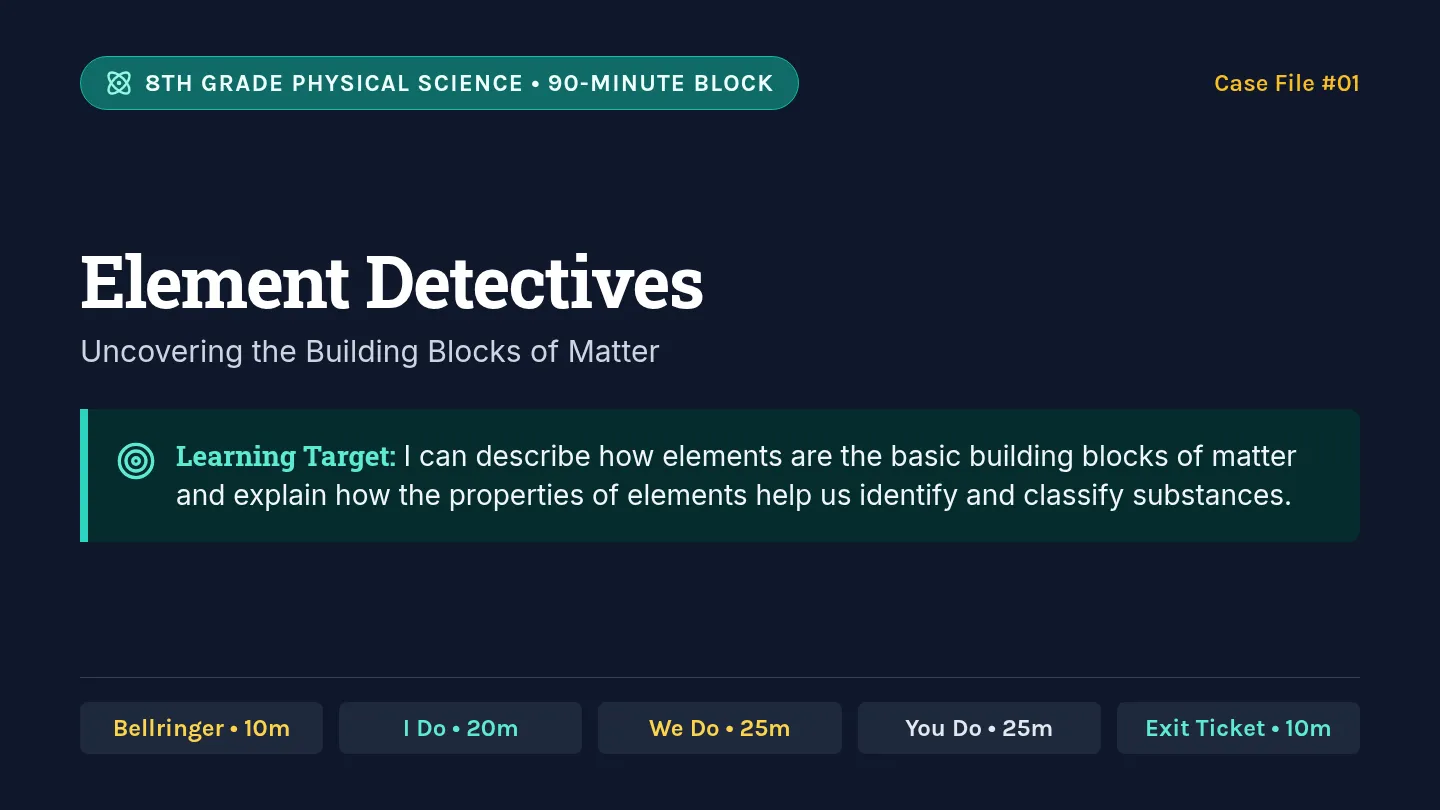
Element Detectives
Name: ___________________________
Date: _______________ Period: _____
Learning Target: I can describe how elements are the basic building blocks of matter and explain how the properties of elements help us identify and classify substances.
Bellringer What Is It Made Of?
10 min
Imagine three everyday items: a copper penny , a helium balloon , and table salt . Which of these do you think are made of a single pure element, and which are combinations of different substances? Explain your thinking below.
Part 1: I Do Building Blocks of Matter (Guided Notes)
20 min
1. Matter & Atoms
Everything that has mass and takes up space is matter . All matter is made of tiny particles called atoms .
2. Pure Elements
An element is a pure substance made of only one type of atom . It cannot be broken down into simpler substances.
3. Compounds
When two or more different elements chemically bond, they form a compound (like H2O) with brand-new properties.
29
Cu
Copper
Metal • Solid
Follow along as we analyze how properties identify elements:
A. Physical Properties (observed without changing the substance):
Examples (color, state, etc.):
B. Chemical Properties (how a substance reacts with other matter):
Examples (flammability, etc.):
C. Key Idea: Every element has its own unique set of properties, just like a fingerprint. Explain why two elements can never have the exact same set of properties:
Part 2: We Do Property Detectives & Classification
25 min
Activity A: Element or Compound? (Partner & Class Check)
With your partner, examine each substance and its chemical formula. Decide if it is a pure element or a compound , and explain your reasoning.
Substance & Formula
Element or Compound?
How Do You Know? (Evidence)
Pure Iron Nail (Fe)
Carbon Dioxide Gas (CO2)
Neon Sign Gas (Ne)
Table Sugar (C12H22O11)
Aluminum Foil (Al)
Activity B: Classifying Elements by Their Properties
Metals
Shiny luster, malleable (bendable), good conductors of heat and electricity.
Nonmetals
Dull appearance, brittle if solid, poor conductors (insulators), many are gases.
Metalloids
Mix of metal and nonmetal traits; semiconductors (used in electronics).
Guided Mystery Case: Read the lab observations for each mystery element. Classify it as a metal , nonmetal , or metalloid and cite two properties that prove your classification.
Sample X: Silver-gray solid, shiny surface, bends easily into a wire without breaking, and conducts electricity very well.
Sample Y: Bright yellow solid, dull surface, shatters into powder when tapped with a hammer, and does not conduct electricity.
Part 3: You Do Independent Mystery Lab & Analysis
25 min
Task 1: Identify the Unknown Elements
Use the Element Reference Key below to identify Unknown Samples 1–4. Write the element's name, its classification, and one piece of property evidence.
Copper (Cu): Reddish-brown metal; conducts electricity; malleable.
Sulfur (S): Yellow nonmetal; brittle solid; poor conductor.
Silicon (Si): Shiny gray metalloid; brittle; semiconductor.
Helium (He): Colorless nonmetal gas; lighter than air; non-reactive.
Lab Observations
Element Name
Classification
Property Evidence
Sample 1: Shiny gray solid; shatters when struck; conducts electricity moderately.
Sample 2: Colorless gas; fills a balloon and floats; does not burn near a flame.
Sample 3: Reddish-brown solid; bends easily without snapping; high electrical conductivity.
Sample 4: Dull yellow solid; crumbles into dust; blocks electrical current.
Task 2: Evaluate the Claim (Constructed Response)
A student claims: "Because table salt (NaCl) is made from sodium—a soft, reactive metal—and chlorine—a toxic green gas—table salt must be a single element that is both toxic and explosive." Do you agree or disagree? Use what you know about elements as building blocks and how properties classify substances to explain your answer in 4–5 sentences.
Part 3: You Do Engineering with Elements
Application
Imagine you are designing a new smartphone. For each part below, state whether you should choose a metal , nonmetal , or metalloid , and explain which specific properties make it the best choice.
1. Internal Wiring (carries power from the battery to the screen):
2. Processor Chip (needs to control and switch electrical signals precisely):
3. Outer Electrical Insulation (prevents heat and electricity from shocking the user):
Exit Ticket: Show What You Know
10 min
1. Which statement best explains why elements are considered the basic building blocks of matter?
A. Elements are always solids that can be seen with the naked eye.
B. Each element is made of one type of atom that combines with others to form all substances.
C. Elements can be easily broken down into smaller parts using a magnet.
D. All elements share the exact same physical and chemical properties.
2. Explain one way a scientist can tell two unknown solid elements apart using their properties.
Element Detectives Slides 8th Grade Physical Science • 90-Minute Block
Case File #01
Element Detectives
Uncovering the Building Blocks of Matter
Learning Target: I can describe how elements are the basic building blocks of matter and explain how the properties of elements help us identify and classify substances.
Bellringer • 10m
I Do • 20m
We Do • 25m
You Do • 25m
Exit Ticket • 10m
Bellringer
What Is It Made Of?
10 min
Imagine three everyday items. Which do you think are made of a single pure element , and which are combinations of different substances?
🪙
Copper Penny
Shiny reddish metal coin
🎈
Helium Balloon
Gas that floats in air
🧂
Table Salt
White crystals for food
Write your prediction and explain your thinking in the Bellringer box on Page 1.
Part 1: I Do
Building Blocks of Matter
20 min
1
Matter & Atoms
Everything that has mass and takes up space is matter . All matter is made of tiny particles called atoms .
Atoms = Tiny particles
2
Pure Elements
An element is a pure substance made of only one type of atom . It cannot be broken down into simpler substances.
Example: Copper (Cu)
3
Compounds
When two or more different elements chemically bond, they form a compound with brand-new properties.
Example: Water (H2O)
Follow along with the Guided Notes on Page 1 of your worksheet.
Part 1: I Do
An Element's "Fingerprint"
Guided Modeling
29
Cu
Copper
Metal • Solid
A. Physical Properties
Observed without changing the substance into something new. Examples: reddish-brown color, shiny luster, solid state, conducts electricity
B. Chemical Properties
How a substance reacts with other matter to form new substances. Examples: reacts slowly with air/moisture (turns green), non-flammable
Key Idea: Every element has its own unique set of properties—no two elements share the exact same fingerprint!
Part 2: We Do
Element or Compound?
25 min
Partner Check (Activity A): Look at each chemical formula. Is it a pure element or a compound ? What is your evidence?
1. Pure Iron Nail
Fe
2. Carbon Dioxide Gas
CO2
3. Neon Sign Gas
Ne
4. Table Sugar
C12H22O11
5. Aluminum Foil
Al
Tip: Count the capital letters! One element symbol = pure element. Two or more = compound.
Part 2: We Do
Three Families of Elements
Activity B
Metals
• Shiny luster
• Malleable (bendable)
• Good conductors of heat & electricity
Ex: Iron, Copper
Nonmetals
• Dull appearance
• Brittle if solid
• Poor conductors (insulators); many are gases
Ex: Sulfur, Helium
Metalloids
• Mix of metal & nonmetal traits
• Often shiny but brittle
• Semiconductors (used in electronics)
Ex: Silicon
Use these three categories to solve the Guided Mystery Cases on Page 2.
Part 2: We Do
Guided Mystery Cases
Class Discussion
Classify each mystery sample as a metal , nonmetal , or metalloid and cite two properties that prove it.
Sample X
Silver-gray solid, shiny surface, bends easily into a wire without breaking, and conducts electricity very well.
What family is Sample X? Which 2 clues prove it?
Sample Y
Bright yellow solid, dull surface, shatters into powder when tapped with a hammer, and does not conduct electricity.
What family is Sample Y? Which 2 clues prove it?
Record your classification and evidence in the Sample X & Sample Y boxes on Page 2.
Part 3: You Do
Independent Mystery Lab
25 min
Task 1: Unknown Samples 1–4
Use the Element Reference Key on Page 3 to identify each sample:
• Copper (Cu)
• Sulfur (S)
• Silicon (Si)
• Helium (He)
Task 2: Evaluate the Claim
A student claims table salt (NaCl) must be a single toxic, explosive element because sodium is reactive and chlorine is toxic.
Do you agree or disagree? Explain in 4–5 complete sentences!
Work independently and silently on Page 3 before moving to Page 4.
Part 3: You Do
Engineering with Elements
Task 3 • Page 4
You are designing a new smartphone! Choose a metal , nonmetal , or metalloid for each part and explain which properties make it best.
1. Internal Wiring
Carries power from the battery to the screen.
2. Processor Chip
Controls and switches electrical signals precisely.
3. Outer Insulation
Prevents heat and electricity from shocking the user.
Complete Task 3 on Page 4, then move straight into the Exit Ticket.
Exit Ticket: Show What You Know
10 min
Complete Silently on Page 4
Question 1: Why are elements considered the basic building blocks of matter?Question 2: Explain one way a scientist can tell two unknown solid elements apart using their properties.
Target Check: Can you describe elements as building blocks and use properties to identify & classify substances?
Turn in your completed Element Detectives packet when finished.
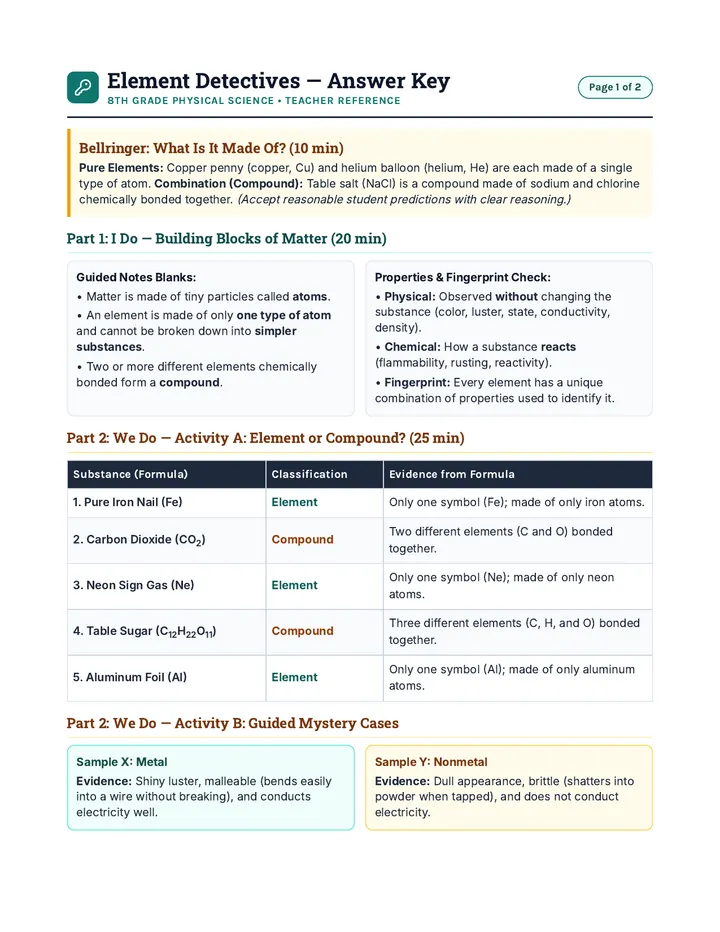
Element Detectives Answer Key Element Detectives — Answer Key
8th Grade Physical Science • Teacher Reference
Page 1 of 2
Bellringer: What Is It Made Of? (10 min)
Pure Elements: Copper penny (copper, Cu) and helium balloon (helium, He) are each made of a single type of atom. Combination (Compound): Table salt (NaCl) is a compound made of sodium and chlorine chemically bonded together. (Accept reasonable student predictions with clear reasoning.)
Part 1: I Do — Building Blocks of Matter (20 min)
Guided Notes Blanks:
• Matter is made of tiny particles called atoms .
• An element is made of only one type of atom and cannot be broken down into simpler substances .
• Two or more different elements chemically bonded form a compound .
Properties & Fingerprint Check:
• Physical: Observed without changing the substance (color, luster, state, conductivity, density).
• Chemical: How a substance reacts (flammability, rusting, reactivity).
• Fingerprint: Every element has a unique combination of properties used to identify it.
Part 2: We Do — Activity A: Element or Compound? (25 min)
Substance (Formula)
Classification
Evidence from Formula
1. Pure Iron Nail (Fe)
Element
Only one symbol (Fe); made of only iron atoms.
2. Carbon Dioxide (CO2)
Compound
Two different elements (C and O) bonded together.
3. Neon Sign Gas (Ne)
Element
Only one symbol (Ne); made of only neon atoms.
4. Table Sugar (C12H22O11)
Compound
Three different elements (C, H, and O) bonded together.
5. Aluminum Foil (Al)
Element
Only one symbol (Al); made of only aluminum atoms.
Part 2: We Do — Activity B: Guided Mystery Cases
Sample X: Metal
Evidence: Shiny luster, malleable (bends easily into a wire without breaking), and conducts electricity well.
Sample Y: Nonmetal
Evidence: Dull appearance, brittle (shatters into powder when tapped), and does not conduct electricity.
Element Detectives — Answer Key
Part 3 (You Do) & Exit Ticket
Page 2 of 2
Part 3: You Do — Task 1: Identify Unknown Samples 1–4 (25 min)
Sample
Element
Family
Key Matching Evidence
Sample 1
Silicon (Si)
Metalloid
Silver-gray, shiny, brittle, semiconductor.
Sample 2
Helium (He)
Nonmetal
Colorless gas, less dense than air, unreactive.
Sample 3
Copper (Cu)
Metal
Reddish-brown, shiny, bends easily, conducts well.
Sample 4
Sulfur (S)
Nonmetal
Bright yellow solid, dull, shatters, poor conductor.
Task 2: Evaluate the Claim (NaCl) — Exemplar Response
I disagree with the student's claim. Table salt (NaCl) is not a single element; it is a compound made of two different elements, sodium (Na) and chlorine (Cl), chemically bonded together. When elements chemically combine to form a compound, they create a brand-new substance with completely different physical and chemical properties from the original elements. That is why table salt is a safe, edible white crystal even though pure sodium is reactive and pure chlorine is toxic.
Task 3: Engineering with Elements (Smartphone Design)
1. Internal Wiring — Metal (e.g., Copper): Metals are good conductors of electricity so power flows efficiently, and they are malleable/ductile so they can be shaped into thin wires without breaking.
2. Processor Chip — Metalloid (e.g., Silicon): Metalloids are semiconductors, meaning they can both conduct and block electricity to control signals precisely inside computer chips.
3. Outer Insulation — Nonmetal: Nonmetals are poor conductors (good insulators) of heat and electricity, which protects the user from electric shock and heat.
Exit Ticket: Show What You Know (10 min)
1. Why are elements considered the basic building blocks of matter? Elements are pure substances made of only one type of atom and cannot be broken down into simpler substances. All other matter and compounds are built by combining atoms of different elements.
2. Explain one way a scientist can tell two unknown solid elements apart using their properties. A scientist can test physical or chemical properties—such as electrical conductivity, malleability vs. brittleness, luster, color, density, or reactivity with acid/water—and compare the results to known element "fingerprints."