Atomic Structure Unit Test
Chemistry Unit Assessment Time: 45 Minutes • Total: 50 Points
Atomic Structure, Models & Isotopes
Name:
Date:
Period:
Score: / 50
Materials Allowed: Periodic Table of Elements and a scientific calculator. Show all work for calculation problems.
Part 1: Multiple Choice (10 points — 1 point each)
Directions: Read each question carefully and circle the letter of the best answer.
1. Which subatomic particle determines the identity of an element?
A) Neutron
B) Proton
C) Electron
D) Valence shell
2. Which subatomic particle carries a negative charge and is located outside the nucleus?
A) Proton
B) Neutron
C) Electron
D) Nucleus
3. A neutral atom of Phosphorus has an atomic number of 15 and a mass number of 31. How many electrons does this atom have?
A) 16
B) 15
C) 31
D) 46
4. How are elements arranged on the modern Periodic Table?
A) In order of increasing atomic mass
B) In alphabetical order by chemical symbol
C) In order of increasing atomic number
D) In order of increasing neutron count
5. Calcium (Ca) is located in Period 4, Group 2 of the Periodic Table. How many energy levels surround the nucleus of a neutral calcium atom?
A) 2
B) 4
C) 20
D) 40
6. What is the maximum number of electrons that can fit in the first energy level of a Bohr model?
A) 1
B) 2
C) 8
D) 18
7. Why do elements in the same group (vertical column) on the Periodic Table share similar chemical properties?
A) They have the same atomic mass
B) They have the same number of energy levels
C) They have the same number of valence electrons
D) They have the same number of neutrons
8. How many neutrons are present in an atom of \(^{79}_{35}\text{Br}\)?
A) 35
B) 44
C) 79
D) 114
9. Isotopes of the same element always have the same number of:
A) Protons
B) Neutrons
C) Mass numbers
D) Energy levels
10. Gallium (Ga) has an average atomic mass of \(69.72\text{ amu}\) and two naturally occurring isotopes: Ga-69 and Ga-71. Which isotope is more abundant in nature?
A) Ga-69, because the average atomic mass is closer to 69 than to 71
B) Ga-71, because heavier isotopes always make up the majority of a sample
C) Both isotopes are equally abundant (50% each)
D) Neither isotope occurs naturally
Part 2: Subatomic Particles & Isotopic Notation (10 points — 0.5 point per blank)
Directions: Use your Periodic Table to complete the missing values for each neutral atom below.
| Element Name |
Atomic Number |
Mass Number |
Protons (\(p^+\)) |
Neutrons (\(n^0\)) |
Electrons (\(e^-\)) |
Isotopic Notation |
| Carbon |
6 |
14 |
|
|
|
|
| Chlorine |
|
|
17 |
20 |
|
|
| Iron |
26 |
|
|
|
|
\(^{56}_{26}\text{Fe}\) |
| Sodium |
|
23 |
|
|
11 |
|
|
10 |
|
|
12 |
10 |
|
Part 3: Bohr Models & Lewis Dot Diagrams (12 points)
A. Bohr Model Construction (4 points)
Draw a complete Bohr model for a neutral atom of Nitrogen (N) (Atomic Number: 7, Mass Number: 14). Label the number of protons (\(p^+\)) and neutrons (\(n^0\)) in the nucleus, draw the correct number of energy levels, and place each electron as a dot on the appropriate ring.
Protons (\(p^+\)):
Neutrons (\(n^0\)):
Energy Levels:
B. Lewis Dot Diagrams (8 points — 2 points each)
Draw the correct Lewis Dot Diagram for each neutral element below. Write the chemical symbol in the center and place one dot on each of the four sides before pairing any dots.
1. Lithium (Li) Group 1
2. Carbon (C) Group 14
3. Sulfur (S) Group 16
4. Argon (Ar) Group 18
Part 4: Periodic Trends & Isotope Reasoning (8 points — 4 points each)
Directions: Answer each question completely in the spaces provided using full sentences.
11. Sodium (Na, Atomic #11) and Potassium (K, Atomic #19) are both in Group 1 of the Periodic Table.
a) Explain why Sodium and Potassium have very similar chemical properties. (2 pts)
b) Explain how the Bohr model of Potassium differs from the Bohr model of Sodium in terms of energy levels. (2 pts)
12. Two atoms are analyzed in a lab: Atom X has 29 protons and 34 neutrons, while Atom Y has 29 protons and 36 neutrons.
a) Are Atom X and Atom Y the same element or different elements? Justify your answer. (2 pts)
b) Write the complete isotopic notation for both Atom X and Atom Y. (2 pts)
Atom X:
Atom Y:
Part 5: Average Atomic Mass Calculation (10 points)
13. Naturally occurring Boron (B) consists of two stable isotopes shown in the data table below.
| Isotope |
Isotopic Mass (amu) |
Percent Abundance (%) |
| Boron-10 |
10.01 amu |
19.90% |
| Boron-11 |
11.01 amu |
80.10% |
a) Show the step-by-step calculation to find the average atomic mass of Boron. Round your final answer to two decimal places and include units. (7 pts)
b) Explain why the average atomic mass of Boron is much closer to 11 amu than to 10 amu. (3 pts)
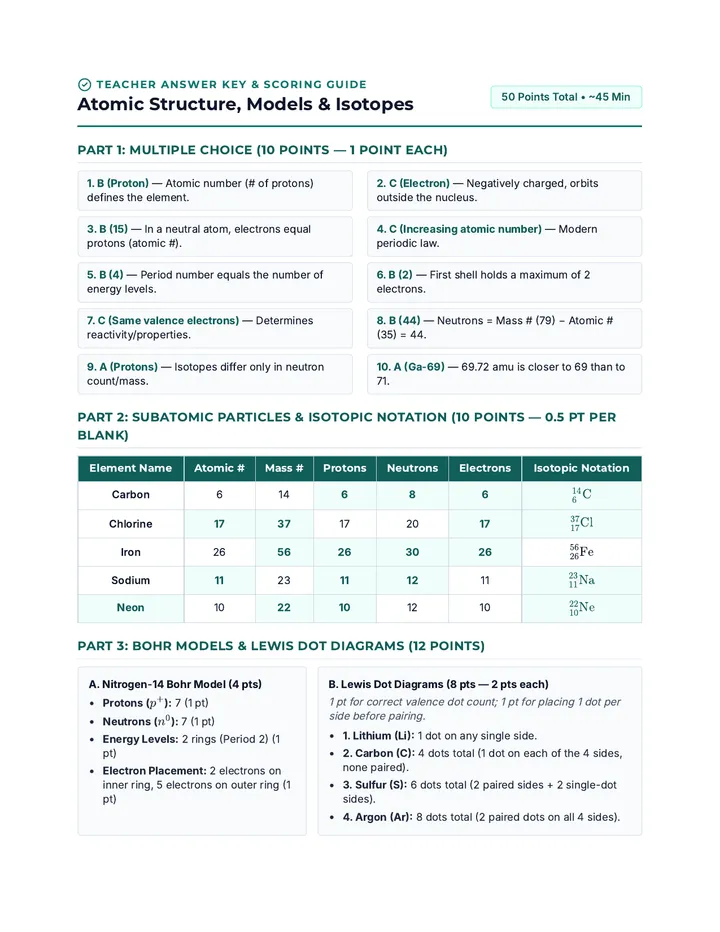
Atomic Structure Answer Key
Teacher Answer Key & Scoring Guide
Atomic Structure, Models & Isotopes
50 Points Total • ~45 Min
Part 1: Multiple Choice (10 points — 1 point each)
1. B (Proton) — Atomic number (# of protons) defines the element.
2. C (Electron) — Negatively charged, orbits outside the nucleus.
3. B (15) — In a neutral atom, electrons equal protons (atomic #).
4. C (Increasing atomic number) — Modern periodic law.
5. B (4) — Period number equals the number of energy levels.
6. B (2) — First shell holds a maximum of 2 electrons.
7. C (Same valence electrons) — Determines reactivity/properties.
8. B (44) — Neutrons = Mass # (79) − Atomic # (35) = 44.
9. A (Protons) — Isotopes differ only in neutron count/mass.
10. A (Ga-69) — 69.72 amu is closer to 69 than to 71.
Part 2: Subatomic Particles & Isotopic Notation (10 points — 0.5 pt per blank)
| Element Name |
Atomic # |
Mass # |
Protons |
Neutrons |
Electrons |
Isotopic Notation |
| Carbon |
6 |
14 |
6 |
8 |
6 |
\(^{14}_{6}\text{C}\) |
| Chlorine |
17 |
37 |
17 |
20 |
17 |
\(^{37}_{17}\text{Cl}\) |
| Iron |
26 |
56 |
26 |
30 |
26 |
\(^{56}_{26}\text{Fe}\) |
| Sodium |
11 |
23 |
11 |
12 |
11 |
\(^{23}_{11}\text{Na}\) |
| Neon |
10 |
22 |
10 |
12 |
10 |
\(^{22}_{10}\text{Ne}\) |
Part 3: Bohr Models & Lewis Dot Diagrams (12 points)
A. Nitrogen-14 Bohr Model (4 pts)
- Protons (\(p^+\)): 7 (1 pt)
- Neutrons (\(n^0\)): 7 (1 pt)
- Energy Levels: 2 rings (Period 2) (1 pt)
- Electron Placement: 2 electrons on inner ring, 5 electrons on outer ring (1 pt)
B. Lewis Dot Diagrams (8 pts — 2 pts each)
1 pt for correct valence dot count; 1 pt for placing 1 dot per side before pairing.
- 1. Lithium (Li): 1 dot on any single side.
- 2. Carbon (C): 4 dots total (1 dot on each of the 4 sides, none paired).
- 3. Sulfur (S): 6 dots total (2 paired sides + 2 single-dot sides).
- 4. Argon (Ar): 8 dots total (2 paired dots on all 4 sides).
Teacher Answer Key & Scoring Guide (Continued) Parts 4 & 5
Part 4: Periodic Trends & Isotope Reasoning (8 points)
11. Sodium (Na) and Potassium (K) Comparison (4 points)
a) Similar chemical properties (2 pts): Both Sodium and Potassium are in Group 1, so they each have 1 valence electron (1 pt). Elements with the same number of valence electrons react in very similar ways (1 pt).
b) Bohr model energy levels (2 pts): Sodium is in Period 3 and has 3 energy levels (1 pt), whereas Potassium is in Period 4 and has 4 energy levels (1 pt).
12. Atom X (29p, 34n) & Atom Y (29p, 36n) (4 points)
a) Same element justification (2 pts): They are the same element (Copper, Cu) (1 pt) because both atoms have the same atomic number / 29 protons; they are isotopes with different numbers of neutrons (1 pt).
b) Isotopic notation (2 pts — 1 pt each): Atom X: \(^{63}_{29}\text{Cu}\) (Mass # = 29 + 34 = 63) • Atom Y: \(^{65}_{29}\text{Cu}\) (Mass # = 29 + 36 = 65)
Part 5: Average Atomic Mass Calculation (10 points)
13a) Step-by-Step Calculation for Boron (7 points)
Step 1 — Convert percentages to decimals (2 pts):
Boron-10: \(19.90\% = 0.1990\) | Boron-11: \(80.10\% = 0.8010\)
Step 2 — Multiply each mass by its decimal abundance (2 pts):
Boron-10 contribution: \(10.01\text{ amu} \times 0.1990 = 1.99199\text{ amu}\)
Boron-11 contribution: \(11.01\text{ amu} \times 0.8010 = 8.81901\text{ amu}\)
Step 3 — Add contributions and round to 2 decimal places (3 pts):
\(1.99199 + 8.81901 = 10.811\text{ amu} \approx \mathbf{10.81\text{ amu}}\)
Scoring note: 1 pt for correct rounding to two decimal places; 1 pt for including "amu" units.
13b) Conceptual Explanation (3 points)
The average atomic mass is a weighted average (1 pt). Because Boron-11 is much more abundant (80.10%) than Boron-10 (19.90%) (1 pt), Boron-11 has a much greater weight/pull on the final average, making it closer to 11 amu (1 pt).