Cell Structure Quiz
Name: ________________________
Class: ___________________
Date: __________
Cell Structure and Membrane Transport
Identify the choice that best completes the statement or answers the question.

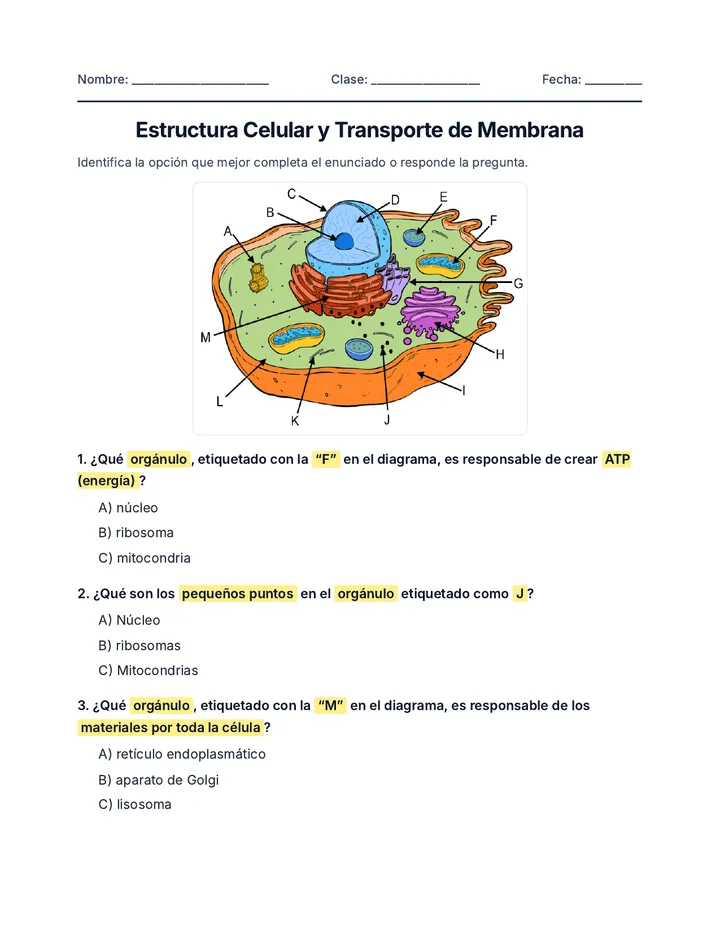
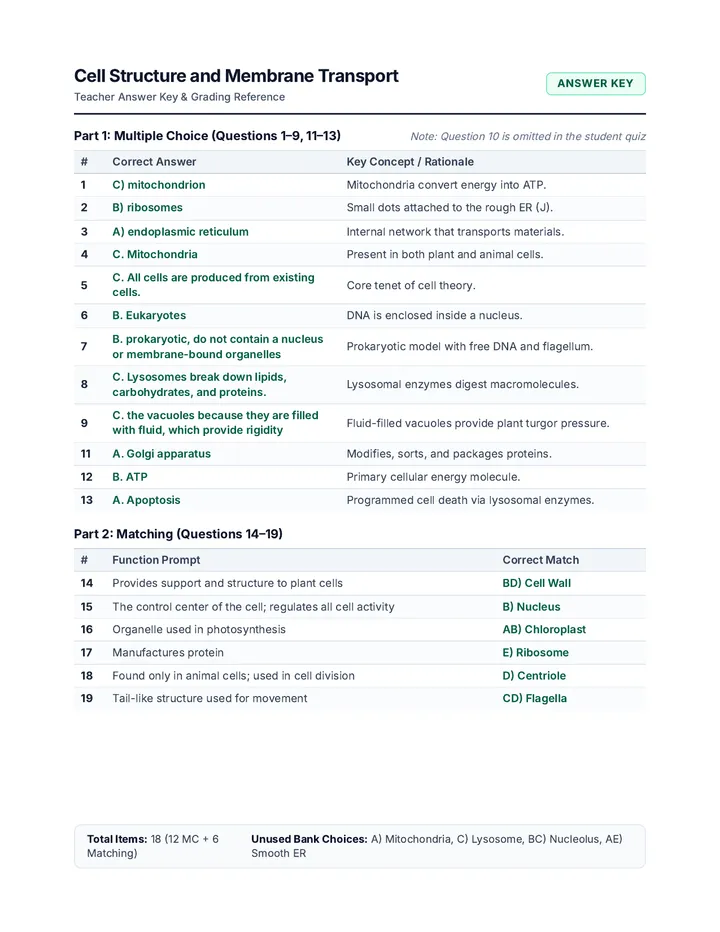
1. Which organelle, labeled “F” in the diagram, is responsible for creating ATP (energy)?
A) nucleus
B) ribosome
C) mitochondrion
2. What are the small dots on the organelle labeled J?
A) Nucleus
B) ribosomes
C) Mitochondria
3. Which organelle, labeled “M” in the diagram, is responsible for materials throughout the cell?
A) endoplasmic reticulum
B) Golgi apparatus
C) lysosome
4. Which of the following structures are present in both plant and animal cells?
A. Cell Walls
B. Single vacuole
C. Mitochondria
5. Which of the following statements is part of the cell theory?
A. Cells are composed mostly of empty space.
B. Cells are generally large enough for the unaided eye to see.
C. All cells are produced from existing cells.
6. The cells of all organisms contain DNA. In which type of cell is DNA enclosed in a nucleus?
A. Bacteria
B. Eukaryotes
C. Prokaryotes
7. A model of a cell is shown.

The cell is (1)________________ because it (2)________________
A. eukaryotic, contains membrane-bound organelles
B. prokaryotic, do not contain a nucleus or membrane-bound organelles
C. prokaryotic, contain membrane-bound organelles
8. Lysosomes are organelles that contain enzymes. Which of the following is a function of lysosomes?
A. Lysosomes build lipids, carbohydrates, and proteins.
B. Lysosomes package lipids, carbohydrates, and proteins.
C. Lysosomes break down lipids, carbohydrates, and proteins.
9. Which organelles allow plants to support heavy structures such as leaves and flowers?
A. the cell membranes because they regulate what enters and leaves the cells
B. the chloroplasts because they convert sunlight into chemical energy
C. the vacuoles because they are filled with fluid, which provide rigidity
11. In eukaryotic cells, a number of organelles allow the cell to produce and distribute proteins. Where are proteins modified, sorted, and packaged?
A. Golgi apparatus
B. Ribosomes
C. rough endoplasmic reticulum
12. The energy molecule produced by mitochondria is called:
A. DNA
B. ATP
C. RNA
13. Cells will sometimes destroy itself by releasing the enzymes within the lysosomes. This process is called:
A. Apoptosis
B. Assimilation
C. Acclimation
Questions 14–19: Matching. Match the organelle with its function.
14. Provides support and structure to plant cells
15. The control center of the cell. Regulates all cell activity and functions
16. Organelle used in photosynthesis
17. Manufactures protein
18. Found only in animal cells. Used in cell division
19. Tail-like structure used for movement
A) Mitochondria
B) Nucleus
C) Lysosome
D) Centriole
E) Ribosome
AB) Chloroplast
BC) Nucleolus
BD) Cell Wall
AE) Smooth ER
CD) Flagella
Prueba Estructura Celular
Nombre: ________________________
Clase: ___________________
Fecha: __________
Estructura Celular y Transporte de Membrana
Identifica la opción que mejor completa el enunciado o responde la pregunta.

1. ¿Qué orgánulo, etiquetado con la “F” en el diagrama, es responsable de crear ATP (energía)?
A) núcleo
B) ribosoma
C) mitocondria
2. ¿Qué son los pequeños puntos en el orgánulo etiquetado como J?
A) Núcleo
B) ribosomas
C) Mitocondrias
3. ¿Qué orgánulo, etiquetado con la “M” en el diagrama, es responsable de los materiales por toda la célula?
A) retículo endoplasmático
B) aparato de Golgi
C) lisosoma
4. ¿Cuáles de las siguientes estructuras están presentes tanto en células vegetales como animales?
A. Paredes celulares
B. Vacuola única
C. Mitocondrias
5. ¿Cuál de los siguientes enunciados forma parte de la teoría celular?
A. Las células están compuestas principalmente de espacio vacío.
B. Las células son generalmente lo bastante grandes para verse a simple vista.
C. Todas las células se producen a partir de células existentes.
6. Las células de todos los organismos contienen ADN. ¿En qué tipo de célula está el ADN encerrado en un núcleo?
A. Bacterias
B. Eucariotas
C. Procariotas
7. Se muestra un modelo de una célula.

La célula es (1)________________ porque (2)________________
A. eucariota, contiene orgánulos rodeados por membrana
B. procariota, no contiene un núcleo ni orgánulos rodeados por membrana
C. procariota, contiene orgánulos rodeados por membrana
8. Los lisosomas son orgánulos que contienen enzimas. ¿Cuál de las siguientes es una función de los lisosomas?
A. Los lisosomas construyen lípidos, carbohidratos y proteínas.
B. Los lisosomas empaquetan lípidos, carbohidratos y proteínas.
C. Los lisosomas descomponen lípidos, carbohidratos y proteínas.
9. ¿Qué orgánulos permiten que las plantas sostengan estructuras pesadas como hojas y flores?
A. las membranas celulares, porque regulan lo que entra y sale de las células
B. los cloroplastos, porque convierten la luz solar en energía química
C. las vacuolas, porque están llenas de líquido, lo que proporciona rigidez
11. En las células eucariotas, varios orgánulos permiten que la célula produzca y distribuya proteínas. ¿Dónde se modifican, clasifican y empaquetan las proteínas?
A. Aparato de Golgi
B. Ribosomas
C. Retículo endoplasmático rugoso
12. La molécula de energía producida por las mitocondrias se llama:
A. ADN
B. ATP
C. ARN
13. A veces una célula se autodestruye liberando las enzimas dentro de los lisosomas. Este proceso se llama:
A. Apoptosis
B. Asimilación
C. Aclimatación
Preguntas 14–19: Emparejamiento. Empareja el orgánulo con su función.
14. Proporciona soporte y estructura a las células vegetales
15. El centro de control de la célula. Regula toda la actividad y funciones celulares
16. Orgánulo usado en la fotosíntesis
17. Fabrica proteínas
18. Se encuentra solo en células animales. Se usa en la división celular
19. Estructura similar a una cola usada para el movimiento
A) Mitocondria
B) Núcleo
C) Lisosoma
D) Centríolo
E) Ribosoma
AB) Cloroplasto
BC) Nucléolo
BD) Pared celular
AE) RE liso
CD) Flagelos