DNA Copy Lab Student Packet Mini-Unit 1 • 5-Day Student Packet NYSSLS Life Science
DNA Copy Lab: DNA Synthesis
How cells make an exact copy of their genetic instructions before dividing
Name: ____________________________________
Date: _________________
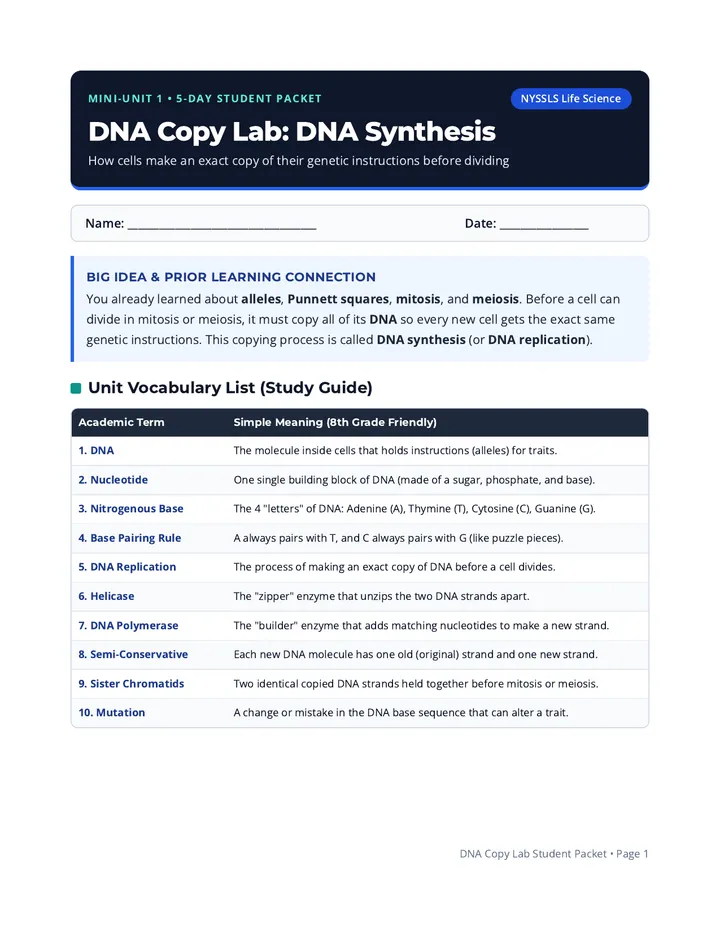
Big Idea & Prior Learning Connection
You already learned about alleles , Punnett squares , mitosis , and meiosis . Before a cell can divide in mitosis or meiosis, it must copy all of its DNA so every new cell gets the exact same genetic instructions. This copying process is called DNA synthesis (or DNA replication ).
Unit Vocabulary List (Study Guide)
Academic Term
Simple Meaning (8th Grade Friendly)
1. DNA
The molecule inside cells that holds instructions (alleles) for traits.
2. Nucleotide
One single building block of DNA (made of a sugar, phosphate, and base).
3. Nitrogenous Base
The 4 "letters" of DNA: Adenine (A), Thymine (T), Cytosine (C), Guanine (G).
4. Base Pairing Rule
A always pairs with T, and C always pairs with G (like puzzle pieces).
5. DNA Replication
The process of making an exact copy of DNA before a cell divides.
6. Helicase
The "zipper" enzyme that unzips the two DNA strands apart.
7. DNA Polymerase
The "builder" enzyme that adds matching nucleotides to make a new strand.
8. Semi-Conservative
Each new DNA molecule has one old (original) strand and one new strand.
9. Sister Chromatids
Two identical copied DNA strands held together before mitosis or meiosis.
10. Mutation
A change or mistake in the DNA base sequence that can alter a trait.
DNA Copy Lab Student Packet • Page 1
Word Wall Matching Exercise
Vocabulary Check
Directions: Read each numbered academic vocabulary word in Column A . Find its matching definition in Column B . Write the letter from Column B on the blank line next to the number in Column A.
Column A: Vocabulary Terms
______ 1. DNA
______ 2. Nucleotide
______ 3. Nitrogenous Base
______ 4. Base Pairing Rule
______ 5. DNA Replication
______ 6. Helicase
______ 7. DNA Polymerase
______ 8. Semi-Conservative
______ 9. Sister Chromatids
______ 10. Mutation
Column B: Definitions
A. The "builder" enzyme that brings in new nucleotides and proofreads the copy.
B. Two identical copied DNA strands attached together before cell division.
C. A mistake or change in the order of DNA bases.
D. The molecule in the nucleus that stores genetic instructions for traits.
E. Each copied DNA has one original strand and one brand-new strand.
F. The "zipper" enzyme that breaks hydrogen bonds to separate DNA strands.
G. The process of making an exact copy of DNA before mitosis or meiosis.
H. One single building block of DNA (sugar + phosphate + base).
I. The rule that A pairs with T, and C pairs with G.
J. The four DNA letters: Adenine (A), Thymine (T), Cytosine (C), and Guanine (G).
Bridge Check: Mitosis, Meiosis & Alleles
Complete the sentence using the word bank: mitosis, identical, alleles .
Before a skin cell divides by __________________________, it must copy its DNA so both new cells receive __________________________ copies of all __________________________.
DNA Copy Lab Student Packet • Page 2
Day 1 of 5 • 45-Minute Lesson
Why Cells Copy DNA
NYSSLS HS-LS1-4
1. Do Now (4 Minutes)
Think Back to Mitosis & Meiosis
Suppose a parent cell has 46 chromosomes. After mitosis , how many chromosomes must each new daughter cell have? Why can't the cell just split its 46 chromosomes in half (23 each) for body cells?
2. Guided Reading / Video Segment (6 Minutes)
Chunked Reading
Chunk 1 — DNA is the Master Recipe: Every cell in your body needs a full set of instructions to stay alive. Those instructions are written in DNA (deoxyribonucleic acid). Different versions of a gene on DNA are called alleles —just like the alleles you put in a Punnett square!
Chunk 2 — Timing is Everything: A cell copies its DNA during Interphase (S phase) before mitosis or meiosis begins. If a cell skipped DNA copying, new cells would be missing instructions and could not survive.
3. Mini-Lesson: Key Notes & Vocabulary Annotations (12–15 Minutes)
DNA Synthesis (Replication): Making an exact copy of DNA. ("Synthesis" means to build or make.) Before Mitosis: Body cells copy DNA so both new cells are 100% identical (46 chromosomes → copies to 92 chromatids → splits into 46 & 46).Before Meiosis: Sex cells (sperm/egg) also copy DNA first, then divide twice so each gamete gets 23 chromosomes with one allele per gene.
Sentence Starter Check-In:
Cells must copy their DNA before dividing because ___________________________________________
________________________________________________________________________________________.
DNA Copy Lab Student Packet • Page 3
Day 1 Activity & Exit Ticket
20-Minute Student Activity
Directions: Study the large diagram below. On the blank lines inside/beside the diagram, annotate (label) : (1) Parent Cell (46 chromosomes) , (2) DNA Synthesis (Copying) , and (3) Two Identical Daughter Cells (46 chromosomes each) .
46 46 x 2 46 46
1. Explain in your own words: How does DNA synthesis help both mitosis and Punnett square inheritance work?
Sentence Starter: DNA synthesis helps mitosis and inheritance because...
Day 1 Exit Ticket
Which statement best explains why DNA must be copied before a cell divides by mitosis?
A. So the new cells will have half the DNA of the parent cell.
B. So each new cell receives a complete, identical set of genetic instructions.
C. So the cell can destroy old alleles it no longer needs.
D. So the cell can turn into a sperm or egg cell immediately.
Unfinished questions in this lesson are due as Homework at our next class meeting
DNA Copy Lab Student Packet • Page 4
Day 2 of 5 • 45-Minute Lesson
DNA Structure & Base Pairing
NYSSLS HS-LS1-1
1. Do Now (4 Minutes)
Think of a zipper on a jacket. Why is it helpful for DNA to be shaped like a twisted ladder (double helix) with two sides that can separate?
2. Guided Reading / Video Segment (6 Minutes)
Chunked Reading
Chunk 1 — Nucleotides (The Bricks): DNA is built from small pieces called nucleotides . Each nucleotide has 3 parts: a sugar , a phosphate , and a nitrogenous base . The sugar and phosphate form the strong outside rails of the ladder.
Chunk 2 — The 4 Letters (Bases): The middle steps of the ladder are made of four bases: Adenine (A) , Thymine (T) , Cytosine (C) , and Guanine (G) . They always pair up by the Base Pairing Rule : A with T ("Apples in the Tree") and C with G ("Cars in the Garage").
3. Mini-Lesson: Why Base Pairing Makes Copying Easy (12–15 Minutes)
Weak Middle Bonds: The two sides of DNA are held together in the middle by weak hydrogen bonds , so the cell can unzip them easily.Complementary Strands: Because A only fits with T and C only fits with G, knowing one side of DNA tells you the exact other side!Example: If one strand reads A - T - G - C - C - A , the matching strand must be T - A - C - G - G - T .
Quick Practice — Write the matching DNA strand:
Original Strand: G – A – T – C – A – G – T – C
Matching Strand: ___ – ___ – ___ – ___ – ___ – ___ – ___ – ___
DNA Copy Lab Student Packet • Page 5
Day 2 Activity & Exit Ticket
20-Minute Student Activity
Directions: Annotate the DNA ladder below. Label: (1) Sugar-Phosphate Backbone , (2) Hydrogen Bond , and (3) fill in the 4 missing base letters on the right side using the Base Pairing Rule (A↔T, C↔G).
A C T G
1. Why is it important that the middle of DNA has weak hydrogen bonds instead of strong bonds?
Day 2 Exit Ticket
If a DNA sample is 30% Adenine (A), what percentage of the DNA must be Thymine (T)?
A. 15%
B. 20%
C. 30%
D. 70%
Unfinished questions in this lesson are due as Homework at our next class meeting
DNA Copy Lab Student Packet • Page 6
Day 3 of 5 • 45-Minute Lesson
Unzipping & Copying: The Enzymes
NYSSLS HS-LS1-1
1. Do Now (4 Minutes)
Imagine you need to make an exact photocopy of a closed book. What is the very first thing you must do to the book before you can copy the pages?
2. Guided Reading / Video Segment (6 Minutes)
Chunked Reading
Chunk 1 — Step 1: Helicase Unzips: Special helper proteins called enzymes do the work of copying DNA. First, an enzyme called helicase acts like a zipper pull. It breaks the weak hydrogen bonds and separates the two DNA strands, creating a Y-shaped replication fork .
Chunk 2 — Step 2: DNA Polymerase Builds: Next, an enzyme called DNA polymerase moves along each open strand. It grabs free nucleotides floating in the nucleus and snaps them into place using the Base Pairing Rule (A↔T, C↔G).
3. Mini-Lesson: Enzyme Teamwork (12–15 Minutes)
Helicase ("Unzipper")
Breaks weak hydrogen bonds between A-T and C-G to open up the DNA ladder.
DNA Polymerase ("Builder")
Adds matching new nucleotides to build the new DNA strands and checks for mistakes.
Sentence Starter Check-In:
First, helicase _____________________________________________________________________.
Then, DNA polymerase ______________________________________________________________.
DNA Copy Lab Student Packet • Page 7
Day 3 Activity & Exit Ticket
20-Minute Student Activity
Directions: Annotate the Replication Fork diagram below. Label: (1) Helicase (the triangle unzipping the strands), (2) DNA Polymerase (the circles adding new bases), and (3) Original Strand vs. New Strand .
1. What would happen to DNA replication if a cell had no helicase enzyme?
Day 3 Exit Ticket
Which enzyme is responsible for adding new complementary nucleotides (A, T, C, G) to build a new DNA strand?
A. Helicase
B. DNA Polymerase
C. Amylase
D. Ribosome
Unfinished questions in this lesson are due as Homework at our next class meeting
DNA Copy Lab Student Packet • Page 8
Day 4 of 5 • 45-Minute Lesson
Two Identical Copies (Semi-Conservative)
NYSSLS HS-LS1-4
1. Do Now (4 Minutes)
Look at the word semi-conservative . "Semi" means half , and "conserve" means to save or keep . What do you think a "semi-conservative" copy of DNA means?
2. Guided Reading / Video Segment (6 Minutes)
Chunked Reading
Chunk 1 — Half Old, Half New: When DNA replication finishes, you have two identical DNA molecules . Each molecule has one original (old) strand and one brand-new strand . Scientists call this semi-conservative replication .
Chunk 2 — Connecting to Sister Chromatids & Alleles: Those two identical DNA copies stay joined together as sister chromatids (shaped like an X). During mitosis or meiosis, the sister chromatids pull apart so each new cell gets the exact same alleles!
3. Mini-Lesson: From DNA Copy to Traits (12–15 Minutes)
Template Strand: Each old DNA strand acts as a template (pattern) to build the new strand.Exact Match: Because of A↔T and C↔G, both new DNA double helices have the exact same base sequence as the original.Why It Matters: Whether an allele is dominant (B ) or recessive (b ), semi-conservative replication keeps the allele code intact when cells divide!
Sentence Starter Check-In:
DNA replication is called semi-conservative because each new DNA molecule is made of
________________________________________________________________________________________.
DNA Copy Lab Student Packet • Page 9
Day 4 Activity & Exit Ticket
20-Minute Student Activity
Directions: Study the diagram of Semi-Conservative Replication. Color or label the Original Strands (solid navy) and New Strands (dashed teal). Write the matching bases in the blank boxes on the right!
Original DNA A T C G G C Copy 1 A C G Copy 2 T G C
1. Compare Copy 1 and Copy 2 above. Are their base sequences identical? Explain how you know.
Day 4 Exit Ticket
At the end of DNA replication, each of the two resulting DNA molecules contains:
A. Two brand-new strands
B. Two original strands
C. One original strand and one newly built strand
D. Only RNA bases
Unfinished questions in this lesson are due as Homework at our next class meeting
DNA Copy Lab Student Packet • Page 10
Day 5 of 5 • 45-Minute Lesson
Copying Mistakes & Mutations
NYSSLS HS-LS3-2
1. Do Now (4 Minutes)
If you type a 1,000-word essay very fast, you might make a typo. What could happen if DNA polymerase makes a "typo" while copying a gene?
2. Guided Reading / Video Segment (6 Minutes)
Chunked Reading
Chunk 1 — Proofreading: DNA polymerase is amazing because it also proofreads its own work and fixes almost every mistake!
Chunk 2 — Mutations & Alleles: Sometimes a mistake slips through. A permanent change in the DNA base sequence is called a mutation . If a mutation happens during meiosis (making sperm or egg), it can create a new allele that is passed to offspring!
3. Mini-Lesson: Body Cells vs. Sex Cells (12–15 Minutes)
Mutation in a Body Cell (Mitosis): Affects only that person's body cells (cannot be passed to children).Mutation in a Sex Cell / Gamete (Meiosis): Can be passed to offspring and may create new genetic variation.Effects of Mutations: A mutation can be harmful , helpful , or have no effect at all .
Sentence Starter Check-In:
A DNA copying mutation can only be passed to offspring if it happens in a ______________________
________________________________________________________________________________________.
DNA Copy Lab Student Packet • Page 11
Day 5 Activity & Exit Ticket
20-Minute Student Activity
Directions: Compare the Normal DNA Copy and the Mutated DNA Copy below. Circle the mismatched base pair in the Mutated Copy and write what the correct base should have been.
Normal DNA Copy A – T C – G G – C T – A Mutated DNA Copy A – T C – A G – C T – A
1. What mistake happened in the Mutated DNA Copy, and how could this affect a trait (or allele)?
Day 5 Exit Ticket
A mutation occurs during DNA replication in a human skin cell. Who can inherit this mutation?
A. Only new skin cells made by mitosis from that cell
B. All of the person's future children
C. Only the person's sperm or egg cells
D. Every cell in the person's body
Unfinished questions in this lesson are due as Homework at our next class meeting
DNA Copy Lab Student Packet • Page 12
20-Question NYSSLS Regents Practice Set • DNA Synthesis
NYS Life Science Regents Practice (Questions 1–4)
Phenomenon Stimulus (Cluster 1): Scientists studied rapidly dividing onion root tip cells under a microscope. Before the cells entered mitosis, the total mass of DNA inside each nucleus doubled from 10 picograms (pg) to 20 pg.
1. Which cellular process caused the DNA mass in the onion cell nucleus to double from 10 pg to 20 pg?
(1) Meiosis (2) DNA Replication (3) Cellular Respiration (4) Osmosis
2. After mitosis finishes, what will be the DNA mass inside each of the two new daughter cells?
(1) 5 pg (2) 10 pg (3) 20 pg (4) 40 pg
3. Which enzyme was responsible for unzipping the onion DNA strands at the start of this doubling process?
(1) Helicase (2) Insulin (3) Amylase (4) Hemoglobin
4. [Constructed Response] Explain why the onion root tip cell had to double its DNA before starting mitosis.
DNA Copy Lab Student Packet • Page 13
NYS Life Science Regents Practice (Questions 5–9)
Phenomenon Stimulus (Cluster 2): A student analyzes a short section of DNA from a pea plant gene that controls flower color (purple allele P vs. white allele p ). One strand of the DNA reads: T – A – C – G – G – A – T – C .
5. What is the complementary base sequence built by DNA polymerase on the opposite strand?
(1) A – T – G – C – C – T – A – G
(2) T – A – C – G – G – A – T – C
(3) U – A – G – C – C – U – A – G
(4) C – G – A – T – T – C – G – A
6. Which three parts make up a single DNA nucleotide?
(1) Amino acid, lipid, and sugar
(2) Sugar, phosphate group, and nitrogenous base
(3) Enzyme, protein, and starch
(4) Nucleus, ribosome, and cell wall
7. [Constructed Response] A pea plant has genotype Pp . Explain how DNA replication before meiosis ensures that half of its pollen grains carry the P allele and half carry the p allele.
8. Which statement best describes the structure of the two new DNA molecules formed after replication?
(1) One molecule has both old strands; the other has both new strands.
(2) Each molecule has one old strand and one new strand.
(3) Both molecules contain completely different base sequences.
(4) Both molecules are made of single-stranded RNA.
9. [Constructed Response] Why is the term "semi-conservative" used to describe DNA replication?
DNA Copy Lab Student Packet • Page 14
NYS Life Science Regents Practice (Questions 10–14)
Phenomenon Stimulus (Cluster 3): Researchers measured the percentage of nitrogenous bases in DNA samples from three different organisms: Human: A = 30%, T = 30%, C = 20%, G = 20% | Corn: A = 27%, T = ?, C = 23%, G = ?
10. Based on the base pairing rule, what are the missing percentages for Thymine (T) and Guanine (G) in Corn DNA?
(1) T = 23%, G = 27% (2) T = 27%, G = 23% (3) T = 50%, G = 50% (4) T = 30%, G = 20%
11. Why do Human DNA and Corn DNA follow the same A=T and C=G pattern even though they are completely different organisms?
(1) All living things share the same DNA base-pairing chemistry.
(2) Humans and corn have the exact same traits.
(3) Corn cells do not use DNA polymerase.
(4) Only plant cells have nitrogenous bases.
12. [Constructed Response] Explain what makes Human DNA different from Corn DNA if both use the exact same four bases (A, T, C, and G).
13. Which type of bond holds the two complementary DNA strands together across the middle of the double helix?
(1) Weak hydrogen bonds (2) Ionic salt bonds (3) Metallic bonds (4) Peptide bonds
14. [Constructed Response] Explain why it is an advantage for DNA strands to be held together by weak bonds in the middle rather than permanent, unbreakable bonds.
DNA Copy Lab Student Packet • Page 15
NYS Life Science Regents Practice (Questions 15–20)
Phenomenon Stimulus (Cluster 4): During DNA replication in a mouse embryo cell, DNA polymerase accidentally inserts a G instead of an A . The cell fails to fix the error before dividing.
15. What is this permanent change in the DNA base sequence called?
(1) Homeostasis (2) Mutation (3) Diffusion (4) Mitosis
16. Which enzyme normally proofreads and fixes base-pairing mistakes during DNA synthesis?
(1) Helicase (2) DNA Polymerase (3) Catalase (4) Lipase
17. Under what condition could this mouse pass the DNA change to its offspring?
(1) If the mutation is in a muscle cell (2) If the mutation is in a gamete (sperm/egg) (3) If the mouse eats different food (4) If the mutation is in a skin cell
18. Two identical copied DNA strands held together before mitosis are called:
(1) Sister chromatids (2) Ribosomes (3) Vacuoles (4) Punnett squares
19. [Constructed Response] Explain how a copying mistake (mutation) in a gamete could lead to a new allele in a population.
20. [Constructed Response] Describe the roles of BOTH helicase and DNA polymerase in making two identical DNA molecules.
Unfinished questions in this lesson are due as Homework at our next class meeting
DNA Copy Lab Student Packet • Page 16
DNA Copy Lab Slide Deck Mini-Unit 1 • 5-Day Slide Deck NYSSLS Life Science
DNA Copy Lab: DNA Synthesis
How cells make an exact copy of their genetic instructions before mitosis and meiosis.
Prior Learning Connection: Alleles • Punnett Squares • Mitosis • Meiosis
Unit Vocabulary Word Wall
1. DNA
2. Nucleotide
3. Nitrogenous Base
4. Base Pairing Rule
5. DNA Replication
6. Helicase
7. DNA Polymerase
8. Semi-Conservative
9. Sister Chromatids
10. Mutation
Complete the Word Wall Matching Exercise on Page 2 of your packet!
Day 1: Why Cells Copy DNA 4-Min Do Now
Suppose a parent cell has 46 chromosomes.
After mitosis , how many chromosomes must each new daughter cell have? Why can't the cell just split 46 in half (23 each) for body cells?
Write your answer in your Day 1 Do Now box.
Day 1: Guided Reading / Video
6 Minutes
Teacher-Selected Video
Insert class video link here, or use the 6-minute chunked reading on the right.
1. DNA = Master Recipe: Instructions are stored as alleles on DNA.
2. Timing: Cells copy DNA during Interphase (S phase) before mitosis or meiosis begins.
Follow along on Page 3 of your packet.
Day 1 Mini-Lesson: DNA Synthesis
12–15 Minutes
DNA Synthesis (Replication): Making an exact copy of DNA.Before Mitosis: Body cells copy 46 chromosomes so both new cells get all 46.Before Meiosis: Sex cells copy DNA first, then divide twice into 23-chromosome gametes.
Sentence Starter: "Cells must copy their DNA before dividing because..."
Day 1 Activity: Annotate Cell Division
20 Minutes
46 Parent Cell 46 x 2 DNA Synthesis 46 46 2 Daughter Cells
Label your diagram on Page 4 and answer Question 1.
Day 1 Exit Ticket
Why must DNA be copied before mitosis?
A. So new cells have half the DNA of the parent cell.
B. So each new cell receives a complete, identical set of instructions.
C. So the cell can destroy old alleles.
D. So the cell turns into a gamete immediately.
Unfinished questions in this lesson are due as Homework at our next class meeting
Day 2: DNA Structure & Base Pairing 4-Min Do Now
Think of a zipper on a jacket. Why is it helpful for DNA to be shaped like a twisted ladder with two sides that can separate?
Write your answer in your Day 2 Do Now box (Page 5).
Day 2: Guided Reading / Video
6 Minutes
Teacher-Selected Video
Insert class video link here, or use the 6-minute chunked reading on the right.
1. Nucleotides: Made of a sugar, phosphate, and nitrogenous base.
2. Base Pairing Rule: A pairs with T , and C pairs with G !
Follow along on Page 5 of your packet.
Day 2 Mini-Lesson: Base Pairing
12–15 Minutes
Weak Hydrogen Bonds: Hold the middle of the DNA ladder together so it can unzip easily.Complementary Strands: Knowing one side tells you the exact other side!Practice: G - A - T - C - A - G - T - C → C - T - A - G - T - C - A - G
Memory Trick: Apples in the Tree (A-T) • Cars in the Garage (C-G)
Day 2 Activity: Annotate the DNA Ladder
20 Minutes
Sugar-Phosphate Backbone Hydrogen Bonds A ? C ? T ? G ?
Complete the diagram and Question 1 on Page 6.
Day 2 Exit Ticket
If a DNA sample is 30% Adenine (A), what percentage must be Thymine (T)?
A. 15%
B. 20%
C. 30%
D. 70%
Unfinished questions in this lesson are due as Homework at our next class meeting
Day 3: Unzipping & Copying 4-Min Do Now
Imagine you need to make an exact photocopy of a closed book. What is the very first thing you must do before you can copy the pages?
Write your answer in your Day 3 Do Now box (Page 7).
Day 3: Guided Reading / Video
6 Minutes
Teacher-Selected Video
Insert class video link here, or use the 6-minute chunked reading on the right.
Step 1 — Helicase: The "zipper" enzyme breaks weak hydrogen bonds to open the DNA.
Step 2 — DNA Polymerase: The "builder" enzyme adds matching nucleotides (A↔T, C↔G).
Follow along on Page 7 of your packet.
Day 3 Mini-Lesson: Enzyme Teamwork
12–15 Minutes
Helicase ("Unzipper")
Breaks weak hydrogen bonds to create a Y-shaped replication fork.
DNA Polymerase ("Builder")
Snaps new matching nucleotides into place and proofreads the copy.
Complete the Sentence Starters at the bottom of Page 7.
Day 3 Activity: Replication Fork
20 Minutes
Helicase DNA Polymerase Original Strand New Strand
Annotate the Replication Fork on Page 8.
Day 3 Exit Ticket
Which enzyme adds new complementary nucleotides (A, T, C, G) to build a new DNA strand?
A. Helicase
B. DNA Polymerase
C. Amylase
D. Ribosome
Unfinished questions in this lesson are due as Homework at our next class meeting
Day 4: Two Identical Copies 4-Min Do Now
"Semi" means half , and "conserve" means to save . What do you think a semi-conservative copy of DNA means?
Write your answer in your Day 4 Do Now box (Page 9).
Day 4: Guided Reading / Video
6 Minutes
Teacher-Selected Video
Insert class video link here, or use the 6-minute chunked reading on the right.
1. Half Old, Half New: Each copied DNA molecule has one old strand and one new strand .
2. Sister Chromatids: Identical copies stay joined before mitosis or meiosis so alleles pass safely!
Follow along on Page 9 of your packet.
Day 4 Mini-Lesson: Semi-Conservative
12–15 Minutes
Template Strand: Each old strand acts as a pattern for the new strand.Exact Match: Both DNA copies have the exact same A-T-C-G sequence.Allele Protection: Keeps dominant (B) and recessive (b) alleles accurate for daughter cells.
Sentence Starter: "DNA replication is semi-conservative because..."
Day 4 Activity: Two Identical Copies
20 Minutes
Original DNA Copy 1 (Old + New) Copy 2 (New + Old)
Fill in the missing bases on Page 10.
Day 4 Exit Ticket
At the end of DNA replication, each resulting DNA molecule contains:
A. Two brand-new strands
B. Two original strands
C. One original strand and one newly built strand
D. Only RNA bases
Unfinished questions in this lesson are due as Homework at our next class meeting
Day 5: Mistakes & Mutations 4-Min Do Now
If you type a 1,000-word essay very fast, you might make a typo. What could happen if DNA polymerase makes a "typo" while copying a gene?
Write your answer in your Day 5 Do Now box (Page 11).
Day 5: Guided Reading / Video
6 Minutes
Teacher-Selected Video
Insert class video link here, or use the 6-minute chunked reading on the right.
1. Proofreading: DNA polymerase checks and fixes almost every copying mistake.
2. Mutations: A permanent DNA change in a gamete (meiosis) can create a new allele passed to offspring!
Follow along on Page 11 of your packet.
Day 5 Mini-Lesson: Body vs. Sex Cells
12–15 Minutes
Body Cell Mutation (Mitosis): Stays in that person's body; NOT passed to children.Sex Cell / Gamete Mutation (Meiosis): CAN be passed to offspring and create new alleles.Effects: Mutations can be helpful, harmful, or neutral.
Complete the Sentence Starter on Page 11.
Day 5 Activity: Spot the Mutation
20 Minutes
Normal DNA Copy
A – T
C – G
G – C
T – A
Mutated DNA Copy
A – T
C – A
G – C
T – A
Circle the error on Page 12, then begin the 20-Question Regents Practice Set!
Day 5 Exit Ticket
A mutation occurs during DNA replication in a human skin cell. Who can inherit this mutation?
A. Only new skin cells made by mitosis from that cell
B. All of the person's future children
C. Only the person's sperm or egg cells
D. Every cell in the person's body
Unfinished questions in this lesson are due as Homework at our next class meeting
DNA Copy Lab Teacher Guide & Answer Key Mini-Unit 1 • Teacher Guide & Answer Key
DNA Copy Lab: Pacing & Instruction
Standard 45-Minute Daily Routine: 4 min Do Now → 6 min Teacher-Selected Video (or Chunked Reading) → 12–15 min Mini-Lesson & Vocab Annotations → 20 min Diagram Activity & Exit Ticket. Unfinished work becomes homework.
5-Day Pacing & NYSSLS Alignment
Day
Topic
Objective & Prior Knowledge Bridge
Day 1
Why Cells Copy DNA
Connects Mitosis/Meiosis & Alleles to S-phase DNA synthesis (HS-LS1-4).
Day 2
Structure & Base Pairing
Nucleotides, sugar-phosphate backbone, weak H-bonds, A-T / C-G rule (HS-LS1-1).
Day 3
Enzymes: Helicase & Pol
Helicase unzips replication fork; DNA polymerase adds matching bases (HS-LS1-1).
Day 4
Semi-Conservative Copy
1 old + 1 new strand; sister chromatids keep alleles intact (HS-LS1-4).
Day 5
Mistakes & Mutations
Proofreading; body cell (mitosis) vs. gamete (meiosis) mutations (HS-LS3-2).
Struggling Reader Scaffolds
Chunked readings isolate 1–2 concepts per block.
Sentence starters model academic phrasing.
Large, uncluttered diagrams reduce cognitive load.
Pre-teach the 10-word Word Wall on Day 1.
6-Minute Video Placeholder
The Slide Deck includes a dedicated 6-minute placeholder on Days 1–5. Add any district-approved YouTube/video link, or run the built-in 6-minute chunked reading directly without video.
DNA Copy Lab Teacher Guide & Answer Key • Page 1
Answer Key: Word Wall & Days 1–5
Page 2 — Word Wall Matching & Bridge Check
1. D | 2. H | 3. J | 4. I | 5. G | 6. F | 7. A | 8. E | 9. B | 10. C
Bridge Check: mitosis; identical; alleles.
Day 1 (Pages 3–4): Do Now: 46 chromosomes; body cells need a full set of instructions to function. Diagram Labels: Parent Cell (46), DNA Synthesis (46x2), Two Identical Daughter Cells (46 each). Q1: Copies DNA so mitosis gives each cell full instructions/alleles. Exit Ticket: B .
Day 2 (Pages 5–6): Do Now: Two sides can unzip easily to be copied. Mini-Lesson Practice: C – T – A – G – T – C – A – G. Diagram: Backbone (outer rails), Hydrogen Bond (dashed middle), Missing bases top-to-bottom: T, G, A, C . Q1: Weak bonds allow DNA to unzip easily without breaking the backbone. Exit Ticket: C (30%) .
Day 3 (Pages 7–8): Do Now: Open the book. Diagram: Triangle = Helicase; Circles = DNA Polymerase; Solid Navy = Original Strand; Dashed Teal = New Strand. Q1: DNA could not unzip, so DNA polymerase could not copy the bases. Exit Ticket: B (DNA Polymerase) .
Day 4 (Pages 9–10): Do Now: Keeping half of the original DNA in each new copy. Diagram: Copy 1 right boxes: T, G, C . Copy 2 left boxes: A, C, G . Q1: Yes, both are A-T, C-G, G-C because of base pairing. Exit Ticket: C .
Day 5 (Pages 11–12): Do Now: A mistake/mutation could change the gene's instructions. Diagram: Circle C – A ; should be C – G . Q1: C paired with A instead of G; can change the DNA code/allele and alter a trait. Exit Ticket: A .
DNA Copy Lab Teacher Guide & Answer Key • Page 2
Answer Key: 20-Question Regents Practice Set
Q#
Type
Correct Answer / Constructed Response Scoring Guide
1
MC
(2) DNA Replication
2
MC
(2) 10 pg
3
MC
(1) Helicase
4
CR
So each of the two new daughter cells receives a complete, identical 10 pg set of DNA/instructions.
5
MC
(1) A – T – G – C – C – T – A – G
6
MC
(2) Sugar, phosphate group, and nitrogenous base
7
CR
Replication copies both P and p alleles into sister chromatids; meiosis then separates them so gametes get one allele each (50% P, 50% p).
8
MC
(2) Each molecule has one old strand and one new strand.
9
CR
Because each new DNA molecule saves ("conserves") half of the original molecule (one old strand + one new strand).
10
MC
(2) T = 27%, G = 23%
11
MC
(1) All living things share the same DNA base-pairing chemistry.
12
CR
The sequence (order) and length of the bases (A, T, C, G) are different, coding for different genes/traits.
13
MC
(1) Weak hydrogen bonds
14
CR
Weak bonds allow helicase to easily unzip the two strands for replication without damaging the sugar-phosphate backbone.
15
MC
(2) Mutation
16
MC
(2) DNA Polymerase
17
MC
(2) If the mutation is in a gamete (sperm/egg)
18
MC
(1) Sister chromatids
19
CR
A base change in a gamete alters the gene's code, creating a new allele that is passed to offspring during fertilization.
20
CR
Helicase unzips the DNA double helix by breaking hydrogen bonds; DNA polymerase adds complementary bases (A-T, C-G) to build two new strands.
DNA Copy Lab Teacher Guide & Answer Key • Page 3
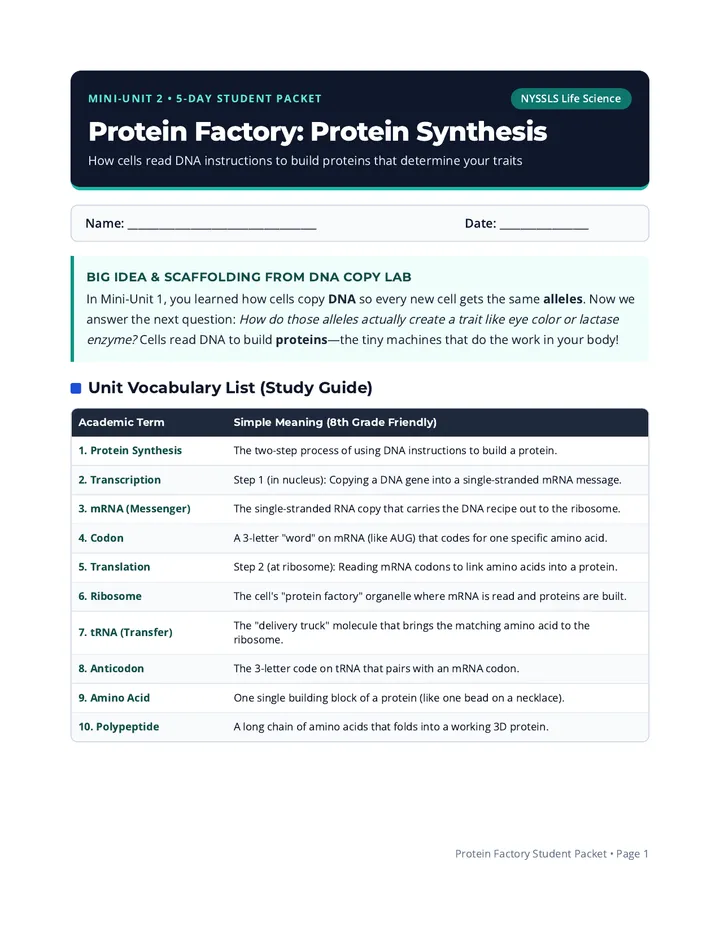
Protein Factory Student Packet Mini-Unit 2 • 5-Day Student Packet NYSSLS Life Science
Protein Factory: Protein Synthesis
How cells read DNA instructions to build proteins that determine your traits
Name: ____________________________________
Date: _________________
Big Idea & Scaffolding from DNA Copy Lab
In Mini-Unit 1, you learned how cells copy DNA so every new cell gets the same alleles . Now we answer the next question: How do those alleles actually create a trait like eye color or lactase enzyme? Cells read DNA to build proteins —the tiny machines that do the work in your body!
Unit Vocabulary List (Study Guide)
Academic Term
Simple Meaning (8th Grade Friendly)
1. Protein Synthesis
The two-step process of using DNA instructions to build a protein.
2. Transcription
Step 1 (in nucleus): Copying a DNA gene into a single-stranded mRNA message.
3. mRNA (Messenger)
The single-stranded RNA copy that carries the DNA recipe out to the ribosome.
4. Codon
A 3-letter "word" on mRNA (like AUG) that codes for one specific amino acid.
5. Translation
Step 2 (at ribosome): Reading mRNA codons to link amino acids into a protein.
6. Ribosome
The cell's "protein factory" organelle where mRNA is read and proteins are built.
7. tRNA (Transfer)
The "delivery truck" molecule that brings the matching amino acid to the ribosome.
8. Anticodon
The 3-letter code on tRNA that pairs with an mRNA codon.
9. Amino Acid
One single building block of a protein (like one bead on a necklace).
10. Polypeptide
A long chain of amino acids that folds into a working 3D protein.
Protein Factory Student Packet • Page 1
Word Wall Matching Exercise
Vocabulary Check
Directions: Read each numbered academic vocabulary word in Column A . Find its matching definition in Column B . Write the letter from Column B on the blank line next to the number in Column A.
Column A: Vocabulary Terms
______ 1. Protein Synthesis
______ 2. Transcription
______ 3. mRNA
______ 4. Codon
______ 5. Translation
______ 6. Ribosome
______ 7. tRNA
______ 8. Anticodon
______ 9. Amino Acid
______ 10. Polypeptide
Column B: Definitions
A. The "delivery truck" molecule that carries an amino acid to the ribosome.
B. A 3-letter code on mRNA that calls for one specific amino acid.
C. The cell organelle ("factory") where proteins are assembled.
D. A long chain of amino acids that folds into a working protein.
E. Step 1 in the nucleus: making an mRNA copy of a DNA gene.
F. The 3-letter code on tRNA that matches up with an mRNA codon.
G. The complete two-step process of building a protein from DNA.
H. One single building block (monomer) of a protein.
I. The single-stranded messenger molecule that leaves the nucleus.
J. Step 2 at the ribosome: decoding mRNA to link amino acids together.
Bridge Check: From DNA Copy Lab to Protein Factory
Complete the sentence using the word bank: nucleus, proteins, DNA .
A cell's __________________________ stays safely inside the __________________________, so it sends an mRNA copy out to the ribosome to build __________________________.
Protein Factory Student Packet • Page 2
Day 1 of 5 • 45-Minute Lesson
Transcription: DNA to mRNA
NYSSLS HS-LS1-1
1. Do Now (4 Minutes)
Think of a priceless, one-of-a-kind cookbook in a library that cannot leave the building. If you want to cook a recipe at home (at the ribosome), what should you do?
2. Guided Reading / Video Segment (6 Minutes)
Chunked Reading
Chunk 1 — Why DNA Stays Put: DNA is too big and too important to leave the nucleus . Instead, the cell makes a temporary, single-stranded copy of just one gene called mRNA (messenger RNA). This step is called transcription .
Chunk 2 — RNA's Special Letter (U): RNA uses A, C, and G just like DNA—but instead of Thymine (T), RNA uses Uracil (U) ! So during transcription, DNA's A pairs with RNA's U .
3. Mini-Lesson: DNA vs. mRNA Rules (12–15 Minutes)
Location: Transcription happens inside the nucleus .Base Pairing for mRNA: DNA A → U , DNA T → A , DNA C → G , DNA G → C .Example: DNA: T A C - G G A → mRNA: A U G - C C U.
Quick Practice — Transcribe DNA into mRNA (Remember: No T in RNA, use U!):
DNA Template: T – A – C – A – A – G – C – T – A
mRNA Strand: ___ – ___ – ___ – ___ – ___ – ___ – ___ – ___ – ___
Protein Factory Student Packet • Page 3
Day 1 Activity & Exit Ticket
20-Minute Student Activity
Directions: Annotate the Transcription diagram below. Label: (1) Nucleus , (2) DNA (Double Strand) , (3) mRNA (Single Strand) , and (4) Cytoplasm / Ribosome .
1. Explain why a cell uses mRNA instead of sending the original DNA out to the ribosome.
Sentence Starter: A cell uses mRNA instead of DNA because...
Day 1 Exit Ticket
If a DNA template strand reads A – C – G – T , what is the matching mRNA sequence?
A. T – G – C – A
B. U – G – C – A
C. A – C – G – U
D. U – C – G – T
Unfinished questions in this lesson are due as Homework at our next class meeting
Protein Factory Student Packet • Page 4
Day 2 of 5 • 45-Minute Lesson
Codons & The Genetic Code
NYSSLS HS-LS1-1
1. Do Now (4 Minutes)
Look at these letters: CATDOGBUG. How does grouping them into 3-letter words (CAT - DOG - BUG) help you read the message?
2. Guided Reading / Video Segment (6 Minutes)
Chunked Reading
Chunk 1 — 3-Letter Words (Codons): The ribosome reads mRNA three letters at a time. Each 3-letter group on mRNA is called a codon .
Chunk 2 — Start, Amino Acids & Stop: Each codon matches one specific amino acid (protein building block). AUG is the universal Start codon (Methionine). Codons like UAA tell the ribosome to Stop !
3. Mini-Lesson: Using a Codon Chart (12–15 Minutes)
Universal Code: Every living thing—bacteria, corn, mice, and humans—uses the same codon chart!How to Read It: Find the 3-letter mRNA codon (NOT DNA!) in the chart to see which amino acid it builds.Example: mRNA AUG - CCU - UAA → Start (Met) – Proline – STOP .
Sentence Starter Check-In:
An mRNA codon is made of ________ bases and codes for one ____________________________.
Protein Factory Student Packet • Page 5
Day 2 Activity & Exit Ticket
20-Minute Student Activity
Directions: Use the Mini Codon Chart below to decode the mRNA strip into amino acids. Write each amino acid in the blank boxes!
Mini mRNA Codon Chart
AUG = Met (Start)
CCU = Proline
GGA = Glycine
UUC = Phenylalanine
AAA = Lysine
CGU = Arginine
GUC = Valine
UAA = STOP
Decode This mRNA Strip (Group into 3-letter codons):
AUG
GGA
UUC
UAA
1. Why is it important that ALL living organisms (from bacteria to humans) use the same genetic codon chart?
Day 2 Exit Ticket
Using the Mini Codon Chart above, how many amino acids are coded by AUG - CCU - AAA - UAA (not counting STOP)?
A. 1
B. 3
C. 4
D. 12
Unfinished questions in this lesson are due as Homework at our next class meeting
Protein Factory Student Packet • Page 6
Day 3 of 5 • 45-Minute Lesson
Translation: tRNA, Anticodons & Ribosomes
NYSSLS HS-LS1-1
1. Do Now (4 Minutes)
In a factory, the manager reads the blueprint, and delivery trucks bring the parts. If the ribosome is the factory and mRNA is the blueprint, what job does tRNA ("transfer RNA") do?
2. Guided Reading / Video Segment (6 Minutes)
Chunked Reading
Chunk 1 — The Ribosome Factory: After mRNA leaves the nucleus, it attaches to a ribosome in the cytoplasm. Here, translation happens: turning the RNA code into a protein!
Chunk 2 — tRNA & Anticodons: Floating tRNA molecules act like delivery trucks. Each tRNA carries one specific amino acid on top and has a 3-letter anticodon on the bottom that snaps onto the matching mRNA codon (A↔U, C↔G).
3. Mini-Lesson: Codon Meets Anticodon (12–15 Minutes)
Matching Rule (RNA to RNA): mRNA A ↔ U tRNA, and mRNA C ↔ G tRNA.Example: If mRNA codon is AUG, the matching tRNA anticodon is UAC!Assembly Line: As the ribosome moves along mRNA, tRNAs drop off amino acids one by one, linking them into a growing chain.
Sentence Starter Check-In:
During translation at the ribosome, tRNA uses its _______________________ to match the mRNA
_______________________ and drop off the correct _______________________.
Protein Factory Student Packet • Page 7
Day 3 Activity & Exit Ticket
20-Minute Student Activity
Directions: Annotate the Translation diagram below. Label: (1) Ribosome , (2) Amino Acid , (3) tRNA , (4) mRNA , and fill in the missing Anticodon letters!
AUG GGA UUC ___ Gly
1. For the mRNA codon GGA above, what must the matching tRNA anticodon be?
Day 3 Exit Ticket
Which cell organelle is the site of translation where amino acids are joined into a protein?
A. Nucleus
B. Ribosome
C. Vacuole
D. Cell Wall
Unfinished questions in this lesson are due as Homework at our next class meeting
Protein Factory Student Packet • Page 8
Day 4 of 5 • 45-Minute Lesson
From Amino Acid Chain to Trait
NYSSLS HS-LS1-1
1. Do Now (4 Minutes)
Why does a key only open one specific lock? How might the 3D shape of a protein be like a key?
2. Guided Reading / Video Segment (6 Minutes)
Chunked Reading
Chunk 1 — Shape = Function: When the ribosome finishes linking amino acids into a polypeptide chain, the chain folds into a specific 3D protein . The exact order of amino acids controls how the protein folds—and a protein's shape determines its job!
Chunk 2 — Connecting to Alleles & Punnett Squares: A dominant allele (like B for brown pigment) codes for a working protein enzyme. A recessive allele (b ) often codes for a different-shaped or non-working protein!
3. Mini-Lesson: The Central Dogma Chain (12–15 Minutes)
DNA (Gene/Allele) → mRNA (Transcription) → Amino Acid Chain (Translation) → Folded Protein → Trait!
Sentence Starter Check-In:
The order of amino acids is important because it determines the protein's _____________________
which determines _______________________________________________________________________.
Protein Factory Student Packet • Page 9
Day 4 Activity & Exit Ticket
20-Minute Student Activity
Directions: Annotate the Protein Folding diagram below. Label: (1) Polypeptide (Amino Acid Chain) , (2) Folding , and (3) Working 3D Protein .
1. A student has two recessive alleles (bb ) in a Punnett square. How does this relate to protein synthesis?
Day 4 Exit Ticket
What directly determines the final 3D shape and function of a protein?
A. The number of vacuoles in the cell
B. The specific sequence (order) of amino acids
C. The size of the cell membrane
D. The number of chromosomes in mitosis
Unfinished questions in this lesson are due as Homework at our next class meeting
Protein Factory Student Packet • Page 10
Day 5 of 5 • 45-Minute Lesson
Mutations & Protein Shape
NYSSLS HS-LS3-2
1. Do Now (4 Minutes)
If one letter in a DNA gene changes (a mutation), what happens to the mRNA codon made from that gene?
2. Guided Reading / Video Segment (6 Minutes)
Chunked Reading
Chunk 1 — The Domino Effect: A change in DNA (mutation) changes the mRNA codon . A changed codon can bring in a different amino acid .
Chunk 2 — Altered Protein: When an amino acid changes, the protein may fold into the wrong 3D shape and stop working properly (for example, sickle cell hemoglobin). Sometimes, though, two codons code for the same amino acid, so the protein stays normal!
3. Mini-Lesson: Types of DNA Mutations (12–15 Minutes)
Substitution: One base is swapped for another (changes 1 codon).Insertion or Deletion: A base is added or removed—this shifts every codon after it!
Sentence Starter Check-In:
A DNA mutation can harm a cell because changing the DNA changes the _____________________
which can change the _______________________ and fold the protein into the wrong shape.
Protein Factory Student Packet • Page 11
Day 5 Activity & Exit Ticket
20-Minute Student Activity
Directions: Compare the Normal Gene and Mutated Gene below. Fill in the missing mRNA codon and circle where the amino acid changed!
Normal Gene DNA: C C T mRNA: G G A Amino Acid: Glycine Mutated Gene DNA: C A T mRNA: Amino Acid: Valine
1. Explain how changing one DNA letter (C→A) above can stop the final protein from working.
Day 5 Exit Ticket
Which sequence correctly shows the flow of genetic information to make a trait?
A. Protein → mRNA → DNA
B. DNA → mRNA → Amino Acid Chain → Protein
C. mRNA → DNA → tRNA → Nucleus
D. Ribosome → DNA → Codon
Unfinished questions in this lesson are due as Homework at our next class meeting
Protein Factory Student Packet • Page 12
20-Question NYSSLS Regents Practice Set • Protein Synthesis
NYS Life Science Regents Practice (Questions 1–4)
Phenomenon Stimulus (Cluster 1): Insulin is a protein hormone made by pancreas cells to control blood sugar. A pancreas cell reads the insulin gene on DNA: T A C - G G A - A A G.
1. Where inside the pancreas cell does transcription of the insulin gene take place?
(1) Ribosome (2) Nucleus (3) Cell membrane (4) Mitochondrion
2. What is the mRNA sequence transcribed from the DNA strand T A C - G G A - A A G?
(1) A U G - C C U - U U C (2) A T G - C C T - T T C (3) U A C - G G A - A A G (4) T A C - G G A - A A G
3. Which organelle will the insulin mRNA travel to next to assemble amino acids?
(1) Vacuole (2) Chloroplast (3) Ribosome (4) Lysosome
4. [Constructed Response] Explain why the pancreas cell makes an mRNA copy of the insulin gene instead of moving the DNA out to the cytoplasm.
Protein Factory Student Packet • Page 13
NYS Life Science Regents Practice (Questions 5–9)
Phenomenon Stimulus (Cluster 2): During translation, an mRNA strand with codons AUG - CCU - GGA - UAA is read by a ribosome.
5. Which molecule carries amino acids to the ribosome and pairs with mRNA codons?
(1) DNA polymerase (2) tRNA (3) Helicase (4) Glucose
6. What is the tRNA anticodon that matches the mRNA codon CCU ?
(1) GGA (2) GGT (3) CCU (4) UUC
7. [Constructed Response] How many bases make up one codon, and what does each codon specify during translation?
8. Which nitrogenous base is found in RNA (mRNA and tRNA) but NOT in DNA?
(1) Adenine (2) Cytosine (3) Guanine (4) Uracil
9. [Constructed Response] Explain the difference between transcription and translation in protein synthesis.
Protein Factory Student Packet • Page 14
NYS Life Science Regents Practice (Questions 10–14)
Phenomenon Stimulus (Cluster 3): Scientists inserted a jellyfish gene for glowing green protein (GFP) into a mouse embryo. The mouse cells successfully read the jellyfish DNA and glowed green under UV light.
10. Why were the mouse cells able to read the jellyfish gene and build the exact same GFP protein?
(1) All organisms share the same universal genetic code (codons). (2) Mice and jellyfish are the same species. (3) Jellyfish do not have ribosomes. (4) Mouse DNA has no bases.
11. What are the building blocks linked together by the ribosome to form the GFP protein?
(1) Simple sugars (2) Amino acids (3) Fatty acids (4) Nucleotides
12. [Constructed Response] Explain why the 3D shape of the GFP protein is essential for it to glow.
13. If the mouse later reproduces by meiosis, can it pass the GFP allele to its offspring?
(1) Yes, because the gene is in its DNA (2) No, proteins cannot be inherited (3) Only if the mouse eats jellyfish (4) Only through mitosis
14. [Constructed Response] Describe how a Punnett square allele (like B or b ) relates to protein synthesis inside a cell.
Protein Factory Student Packet • Page 15
NYS Life Science Regents Practice (Questions 15–20)
Phenomenon Stimulus (Cluster 4): A single-base mutation in a human hemoglobin gene changes the mRNA codon from GAG (Glutamic acid) to GUG (Valine), causing red blood cells to sickle.
15. What caused the hemoglobin protein to fold into the wrong shape?
(1) A different amino acid was placed in the chain (2) The cell ran out of ribosomes (3) Mitosis stopped (4) DNA was replaced by starch
16. Which type of DNA mutation happened when one base was swapped for another?
(1) Substitution (2) Meiosis (3) Replication (4) Osmosis
17. A long chain of amino acids before it folds into a 3D protein is called a:
(1) Polypeptide (2) Nucleotide (3) Chromatid (4) Codon
18. Why do some DNA mutations NOT change the final protein at all?
(1) More than one codon can code for the same amino acid (2) mRNA ignores all mutations (3) Ribosomes fix DNA directly (4) Proteins have no shape
19. [Constructed Response] Explain why deleting ONE base from a DNA gene is usually much more harmful than substituting one base.
20. [Constructed Response] Summarize the complete path from DNA in the nucleus to a working protein in the cytoplasm, naming mRNA , ribosome , tRNA , and amino acids .
Unfinished questions in this lesson are due as Homework at our next class meeting
Protein Factory Student Packet • Page 16
Protein Factory Slide Deck Mini-Unit 2 • 5-Day Slide Deck NYSSLS Life Science
Protein Factory: Protein Synthesis
How cells read DNA instructions to build proteins that determine your traits.
Building On: DNA Copy Lab • Alleles • Punnett Squares • Mitosis • Meiosis
Unit Vocabulary Word Wall
1. Protein Synthesis
2. Transcription
3. mRNA (Messenger)
4. Codon
5. Translation
6. Ribosome
7. tRNA (Transfer)
8. Anticodon
9. Amino Acid
10. Polypeptide
Complete the Word Wall Matching Exercise on Page 2 of your packet!
Day 1: Transcription (DNA to mRNA) 4-Min Do Now
Think of a priceless, one-of-a-kind cookbook in a library that cannot leave the building. If you want to cook a recipe at home (at the ribosome), what should you do?
Write your answer in your Day 1 Do Now box (Page 3).
Day 1: Guided Reading / Video
6 Minutes
Teacher-Selected Video
Insert class video link here, or use the 6-minute chunked reading on the right.
1. DNA Stays in Nucleus: Cells make a single-stranded copy called mRNA (Transcription).
2. RNA Uses U: Instead of Thymine (T), RNA uses Uracil (U) ! So DNA A pairs with RNA U .
Follow along on Page 3 of your packet.
Day 1 Mini-Lesson: DNA vs. mRNA
12–15 Minutes
Location: Transcription happens inside the nucleus .RNA Pairing: DNA A → U , T → A, C → G, G → C.Practice: T A C - A A G → A U G - U U C
Complete the Quick Practice at the bottom of Page 3.
Day 1 Activity: Annotate Transcription
20 Minutes
Nucleus DNA mRNA (leaves nucleus) Ribosome
Label your diagram on Page 4 and answer Question 1.
Day 1 Exit Ticket
If a DNA template strand reads A – C – G – T , what is the matching mRNA sequence?
A. T – G – C – A
B. U – G – C – A
C. A – C – G – U
D. U – C – G – T
Unfinished questions in this lesson are due as Homework at our next class meeting
Day 2: Codons & Genetic Code 4-Min Do Now
Look at these letters: CATDOGBUG. How does grouping them into 3-letter words (CAT - DOG - BUG) help you read the message?
Write your answer in your Day 2 Do Now box (Page 5).
Day 2: Guided Reading / Video
6 Minutes
Teacher-Selected Video
Insert class video link here, or use the 6-minute chunked reading on the right.
1. Codons: 3-letter "words" on mRNA. Each codon codes for one amino acid .
2. Start & Stop: AUG = Start (Met); UAA = Stop!
Follow along on Page 5 of your packet.
Day 2 Mini-Lesson: Codon Chart
12–15 Minutes
Universal Code: Every living organism uses the exact same codon chart!Always Use mRNA: Look up the mRNA codon (not DNA) in the chart.Example: AUG - CCU - UAA → Start (Met) – Proline – STOP.
Complete the Sentence Starter on Page 5.
Day 2 Activity: Decode the mRNA Strip
20 Minutes
AUG = Met (Start)
CCU = Proline
GGA = Glycine
UUC = Phe
AUG
GGA
UUC
UAA
Write the amino acids in the blank boxes on Page 6.
Day 2 Exit Ticket
How many amino acids are coded by AUG - CCU - AAA - UAA (not counting STOP)?
A. 1
B. 3
C. 4
D. 12
Unfinished questions in this lesson are due as Homework at our next class meeting
Day 3: Translation & Ribosomes 4-Min Do Now
If the ribosome is the factory and mRNA is the blueprint, what job does tRNA ("transfer RNA") do?
Write your answer in your Day 3 Do Now box (Page 7).
Day 3: Guided Reading / Video
6 Minutes
Teacher-Selected Video
Insert class video link here, or use the 6-minute chunked reading on the right.
1. Ribosome: The protein factory where translation happens.
2. tRNA & Anticodons: Delivery trucks that match their 3-letter anticodon to the mRNA codon (A↔U, C↔G).
Follow along on Page 7 of your packet.
Day 3 Mini-Lesson: Codon vs. Anticodon
12–15 Minutes
RNA-to-RNA Pairing: mRNA A ↔ tRNA U; mRNA C ↔ tRNA G.Example: mRNA codon AUG matches tRNA anticodon UAC.Assembly Line: Ribosome links amino acids together into a growing chain.
Complete the Sentence Starter on Page 7.
Day 3 Activity: Ribosome Assembly
20 Minutes
Ribosome AUG GGA UUC mRNA CCU Gly Amino Acid tRNA
Annotate the diagram and fill in the anticodon on Page 8.
Day 3 Exit Ticket
Which cell organelle is the site of translation where amino acids are joined into a protein?
A. Nucleus
B. Ribosome
C. Vacuole
D. Cell Wall
Unfinished questions in this lesson are due as Homework at our next class meeting
Day 4: Amino Acid Chain to Trait 4-Min Do Now
Why does a key only open one specific lock? How might the 3D shape of a protein be like a key?
Write your answer in your Day 4 Do Now box (Page 9).
Day 4: Guided Reading / Video
6 Minutes
Teacher-Selected Video
Insert class video link here, or use the 6-minute chunked reading on the right.
1. Shape = Function: The order of amino acids controls how the protein folds into a 3D shape.
2. Alleles & Proteins: Dominant/recessive alleles in Punnett squares code for different versions of proteins!
Follow along on Page 9 of your packet.
Day 4 Mini-Lesson: Central Dogma
12–15 Minutes
DNA (Allele) → mRNA → Amino Acid Chain → Folded Protein → Trait!
Complete the Sentence Starter on Page 9.
Day 4 Activity: Protein Folding
20 Minutes
Polypeptide Chain Folding Working 3D Protein
Annotate the diagram and answer Question 1 on Page 10.
Day 4 Exit Ticket
What directly determines the final 3D shape and function of a protein?
A. The number of vacuoles in the cell
B. The specific sequence (order) of amino acids
C. The size of the cell membrane
D. The number of chromosomes in mitosis
Unfinished questions in this lesson are due as Homework at our next class meeting
Day 5: Mutations & Protein Shape 4-Min Do Now
If one letter in a DNA gene changes (a mutation), what happens to the mRNA codon made from that gene?
Write your answer in your Day 5 Do Now box (Page 11).
Day 5: Guided Reading / Video
6 Minutes
Teacher-Selected Video
Insert class video link here, or use the 6-minute chunked reading on the right.
1. Domino Effect: DNA mutation → changed mRNA codon → different amino acid.
2. Altered Shape: The protein may fold into the wrong 3D shape and stop working!
Follow along on Page 11 of your packet.
Day 5 Mini-Lesson: Mutation Types
12–15 Minutes
Substitution: One base swaps for another (changes 1 codon).Insertion / Deletion: Adds or removes a base, shifting every codon after it!Silent Mutations: Sometimes two codons code for the same amino acid.
Complete the Sentence Starter on Page 11.
Day 5 Activity: Spot the Protein Change
20 Minutes
Normal Gene
DNA: C C T
mRNA: G G A
Glycine
Mutated Gene
DNA: C A T
mRNA: G U A
Valine
Complete Page 12, then begin the 20-Question Regents Practice Set!
Day 5 Exit Ticket
Which sequence correctly shows the flow of genetic information to make a trait?
A. Protein → mRNA → DNA
B. DNA → mRNA → Amino Acid Chain → Protein
C. mRNA → DNA → tRNA → Nucleus
D. Ribosome → DNA → Codon
Unfinished questions in this lesson are due as Homework at our next class meeting
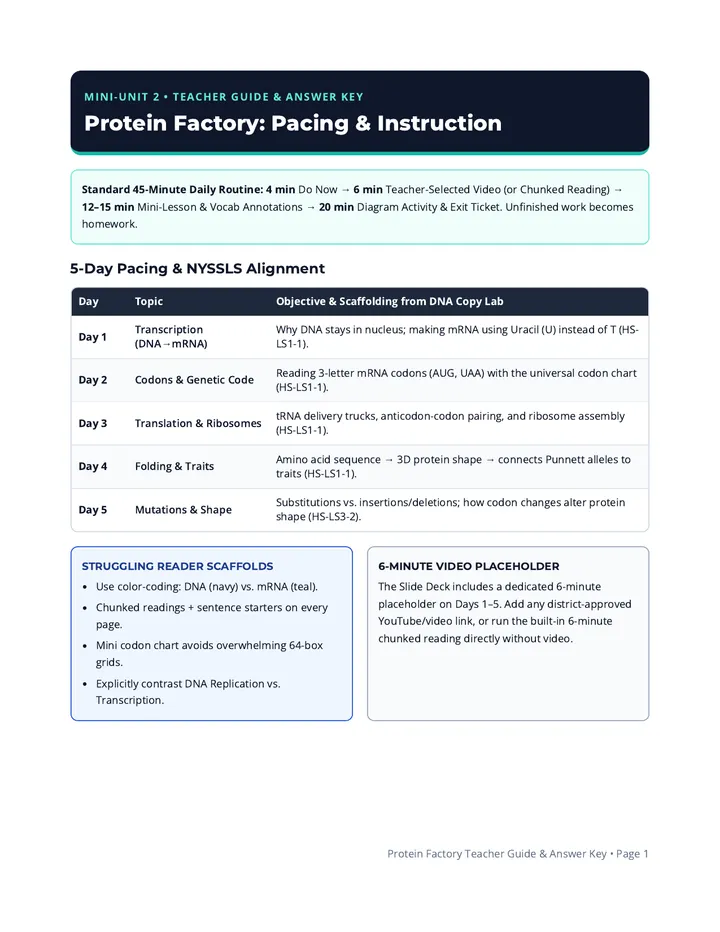
Protein Factory Teacher Guide & Answer Key Mini-Unit 2 • Teacher Guide & Answer Key
Protein Factory: Pacing & Instruction
Standard 45-Minute Daily Routine: 4 min Do Now → 6 min Teacher-Selected Video (or Chunked Reading) → 12–15 min Mini-Lesson & Vocab Annotations → 20 min Diagram Activity & Exit Ticket. Unfinished work becomes homework.
5-Day Pacing & NYSSLS Alignment
Day
Topic
Objective & Scaffolding from DNA Copy Lab
Day 1
Transcription (DNA→mRNA)
Why DNA stays in nucleus; making mRNA using Uracil (U) instead of T (HS-LS1-1).
Day 2
Codons & Genetic Code
Reading 3-letter mRNA codons (AUG, UAA) with the universal codon chart (HS-LS1-1).
Day 3
Translation & Ribosomes
tRNA delivery trucks, anticodon-codon pairing, and ribosome assembly (HS-LS1-1).
Day 4
Folding & Traits
Amino acid sequence → 3D protein shape → connects Punnett alleles to traits (HS-LS1-1).
Day 5
Mutations & Shape
Substitutions vs. insertions/deletions; how codon changes alter protein shape (HS-LS3-2).
Struggling Reader Scaffolds
Use color-coding: DNA (navy) vs. mRNA (teal).
Chunked readings + sentence starters on every page.
Mini codon chart avoids overwhelming 64-box grids.
Explicitly contrast DNA Replication vs. Transcription.
6-Minute Video Placeholder
The Slide Deck includes a dedicated 6-minute placeholder on Days 1–5. Add any district-approved YouTube/video link, or run the built-in 6-minute chunked reading directly without video.
Protein Factory Teacher Guide & Answer Key • Page 1
Answer Key: Word Wall & Days 1–5
Page 2 — Word Wall Matching & Bridge Check
1. G | 2. E | 3. I | 4. B | 5. J | 6. C | 7. A | 8. F | 9. H | 10. D
Bridge Check: DNA; nucleus; proteins.
Day 1 (Pages 3–4): Do Now: Make a copy of just the recipe you need to take home. Mini-Lesson Practice: A – U – G – U – U – C – G – A – U. Diagram Labels: Nucleus (dashed circle), DNA (double strand), mRNA (teal arrow leaving nucleus), Cytoplasm/Ribosome (oval). Q1: DNA is too large/valuable to leave the nucleus, so mRNA carries a temporary copy. Exit Ticket: B (U – G – C – A) .
Day 2 (Pages 5–6): Do Now: Grouping into 3-letter words makes the message readable. Diagram Strip: AUG = Met (Start) ; GGA = Glycine ; UUC = Phenylalanine ; UAA = STOP . Q1: Shows all life shares a common evolutionary history and universal genetic code. Exit Ticket: B (3) .
Day 3 (Pages 7–8): Do Now: tRNA acts as delivery trucks bringing amino acids to the ribosome. Diagram: Ribosome (large oval), mRNA (navy strip), tRNA (blue box), Amino Acid (yellow circle), Missing Anticodon = CCU . Q1: CCU . Exit Ticket: B (Ribosome) .
Day 4 (Pages 9–10): Do Now: A protein's 3D shape fits only specific molecules (lock and key) to do its job. Diagram Labels: Polypeptide (chain of circles), Folding (arrow), Working 3D Protein (folded shape). Q1: Both recessive alleles (bb) code for a non-working or differently shaped protein, producing the recessive trait. Exit Ticket: B .
Day 5 (Pages 11–12): Do Now: The mRNA codon changes too. Diagram: Mutated mRNA box = G U A ; circle Glycine → Valine change. Q1: Changing C to A changes the mRNA codon (GGA→GUA), placing Valine instead of Glycine, which can misfold the protein. Exit Ticket: B .
Protein Factory Teacher Guide & Answer Key • Page 2
Answer Key: 20-Question Regents Practice Set
Q#
Type
Correct Answer / Constructed Response Scoring Guide
1
MC
(2) Nucleus
2
MC
(1) A U G - C C U - U U C
3
MC
(3) Ribosome
4
CR
DNA is too large to leave the nucleus and must be protected; mRNA is a small, disposable copy that travels to the ribosome.
5
MC
(2) tRNA
6
MC
(1) GGA
7
CR
Three bases make up one codon; each codon specifies one specific amino acid (or a Start/Stop signal).
8
MC
(4) Uracil
9
CR
Transcription copies DNA into mRNA inside the nucleus; translation reads mRNA codons at the ribosome to assemble amino acids into a protein.
10
MC
(1) All organisms share the same universal genetic code (codons).
11
MC
(2) Amino acids
12
CR
A protein's 3D shape determines its function; if GFP does not fold into the right shape, it cannot glow.
13
MC
(1) Yes, because the gene is in its DNA
14
CR
Each allele (B or b) is a slightly different DNA sequence that codes for a different version of a protein, producing different traits.
15
MC
(1) A different amino acid was placed in the chain
16
MC
(1) Substitution
17
MC
(1) Polypeptide
18
MC
(1) More than one codon can code for the same amino acid
19
CR
Deleting one base shifts every 3-letter codon after the mutation (frameshift), changing almost all remaining amino acids.
20
CR
DNA in the nucleus is transcribed into mRNA, which travels to a ribosome where tRNA delivers matching amino acids to build a folded protein.
Protein Factory Teacher Guide & Answer Key • Page 3