Is Rain Cause Worksheet
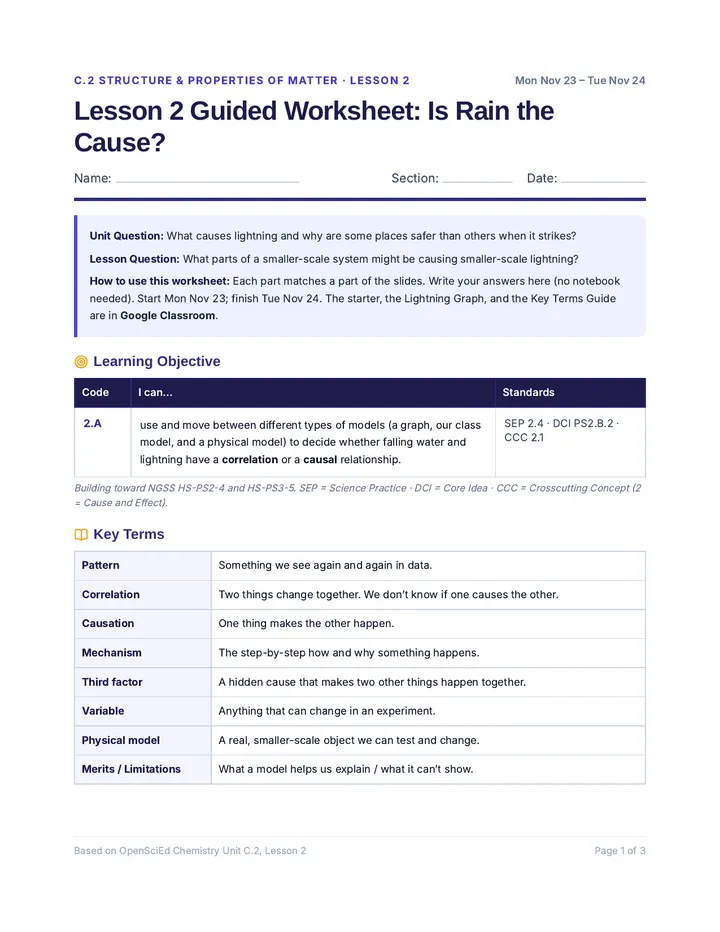
C.2 Structure & Properties of Matter · Lesson 2 Mon Nov 23 – Tue Nov 24
Lesson 2 Guided Worksheet: Is Rain the Cause?
Name:
Section:
Date:
Unit Question: What causes lightning and why are some places safer than others when it strikes?
Lesson Question: What parts of a smaller-scale system might be causing smaller-scale lightning?
How to use this worksheet: Each part matches a part of the slides. Write your answers here (no notebook needed). Start Mon Nov 23; finish Tue Nov 24. The starter, the Lightning Graph, and the Key Terms Guide are in Google Classroom.
Learning Objective
| Code |
I can… |
Standards |
| 2.A |
use and move between different types of models (a graph, our class model, and a physical model) to decide whether falling water and lightning have a correlation or a causal relationship. |
SEP 2.4 · DCI PS2.B.2 · CCC 2.1 |
Building toward NGSS HS-PS2-4 and HS-PS3-5. SEP = Science Practice · DCI = Core Idea · CCC = Crosscutting Concept (2 = Cause and Effect).
Key Terms
Based on OpenSciEd Chemistry Unit C.2, Lesson 2 Page 1 of 3
Mon Nov 23 · Lecture Time · Is Rain the Cause?
Starter: answer today’s question in Google Classroom.
Part 1 · Lesson 1 Recap
| What did our class model show about what causes lightning? |
What were we still unsure about? |
|
|
Part 2 · Predict: Do rainier clouds make more lightning?
Circle one: YES NO NOT SURE
My reason:
Part 3 · Read the Lightning Graph
1. What do the title and the axes mean?
x-axis:
y-axis:
2. What do you notice about the scales and the shape of the line?
3. As rainfall goes up, lightning goes up / down / stays the same (circle).
Part 4 · From a Pattern to a Cause
Word bank: pattern · correlation · causation · mechanism
| Step |
Word |
What it means |
| 1 |
|
Something we see again and again in data. |
| 2 |
|
Two things change together. |
| 3 |
|
One thing makes the other happen. |
| 4 |
|
The step-by-step how and why. |
Lesson 2 Guided Worksheet Page 2 of 3
Part 5 · Four Corners: Is one causing the other?
|
Statement |
Correlation, Causation, or Both? |
| A |
They happen together, but there is no connection. |
|
| B |
Clouds make lightning because they make rain. |
|
| C |
Clouds make rain because they make lightning. |
|
| D |
Clouds make both because of a third factor. |
|
| E |
We need more information. |
|
My corner: because
Part 6 · Correlation Is NOT Causation
1. Ice cream sales and sunburns both go up in summer. What is the third factor that causes both?
2. What is a possible third factor for rain and lightning?
Part 7 · Our Class Model: Merits and Limitations
| Merits (what it helps us explain) |
Limitations (what it can’t show) |
|
|
Part 8 · Why a Small Model?
Real lightning is too big and dangerous to test. If we built a small storm, what parts would it need?
Exit (Google Classroom)
Does the graph prove that rain causes lightning? Why or why not? Answer in Google Classroom.
Tue Nov 24: After Regents Review Quiz 2 (Physical Science: Chemistry C.1) on Pear Assessment, finish Parts 1–8 and the exit, then turn in this worksheet. The water dropper comes next in Lab Entry No. 2 (Mon Nov 30).
Based on OpenSciEd Chemistry Unit C.2, Lesson 2 Page 3 of 3
Lightning System Lab Entry
Lab Entry #02 · Guided Digital Lab
LIGHTNING SYSTEM
Lightning in a Bucket? · C.2 Lesson 2 · Mon Nov 30 · Video in Google Classroom
Name:
Sec:
Date:
Your Job: Act as a storm investigator. Watch a small-scale physical model and decide what it tells us about falling water and lightning.
3 Key Clues: ① Physical model (small and testable) · ② Matter & energy (what moves) · ③ Cause & effect
1
Case File: The Small Storm
Scenario: Lightning is too dangerous to test, so we use a physical model: the water dropper. Water drips through metal rings into metal buckets wired to two pennies.
1. Why use a physical model? ☐ Test safely ☐ Looks like a storm
2. Which class-model parts does it have? (Check 4)
☐ Store of water ☐ Falling water ☐ A spark ☐ Bottom object ☐ A cloud

Evidence: the water dropper diagram.
3. Sort each part by its material. Check one box per row.
| Part |
Metal |
Plastic |
Water |
| Tub (A) and cups (M) |
☐ |
☐ |
☐ |
| Pipettes (G) |
☐ |
☐ |
☐ |
| Rings (I), buckets (J), pennies (L), wires (K) |
☐ |
☐ |
☐ |
| What drips through the rings |
☐ |
☐ |
☐ |
2
Case File: The Video Evidence
Watch: Watch the foil leaves in the jar (the electroscope) and the gap between the pennies.
Electroscope (left) · pennies gap (right)
4. Before a spark, the foil leaves: ☐ Push apart ☐ Stay still
5. Right after the spark, the leaves: ☐ Come back together ☐ Push farther apart
6. Sparks happen: ☐ Every 30–60 s while water drips ☐ Only when touched
7. Battery or plug? ☐ Yes ☐ No
8. Energy leaves as: (Check 2) ☐ Light ☐ Sound ☐ Cold
3 Things I Notice
2 Things I Wonder
C.2 · Lesson 2 · Lightning System (water dropper) Page 1 of 2
3
Case File: Matter and Energy Flows
9. What matter is moving? ☐ Water ☐ Metal buckets ☐ Pennies
10. How is energy moving? ☐ As water falls, then across gap as a spark ☐ Stays in tub
11. Falling water and sparks happen together. This alone shows: ☐ Correlation ☐ Proven causation
12. What other data would help us decide if it is causation?
4
Case File: Model + Graph
Remember: The Lesson 2 graph: storms with more falling water make more lightning. Now the small model makes sparks only while water falls.

Lesson 2 Lightning Graph
13. Putting both together, many of us now lean toward:
☐ A · no connection ☐ B · clouds make lightning because they make rain ☐ C · rain because of lightning
14. Are we certain yet? ☐ Yes ☐ No, we still need the mechanism (the how)
5
Case File: Merits and Limitations
15. Is each statement a merit (it helps) or a limitation (it can’t show)?
| Statement about the water dropper |
Merit |
Limitation |
| It includes falling water AND a spark. |
☐ |
☐ |
| We can change the water flow and test it. |
☐ |
☐ |
| It has the same parts as our class model. |
☐ |
☐ |
| It does not show what happens at the particle level. |
☐ |
☐ |
| It does not look like a storm cloud. |
☐ |
☐ |
Final ChallengeCASE CLOSED · 16. MATCH THE MODEL
Write A–D in each box.
Water in the top tub
Dripping water
The two pennies
The spark between pennies
A · A lightning bolt
B · Rain falling
C · Water stored in the cloud
D · Cloud bottom & ground
17. How could the water dropper help us figure out what lightning is?
C.2 · Lesson 2 · Lightning System (water dropper) Page 2 of 2
What Is Spark Worksheet
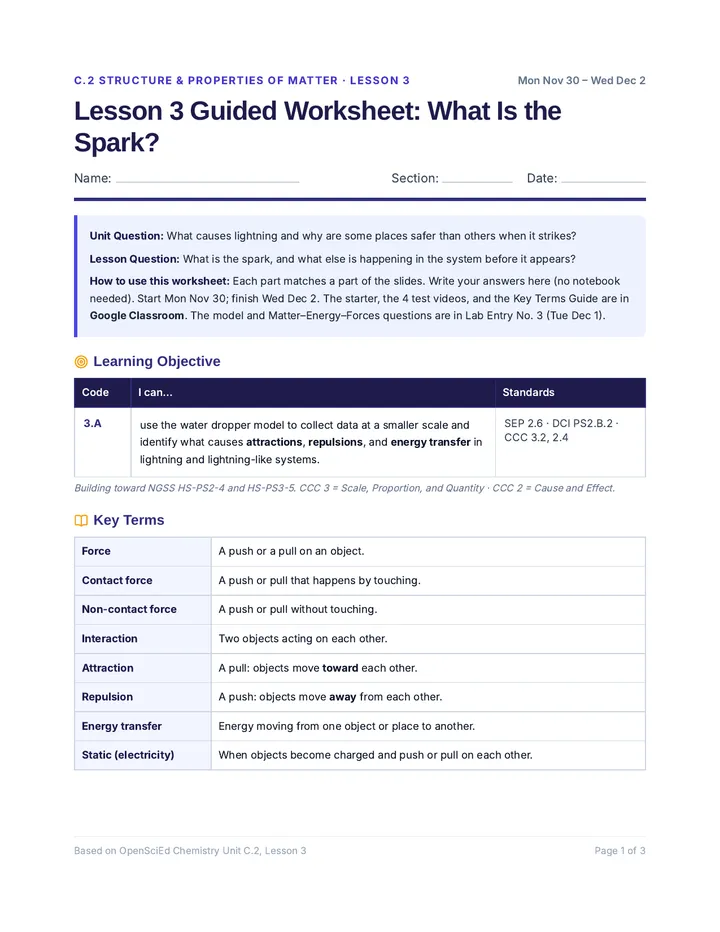
C.2 Structure & Properties of Matter · Lesson 3 Mon Nov 30 – Wed Dec 2
Lesson 3 Guided Worksheet: What Is the Spark?
Name:
Section:
Date:
Unit Question: What causes lightning and why are some places safer than others when it strikes?
Lesson Question: What is the spark, and what else is happening in the system before it appears?
How to use this worksheet: Each part matches a part of the slides. Write your answers here (no notebook needed). Start Mon Nov 30; finish Wed Dec 2. The starter, the 4 test videos, and the Key Terms Guide are in Google Classroom. The model and Matter–Energy–Forces questions are in Lab Entry No. 3 (Tue Dec 1).
Learning Objective
| Code |
I can… |
Standards |
| 3.A |
use the water dropper model to collect data at a smaller scale and identify what causes attractions, repulsions, and energy transfer in lightning and lightning-like systems. |
SEP 2.6 · DCI PS2.B.2 · CCC 3.2, 2.4 |
Building toward NGSS HS-PS2-4 and HS-PS3-5. CCC 3 = Scale, Proportion, and Quantity · CCC 2 = Cause and Effect.
Key Terms
Based on OpenSciEd Chemistry Unit C.2, Lesson 3 Page 1 of 3
Mon Nov 30 · Lecture Time · Testing Objects Near the Dropper
Starter: answer today’s question in Google Classroom.
Part 1 · Why Test Objects?
How could testing objects near the water dropper help us figure out what the spark is?
Part 2 · Building Our Force Words
Word bank: force · contact force · non-contact force · interaction
| Step |
Word |
Meaning |
My own example |
| 1 |
|
A push or a pull on an object. |
|
| 2 |
|
Push or pull by touching. |
|
| 3 |
|
Push or pull without touching. |
|
| 4 |
|
Two objects acting on each other. |
|
Part 3 · Watch and Record: The 4 Test Videos
For each video, watch: does the object move toward or away? Near which part? What happens at a spark?
| Station |
I NOTICE… |
Toward or away? Which part? |
I WONDER… |
| A · Light bulb |
|
|
|
| B · Plastic bag |
|
|
|
| C · Balloon |
|
|
|
| D · Tinsel |
|
|
|
Lesson 3 Guided Worksheet Page 2 of 3
Wed Dec 2 · Lecture Time · Pushes, Pulls, and Patterns
Part 4 · Attraction or Repulsion?
| Object |
Circle one |
| B · Plastic bag near a metal ring |
attraction / repulsion |
| C · Balloon near metal parts |
attraction / repulsion |
| D · Tinsel strands near a bucket |
attraction / repulsion |
Part 5 · Find the Patterns
1. What types of interactions did you notice?
2. What evidence of energy transfer did you see?
3. Circle: the pushes and pulls happened mostly near metal / plastic parts.
4. Circle: the forces were stronger when objects were closer / farther .
5. What happened to the pushes and pulls right after a spark?
Part 6 · Everyday Static
1. When have you seen pushes or pulls without touching?
2. When have you felt small sparks or shocks?
3. How is a shock from a doorknob like the spark in the water dropper?
Exit (Google Classroom)
What did the test videos show about forces near the water dropper? Answer in Google Classroom.
Wed Dec 2: Finish Parts 4–6 and the exit during lecture time, then turn in this worksheet. Lab time: Regents Review Quiz 3 on Pear Assessment.
Based on OpenSciEd Chemistry Unit C.2, Lesson 3 Page 3 of 3
Falling Water Sparks Slides
C.2 Structure & Properties of Matter · Lessons 2–3
Falling Water and Sparks
Can a small model in a classroom help us figure out what causes lightning?
Grade 11 Chemistry · Key Terms Guide in Google Classroom Nov 23 – Dec 2
Our Questions & Goals
What we are figuring out
Unit Question: What causes lightning and why are some places safer than others when it strikes?
Lesson 2 · Goal 2.A
Use different models to decide if falling water and lightning have a correlation or a causal relationship.
Lesson 3 · Goal 3.A
Use the water dropper to collect data on what causes attractions, repulsions, and energy transfer.
Schedule
Our plan, day by day
Mon 11/23 · Lab Lab Entry No. 1: Lightning Case Files
Mon 11/23 · Lecture Lesson 2: Is rain the cause? (worksheet)
Tue 11/24 · Lecture Regents Review Quiz 2 + finish Lesson 2 worksheet
Mon 11/30 · Lab Lab Entry No. 2: Lightning System (digital lab)
Mon 11/30 · Lecture Lesson 3: What is the spark? (worksheet)
Tue 12/1 · Lecture Lab Entry No. 3: Model and M-E-F (paper)
Wed 12/2 Lecture: finish Lesson 3 worksheet · Lab: Regents Quiz 3
Mon Nov 23 · Lab Time · Lab Entry No. 1
Lightning Case Files
When and where does lightning strike? Read each case, check the evidence, and pick the best answer on your lab sheet.
3 Key Clues: ① Warmth (Sun energy) · ② Moisture (humid air) · ③ Exposure (outside with no shelter)
Lab Entry No. 1 · Possible Answers
Cases 1 & 2: Vacation & Desert
Case 1: Summer Vacation
1. Tampa, FL. Red/orange on map = most U.S. lightning.
2. Warmth + Moisture. Hot, humid air feeds storms.
3. Morning. Afternoon heating builds storms.
Case 2: Desert Debate
4. Disagree. Heat alone is not enough.
5. Moisture. The Sahara air is very dry.
6. Near the equator. Central Africa is warm AND wet.
Lab Entry No. 1 · Possible Answers
Cases 3–6 & Risk Ranking
Cases 3–4 (Fisherman & Mountain): Less lightning does not mean safe! Being the tallest or most exposed object creates high risk.
Cases 5–6 (Field Day & Soccer): October has fewest flashes. Distance ≈ 9 ÷ 3 = 3 km (too close!). Wait 30 min indoors.
Final Risk Rank (1 = most at risk → 4 = safest): 1. Golfer in FL → 2. Hiker in CO → 3. Sahara guide → 4. Student indoors
Mon Nov 23 · Lecture Time · Lesson 2
Is rain the cause?
Data on rain and lightning, and the difference between correlation and causation.
Starter Question · Google Classroom
When it storms, does the rain cause the lightning? Why do you think so?
Lesson 1 Recap · Part 1
What our class model already includes
We agree
- The ground and objects on it
- Clouds (tiny water droplets)
- Air
- Something moving between cloud and ground
We’re unsure
- Is falling water (rain) needed?
- What exactly moves?
- What is lightning made of?
Lesson 2 · Parts 2 & 3
Do rainier clouds make more lightning?

Xu, Adler & Wang (2013) · Handout in Google Classroom
Axes: x = rainfall (km²·mm/hr) up to 300,000; y = lightning flashes per minute up to 500.
Shape: Curves upward! More rain goes with more lightning, and lightning grows faster at high rainfall.
Lesson 2 · Part 4
From a pattern to a cause, step by step
Step 1
Pattern
Something we see again and again in data.
Step 2
Correlation
Two things change together. Rain and lightning rise together.
Step 3
Causation
One thing makes the other happen. Not proven yet!
Step 4
Mechanism
The step-by-step how and why needed to prove a cause.
Lesson 2 · Parts 5 & 6
Correlation is NOT causation
A. Correlation only. · B, C, D. Correlation and causation. · E. Correlation; unsure.
Third factor: Hot, sunny weather causes both ice cream sales and sunburns. For storms, warm humid rising air makes clouds that produce both rain and lightning.
Big idea: The graph shows correlation. We need an experiment and a mechanism!
Lesson 2 · Parts 7 & 8
Our class model & why a physical model
Class Model Merits
- Shows the parts we think matter
- Easy to picture
- Lets us zoom in on particles
Class Model Limitations
- Doesn’t show how parts connect
- Can’t be tested directly
- Doesn’t explain falling water’s role
Physical model: A real, smaller-scale object we can test and change safely to study something too big or dangerous.
Tue Nov 24 · Lecture Time
Regents Review Quiz 2 + Finish Worksheet
1
Open Pear Assessment from Google Classroom.
2
Complete the Chemistry C.1 quiz on your own (15 min, no notes).
3
Finish Lesson 2 worksheet Parts 1–8 & Exit in Google Classroom.
Exit Question: Does the graph prove that rain causes lightning? Why or why not?
Mon Nov 30 · Lab Time · Lab Entry No. 2
Lightning System
Guided digital lab: watch a small storm with falling water and a real spark. Record everything on printed Lab Entry No. 2.
Your Job: ① Physical model · ② Matter & energy (what moves) · ③ Cause & effect
Lab Entry No. 2 · Case 2
Watch the water, foil, and pennies
Write 3 notices & 2 wonders
Embedded media
Electroscope: Watch the foil leaves in the jar before and right after a spark.
Gap between pennies: Look and listen! Is there a battery or wall plug?
Lab Entry No. 2 · Possible Answers
What the video evidence shows
4–5. Foil leaves: Push apart before a spark, then come back together right after. Something builds up and is released!
6. Timing: Sparks happen every 30–60 seconds only while water drips.
7–8. Energy: No battery or plug! Energy leaves the spark as light and sound.
Electric discharge: Built-up charge suddenly jumps across the air gap—like tiny lightning!
Lab Entry No. 2 · Cases 3–5 & Final Challenge
Matching the model to a storm
| Water dropper system |
Real thunderstorm |
| Water in the top tub |
C · Water stored in the cloud |
| Dripping water |
B · Falling water (rain) |
| The two pennies |
D · The cloud bottom and the ground |
| Spark between pennies |
A · A lightning bolt |
Next question: What objects could we bring near the water dropper to find out what the spark is?
Mon Nov 30 · Lecture Time · Lesson 3
What is the spark?
Test objects near the water dropper. Look for pushes, pulls, and energy.
Starter Question · Google Classroom
Name something that can push or pull an object without touching it.
Lesson 3 · Part 2
Building our force words
Step 1
Force
A push or a pull on an object.
Step 2
Contact force
Push or pull that happens by touching.
Step 3
Non-contact
Pushes or pulls without touching.
Step 4
Interaction
Two objects acting on each other.
Lesson 3 · Part 3 · Test Videos 1 & 2
Stations A & B: Light bulb & Plastic bag
Embedded media
A · Light bulb: Where does it light up?
Embedded media
B · Plastic bag: Toward or away? Which part?
Lesson 3 · Part 3 · Test Videos 3 & 4
Stations C & D: Balloon & Tinsel
Embedded media
C · Balloon: What happens near metal parts?
Embedded media
D · Tinsel: What do the strands do?
Lesson 3 · Key Terms & Observations
Two kinds of non-contact force
Attraction
A pull: objects move toward each other.
Bag & balloon pulled toward metal rings and buckets.
Repulsion
A push: objects move away from each other.
Tinsel strands spread apart near the bucket.
Light bulb: Glows briefly when touched to metal parts—brighter if longer since the last spark!
Tue Dec 1 · Lab Entry No. 3 · Page 1
Model One Interaction
1 · My object
Circle A, B, C, or D. Did it move toward or away? Circle attraction or repulsion.
2 · Zoom-in bubble
Draw what particles might be doing before and during a spark. Use ? when unsure.
3 · Explain it
Finish: “I think the object moved because…”
On the drawing: Draw your object near the part it moved toward or away from, and add arrows.
Tue Dec 1 · Lab Entry No. 3 · Page 2
Matter, Energy, AND Forces
Matter
Water drips into buckets; bag, balloon, and tinsel move. Something may build up on metal (?).
Energy
The bulb glows, objects move, and the spark gives off light and sound.
Force(s)
Non-contact attraction & repulsion; stronger up close, weaker right after a spark.
Put it together
Falling water builds something up → pushes & pulls grow → jumps gap as a spark, releasing energy.
Wed Dec 2 · Lesson 3 · Parts 4–6
Patterns & everyday static
Patterns across tests: Attraction or repulsion without touching, mostly near metal parts, stronger when closer, and weaker right after a spark.
Everyday static: Rubbing a balloon on hair, plastic wrap sticking, a doorknob shock after walking on carpet, dryer clothes crackling.
Static: When objects become charged and push or pull on each other. Is lightning giant static?
Wed Dec 2 · Wrap-Up & Lab Time
Lesson 3 Exit & Regents Review Quiz 3
Exit Question (Google Classroom): What did the test videos show about forces near the water dropper?
1
Turn in Lesson 3 worksheet, then open Pear Assessment.
2
Answer Chemistry C.1 questions on your own (no notes).
3
Submit, then review your Key Terms Guide quietly.