Bug Defense Slides Field Guide Vocabulary Grades 2 & 3 Science
Insect Defense Squad
How tiny bugs use clever strategies , special body parts , and fast actions to stay safe!
10 Power Words
Real Bug Examples
Word Detective Game
Our 3 Vocabulary Groups
10 Bold Words
Strategies
Smart tricks to fool hungry predators:
• camouflage
• mimicry
• warning colors
Body Parts
Built-in gear that protects the bug:
Actions
Fast moves insects do to escape or fight:
• hide • sting
• bite • spray
Watch for the bold words as we explore each bug!
Strategy & Action
Disappearing Acts
🌿🪲
camouflage
Colors or patterns that help an insect blend in with leaves, bark, or dirt.
Example: A walking stick uses camouflage to look just like a brown twig!
hide
To go somewhere out of sight so hungry predators cannot find you.
Example: Many beetles hide under rocks or tree bark during the day.
Think About It: If a bird cannot see you, it cannot eat you!
Survival Strategies
Bright Tricks & Copycats
🐞🦋
warning colors
Bright red, yellow, or orange colors that shout, "Stay away! I taste bad or I am dangerous!"
Example: A ladybug's red shell uses warning colors to scare off birds.
mimicry
Looking or acting like another dangerous or bad-tasting animal to stay safe.
Example: A harmless hoverfly uses mimicry to look like a stinging wasp!
Memory Trick: Mimicry sounds like "mimic," which means to copy!
Body Parts
Built-In Bug Gear
🛡️🐝
armor
A hard outer shell that protects an insect's soft body, like a knight's suit.
Beetles wear tough armor on their backs.
jaws
Strong mouth parts that insects use to pinch, grab, or chomp enemies.
Stag beetles have giant jaws for pinching.
stinger
A sharp, needle-like part on the back of a bee or wasp's body.
A wasp uses its stinger only when threatened.
These body parts help insects block attacks or fight back!
Defense Actions
Fast Moves to Fight Back
⚡🐜
sting
To poke an enemy with a sharp stinger that often carries venom.
Honeybees sting to protect their hive.
bite
To pinch or chomp an attacker using strong jaws.
Soldier ants bite intruders near their nest.
spray
To shoot out a smelly or hot liquid to scare predators away.
Stink bugs spray a bad smell when scared!
Notice how sting , bite , and spray are action verbs!
Word Detective Challenge
Turn & Talk
Clue 1: I am a harmless fly, but I wear black and yellow stripes so birds think I am a wasp. What strategy am I using?
Clue 2: I have a hard outer shell on my back that works like a knight's suit. What body part do I have?
Clue 3: When a frog tries to eat me, I shoot out a stinky liquid! What defense action do I use?
Next up: Read the Field Guide passage and complete your worksheet!
Bug Defense Teacher Guide Teacher Guide • Grades 2–3
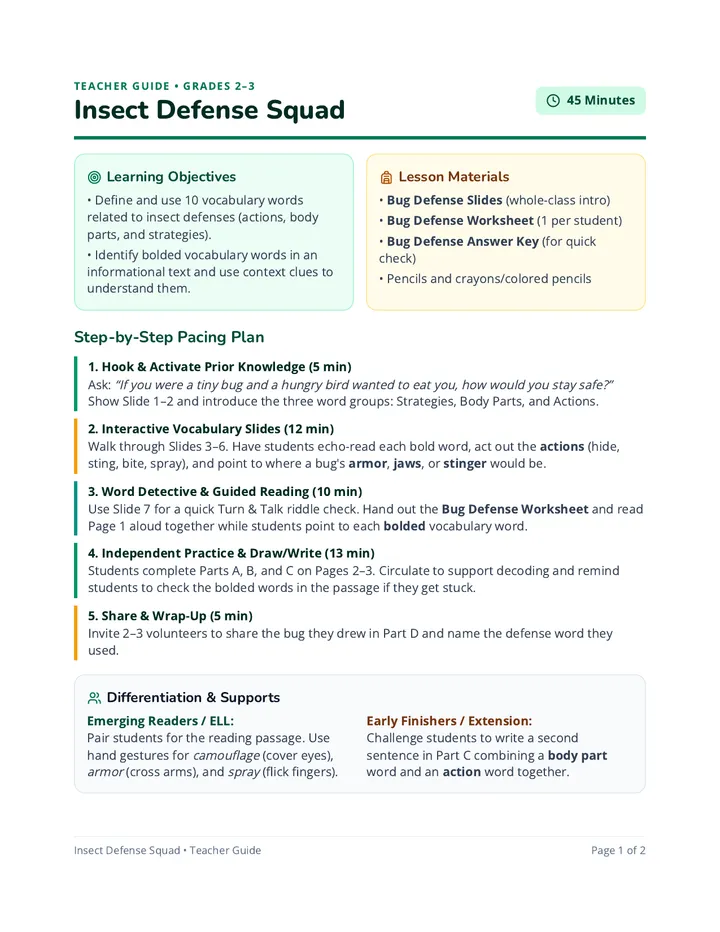
Insect Defense Squad
45 Minutes
Learning Objectives
• Define and use 10 vocabulary words related to insect defenses (actions, body parts, and strategies).
• Identify bolded vocabulary words in an informational text and use context clues to understand them.
Lesson Materials
• Bug Defense Slides (whole-class intro)
• Bug Defense Worksheet (1 per student)
• Bug Defense Answer Key (for quick check)
• Pencils and crayons/colored pencils
Step-by-Step Pacing Plan
1. Hook & Activate Prior Knowledge (5 min)
Ask: “If you were a tiny bug and a hungry bird wanted to eat you, how would you stay safe?” Show Slide 1–2 and introduce the three word groups: Strategies, Body Parts, and Actions.
2. Interactive Vocabulary Slides (12 min)
Walk through Slides 3–6. Have students echo-read each bold word, act out the actions (hide, sting, bite, spray), and point to where a bug's armor , jaws , or stinger would be.
3. Word Detective & Guided Reading (10 min)
Use Slide 7 for a quick Turn & Talk riddle check. Hand out the Bug Defense Worksheet and read Page 1 aloud together while students point to each bolded vocabulary word.
4. Independent Practice & Draw/Write (13 min)
Students complete Parts A, B, and C on Pages 2–3. Circulate to support decoding and remind students to check the bolded words in the passage if they get stuck.
5. Share & Wrap-Up (5 min)
Invite 2–3 volunteers to share the bug they drew in Part D and name the defense word they used.
Differentiation & Supports
Emerging Readers / ELL:
Pair students for the reading passage. Use hand gestures for camouflage (cover eyes), armor (cross arms), and spray (flick fingers).
Early Finishers / Extension:
Challenge students to write a second sentence in Part C combining a body part word and an action word together.
Insect Defense Squad • Teacher Guide Page 1 of 2
Vocabulary Reference Chart
10 Target Words
Word
Category
Kid-Friendly Definition & Example
camouflage
Strategy
Colors or patterns that help a bug blend in. (A walking stick looks like a twig.)
mimicry
Strategy
Looking or acting like a dangerous animal to stay safe. (A hoverfly looks like a wasp.)
warning colors
Strategy
Bright red, yellow, or orange colors that say “Stay away!” (Bright ladybugs.)
armor
Body Part
A hard outer shell that protects an insect's soft body. (A beetle's tough shell.)
jaws
Body Part
Strong mouth parts used to pinch or chomp. (Stag beetles have big jaws.)
stinger
Body Part
A sharp, needle-like part on the back of a bee or wasp.
hide
Action
To go somewhere out of sight so predators cannot find you.
sting
Action
To poke an enemy with a sharp stinger. (Bees sting to protect their hive.)
bite
Action
To pinch or chomp an attacker using strong jaws. (Ants bite intruders.)
spray
Action
To shoot out a smelly or hot liquid to scare predators. (Stink bugs spray!)
Watch Out For Common Misconceptions
• Camouflage vs. Mimicry: Camouflage helps a bug blend into things like leaves or bark (hiding in plain sight). Mimicry means copying another animal (like a harmless fly looking like a wasp).
• Stinger vs. Sting: Point out that stinger is a noun (the body part), while sting is a verb (the action).
Insect Defense Squad • Teacher Guide Page 2 of 2
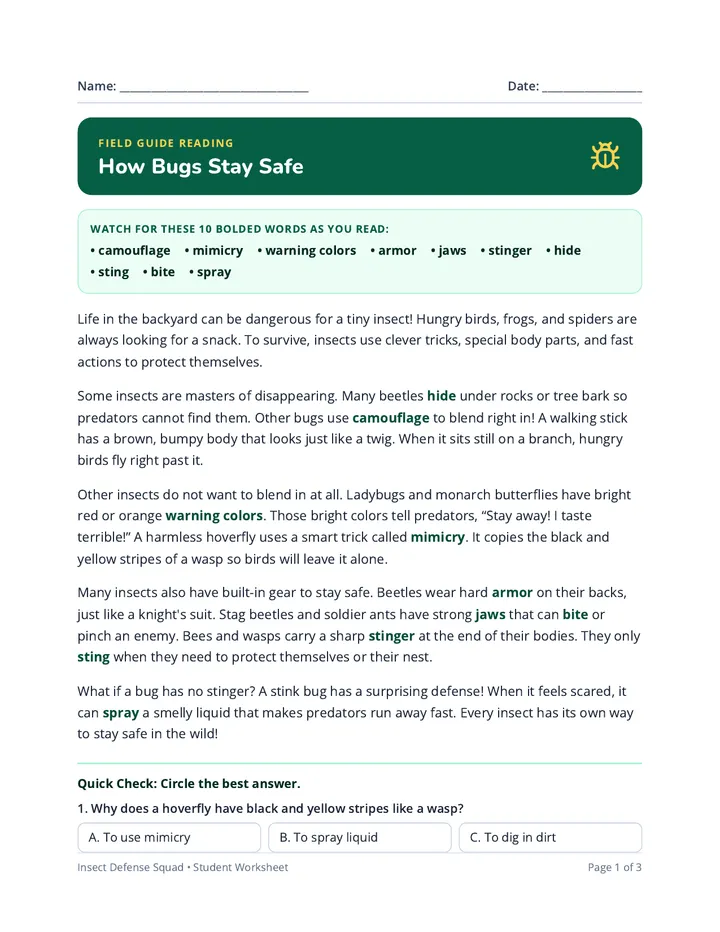
Bug Defense Worksheet Name: ____________________________________
Date: ___________________
Field Guide Reading
How Bugs Stay Safe
Watch for these 10 bolded words as you read:
• camouflage • mimicry • warning colors • armor • jaws • stinger • hide • sting • bite • spray
Life in the backyard can be dangerous for a tiny insect! Hungry birds, frogs, and spiders are always looking for a snack. To survive, insects use clever tricks, special body parts, and fast actions to protect themselves.
Some insects are masters of disappearing. Many beetles hide under rocks or tree bark so predators cannot find them. Other bugs use camouflage to blend right in! A walking stick has a brown, bumpy body that looks just like a twig. When it sits still on a branch, hungry birds fly right past it.
Other insects do not want to blend in at all. Ladybugs and monarch butterflies have bright red or orange warning colors . Those bright colors tell predators, “Stay away! I taste terrible!” A harmless hoverfly uses a smart trick called mimicry . It copies the black and yellow stripes of a wasp so birds will leave it alone.
Many insects also have built-in gear to stay safe. Beetles wear hard armor on their backs, just like a knight's suit. Stag beetles and soldier ants have strong jaws that can bite or pinch an enemy. Bees and wasps carry a sharp stinger at the end of their bodies. They only sting when they need to protect themselves or their nest.
What if a bug has no stinger? A stink bug has a surprising defense! When it feels scared, it can spray a smelly liquid that makes predators run away fast. Every insect has its own way to stay safe in the wild!
Quick Check: Circle the best answer.
1. Why does a hoverfly have black and yellow stripes like a wasp?
A. To use mimicry
B. To spray liquid
C. To dig in dirt
Insect Defense Squad • Student Worksheet Page 1 of 3
Part A
Match the Vocabulary Word
Write the letter of the matching meaning on each line.
1. camouflage
2. armor
3. mimicry
4. warning colors
5. stinger
A. A hard outer shell that protects a bug
B. Looking like a dangerous animal to stay safe
C. Bright colors that tell predators to stay away
D. Colors or patterns that help a bug blend in
E. A sharp part on the back of a bee or wasp
Part B
Use the Word Bank
Choose the best word from the Word Bank to finish each sentence.
hide bite spray sting jaws
1. Soldier ants use their strong to pinch enemies.
2. A stink bug can a bad smell when it feels scared.
3. Many beetles under leaves or logs during the day.
4. A honeybee will if someone tries to hurt its hive.
5. A stag beetle can an attacker that gets too close.
Insect Defense Squad • Student Worksheet Page 2 of 3
Part C
Sort the Defense Words
Write each word from the box into the correct column below.
camouflage armor spray mimicry jaws hide
Strategies
Body Parts
Defense Actions
Part D
Design a Super Bug!
Draw a bug using at least one defense word from our lesson. Then write 2 sentences to explain how your bug stays safe.
Insect Defense Squad • Student Worksheet Page 3 of 3
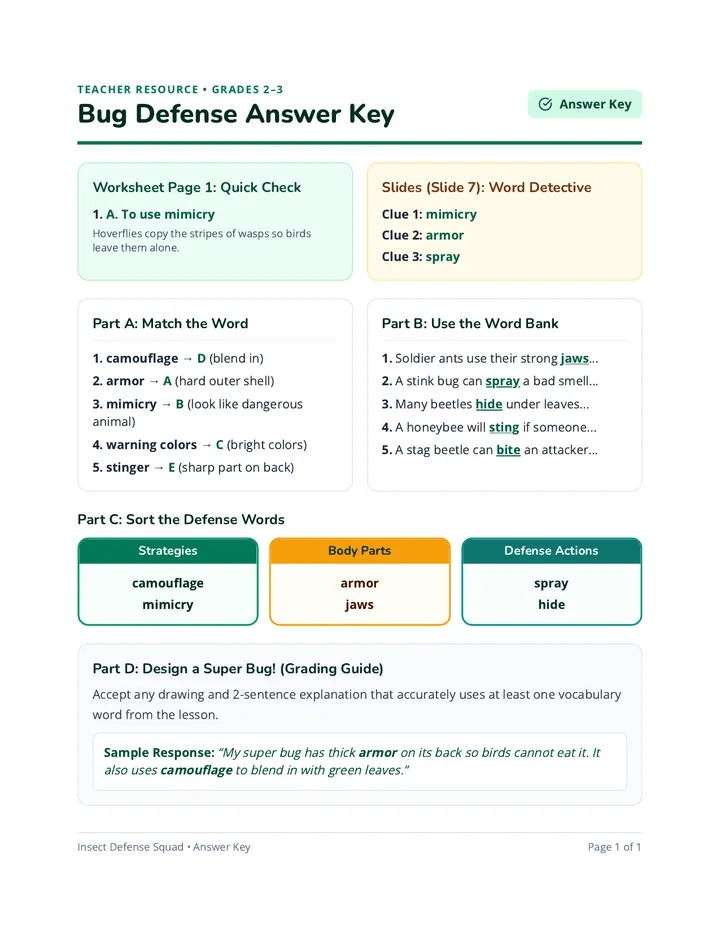
Bug Defense Answer Key Teacher Resource • Grades 2–3
Bug Defense Answer Key
Answer Key
Worksheet Page 1: Quick Check
1. A. To use mimicry
Hoverflies copy the stripes of wasps so birds leave them alone.
Slides (Slide 7): Word Detective
Clue 1: mimicryClue 2: armorClue 3: spray
Part A: Match the Word
1. camouflage → D (blend in)2. armor → A (hard outer shell)3. mimicry → B (look like dangerous animal)4. warning colors → C (bright colors)5. stinger → E (sharp part on back)
Part B: Use the Word Bank
1. Soldier ants use their strong jaws...2. A stink bug can spray a bad smell...3. Many beetles hide under leaves...4. A honeybee will sting if someone...5. A stag beetle can bite an attacker...
Part C: Sort the Defense Words
Strategies
camouflage
mimicry
Body Parts
armor
jaws
Defense Actions
spray
hide
Part D: Design a Super Bug! (Grading Guide)
Accept any drawing and 2-sentence explanation that accurately uses at least one vocabulary word from the lesson.
Sample Response: “My super bug has thick armor on its back so birds cannot eat it. It also uses camouflage to blend in with green leaves.”
Insect Defense Squad • Answer Key Page 1 of 1