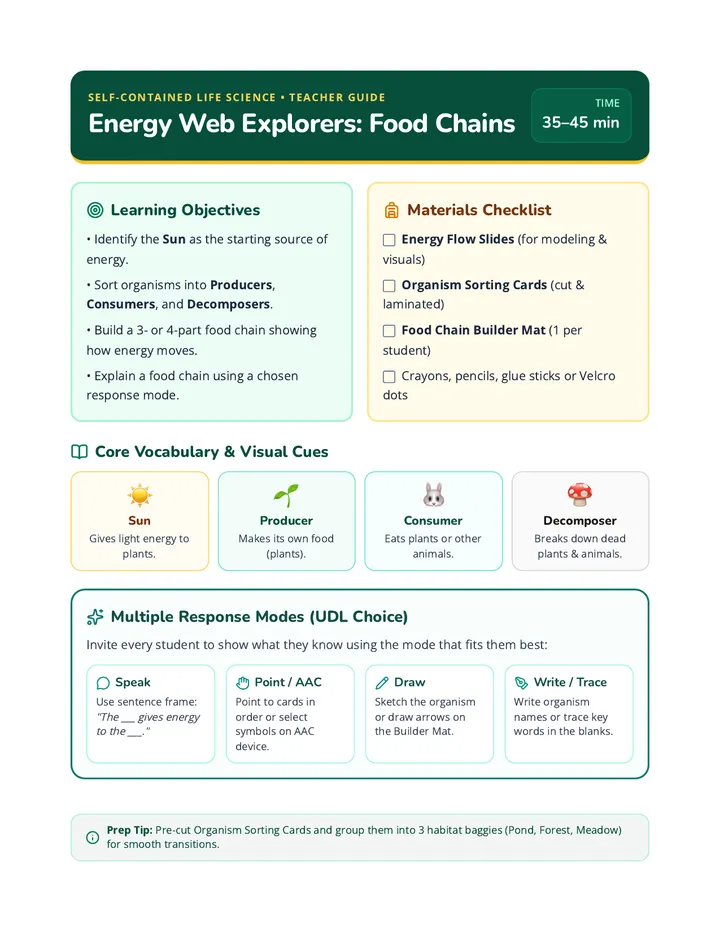
Food Chain Teacher Guide Self-Contained Life Science • Teacher Guide
Energy Web Explorers: Food Chains
TIME
35–45 min
Learning Objectives
• Identify the Sun as the starting source of energy.
• Sort organisms into Producers , Consumers , and Decomposers .
• Build a 3- or 4-part food chain showing how energy moves.
• Explain a food chain using a chosen response mode.
Materials Checklist
Energy Flow Slides (for modeling & visuals)Organism Sorting Cards (cut & laminated)Food Chain Builder Mat (1 per student)Crayons, pencils, glue sticks or Velcro dots
Core Vocabulary & Visual Cues
☀️
Sun
Gives light energy to plants.
🌱
Producer
Makes its own food (plants).
🐰
Consumer
Eats plants or other animals.
🍄
Decomposer
Breaks down dead plants & animals.
Multiple Response Modes (UDL Choice)
Invite every student to show what they know using the mode that fits them best:
Speak
Use sentence frame: "The ___ gives energy to the ___."
Point / AAC
Point to cards in order or select symbols on AAC device.
Draw
Sketch the organism or draw arrows on the Builder Mat.
Write / Trace
Write organism names or trace key words in the blanks.
Prep Tip: Pre-cut Organism Sorting Cards and group them into 3 habitat baggies (Pond, Forest, Meadow) for smooth transitions.
Step-by-Step Lesson Flow
1. Warm-Up: Where Do We Get Energy?
5 min
Show Slide 2. Ask: "What did you eat for breakfast?" Let students answer by pointing to food pictures, speaking, or using AAC. Connect food to energy to move and grow.
2. Direct Instruction: Meet the Chain
10 min
Use Slides 3–6 to introduce Sun → Producer → Consumer → Decomposer . Emphasize that arrows mean "gives energy to." Model building one Pond food chain together on the board.
3. Hands-On Sorting: Build Your Chain
15 min
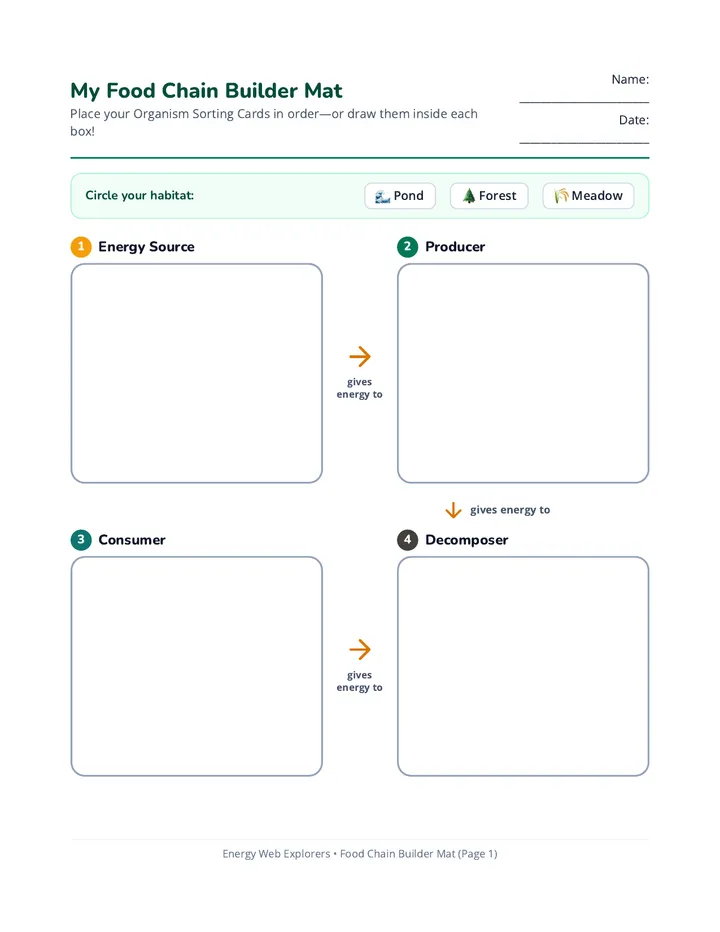
Give each student or pair a Food Chain Builder Mat and one habitat set of Organism Sorting Cards . Students match and place cards in order from Sun to Decomposer. Circulate to prompt: "Who eats the plant?"
4. Explain & Share (Multiple Response Modes)
8 min
Students complete the bottom of their Builder Mat by choosing to draw , write , or circle , then share their chain with a partner or adult by speaking or pointing along the arrows.
5. Wrap-Up Check
5 min
Show Slide 8 ("Spot the Missing Link"). Have the whole class point to or name the missing organism to close the lesson.
Self-Contained Supports
• Errorless / 3-Card Start: Begin with just Sun → Producer → Consumer before adding Decomposer.
• Tactile Assist: Add Velcro dots to mats and cards for students with fine-motor needs.
• Sensory/Pacing: Offer a 2-minute movement break ("Act like a frog!") between Steps 2 and 3.
Sample Food Chains Key
• Pond: ☀️ Sun → 🌿 Algae → 🐸 Frog → 🦅 Heron → 🦠 Bacteria/Worm
• Forest: ☀️ Sun → 🌳 Oak Leaf → 🐿️ Squirrel → 🦊 Fox → 🍄 Mushroom
• Meadow: ☀️ Sun → 🌾 Grass → 🦗 Grasshopper → 🐦 Robin → 🪱 Earthworm
Energy Web Explorers • Teacher Guide
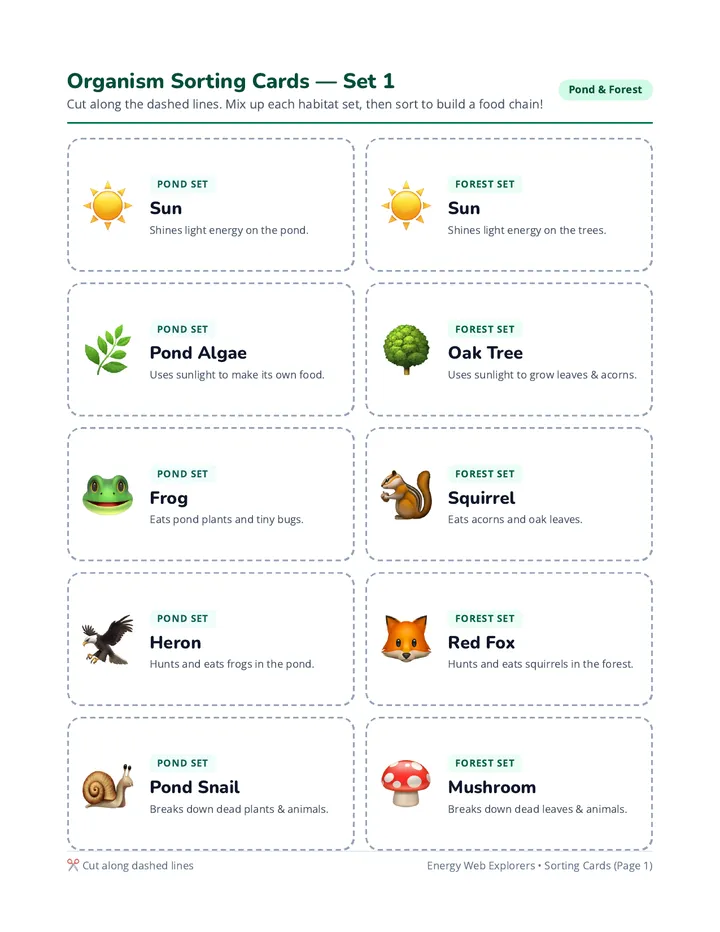
Organism Sorting Cards Organism Sorting Cards — Set 1
Cut along the dashed lines. Mix up each habitat set, then sort to build a food chain!
Pond & Forest
☀️
Pond Set
Sun
Shines light energy on the pond.
☀️
Forest Set
Sun
Shines light energy on the trees.
🌿
Pond Set
Pond Algae
Uses sunlight to make its own food.
🌳
Forest Set
Oak Tree
Uses sunlight to grow leaves & acorns.
🐸
Pond Set
Frog
Eats pond plants and tiny bugs.
🐿️
Forest Set
Squirrel
Eats acorns and oak leaves.
🦅
Pond Set
Heron
Hunts and eats frogs in the pond.
🦊
Forest Set
Red Fox
Hunts and eats squirrels in the forest.
🐌
Pond Set
Pond Snail
Breaks down dead plants & animals.
🍄
Forest Set
Mushroom
Breaks down dead leaves & animals.
✂️ Cut along dashed lines Energy Web Explorers • Sorting Cards (Page 1)
Organism Sorting Cards — Set 2
Meadow habitat cards plus Role Label cards for extra sorting practice.
Meadow & Roles
☀️
Meadow Set
Sun
Shines light energy on the meadow.
⭐
Role Label
Energy Source
Starts every food chain.
🌾
Meadow Set
Meadow Grass
Uses sunlight to grow tall and green.
🌱
Role Label
Producer
Makes its own food using sunlight.
🦗
Meadow Set
Grasshopper
Hops and eats meadow grass.
🐾
Role Label
Consumer
Eats plants or other animals.
🐦
Meadow Set
Robin
Catches and eats grasshoppers.
♻️
Role Label
Decomposer
Breaks down dead plants & animals.
🪱
Meadow Set
Earthworm
Breaks down dead plants into soil.
Create Your Own
Name: ______________________
✂️ Cut along dashed lines Energy Web Explorers • Sorting Cards (Page 2)
Food Chain Builder Mat My Food Chain Builder Mat
Place your Organism Sorting Cards in order—or draw them inside each box!
Name: ________________________
Date: ________________________
Circle your habitat:
🌊 Pond 🌲 Forest 🌾 Meadow
1 Energy Source
gives
2 Producer
gives energy to
3 Consumer
gives
4 Decomposer
Energy Web Explorers • Food Chain Builder Mat (Page 1)
Explain Your Food Chain
Choose how you want to share: Point, Speak, Draw, or Write!
Name: ________________________
Date: ________________________
Option A: Point or Speak
Point to each picture and tell a partner or teacher: "The _____ gives energy to the _____."
☀️
🌱
🐾
♻️
Option B: Draw Your Favorite Organism
Draw one plant or animal from your food chain in the box below.
Option C: Write About Your Chain
Write a sentence or trace the words your teacher helps you start.
Quick Check: Circle or point to the Producer.
Which one makes its own food using sunlight?
🌿
Plant
🐸
Frog
🍄
Mushroom
Energy Web Explorers • Multiple Response Modes (Page 2)
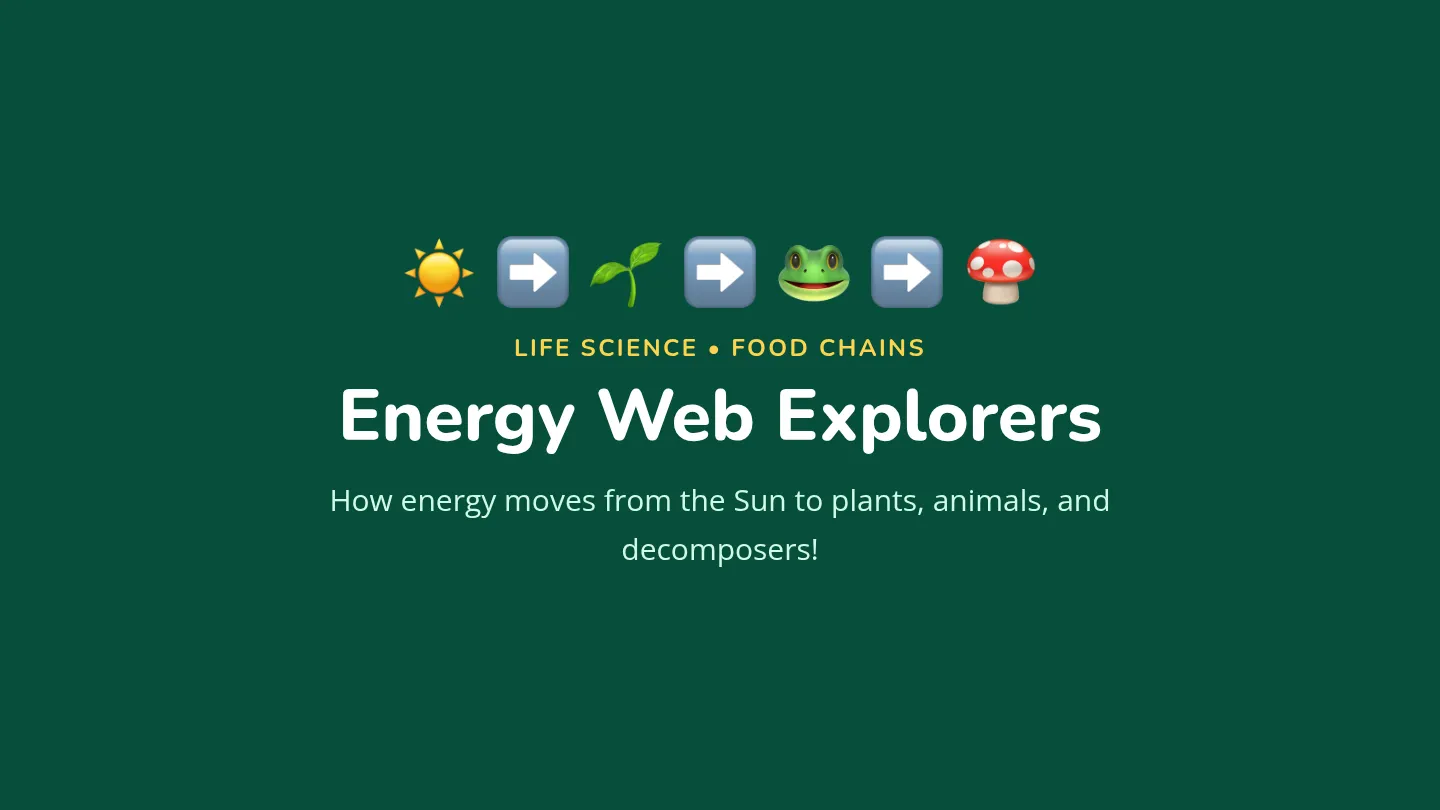
Energy Flow Slides ☀️ ➡️ 🌱 ➡️ 🐸 ➡️ 🍄
Life Science • Food Chains
Energy Web Explorers
How energy moves from the Sun to plants, animals, and decomposers!
Warm-Up
Where do we get energy to move and play?
🍎
Fruit
🍞
Toast
🥛
Milk
Share your answer: Point, Speak, Draw, or Use AAC!
☀️
Step 1: Energy Source
The Sun
• Every food chain starts with the Sun .
• The Sun gives light energy to Earth.
• Plants catch sunlight to grow!
🌱
Step 2: Plant Chefs
Producers
• Producers make their own food using sunlight.
• Examples: grass, trees, flowers, and pond algae.
• They do not eat other organisms!
🐸 🦊
Step 3: Hungry Eaters
Consumers
• Consumers must eat food to get energy.
• Some eat plants (like rabbits and squirrels).
• Some eat other animals (like frogs and foxes).
🍄 🪱
Step 4: Nature's Recyclers
Decomposers
• Decomposers break down dead plants and animals.
• Examples: mushrooms, earthworms, and snails.
• They put nutrients back into the soil!
Guided Practice
A Pond Food Chain
☀️
Sun
➡️
🌿
Algae
➡️
🐸
Frog
➡️
🦅
Heron
➡️
🐌
Snail
Remember: The arrow ➡️ means "gives energy to"!
Wrap-Up Check
Spot the Missing Link!
☀️ Sun ➡️ 🌾 Grass ➡️ ❓ ➡️ 🐦 Robin ➡️ 🪱 Worm
Point to or say which organism fits in the ❓ box:
🦗
Grasshopper
🚗
Car
🪨
Rock