Plant Power Reference Sheet Life Science Vocabulary
Plant Power Reference Sheet
Name:
1. Reactant
A starting substance that enters a chemical reaction and is changed into something new.
Example: Carbon dioxide and water are reactants in photosynthesis.
2. Product
A new substance that is formed as the result of a chemical reaction.
Example: Glucose (sugar) and oxygen are products of photosynthesis.
3. Interdependence
A relationship in which living things rely on one another and their environment to survive.
Example: Plants make oxygen for animals, and animals breathe out carbon dioxide for plants.
4. Exchange
The movement of gases, nutrients, or materials back and forth between an organism and its environment.
Example: Leaves take in carbon dioxide and release oxygen during gas exchange.
5. Chloroplast
A tiny green structure inside plant cells that captures sunlight and uses it to make food.
Example: Plant leaves look green because their cells are packed with chloroplasts.
6. Cell Wall
A stiff, protective outer layer that surrounds a plant cell and gives it structure and support.
Example: Cell walls help plant stems stand upright without a skeleton.
7. Photosynthesis
The process by which plants use sunlight, water, and carbon dioxide to make glucose (food) and oxygen.
Equation: Water + Carbon Dioxide + Sunlight → Glucose + Oxygen
8. Respiration
The process by which living cells break down glucose using oxygen to release usable energy.
Equation: Glucose + Oxygen → Carbon Dioxide + Water + Energy
9. Compare
To examine two or more things to identify how they are alike or similar.
Example: Compare plant and animal cells by noting that both have a nucleus.
10. Contrast
To examine two or more things to identify how they are different.
Example: Contrast plant and animal cells by noting that only plant cells have a cell wall.
Plant Power Practice Quiz Life Science Check-In
Plant Power Practice Quiz
Name:
Date:
Part A: Vocabulary Matching
Write the letter of the matching definition on each line.
1. Reactant
2. Product
3. Chloroplast
4. Cell Wall
5. Exchange
A. A stiff outer layer that supports and protects a plant cell
B. A starting substance that enters a chemical reaction
C. Movement of gases or materials between an organism and its environment
D. A green structure in plant cells that captures sunlight to make food
E. A new substance formed as the result of a chemical reaction
Part B: Multiple Choice
Circle the best answer for each question.
6. Which process do plants use to turn sunlight, water, and carbon dioxide into glucose and oxygen?
A. Respiration
B. Photosynthesis
C. Interdependence
D. Gas exchange
7. During which process do living cells break down glucose with oxygen to release usable energy?
A. Photosynthesis
B. Cell wall support
C. Respiration
D. Sunlight capture
8. Plants release oxygen that animals breathe, and animals exhale carbon dioxide that plants use. What does this illustrate?
A. Interdependence
B. Contrast
C. A single reactant
D. A cell wall
Part C: Compare & Contrast
Write your answer in complete sentences.
9. Compare photosynthesis and respiration. How are these two processes alike?
10. Contrast photosynthesis and respiration. How are their reactants and products different?
Plant Power Quiz Answer Key Teacher Resource
Plant Power Quiz Answer Key
10 Questions • Answer Guide
Part A: Vocabulary Matching
1. B Reactant — A starting substance that enters a chemical reaction
2. E Product — A new substance formed as the result of a chemical reaction
3. D Chloroplast — A green structure in plant cells that captures sunlight to make food
4. A Cell Wall — A stiff outer layer that supports and protects a plant cell
5. C Exchange — Movement of gases or materials between an organism and its environment
Part B: Multiple Choice
6. B. Photosynthesis
Plants use sunlight, water, and carbon dioxide to produce glucose and oxygen.
7. C. Respiration
Living cells break down glucose using oxygen to release usable energy.
8. A. Interdependence
Plants and animals depend on each other for the gases they need to survive.
Part C: Compare & Contrast (Sample Responses)
9. Compare photosynthesis and respiration:
Both processes are chemical reactions inside living cells that involve energy and the same four substances (glucose, oxygen, carbon dioxide, and water). Both are essential for keeping living things alive.
10. Contrast photosynthesis and respiration:
Photosynthesis uses carbon dioxide, water, and sunlight as reactants to make glucose and oxygen, and it happens in chloroplasts. Respiration uses glucose and oxygen as reactants to release energy, carbon dioxide, and water.
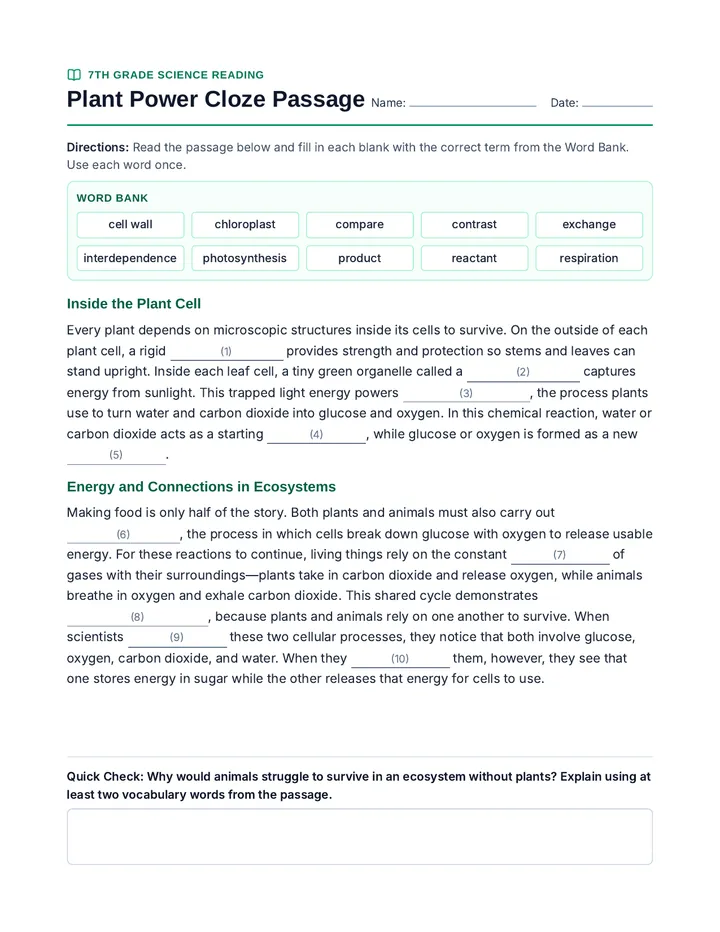
Plant Power Cloze Passage 7th Grade Science Reading
Plant Power Cloze Passage
Name:
Date:
Directions: Read the passage below and fill in each blank with the correct term from the Word Bank. Use each word once.
Word Bank
cell wall
chloroplast
compare
contrast
exchange
interdependence
photosynthesis
product
reactant
respiration
Inside the Plant Cell
Every plant depends on microscopic structures inside its cells to survive. On the outside of each plant cell, a rigid (1) provides strength and protection so stems and leaves can stand upright. Inside each leaf cell, a tiny green organelle called a (2) captures energy from sunlight. This trapped light energy powers (3), the process plants use to turn water and carbon dioxide into glucose and oxygen. In this chemical reaction, water or carbon dioxide acts as a starting (4), while glucose or oxygen is formed as a new (5).
Energy and Connections in Ecosystems
Making food is only half of the story. Both plants and animals must also carry out (6), the process in which cells break down glucose with oxygen to release usable energy. For these reactions to continue, living things rely on the constant (7) of gases with their surroundings—plants take in carbon dioxide and release oxygen, while animals breathe in oxygen and exhale carbon dioxide. This shared cycle demonstrates (8), because plants and animals rely on one another to survive. When scientists (9) these two cellular processes, they notice that both involve glucose, oxygen, carbon dioxide, and water. When they (10) them, however, they see that one stores energy in sugar while the other releases that energy for cells to use.
Quick Check: Why would animals struggle to survive in an ecosystem without plants? Explain using at least two vocabulary words from the passage.
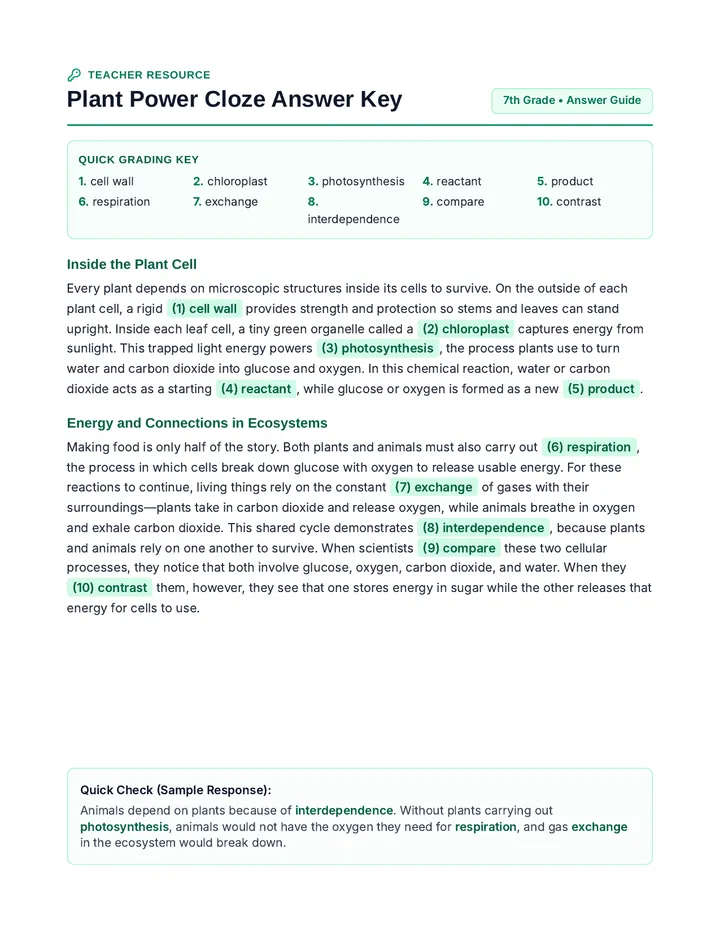
Plant Power Cloze Answer Key Teacher Resource
Plant Power Cloze Answer Key
7th Grade • Answer Guide
Quick Grading Key
cell wall
chloroplast
photosynthesis
reactant
product
respiration
exchange
interdependence
compare
contrast
Inside the Plant Cell
Every plant depends on microscopic structures inside its cells to survive. On the outside of each plant cell, a rigid (1) cell wall provides strength and protection so stems and leaves can stand upright. Inside each leaf cell, a tiny green organelle called a (2) chloroplast captures energy from sunlight. This trapped light energy powers (3) photosynthesis, the process plants use to turn water and carbon dioxide into glucose and oxygen. In this chemical reaction, water or carbon dioxide acts as a starting (4) reactant, while glucose or oxygen is formed as a new (5) product.
Energy and Connections in Ecosystems
Making food is only half of the story. Both plants and animals must also carry out (6) respiration, the process in which cells break down glucose with oxygen to release usable energy. For these reactions to continue, living things rely on the constant (7) exchange of gases with their surroundings—plants take in carbon dioxide and release oxygen, while animals breathe in oxygen and exhale carbon dioxide. This shared cycle demonstrates (8) interdependence, because plants and animals rely on one another to survive. When scientists (9) compare these two cellular processes, they notice that both involve glucose, oxygen, carbon dioxide, and water. When they (10) contrast them, however, they see that one stores energy in sugar while the other releases that energy for cells to use.
Quick Check (Sample Response):
Animals depend on plants because of interdependence. Without plants carrying out photosynthesis, animals would not have the oxygen they need for respiration, and gas exchange in the ecosystem would break down.