Motion in Action Passage 7th Grade Science Reading Passage
Name: _______________________ Date: ____________
Motion in Action: How Objects Move
1. What Is Motion and Frame of Reference?
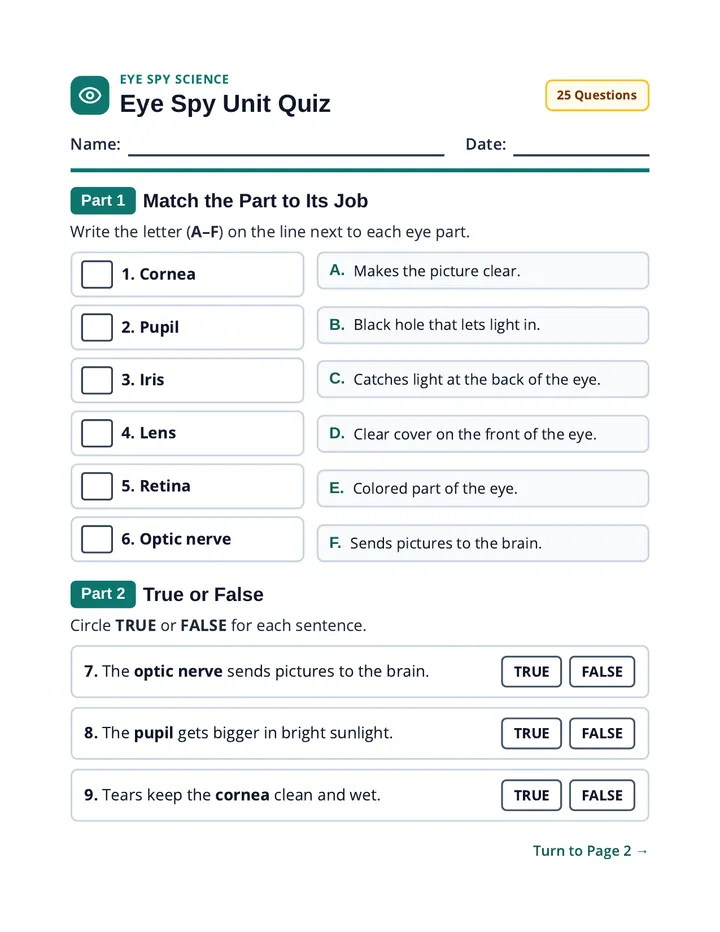
Look around the room, and you will likely notice something moving—even if it is only your eyes scanning this page. In science, motion is defined as a change in position , which is an object's location. When a hummingbird hovers near a flower, its wings beat so rapidly that they appear as a blur because their position changes dozens of times every second.
How we perceive motion depends on our frame of reference —something not moving with respect to an observer that can be used to detect motion. Imagine riding inside a very smooth school bus. If you look at a friend sitting next to you, neither of you appears to be moving relative to each other. You only realize the bus is moving when you look out the window and see stationary trees and sidewalks whizzing past. Meanwhile, someone standing on the sidewalk uses the trees across the street as their frame of reference and easily sees the bus moving as it blocks their view.
Hummingbird wings change position rapidly.
2. Measuring Distance and Direction
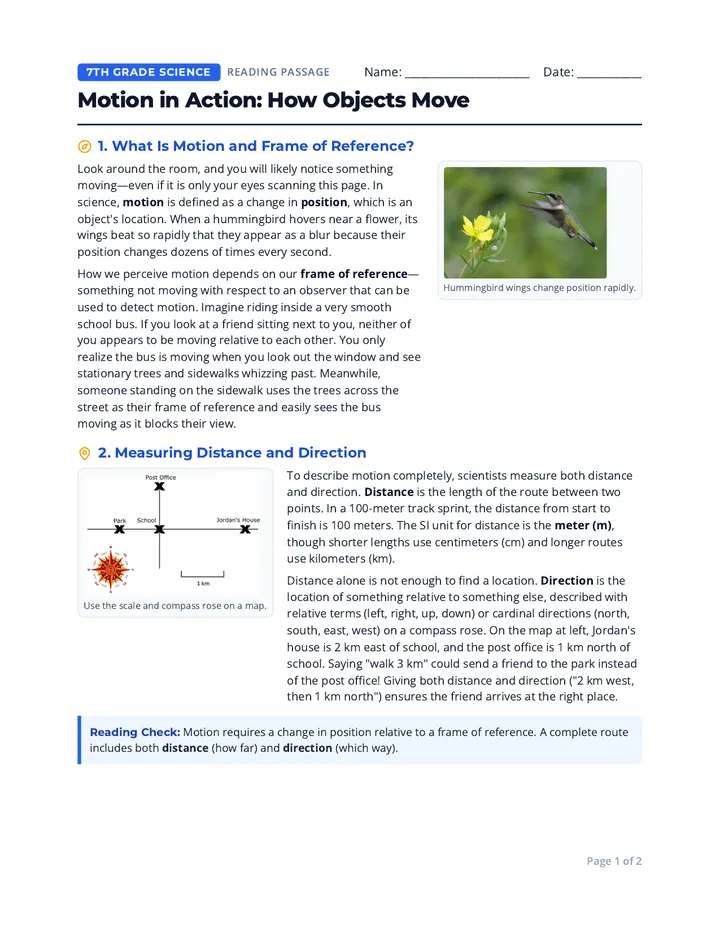
Use the scale and compass rose on a map.
To describe motion completely, scientists measure both distance and direction. Distance is the length of the route between two points. In a 100-meter track sprint, the distance from start to finish is 100 meters. The SI unit for distance is the meter (m) , though shorter lengths use centimeters (cm) and longer routes use kilometers (km).
Distance alone is not enough to find a location. Direction is the location of something relative to something else, described with relative terms (left, right, up, down) or cardinal directions (north, south, east, west) on a compass rose. On the map at left, Jordan's house is 2 km east of school, and the post office is 1 km north of school. Saying "walk 3 km" could send a friend to the park instead of the post office! Giving both distance and direction ("2 km west, then 1 km north") ensures the friend arrives at the right place.
Reading Check: Motion requires a change in position relative to a frame of reference. A complete route includes both distance (how far) and direction (which way).
Page 1 of 2
Motion in Action: How Objects Move 7th Grade Science
3. Vectors and Speed
When both size (such as distance or speed) and direction are combined, motion can be represented by a vector . Scientists draw vectors as arrows: the length of the arrow shows the size, and the way the arrow points shows the direction.
How fast or slow something moves is its speed , which tells how far an object travels in a given amount of time. The SI unit for speed is meters per second (m/s) . Because cars rarely move at one steady pace, scientists distinguish between instantaneous speed (your speed at one exact moment, like 65 mi/h on a highway or 20 mi/h in city traffic) and average speed (total distance divided by total time).
Average Speed Formula:
\( \text{average speed} = \frac{\text{distance}}{\text{time}} \)
Example: \( \frac{120\text{ mi}}{3\text{ h}} = 40\text{ mi/h} \)
4. Velocity: Speed with Direction
Speed tells how fast an object moves, not which way. Velocity measures both speed and direction, making it a vector. Two objects have the same velocity only if they move at the same speed and in the same direction.
At right, Vectors A and B have the same length (speed) but point in different directions, so their velocities differ. Vector C points the same way as A, but is shorter (slower), so its velocity also differs. If a dog runs 36 meters east in 18 seconds, its velocity is \( \frac{36\text{ m}}{18\text{ s}} = 2\text{ m/s east} \).
Length = speed; arrowhead = direction.
5. Acceleration: Changing Velocity
On a roller coaster, the car creeps up the first hill, plunges down, and whips around sharp turns. These changes in speed or direction are called acceleration —the rate of change in velocity. An object accelerates whenever it:
Speeds up (such as a skydiver falling faster and faster toward the ground).Slows down —also called deceleration or negative acceleration (such as opening a parachute or braking).Changes direction —even at a steady speed (such as riding in a circle on a carousel or turning a corner).
You can often feel acceleration in a car: you feel pressed back into your seat when speeding up, pushed forward when braking suddenly, and pushed sideways when turning a corner.
Key Takeaways
Motion & Distance: Change in position; measured in meters (m) relative to a frame of reference.
Speed & Velocity: Speed is distance/time; velocity adds direction (a vector).
Acceleration: Any change in speed (faster or slower) or direction.
Page 2 of 2
Motion Vocab Support 7th Grade Science Vocabulary Support
Name: _______________________ Date: ____________
Motion Vocabulary Field Guide
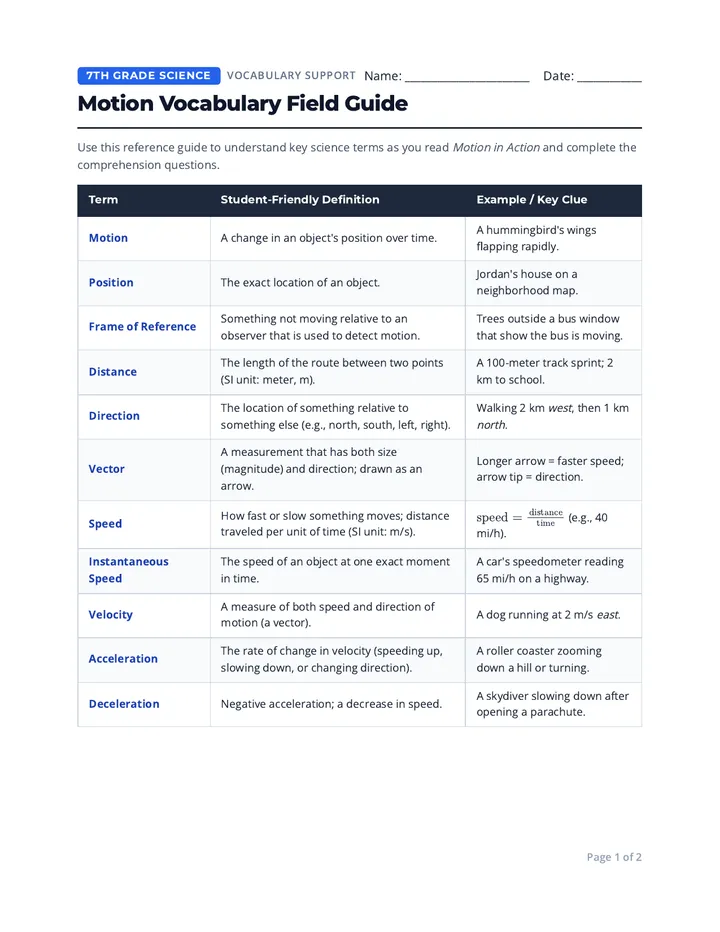
Use this reference guide to understand key science terms as you read Motion in Action and complete the comprehension questions.
Term
Student-Friendly Definition
Example / Key Clue
Motion
A change in an object's position over time.
A hummingbird's wings flapping rapidly.
Position
The exact location of an object.
Jordan's house on a neighborhood map.
Frame of Reference
Something not moving relative to an observer that is used to detect motion.
Trees outside a bus window that show the bus is moving.
Distance
The length of the route between two points (SI unit: meter, m).
A 100-meter track sprint; 2 km to school.
Direction
The location of something relative to something else (e.g., north, south, left, right).
Walking 2 km west , then 1 km north .
Vector
A measurement that has both size (magnitude) and direction; drawn as an arrow.
Longer arrow = faster speed; arrow tip = direction.
Speed
How fast or slow something moves; distance traveled per unit of time (SI unit: m/s).
\( \text{speed} = \frac{\text{distance}}{\text{time}} \) (e.g., 40 mi/h).
Instantaneous Speed
The speed of an object at one exact moment in time.
A car's speedometer reading 65 mi/h on a highway.
Velocity
A measure of both speed and direction of motion (a vector).
A dog running at 2 m/s east .
Acceleration
The rate of change in velocity (speeding up, slowing down, or changing direction).
A roller coaster zooming down a hill or turning.
Deceleration
Negative acceleration; a decrease in speed.
A skydiver slowing down after opening a parachute.
Page 1 of 2
Motion Vocabulary Practice 7th Grade Science
Part A: Word Bank Fill-in-the-Blank
Choose the best term from the Word Bank to complete each sentence. Each term is used once.
vector • frame of reference • deceleration • velocity • distance • instantaneous speed
When you sit on a smooth train and look at the trees outside to tell you are moving, the trees act as your ____________________________.
The length of the route between Jordan's house and his school is the ____________________________.
A ____________________________ is represented by an arrow whose length shows size and whose tip shows direction.
At one exact moment in city traffic, a car's ____________________________ might drop to 20 miles per hour.
Because ____________________________ includes both speed and direction, turning a corner at a constant speed changes it.
When a car presses its brakes to slow down at a red light, it experiences negative acceleration, also called ____________________________.
Part B: Explain in Your Own Words
Answer each question using complete sentences and at least two vocabulary words from Page 1.
1. How is speed different from velocity ? Give an example of each.
2. Explain how two people can look at the same school bus and disagree about whether someone inside is moving, using the term frame of reference .
3. Describe a real-world example of acceleration that does NOT involve speeding up.
Page 2 of 2
Motion Comprehension Worksheet 7th Grade Science Comprehension Questions
Name: _______________________ Date: ____________
Motion in Action: Check Your Understanding
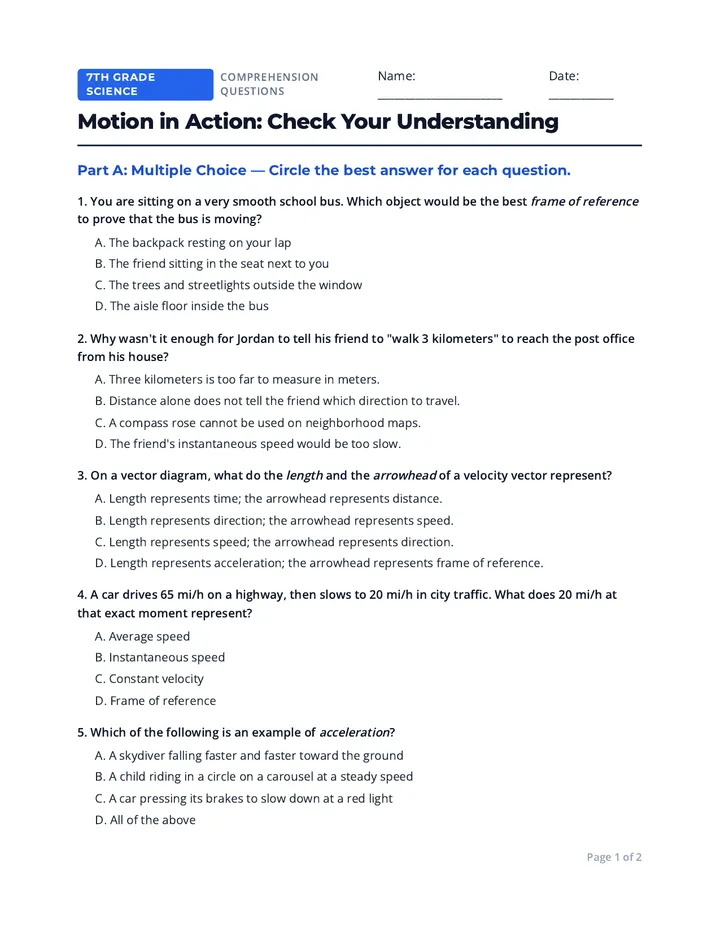
Part A: Multiple Choice — Circle the best answer for each question.
1. You are sitting on a very smooth school bus. Which object would be the best frame of reference to prove that the bus is moving?
A. The backpack resting on your lap
B. The friend sitting in the seat next to you
C. The trees and streetlights outside the window
D. The aisle floor inside the bus
2. Why wasn't it enough for Jordan to tell his friend to "walk 3 kilometers" to reach the post office from his house?
A. Three kilometers is too far to measure in meters.
B. Distance alone does not tell the friend which direction to travel.
C. A compass rose cannot be used on neighborhood maps.
D. The friend's instantaneous speed would be too slow.
3. On a vector diagram, what do the length and the arrowhead of a velocity vector represent?
A. Length represents time; the arrowhead represents distance.
B. Length represents direction; the arrowhead represents speed.
C. Length represents speed; the arrowhead represents direction.
D. Length represents acceleration; the arrowhead represents frame of reference.
4. A car drives 65 mi/h on a highway, then slows to 20 mi/h in city traffic. What does 20 mi/h at that exact moment represent?
A. Average speed
B. Instantaneous speed
C. Constant velocity
D. Frame of reference
5. Which of the following is an example of acceleration ?
A. A skydiver falling faster and faster toward the ground
B. A child riding in a circle on a carousel at a steady speed
C. A car pressing its brakes to slow down at a red light
D. All of the above
Page 1 of 2
Motion in Action: Check Your Understanding 7th Grade Science
Part B: Short Answer — Use evidence from the passage to answer.
6. Jerod rides his bike at a constant speed of 12 km/h going west, then turns north while keeping the exact same speed of 12 km/h. Has Jerod's velocity changed? Explain why or why not.
7. Describe how a passenger inside a car can feel acceleration when the car speeds up, slows down, or turns a corner.
Part C: Speed, Velocity & Vector Calculations — Show your work!
8. Terri rides her bike 3 km up a hill and 3 km back down (6 km total). The round trip takes 0.25 hours. Calculate Terri's average speed in km/h.
9. A dog runs straight west down a sidewalk for 36 meters in 24 seconds. Calculate the dog's average velocity (remember to include direction!).
10. In the box below, draw two vector arrows: Arrow X showing an object moving fast to the east, and Arrow Y showing an object moving slower to the north.
Page 2 of 2
Motion Bundle Answer Key Teacher Resource 7th Grade Science
Motion in Action Bundle
Answer Key: Vocabulary & Comprehension
1. Motion Vocab Support — Part A: Word Bank Fill-in-the-Blank
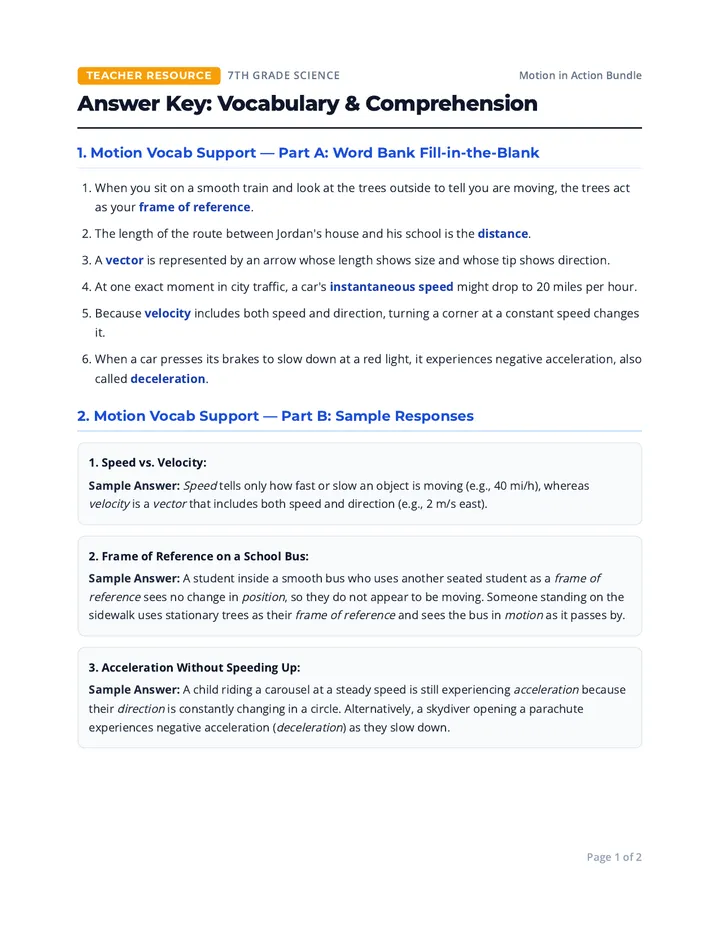
When you sit on a smooth train and look at the trees outside to tell you are moving, the trees act as your frame of reference .
The length of the route between Jordan's house and his school is the distance .
A vector is represented by an arrow whose length shows size and whose tip shows direction.
At one exact moment in city traffic, a car's instantaneous speed might drop to 20 miles per hour.
Because velocity includes both speed and direction, turning a corner at a constant speed changes it.
When a car presses its brakes to slow down at a red light, it experiences negative acceleration, also called deceleration .
2. Motion Vocab Support — Part B: Sample Responses
1. Speed vs. Velocity:
Sample Answer: Speed tells only how fast or slow an object is moving (e.g., 40 mi/h), whereas velocity is a vector that includes both speed and direction (e.g., 2 m/s east).
2. Frame of Reference on a School Bus:
Sample Answer: A student inside a smooth bus who uses another seated student as a frame of reference sees no change in position , so they do not appear to be moving. Someone standing on the sidewalk uses stationary trees as their frame of reference and sees the bus in motion as it passes by.
3. Acceleration Without Speeding Up:
Sample Answer: A child riding a carousel at a steady speed is still experiencing acceleration because their direction is constantly changing in a circle. Alternatively, a skydiver opening a parachute experiences negative acceleration (deceleration ) as they slow down.
Page 1 of 2
Answer Key: Comprehension Worksheet Teacher Resource
Part A: Multiple Choice
1. C — The trees and streetlights outside the window are stationary relative to the ground and show the bus's motion.
2. B — Distance alone does not tell the friend which direction to travel (they might walk 3 km to the park instead).
3. C — On a velocity vector arrow, length represents speed and the arrowhead represents direction.
4. B — Instantaneous speed is an object's speed at one exact moment in time.
5. D — All three (speeding up, changing direction at steady speed, and slowing down) are examples of acceleration.
Part B: Short Answer
6. Yes, Jerod's velocity has changed. Even though his speed stayed constant at 12 km/h, velocity includes both speed and direction. When Jerod turned from west to north, his direction changed, which means his velocity changed.
7. When a car speeds up , you feel pressed back against your seat. When it slows down (decelerates), you feel pushed forward. When it turns , you feel pushed to the side opposite the turn (e.g., pushed left during a right turn).
Part C: Speed, Velocity & Vector Calculations
8. Terri's Average Speed:
\( \text{average speed} = \frac{\text{distance}}{\text{time}} = \frac{6\text{ km}}{0.25\text{ h}} = \mathbf{24\text{ km/h}} \)
Total distance = 6 km
9. Dog's Average Velocity:
\( \text{velocity} = \frac{\text{distance}}{\text{time}} = \frac{36\text{ m}}{24\text{ s}} = \mathbf{1.5\text{ m/s west}} \)
Must include "west"
10. Vector Arrows Check:
Arrow X should be noticeably longer and point to the right (east) . Arrow Y should be shorter and point up (north) .
Page 2 of 2