Transformation Lab Slides Grade 10 Biology • Biotechnology
Bacterial Transformation
How scientists reprogram bacteria using plasmids—and how we read the results on agar plates.
Lesson: Plasmid Power What • Why • How • Results
What Is Transformation?
01 • Definition
Bacterial transformation is the process where a bacterium takes up foreign DNA from its environment and begins expressing the new genes.
Key Tool: The Plasmid
A plasmid is a small, circular ring of DNA separate from the bacterium's main chromosome.
Plasmid
E. coli
Once inside, the bacterium reads the plasmid DNA and builds new proteins!
Result: A genetically modified bacterium with a new trait.
Why Transform Bacteria?
02 • Purpose
Bacteria divide every 20 minutes, turning them into fast, cheap protein factories .
Medicine
Producing human insulin for diabetes and clotting factors without harvesting from animals.
Research
Using GFP (Green Fluorescent Protein) from jellyfish to make cells glow and track diseases.
Industry
Manufacturing laundry enzymes, biofuels, and bacteria that break down oil spills.
Key Idea: Same DNA code works across species—bacteria can read human or jellyfish genes!
What Is Inside the Plasmid?
03 • Plasmid Design
A standard transformation plasmid (like pGLO ) carries three essential parts:
1. Origin (ori)
Copy Switch
Tells the bacterium to copy the plasmid every time the cell divides.
2. ampR Gene
Survival Shield
Makes a protein that destroys ampicillin (an antibiotic), letting transformed cells survive.
3. GFP Gene
Glowing Trait
Codes for Green Fluorescent Protein. Only turns ON when the sugar arabinose is present!
Why include ampR? Only ~1 in 10,000 bacteria actually take up the plasmid. Ampicillin kills the rest so we can find the winners!
How It's Done: 4-Step Protocol
04 • Procedure
1
Make Competent (CaCl2 + Ice)
Calcium ions neutralize negative charges on DNA and cell membranes so the plasmid can get close.
2
Heat Shock (42°C for 50 sec)
Sudden warmth creates temporary pores in the cell membrane—pulling the plasmid inside! Then back to ice.
3
Recovery (LB Broth, 37°C)
Cells rest in nutrient broth for 10–30 min so they can heal and start making antibiotic-resistance proteins.
4
Plate & Incubate
Spread bacteria onto different agar plates (LB, LB+Amp, LB+Amp+Ara) and incubate overnight at 37°C.
Tip: Always label two tubes—+pDNA (gets plasmid) and −pDNA (control, no plasmid).
What Is LB & How Bacteria Grow
05 • Growth Medium
LB (Luria-Bertani) Medium
LB is a nutrient-rich food for bacteria, used as liquid broth or solid gel plates:
• Tryptone & Yeast Extract: Amino acids, sugars, and vitamins for energy & building proteins.
• NaCl (Salt): Balances water inside the cell.
• Agar (on plates): Seaweed gel that creates a solid surface (bacteria don't eat it!).
Binary Fission (Doubling)
At 37°C , E. coli copies its DNA + plasmids and splits in half every 20 minutes :
1 → 2 → 4 → 8 → 16 → Millions!
After 24 hours, one invisible bacterium grows into a visible colony of millions of identical clones.
Key Idea: LB feeds all bacteria—adding ampicillin decides which ones survive!
Reading the Results
06 • Outcomes
Solid Film
Bacterial Lawn
Thousands of bacteria grow everywhere, forming a cloudy carpet. Happens when no antibiotic is present.
Isolated Colonies
Individual dots! Only the few transformed cells survive ampicillin. Add arabinose + UV light and they glow green!
Clear
No Growth
Completely clear agar. Bacteria had no ampR gene , so ampicillin killed every cell.
Remember: A colony = millions of identical clones grown from ONE transformed bacterium.
Quick Check: Predict the Plate!
07 • Think-Pair-Share
Discuss with a partner: What will grow on each plate after 24 hours at 37°C?
Plate A −pDNA (No Plasmid)
Agar: LB + Ampicillin
Question: Do these bacteria have the ampR gene? Will you see a lawn, colonies, or no growth?
Plate B +pDNA (With Plasmid)
Agar: LB + Ampicillin + GFP
Question: Will you see a lawn or colonies? Will they glow under UV light? Why?
Hold your predictions—let's test your reasoning on all 5 experimental plates!
Plate Predictor Challenge
On your activity sheet, predict the growth, appearance, and UV glow for all 5 plates—and explain the biology behind each outcome.
Check: Does the cell have the plasmid? Is ampicillin present? Is arabinose present?
Plate Predictor Activity Grade 10 Biology • Plasmid Power
Plate Predictor Activity
Name: _______________________________
Date: _________________
Part 1: What, Why, and How of Transformation
1. In your own words, what is bacterial transformation , and what role does a plasmid play?
2. Describe one real-world reason why scientists transform bacteria (in medicine, research, or industry).
3. Number the four steps of bacterial transformation in the correct order (1 = first, 4 = last ):
Spread bacteria onto agar plates and incubate overnight at 37°C.
Mix bacteria with CaCl2 and chill on ice to make cells competent.
Add LB nutrient broth and incubate at 37°C for recovery.
Heat shock the cells at 42°C for 50 seconds, then return to ice.
4. Why is the heat shock step necessary for transformation to work?
Reference: Examples of Plate Growth
Bacterial Lawn
Solid cloudy mat; all bacteria survive.
Colony Growth
Isolated dots; only transformed cells survive.
No Growth
Clear agar; antibiotic killed all cells.
Part 2: Predict the Plate Results
E. coli bacteria are divided into two tubes: −pDNA and +pDNA . Predict what you will observe on each plate after 24 hours at 37°C.
Chromosome only
−pDNA Tube (No Plasmid)
Untransformed E. coli . Has no ampR and no GFP gene.
pDNA ampR + GFP (needs Ara)
+pDNA Tube (With Plasmid)
Some cells take up plasmid: ampR (survives Amp) & GFP (glows with arabinose ).
| Plate & Tube | Agar Contents | Predicted Growth
Part 3: Controls & Experimental Analysis
5. Why is Plate 2 (−pDNA on LB + Ampicillin) a critical control in this experiment?
6. A student skips the recovery step (LB broth at 37°C) and plates +pDNA cells directly onto LB + Ampicillin. Predict what happens and explain why.
Plate Predictor Answer Key Teacher Resource • Answer Key
Plate Predictor Answer Key
Grade 10 Biology
Part 1: What, Why, and How of Transformation
1. In your own words, what is bacterial transformation , and what role does a plasmid play?
Model Answer: Bacterial transformation is the uptake of foreign DNA from the environment by a bacterium, causing it to express new genes. A plasmid is a small, circular piece of DNA used to carry those new genes (such as antibiotic resistance or GFP) into the bacterial cell.
2. Describe one real-world reason why scientists transform bacteria (in medicine, research, or industry).
Model Answer (any one):
Medicine: Producing human insulin for diabetes patients or human growth hormone.Research: Inserting GFP so cells glow under UV light to study gene expression or disease.Industry: Making enzymes for detergents, biofuels, or oil-spill cleanup bacteria.
3. Number the four steps of bacterial transformation in the correct order (1 = first, 4 = last ):
4 Spread bacteria onto agar plates and incubate overnight at 37°C.
1 Mix bacteria with CaCl2 and chill on ice to make cells competent.
3 Add LB nutrient broth and incubate at 37°C for recovery.
2 Heat shock the cells at 42°C for 50 seconds, then return to ice.
4. Why is the heat shock step necessary for transformation to work?
Model Answer: The rapid temperature jump from ice (0°C) to 42°C creates temporary pores/openings in the bacterial cell membrane, allowing the negatively charged plasmid DNA to enter the cell before returning to ice closes the pores.
Grading Tip: For Q4, accept any explanation mentioning temporary membrane permeability or pores allowing DNA entry.
Part 2: Plate Prediction Key
Plate & Tube
Agar Contents
Predicted Growth
UV Glow?
Scientific Reasoning
Plate 1
−pDNA
LB Agar
Bacterial Lawn
No
No antibiotic is present, so all untransformed bacteria survive and grow into a solid lawn. No GFP gene.
Plate 2
−pDNA
LB + Ampicillin
No Growth (Clear)
No
Bacteria lack the plasmid (no ampR gene), so ampicillin kills all cells.
Plate 3
+pDNA
LB Agar
Bacterial Lawn
No
No ampicillin is present, so both transformed and untransformed cells grow into a lawn. No arabinose to turn on GFP.
Plate 4
+pDNA
LB + Ampicillin
Isolated Colonies
No
Only the small fraction of bacteria that took up the plasmid (ampR) survive ampicillin, forming individual white colonies. No arabinose = no glow.
Plate 5
+pDNA
LB + Ampicillin + Arabinose
Isolated Colonies
Yes (Green)
Only transformed cells survive ampicillin (forming colonies), and arabinose switches ON the GFP gene so colonies glow green under UV light.
Part 3: Controls & Experimental Analysis
5. Why is Plate 2 (−pDNA on LB + Ampicillin) a critical control in this experiment?
Model Answer: It proves that the ampicillin in the agar actually works and that untransformed E. coli cannot survive on it. Without this negative control, you wouldn't know if colonies on Plates 4 and 5 survived because of transformation or because the antibiotic was expired/missing.
6. A student skips the recovery step (LB broth at 37°C) and plates +pDNA cells directly onto LB + Ampicillin. Predict what happens and explain why.
Model Answer: Very few or zero colonies will grow. After heat shock, the cells need recovery time in nutrient broth to repair their membranes and transcribe/translate the ampR gene into the resistance protein before facing ampicillin.
Common Student Error: Predicting a "lawn" on Plates 4 & 5. Remind students transformation efficiency is low (~0.01%), yielding isolated colonies.
Plasmid Power Teacher Guide Grade 10 Biology • Teacher Guide
Plasmid Power Teacher Guide
55-Minute Lesson
Learning Objectives
Define bacterial transformation and explain the role of a plasmid.
Identify real-world applications (insulin, GFP, industrial enzymes).
Sequence the 4 transformation steps and explain heat shock & recovery.
Predict and justify bacterial growth (lawn, colonies, none) and UV glow across agar plates.
Lesson Materials
Transformation Lab Slides (8 slides)Plate Predictor Activity (2-page student handout)Plate Predictor Answer Key (for teacher review)Optional: UV flashlight or sample pGLO plate photos for hook.
55-Minute Pacing & Facilitation Plan
Time
Phase & Slides
Teacher Moves & Key Talking Points
0–10 min
Hook & What/Why
Slides 1–3
Ask how we get bacteria to make human insulin. Define transformation and plasmids; emphasize the universal genetic code.
10–20 min
Plasmid & Protocol
Slides 4–5
Walk through ori , ampR , and GFP (arabinose switch). Act out or sketch CaCl2 + heat shock (42°C) + recovery so students link temperature to membrane pores.
20–30 min
Results & Quick Check
Slides 6–8
Contrast a lawn vs. isolated colonies . Run a 2-minute Think-Pair-Share on Slide 7 before handing out the activity.
30–48 min
Plate Predictor Activity
Student Worksheet
Students complete Part 1 individually, then collaborate in pairs on the 5-plate prediction table (Part 2) and control questions (Part 3).
48–55 min
Debrief & Wrap-Up
Answer Key
Cold-call predictions for Plates 2, 4, and 5. Reinforce why Plate 4 produces colonies (not a lawn) and why Plate 2 is the negative control.
Common Misconceptions
"All +pDNA cells get transformed": False—only ~1 in 10,000 do, which is why LB+Amp shows colonies instead of a lawn."Ampicillin makes bacteria glow": False—ampicillin selects for plasmid presence; arabinose turns on GFP."Heat shock kills all bacteria": It stresses cells briefly; the 37°C LB recovery step lets them heal.
Differentiation
Support: Provide a 3-question checklist on the board for Part 2: (1) Plasmid? (2) Ampicillin? (3) Arabinose?ELL / Visual: Keep Slide 6 projected during the activity so students can reference lawn vs. colony visuals.Extension: Ask early finishers to calculate transformation efficiency (colonies ÷ µg DNA) or design a 6th plate with −pDNA on LB+Amp+Ara. Plasmid Check Exit Ticket Grade 10 Biology • Exit Ticket
Plasmid Check Exit Ticket
Name: _________________________
Date: _______________
1. A student spreads +pDNA bacteria (carrying ampR and GFP ) onto LB + Ampicillin agar (no arabinose). What will they observe after 24 hours at 37°C?
A) A cloudy bacterial lawn that glows green
B) Isolated white colonies that do not glow
C) Isolated colonies that glow green under UV
D) No growth on the plate
2. Explain the role of heat shock (42°C) and LB medium in bacterial transformation.
Confidence Check (circle one):
[ ] Got it! [ ] Almost there [ ] Need a review
Cut Here
Grade 10 Biology • Exit Ticket
Plasmid Check Exit Ticket
Name: _________________________
Date: _______________
1. A student spreads +pDNA bacteria (carrying ampR and GFP ) onto LB + Ampicillin agar (no arabinose). What will they observe after 24 hours at 37°C?
A) A cloudy bacterial lawn that glows green
B) Isolated white colonies that do not glow
C) Isolated colonies that glow green under UV
D) No growth on the plate
2. Explain the role of heat shock (42°C) and LB medium in bacterial transformation.
Confidence Check (circle one):
[ ] Got it! [ ] Almost there [ ] Need a review
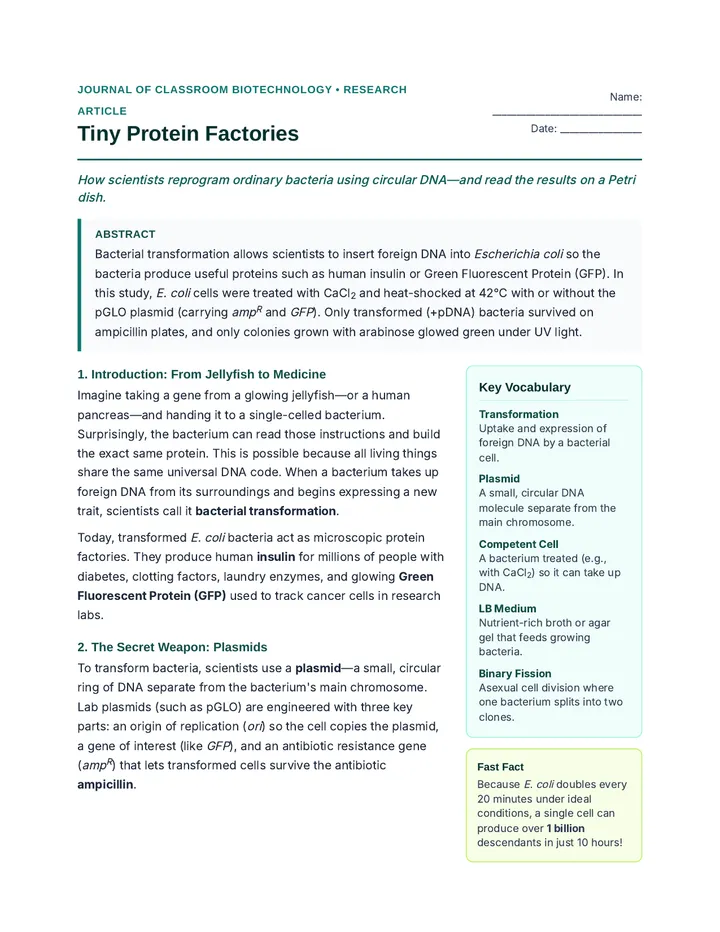
Tiny Protein Factories Article Journal of Classroom Biotechnology • Research Article
Tiny Protein Factories
Name: _______________________________
Date: _________________
How scientists reprogram ordinary bacteria using circular DNA—and read the results on a Petri dish.
Abstract
Bacterial transformation allows scientists to insert foreign DNA into Escherichia coli so the bacteria produce useful proteins such as human insulin or Green Fluorescent Protein (GFP). In this study, E. coli cells were treated with CaCl2 and heat-shocked at 42°C with or without the pGLO plasmid (carrying ampR and GFP ). Only transformed (+pDNA) bacteria survived on ampicillin plates, and only colonies grown with arabinose glowed green under UV light.
1. Introduction: From Jellyfish to Medicine
Imagine taking a gene from a glowing jellyfish—or a human pancreas—and handing it to a single-celled bacterium. Surprisingly, the bacterium can read those instructions and build the exact same protein. This is possible because all living things share the same universal DNA code. When a bacterium takes up foreign DNA from its surroundings and begins expressing a new trait, scientists call it bacterial transformation .
Today, transformed E. coli bacteria act as microscopic protein factories. They produce human insulin for millions of people with diabetes, clotting factors, laundry enzymes, and glowing Green Fluorescent Protein (GFP) used to track cancer cells in research labs.
2. The Secret Weapon: Plasmids
To transform bacteria, scientists use a plasmid —a small, circular ring of DNA separate from the bacterium's main chromosome. Lab plasmids (such as pGLO) are engineered with three key parts: an origin of replication (ori ) so the cell copies the plasmid, a gene of interest (like GFP ), and an antibiotic resistance gene (ampR ) that lets transformed cells survive the antibiotic ampicillin .
Key Vocabulary
Transformation
Uptake and expression of foreign DNA by a bacterial cell.
Plasmid
A small, circular DNA molecule separate from the main chromosome.
Competent Cell
A bacterium treated (e.g., with CaCl2) so it can take up DNA.
LB Medium
Nutrient-rich broth or agar gel that feeds growing bacteria.
Binary Fission
Asexual cell division where one bacterium splits into two clones.
Fast Fact
Because E. coli doubles every 20 minutes under ideal conditions, a single cell can produce over 1 billion descendants in just 10 hours!
3. Experimental Method: Heat Shock & the 20-Minute Clock
Normally, bacterial cell membranes block stray DNA from entering. In this experiment, E. coli bacteria were divided into two tubes: −pDNA (control, no plasmid) and +pDNA (received the pGLO plasmid). Both tubes were chilled in calcium chloride (CaCl2) to make the cells competent —neutralizing electrical charges on the membrane and DNA.
Next came a rapid heat shock at 42°C for 50 seconds, which opened temporary pores in the cell membrane so plasmids could slip inside, followed by a quick return to ice. After resting in warm LB (Luria-Bertani) broth —a nutrient-rich food packed with amino acids, vitamins, and salt—equal volumes of bacteria were spread onto LB agar plates with or without ampicillin and arabinose. Plates were incubated at 37°C for 24 hours so surviving cells could divide every 20 minutes by binary fission .
4. Results & Observations: Reading the Petri Dish
Only about 1 in 10,000 bacteria in the +pDNA tube actually took up the plasmid. On plain LB agar with no antibiotic, all cells survived and merged into a cloudy bacterial lawn . On LB + Ampicillin, untransformed cells died, leaving either no growth (−pDNA) or isolated colonies of transformed survivors (+pDNA). Adding the sugar arabinose switched on the GFP gene, making those colonies glow bright green under UV light (Table 1).
Plate
Tube
Agar Medium
Observed Growth
UV Glow
Plate 1
−pDNA
LB Agar
Bacterial lawn (heavy growth)
No
Plate 2
−pDNA
LB + Ampicillin
No growth (clear)
No
Plate 3
+pDNA
LB Agar
Bacterial lawn (heavy growth)
No
Plate 4
+pDNA
LB + Ampicillin
42 isolated white colonies
No
Plate 5
+pDNA
LB + Ampicillin + Arabinose
38 isolated green colonies
Yes (Green)
5. Conclusion
These results confirm that bacterial transformation requires both a plasmid carrying selectable genes (ampR ) and the proper environmental signals (arabinose) to express a new trait. By combining antibiotic selection with fast bacterial growth, scientists can reliably isolate and scale up cells that produce valuable proteins for medicine and research.
Article Analysis & Comprehension Questions
Use evidence from the Abstract, Experimental Method, and Table 1 to answer each question.
1. According to the Abstract and Section 1, why can E. coli produce a human or jellyfish protein?
A) Bacteria and animals have identical chromosomes
B) All living organisms share the same universal DNA code
C) Ampicillin translates foreign genes into proteins
D) Heat shock turns bacterial DNA into human DNA
2. In the Experimental Method, explain how CaCl2 and heat shock (42°C) work together to get the pGLO plasmid inside E. coli .
3. Compare Plate 1 and Plate 2 in Table 1. What does this comparison prove about the effect of ampicillin on untransformed (−pDNA) bacteria?
4. Compare Plate 4 and Plate 5 in Table 1. Why did Plate 4 grow 42 colonies that did not glow, while Plate 5 grew 38 colonies that did glow?
5. Before transformed bacteria were used to make human insulin, patients relied on insulin extracted from pig and cow pancreases. Explain two advantages of using transformed bacteria instead.
Tiny Protein Factories Answer Key Teacher Resource • Answer Key
Tiny Protein Factories Answer Key
Grade 10 Biology
Article Analysis & Comprehension Questions — Model Answers
1. According to the Abstract and Section 1, why can E. coli produce a human or jellyfish protein?
Correct Answer: B) All living organisms share the same universal DNA code.
Because the genetic code is universal across species, bacterial ribosomes can read human or jellyfish genes and assemble the exact same amino acid sequence.
2. In the Experimental Method, explain how CaCl2 and heat shock (42°C) work together to get the pGLO plasmid inside E. coli .
Model Answer: Chilling cells in CaCl2 makes them competent by neutralizing negative charges on both the DNA and the cell membrane so the plasmid can approach the cell. The rapid heat shock (42°C for 50 seconds) then opens temporary pores in the cell membrane, allowing the plasmid DNA to slip inside before returning to ice closes the pores.
3. Compare Plate 1 and Plate 2 in Table 1. What does this comparison prove about the effect of ampicillin on untransformed (−pDNA) bacteria?
Model Answer: Plate 1 (−pDNA on plain LB) grew a heavy bacterial lawn, proving the bacteria are alive and healthy. Plate 2 (−pDNA on LB + Ampicillin) had no growth, proving that ampicillin kills untransformed E. coli that lack the ampR gene.
4. Compare Plate 4 and Plate 5 in Table 1. Why did Plate 4 grow 42 colonies that did not glow, while Plate 5 grew 38 colonies that did glow?
Model Answer: Both plates contained +pDNA cells on ampicillin, so only transformed cells with the ampR gene survived to form isolated colonies. However, Plate 5 also contained the sugar arabinose , which is required to switch ON the GFP gene so the colonies glow green under UV light. Plate 4 lacked arabinose, so GFP remained switched off.
5. Before transformed bacteria were used to make human insulin, patients relied on insulin extracted from pig and cow pancreases. Explain two advantages of using transformed bacteria instead.
Model Answer (any two):
Exact human protein: Bacteria make true human insulin rather than animal insulin, reducing allergic reactions.Speed & scale: Because E. coli doubles every 20 minutes by binary fission, large amounts can be produced quickly and cheaply without harvesting from livestock.