Thermal Energy Guided Notes
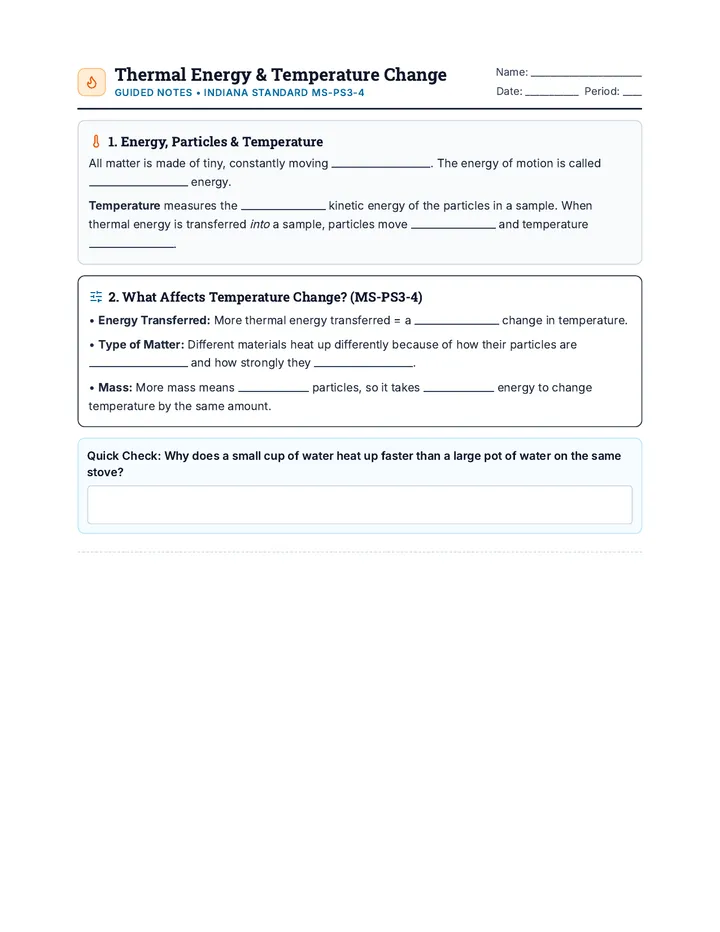
Thermal Energy & Temperature Change
Guided Notes • Indiana Standard MS-PS3-4
Name: _______________________
Date: ___________ Period: ____
1. Energy, Particles & Temperature
All matter is made of tiny, constantly moving . The energy of motion is called energy.
Temperature measures the kinetic energy of the particles in a sample. When thermal energy is transferred into a sample, particles move and temperature .
2. What Affects Temperature Change? (MS-PS3-4)
• Energy Transferred: More thermal energy transferred = a change in temperature.
• Type of Matter: Different materials heat up differently because of how their particles are and how strongly they .
• Mass: More mass means particles, so it takes energy to change temperature by the same amount.
Quick Check: Why does a small cup of water heat up faster than a large pot of water on the same stove?
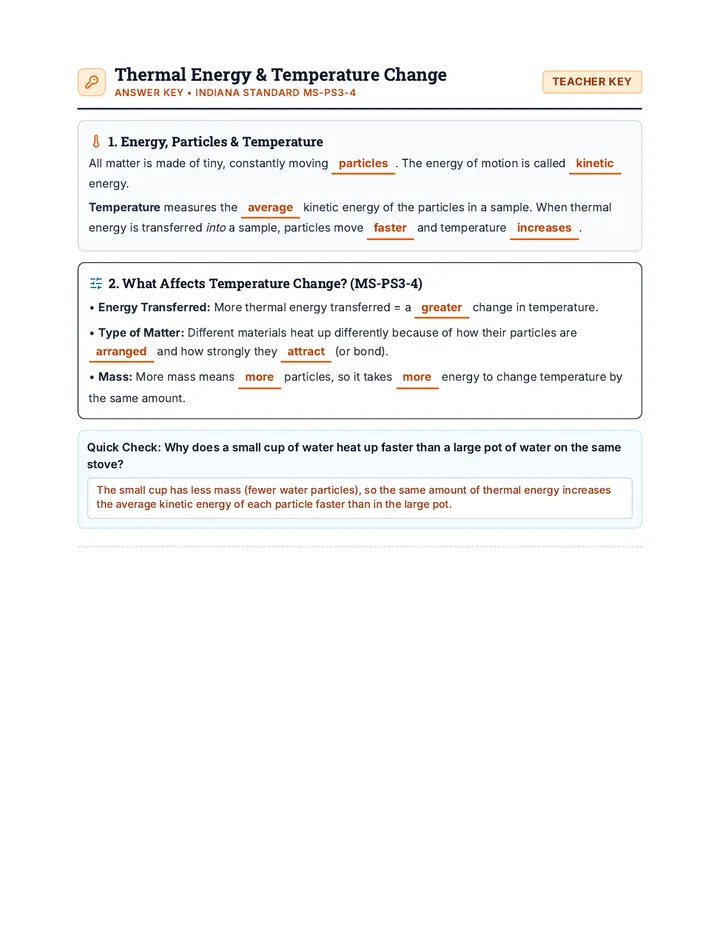
Thermal Energy Answer Key
Thermal Energy & Temperature Change
Answer Key • Indiana Standard MS-PS3-4
Teacher Key
1. Energy, Particles & Temperature
All matter is made of tiny, constantly moving particles. The energy of motion is called kinetic energy.
Temperature measures the average kinetic energy of the particles in a sample. When thermal energy is transferred into a sample, particles move faster and temperature increases.
2. What Affects Temperature Change? (MS-PS3-4)
• Energy Transferred: More thermal energy transferred = a greater change in temperature.
• Type of Matter: Different materials heat up differently because of how their particles are arranged and how strongly they attract (or bond).
• Mass: More mass means more particles, so it takes more energy to change temperature by the same amount.
Quick Check: Why does a small cup of water heat up faster than a large pot of water on the same stove?
The small cup has less mass (fewer water particles), so the same amount of thermal energy increases the average kinetic energy of each particle faster than in the large pot.