Gravity Mass Slides Day 1 • NC Standard PS.5.2
Gravity & Mass
How invisible pulls and the amount of matter in an object shape the way things move.
Motion and Stability: Forces and Interactions
Learning Target
What We Will Discover Today
Define Key Terms
Understand gravity , mass , weight , and air resistance in everyday motion.
Explain Motion
Explain how changing an object's mass changes the force needed to move or stop it.
Core Vocabulary
Gravity & Mass
Gravity
An invisible, non-contact force that pulls objects toward each other. Earth's gravity pulls all objects downward toward the center of the Earth.
Mass
The amount of matter in an object, measured in grams (g) or kilograms (kg). Mass stays the same everywhere—even in outer space!
Core Vocabulary
Weight & Air Resistance
Weight
The measure of the pull of gravity on an object's mass. Because the Moon has less gravity than Earth, you would weigh less on the Moon!
Air Resistance
A force from air pushing upward against a falling object. Flat objects (like a sheet of paper) catch more air and fall slower than crumpled objects.
Big Idea
More Mass = Harder to Move or Stop
Starting Motion
An empty shopping cart has less mass , so a gentle push gets it moving fast. A full cart has more mass and needs a much bigger push.
Stopping Motion
Once moving, an object with greater mass (like a bowling ball) takes more force to slow down or stop than a light soccer ball.
Day 1 Exit Ticket
Check Your Understanding
1. Two identical boxes are on a table. Box A is empty, and Box B is filled with heavy books. Which box requires more force to start moving, and why?
2. In your own words, explain one difference between mass and weight .
Gravity Mass Worksheet Gravity & Mass Practice
Day 1 • NC PS.5.2
Name: ____________________________________ Date: ________________
Directions: Circle the best answer for each question.
1. Which force pulls all objects toward the center of the Earth?
A. Friction
B. Gravity
C. Magnetism
D. Air resistance
2. What does the mass of an object measure?
A. The amount of matter in the object
B. How fast the object is moving
C. The temperature of the object
D. The pull of air on the object
3. An astronaut travels from Earth to the Moon, where gravity is weaker. What happens to the astronaut's mass and weight?
A. Both mass and weight stay the same.
B. Mass stays the same, and weight decreases.
C. Mass decreases, and weight stays the same.
D. Both mass and weight increase.
4. Maya pushes an empty wagon and a wagon loaded with rocks using the same amount of force. Which statement is true?
A. The loaded wagon will move faster because it has more mass.
B. Both wagons will move at the exact same speed.
C. The empty wagon will move faster because it has less mass.
D. The empty wagon will not move at all.
5. A student drops a flat sheet of paper and a crumpled ball of paper from the same height at the same time. Why does the crumpled ball hit the floor first?
A. The crumpled ball has more mass than the flat sheet.
B. Gravity only pulls on round objects.
C. The flat sheet experiences more air resistance pushing upward.
D. The crumpled ball has no gravity acting on it.
Gravity & Mass Practice (Continued) Day 1 • NC PS.5.2
6. Which object would require the GREATEST force to stop if all four are rolling at the same speed?
A. A 10-gram ping-pong ball
B. A 50-gram tennis ball
C. A 400-gram soccer ball
D. A 6,000-gram bowling ball
7. Why does a skydiver open a parachute before landing on the ground?
A. To increase air resistance and slow down the fall
B. To increase the skydiver's mass
C. To turn off Earth's gravity
D. To make the skydiver fall faster
8. A 2 kg wooden block and a 2 kg metal block sit on a desk. How does the pull of Earth's gravity on the two blocks compare?
A. Gravity pulls harder on the metal block.
B. Gravity pulls equally on both blocks because they have the same mass.
C. Gravity pulls harder on the wooden block.
D. Gravity does not pull on objects that are sitting still.
9. Which unit is used to measure the mass of an object in science class?
A. Meters
B. Seconds
C. Kilograms
D. Liters
10. When you toss a basketball straight up into the air, it slows down, stops at the top, and falls back down. Which force causes it to fall back down?
A. Friction
B. Gravity
C. Your hand pushing it
D. Magnetism
Gravity Mass Teacher Guide Day 1 Teacher Guide • NC Standard PS.5.2
Gravity & Mass
45–50 Minutes
Lesson Pacing & Facilitation
1. Hook & Slides 1–2 (5 min): Drop a flat piece of paper and a crumpled paper ball simultaneously. Ask students what they noticed.
2. Direct Instruction & Slides 3–5 (15 min): Introduce gravity, mass, weight, and air resistance. Emphasize that mass stays constant while weight depends on gravity.
3. Exit Ticket & Slide 6 (5 min): Have students write quick responses on index cards or notebooks before starting independent practice.
4. Independent Practice (20 min): Distribute the 10-question Gravity & Mass Worksheet. Review misconceptions as a class.
Exit Ticket Sample Answers
1. Box B (filled with books) requires more force because it has greater mass. Objects with more mass need a larger force to start moving.
2. Mass is the amount of matter in an object and never changes; weight is the pull of gravity on that mass and changes if gravity changes.
Worksheet Answer Key
#
Ans
Explanation
1
B
Gravity pulls all objects toward Earth's center.
2
A
Mass is the amount of matter in an object.
3
B
Mass stays constant; weaker Moon gravity reduces weight.
4
C
Less mass requires less force, so the empty wagon accelerates faster.
5
C
Flat paper catches more air, increasing upward air resistance.
6
D
The 6,000 g bowling ball has the greatest mass, so it is hardest to stop.
7
A
Parachutes trap air to increase air resistance and slow the fall.
8
B
Equal mass (2 kg each) means equal gravitational pull.
9
C
Mass is measured in grams or kilograms.
10
B
Gravity pulls the basketball back toward the ground.
Friction Surface Slides Day 2 • NC Standard PS.5.2
Friction & Surfaces
Why rolling balls slow down, why shoes grip the floor, and how surfaces change motion.
Motion and Stability: Forces and Interactions
Learning Target
What We Will Discover Today
Define Key Terms
Understand friction , surface texture , lubricant , and thermal energy .
Compare Surfaces
Predict how smooth vs. rough surfaces change the distance and speed of a moving object.
Core Vocabulary
Friction & Surface Texture
Friction
A contact force that opposes motion when two surfaces rub against each other. Friction always works in the opposite direction of motion, slowing objects down.
Surface Texture
How rough or smooth a surface is. Rough surfaces (carpet, sandpaper, gravel) create more friction ; smooth surfaces (ice, tile, polished wood) create less friction .
Core Vocabulary
Lubricants & Heat Energy
Lubricant
A slippery substance—such as oil, grease, or water—placed between surfaces to reduce friction and help parts move smoothly.
Thermal Energy (Heat)
Friction turns motion energy into heat. Rub your hands together quickly—the warmth you feel is caused by friction!
Big Idea
When Do We Want More or Less Friction?
More Friction Helps Us...
Walk without slipping, stop a bicycle using brakes, and grip a pencil or basketball.
Less Friction Helps Us...
Slide fast down a playground slide, ice skate smoothly, and keep bike chains spinning with oil.
Day 2 Exit Ticket
Check Your Understanding
1. A toy car is rolled with the same push across tile, carpet, and sandpaper. On which surface will it travel the farthest, and why?
2. Give one real-world example where friction is helpful and one where we try to reduce friction.
Friction Surface Worksheet Friction & Surfaces Practice
Day 2 • NC PS.5.2
Name: ____________________________________ Date: ________________
Directions: Circle the best answer for each question.
1. Which force slows down a soccer ball rolling across grass until it stops?
A. Magnetism
B. Friction
C. Electricity
D. Buoyancy
2. In which direction does friction always act on a moving object?
A. In the same direction the object is moving
B. Straight upward into the air
C. In the opposite direction of the object's motion
D. Toward the nearest magnet
3. A student rolls a marble down a ramp onto four different surfaces. On which surface will the marble travel the SHORTEST distance?
A. Smooth glass
B. Polished wood
C. Thick, shaggy carpet
D. Ice
4. Why do mechanics put oil inside a car engine?
A. To increase friction and stop the engine
B. To act as a lubricant and reduce friction between metal parts
C. To make the engine heavier
D. To increase the pull of gravity
5. When you rub your cold hands together quickly, they feel warm. What causes this warmth?
A. Gravity pulling your hands down
B. Friction turning motion energy into heat
C. Air resistance cooling your skin
D. Mass increasing inside your hands
Friction & Surfaces Practice (Continued) Day 2 • NC PS.5.2
6. Why do winter boots have deep rubber treads on the bottom?
A. To decrease friction so you can slide on ice
B. To increase friction so you do not slip on snow or ice
C. To reduce the mass of the boots
D. To make the boots waterproof
7. Which change would allow a heavy box to slide MORE easily across a wooden floor?
A. Gluing sandpaper to the bottom of the box
B. Putting more heavy books inside the box
C. Placing smooth wheels or rollers under the box
D. Moving the box onto a gravel driveway
8. A hockey puck glides much farther on ice than on concrete when hit with the same force. Why?
A. Ice is smoother and creates less friction than concrete.
B. Ice has stronger gravity than concrete.
C. The puck loses mass when it touches ice.
D. Concrete pushes the puck forward.
9. Which of the following is an example of friction being HELPFUL?
A. Bicycle brakes gripping the wheel to stop before a crosswalk
B. A squeaky door hinge wearing down
C. Engine parts overheating without oil
D. A sled getting stuck on bare grass
10. A student pushes a wooden block across three surfaces: wax paper, aluminum foil, and rough sandpaper. Which order lists the surfaces from LEAST friction to MOST friction?
A. Sandpaper, aluminum foil, wax paper
B. Wax paper, aluminum foil, sandpaper
C. Sandpaper, wax paper, aluminum foil
D. Aluminum foil, sandpaper, wax paper
Friction Surface Teacher Guide Day 2 Teacher Guide • NC Standard PS.5.2
Friction & Surfaces
45–50 Minutes
Lesson Pacing & Facilitation
1. Hook & Slides 1–2 (5 min): Have students rub their palms together for 5 seconds and describe what they feel (heat) and hear.
2. Direct Instruction & Slides 3–5 (15 min): Define friction, surface texture, lubricants, and thermal energy. Discuss helpful vs. unhelpful friction.
3. Exit Ticket & Slide 6 (5 min): Students complete the 2-question exit ticket before independent practice.
4. Independent Practice (20 min): Students complete the 10-question Friction & Surfaces Worksheet; review answers together.
Exit Ticket Sample Answers
1. The car will travel farthest on tile because tile is the smoothest surface and creates the least friction opposing the car's motion.
2. Helpful: shoe treads gripping the floor or bike brakes stopping. Reduce: putting oil on a bike chain or waxing a sled.
Worksheet Answer Key
#
Ans
Explanation
1
B
Friction between the ball and grass slows the ball down.
2
C
Friction always opposes the direction of motion.
3
C
Thick carpet is the roughest surface, creating the most friction.
4
B
Oil is a lubricant that reduces friction between moving parts.
5
B
Friction converts kinetic (motion) energy into thermal (heat) energy.
6
B
Deep treads increase friction for better grip on slippery surfaces.
7
C
Wheels/rollers reduce sliding friction, making the box easier to move.
8
A
Ice is much smoother than concrete, so it exerts less friction.
9
A
Brakes rely on friction to safely slow and stop a bicycle.
10
B
Wax paper is smoothest, aluminum foil is medium, sandpaper is roughest.
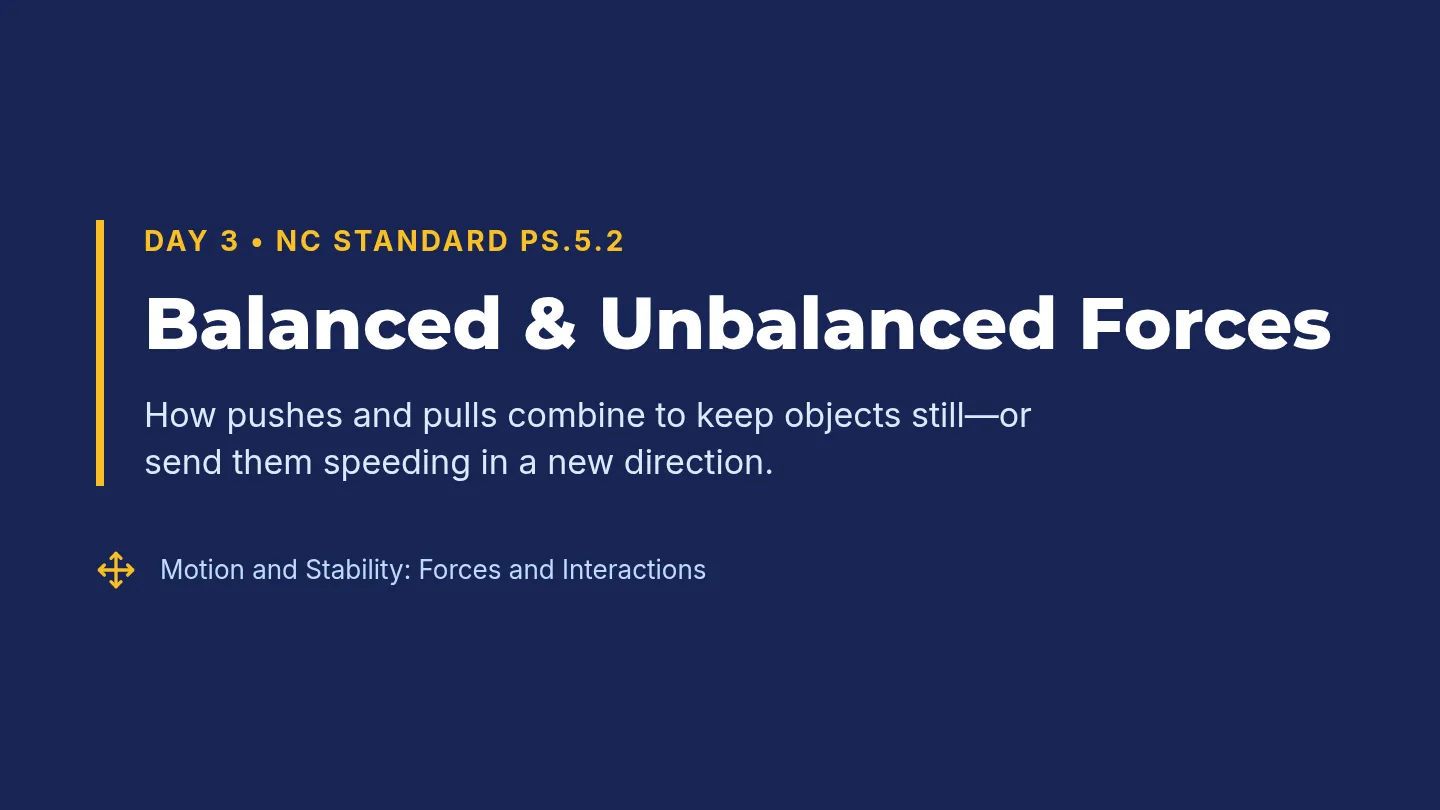
Force Tug Slides Day 3 • NC Standard PS.5.2
Balanced & Unbalanced Forces
How pushes and pulls combine to keep objects still—or send them speeding in a new direction.
Motion and Stability: Forces and Interactions
Learning Target
What We Will Discover Today
Define Key Terms
Understand force , net force , balanced forces , unbalanced forces , and inertia .
Predict Motion
Determine whether an object stays at rest, moves at constant speed, or changes speed/direction.
Core Vocabulary
Force & Net Force
Force
A push or pull on an object, measured in Newtons (N) . Every force has both a strength (size) and a direction.
Net Force
The total force acting on an object when all forces are combined. Same direction = add forces. Opposite directions = subtract forces.
Core Vocabulary
Balanced vs. Unbalanced Forces
Balanced Forces (Net Force = 0 N)
Equal forces pushing or pulling in opposite directions. They cancel each other out, so motion does not change .
Unbalanced Forces (Net Force > 0 N)
Unequal forces acting on an object. They cause the object to start moving, stop, speed up, slow down, or change direction .
Big Idea
Inertia & Changing Motion
Inertia
An object's tendency to keep doing what it is already doing—staying at rest or keeping steady motion—unless an unbalanced force acts on it.
Tug-of-War Example
Team Left pulls with 80 N . Team Right pulls with 50 N . Net force = 30 N Left (unbalanced), so the rope moves left!
Day 3 Exit Ticket
Check Your Understanding
1. Alex pushes a crate to the right with 45 N of force, while Sam pushes it to the left with 45 N of force. Are the forces balanced or unbalanced? What happens to the crate?
2. Name two ways an unbalanced force can change an object's motion.
Force Tug Worksheet Balanced & Unbalanced Forces
Day 3 • NC PS.5.2
Name: ____________________________________ Date: ________________
Directions: Circle the best answer for each question.
1. Which unit is used to measure the strength of a force?
A. Grams
B. Newtons
C. Meters
D. Minutes
2. Two teams play tug-of-war. Team A pulls left with 120 N, and Team B pulls right with 120 N. What is the net force on the rope?
A. 0 N (balanced)
B. 120 N left
C. 120 N right
D. 240 N
3. A book is sitting completely still on a desk. Which statement best describes the forces acting on the book?
A. No forces are acting on the book.
B. Only gravity is acting on the book.
C. Balanced forces are acting on the book.
D. Unbalanced forces are pushing the book sideways.
4. Two students push a heavy desk in the SAME direction. Student 1 pushes with 30 N, and Student 2 pushes with 25 N. What is the net force?
A. 5 N
B. 25 N
C. 30 N
D. 55 N
5. What happens to a moving object when an unbalanced force acts on it?
A. Its speed or direction changes.
B. It must immediately stop moving.
C. Its mass increases.
D. Its motion stays exactly the same.
Balanced & Unbalanced Forces (Continued) Day 3 • NC PS.5.2
6. A soccer ball is rolling east at a steady speed. A player kicks it toward the north. What caused the ball to change direction?
A. Balanced forces
B. An unbalanced force
C. Zero net force
D. A decrease in mass
7. Which term describes an object's tendency to stay at rest or keep moving unless acted on by an unbalanced force?
A. Friction
B. Weight
C. Inertia
D. Lubricant
8. A box is pushed left with 60 N and right with 40 N. What is the net force and direction of motion?
A. 20 N to the left
B. 20 N to the right
C. 100 N to the left
D. 100 N to the right
9. A car is cruising down a straight highway at a constant speed of 60 miles per hour. What can you infer about the forces on the car?
A. The forward force and backward forces (friction/air) are balanced.
B. There is no friction acting on the car.
C. The backward force is much stronger than the forward force.
D. Gravity has stopped pulling on the car.
10. When a school bus suddenly stops, passengers lean forward. Which scientific idea explains why their bodies keep moving forward?
A. Air resistance
B. Inertia
C. Magnetism
D. Balanced weight
Force Tug Teacher Guide Day 3 Teacher Guide • NC Standard PS.5.2
Balanced & Unbalanced Forces
45–50 Minutes
Lesson Pacing & Facilitation
1. Hook & Slides 1–2 (5 min): Have two students gently push opposite sides of a light box with equal force, then unequal force. Ask why the box moved only the second time.
2. Direct Instruction & Slides 3–5 (15 min): Define force (Newtons), net force (adding same-direction, subtracting opposite-direction), balanced/unbalanced forces, and inertia.
3. Exit Ticket & Slide 6 (5 min): Students complete the 2-question exit ticket before starting the worksheet.
4. Independent Practice (20 min): Distribute the 10-question Balanced & Unbalanced Forces Worksheet and review calculations.
Exit Ticket Sample Answers
1. The forces are balanced (45 N − 45 N = 0 N net force). The crate stays still and does not move.
2. An unbalanced force can make an object start moving, stop, speed up, slow down, or change direction (any two).
Worksheet Answer Key
#
Ans
Explanation
1
B
Force is measured in Newtons (N).
2
A
120 N left − 120 N right = 0 N (balanced).
3
C
Gravity pulls down and the desk pushes up equally (balanced).
4
D
Forces in the same direction add together: 30 N + 25 N = 55 N.
5
A
Unbalanced forces cause a change in speed or direction.
6
B
The kick is an unbalanced force that changes the ball's direction.
7
C
Inertia is an object's resistance to a change in motion.
8
A
60 N left − 40 N right = 20 N to the left.
9
A
Constant speed in a straight line means forces are balanced.
10
B
Inertia keeps passengers' bodies moving forward when the bus stops.
Speed Graph Slides Day 4 • NC Standard PS.5.2
Speed & Motion Graphs
Measuring how fast objects travel and reading the story of motion on a distance-time graph.
Motion and Stability: Forces and Interactions
Learning Target
What We Will Discover Today
Calculate Speed
Define position , direction , speed , and acceleration , and use \( \text{Speed} = \frac{\text{Distance}}{\text{Time}} \).
Read Motion Graphs
Infer whether an object is moving fast, moving slowly, or stopped by looking at a distance-time graph.
Core Vocabulary
Position, Direction & Speed
Position & Direction
Position is an object's exact location compared to a reference point. Direction is the path along which an object moves (north, left, up).
Speed
How far an object travels in a certain amount of time: \( \text{Speed} = \text{Distance} \div \text{Time} \) (e.g., meters per second, m/s, or miles per hour, mph).
Core Vocabulary & Math
Acceleration & Calculating Speed
Acceleration
Any change in speed or direction—speeding up, slowing down, or turning a corner. Caused by unbalanced forces .
Example Calculation
A runner sprints 100 meters in 20 seconds . Speed = \( 100 \div 20 = \mathbf{5\text{ m/s}} \).
Big Idea
Reading a Distance-Time Graph
Steep Slant Up
The object is covering a lot of distance in a short time: Moving Fast .
Gentle Slant Up
The object is covering less distance per second: Moving Slowly .
Flat Horizontal Line
Time passes, but distance stays the same: Stopped (At Rest) .
Day 4 Exit Ticket
Check Your Understanding
1. A cyclist rides 30 kilometers in 2 hours. What is the cyclist's average speed? Show your division.
2. On a distance-time graph, what does a flat horizontal line tell you about the object's motion?
Speed Graph Worksheet Speed & Motion Graphs Practice
Day 4 • NC PS.5.2
Name: ____________________________________ Date: ________________
Directions: Circle the best answer for each question.
1. Which formula is used to calculate the average speed of a moving object?
A. Speed = Distance × Time
B. Speed = Distance ÷ Time
C. Speed = Time ÷ Distance
D. Speed = Mass × Gravity
2. A remote-control car travels 24 meters in 6 seconds. What is its average speed?
A. 4 m/s
B. 18 m/s
C. 30 m/s
D. 144 m/s
3. Which of the following is an example of acceleration?
A. A parked bicycle leaning against a wall
B. A train moving straight east at a steady 50 mph
C. A runner speeding up at the end of a race
D. A book resting flat on a table
4. To describe an object's position, what must you always compare it to?
A. Its mass
B. A reference point
C. Its friction
D. A stopwatch
5. A bus travels 120 miles in 2 hours. What is the bus's average speed?
A. 40 mph
B. 60 mph
C. 122 mph
D. 240 mph
Speed & Motion Graphs Practice (Continued) Day 4 • NC PS.5.2
0 10 20 30 Dist (m) 0 2 4 6 8 Time (s) A B C
Use the Distance-Time Graph for Questions 6–8:
The graph shows a student riding a scooter in three segments labeled A , B , and C .
6. During which segment was the scooter completely STOPPED (at rest)?
A. Segment A
B. Segment B
C. Segment C
D. Both A and C
7. During which segment was the scooter moving the FASTEST?
A. Segment A
B. Segment B
C. Segment C
D. It moved at the same speed in A and C
8. How far had the scooter traveled at 2 seconds?
A. 10 meters
B. 20 meters
C. 30 meters
D. 0 meters
9. On a distance-time graph, Car X has a steeper upward line than Car Y. What does this tell you?
A. Car X is moving faster than Car Y.
B. Car Y is moving faster than Car X.
C. Car X is stopped and Car Y is moving.
D. Car X has more mass than Car Y.
10. A dog runs at a steady speed of 5 meters per second for 10 seconds. How far does the dog run?
A. 2 meters
B. 15 meters
C. 50 meters
D. 100 meters
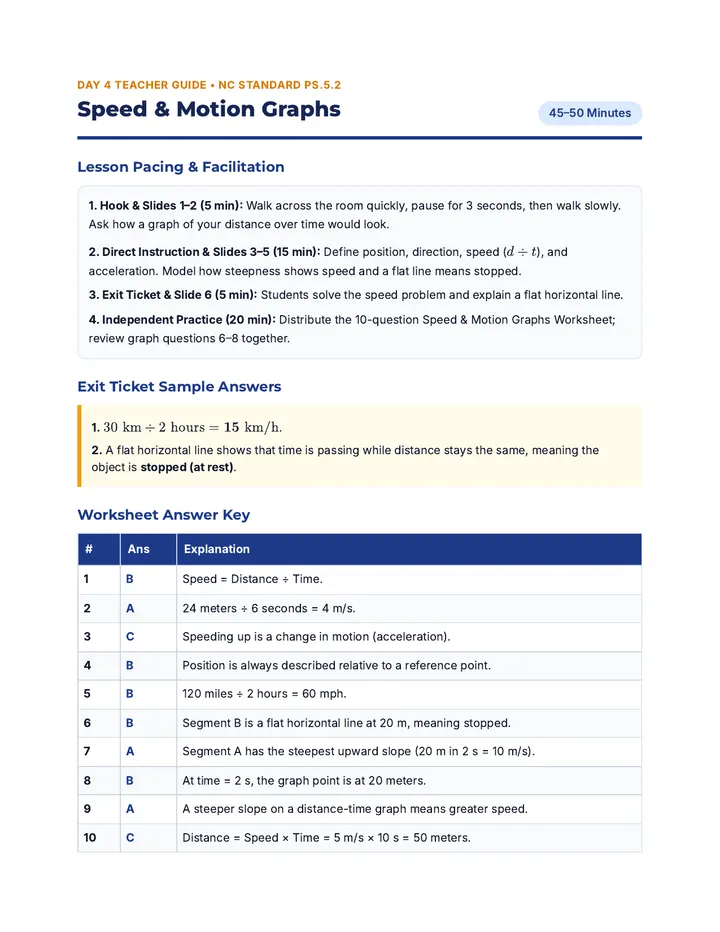
Speed Graph Teacher Guide Day 4 Teacher Guide • NC Standard PS.5.2
Speed & Motion Graphs
45–50 Minutes
Lesson Pacing & Facilitation
1. Hook & Slides 1–2 (5 min): Walk across the room quickly, pause for 3 seconds, then walk slowly. Ask how a graph of your distance over time would look.
2. Direct Instruction & Slides 3–5 (15 min): Define position, direction, speed (\(d \div t\)), and acceleration. Model how steepness shows speed and a flat line means stopped.
3. Exit Ticket & Slide 6 (5 min): Students solve the speed problem and explain a flat horizontal line.
4. Independent Practice (20 min): Distribute the 10-question Speed & Motion Graphs Worksheet; review graph questions 6–8 together.
Exit Ticket Sample Answers
1. \( 30 \text{ km} \div 2 \text{ hours} = \mathbf{15\text{ km/h}} \).
2. A flat horizontal line shows that time is passing while distance stays the same, meaning the object is stopped (at rest) .
Worksheet Answer Key
#
Ans
Explanation
1
B
Speed = Distance ÷ Time.
2
A
24 meters ÷ 6 seconds = 4 m/s.
3
C
Speeding up is a change in motion (acceleration).
4
B
Position is always described relative to a reference point.
5
B
120 miles ÷ 2 hours = 60 mph.
6
B
Segment B is a flat horizontal line at 20 m, meaning stopped.
7
A
Segment A has the steepest upward slope (20 m in 2 s = 10 m/s).
8
B
At time = 2 s, the graph point is at 20 meters.
9
A
A steeper slope on a distance-time graph means greater speed.
10
C
Distance = Speed × Time = 5 m/s × 10 s = 50 meters.
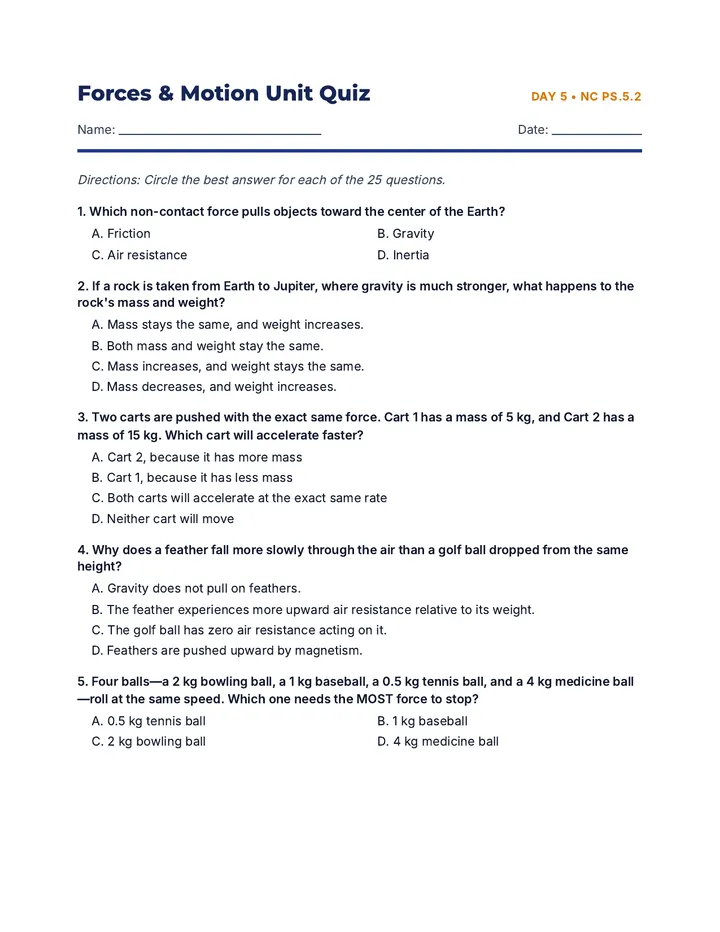
Force Motion Quiz Forces & Motion Unit Quiz
Day 5 • NC PS.5.2
Name: ____________________________________ Date: ________________
Directions: Circle the best answer for each of the 25 questions.
1. Which non-contact force pulls objects toward the center of the Earth?
A. Friction
B. Gravity
C. Air resistance
D. Inertia
2. If a rock is taken from Earth to Jupiter, where gravity is much stronger, what happens to the rock's mass and weight?
A. Mass stays the same, and weight increases.
B. Both mass and weight stay the same.
C. Mass increases, and weight stays the same.
D. Mass decreases, and weight increases.
3. Two carts are pushed with the exact same force. Cart 1 has a mass of 5 kg, and Cart 2 has a mass of 15 kg. Which cart will accelerate faster?
A. Cart 2, because it has more mass
B. Cart 1, because it has less mass
C. Both carts will accelerate at the exact same rate
D. Neither cart will move
4. Why does a feather fall more slowly through the air than a golf ball dropped from the same height?
A. Gravity does not pull on feathers.
B. The feather experiences more upward air resistance relative to its weight.
C. The golf ball has zero air resistance acting on it.
D. Feathers are pushed upward by magnetism.
5. Four balls—a 2 kg bowling ball, a 1 kg baseball, a 0.5 kg tennis ball, and a 4 kg medicine ball—roll at the same speed. Which one needs the MOST force to stop?
A. 0.5 kg tennis ball
B. 1 kg baseball
C. 2 kg bowling ball
D. 4 kg medicine ball
Forces & Motion Unit Quiz (Page 2) Day 5 • NC PS.5.2
6. Which statement best describes how friction affects a sliding object?
A. Friction pushes the object forward to make it speed up.
B. Friction acts in the opposite direction of motion and slows the object down.
C. Friction pulls the object toward the center of the Earth.
D. Friction only acts on objects that are floating in air.
7. A student slides a puck across four different floors using the same push. On which floor will the puck slide the FARTHEST?
A. Rough concrete
B. Thick carpet
C. Smooth waxed gym floor
D. Gravel
8. Why do cyclists put oil on their bicycle chains?
A. To increase friction so the chain grips better
B. To act as a lubricant and reduce friction between metal links
C. To make the bicycle heavier
D. To stop the wheels from turning
9. When two surfaces rub together rapidly, some of the motion energy changes into which form of energy?
A. Thermal (heat) energy
B. Light energy only
C. Gravitational energy
D. Magnetic energy
10. Soccer players wear cleats with spikes on the bottom of their shoes. How do cleats help players on grass?
A. They decrease friction so players can slide farther.
B. They increase friction so players can push off without slipping.
C. They reduce the player's mass.
D. They eliminate gravity on the field.
Forces & Motion Unit Quiz (Page 3) Day 5 • NC PS.5.2
11. What is the standard scientific unit used to measure force?
A. Kilogram
B. Meter
C. Newton
D. Second
12. A lamp sits motionless on a table. Gravity pulls down on the lamp with 15 N, and the table pushes up with 15 N. What is the net force on the lamp?
A. 0 N (balanced)
B. 15 N downward
C. 15 N upward
D. 30 N downward
13. Two dogs pull on a rope toy in opposite directions. Dog A pulls left with 35 N, and Dog B pulls right with 50 N. Which way does the toy move and with what net force?
A. 15 N to the left
B. 15 N to the right
C. 85 N to the right
D. 0 N (it stays still)
14. Which situation shows an UNBALANCED force acting on an object?
A. A trophy sitting still on a shelf
B. A car cruising straight at a constant 45 mph
C. A baseball player hitting a pitched ball into the outfield
D. Two equal teams holding a tug-of-war rope completely still
15. When you are riding a skateboard and the front wheels hit a curb, the skateboard stops, but your body keeps moving forward. Which property causes this?
A. Inertia
B. Lubricant
C. Air resistance
D. Balanced net force
Forces & Motion Unit Quiz (Page 4) Day 5 • NC PS.5.2
16. A swimmer swims 50 meters in 25 seconds. What is the swimmer's average speed?
A. 0.5 m/s
B. 2 m/s
C. 25 m/s
D. 75 m/s
17. A delivery truck drives 180 miles in 3 hours. What was its average speed?
A. 50 mph
B. 60 mph
C. 177 mph
D. 540 mph
18. Which of the following is NOT an example of acceleration?
A. A car turning left around a corner
B. A cyclist pressing the brakes to slow down
C. A sprinter speeding up out of the starting blocks
D. A train traveling straight north at a steady 60 mph
19. If a bird flies at a constant speed of 8 meters per second for 12 seconds, how far does it fly?
A. 4 meters
B. 20 meters
C. 96 meters
D. 1.5 meters
20. A student says, "My backpack is 2 meters to the left of the classroom door." What is the classroom door in this description?
A. A reference point
B. Net force
C. Acceleration
D. Friction
Forces & Motion Unit Quiz (Page 5) Day 5 • NC PS.5.2
0 20 40 60 Dist (m) 0 5 10 15 20 Time (s) 1 2 3
Use the Distance-Time Graph for Questions 21–23:
The graph tracks a cyclist's distance over 20 seconds across three intervals: 1 , 2 , and 3 .
21. During which interval was the cyclist traveling the FASTEST?
A. Interval 1
B. Interval 2
C. Interval 3
D. Intervals 1 and 3
22. What was the cyclist doing during Interval 3 (from 10 s to 20 s)?
A. Speeding up downhill
B. Moving backward toward the start
C. Stopped (at rest) at 60 meters
D. Moving at a steady 6 m/s
23. What was the cyclist's average speed during Interval 1 (0 s to 5 s)?
A. 4 m/s
B. 5 m/s
C. 15 m/s
D. 20 m/s
24. Two students push a box from opposite sides: 40 N to the east and 40 N to the west. Which statement is true?
A. The net force is 80 N east, so the box speeds up.
B. The forces are balanced, so the box's motion does not change.
C. Friction disappears when two people push.
D. The box will move west because west is stronger.
25. A marble rolls down a ramp onto carpet and stops quickly, while an identical marble rolls onto tile and goes much farther. Which force caused the marble on carpet to stop sooner?
A. Stronger gravity on carpet
B. Greater friction on carpet
C. Greater mass on tile
D. Less inertia on carpet
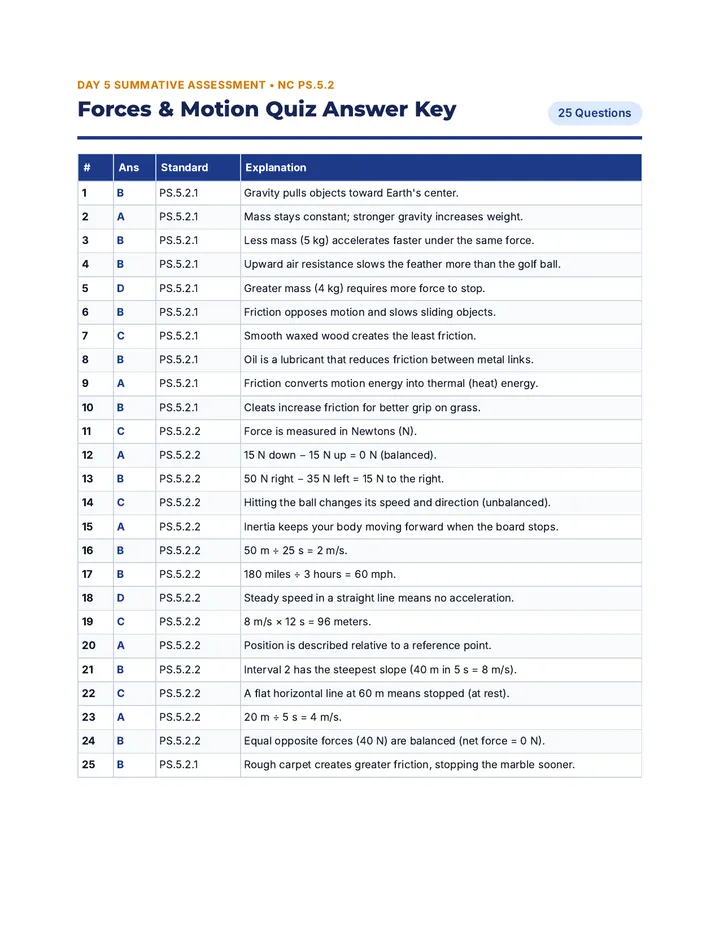
Force Motion Answer Key Day 5 Summative Assessment • NC PS.5.2
Forces & Motion Quiz Answer Key
25 Questions
#
Ans
Standard
Explanation
1
B
PS.5.2.1
Gravity pulls objects toward Earth's center.
2
A
PS.5.2.1
Mass stays constant; stronger gravity increases weight.
3
B
PS.5.2.1
Less mass (5 kg) accelerates faster under the same force.
4
B
PS.5.2.1
Upward air resistance slows the feather more than the golf ball.
5
D
PS.5.2.1
Greater mass (4 kg) requires more force to stop.
6
B
PS.5.2.1
Friction opposes motion and slows sliding objects.
7
C
PS.5.2.1
Smooth waxed wood creates the least friction.
8
B
PS.5.2.1
Oil is a lubricant that reduces friction between metal links.
9
A
PS.5.2.1
Friction converts motion energy into thermal (heat) energy.
10
B
PS.5.2.1
Cleats increase friction for better grip on grass.
11
C
PS.5.2.2
Force is measured in Newtons (N).
12
A
PS.5.2.2
15 N down − 15 N up = 0 N (balanced).
13
B
PS.5.2.2
50 N right − 35 N left = 15 N to the right.
14
C
PS.5.2.2
Hitting the ball changes its speed and direction (unbalanced).
15
A
PS.5.2.2
Inertia keeps your body moving forward when the board stops.
16
B
PS.5.2.2
50 m ÷ 25 s = 2 m/s.
17
B
PS.5.2.2
180 miles ÷ 3 hours = 60 mph.
18
D
PS.5.2.2
Steady speed in a straight line means no acceleration.
19
C
PS.5.2.2
8 m/s × 12 s = 96 meters.
20
A
PS.5.2.2
Position is described relative to a reference point.
21
B
PS.5.2.2
Interval 2 has the steepest slope (40 m in 5 s = 8 m/s).
22
C
PS.5.2.2
A flat horizontal line at 60 m means stopped (at rest).
23
A
PS.5.2.2
20 m ÷ 5 s = 4 m/s.
24
B
PS.5.2.2
Equal opposite forces (40 N) are balanced (net force = 0 N).
25
B
PS.5.2.1
Rough carpet creates greater friction, stopping the marble sooner.