Atom Counter Worksheet
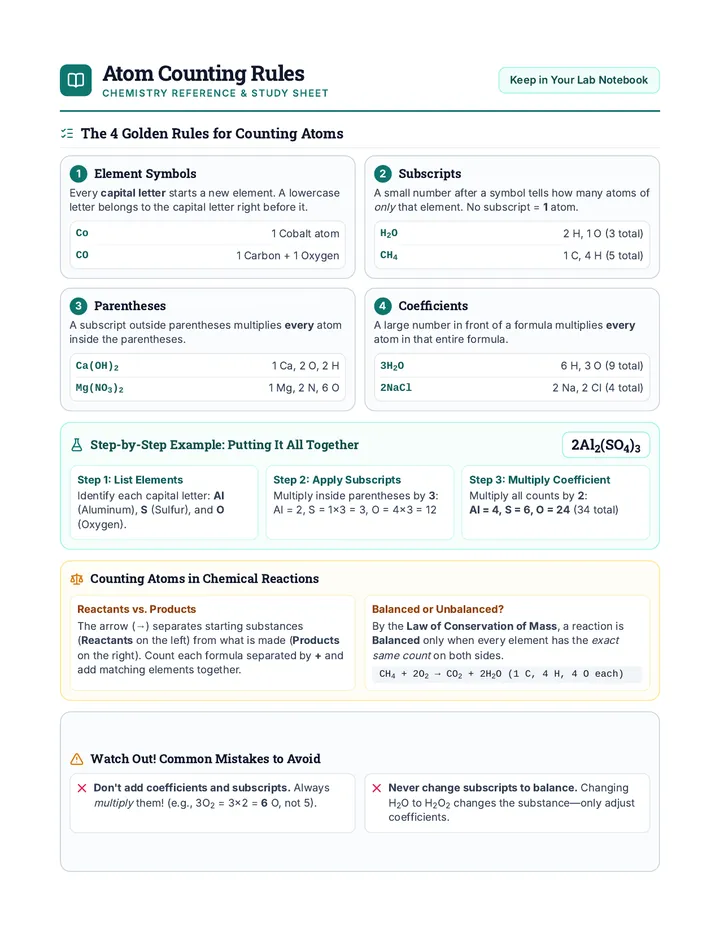
Atom Counting Rules
Chemistry Reference & Study Sheet
Keep in Your Lab Notebook
The 4 Golden Rules for Counting Atoms
1
Element Symbols
Every capital letter starts a new element. A lowercase letter belongs to the capital letter right before it.
Co 1 Cobalt atom
CO 1 Carbon + 1 Oxygen
2
Subscripts
A small number after a symbol tells how many atoms of only that element. No subscript = 1 atom.
H2O 2 H, 1 O (3 total)
CH4 1 C, 4 H (5 total)
3
Parentheses
A subscript outside parentheses multiplies every atom inside the parentheses.
Ca(OH)2 1 Ca, 2 O, 2 H
Mg(NO3)2 1 Mg, 2 N, 6 O
4
Coefficients
A large number in front of a formula multiplies every atom in that entire formula.
3H2O 6 H, 3 O (9 total)
2NaCl 2 Na, 2 Cl (4 total)
Step-by-Step Example: Putting It All Together
2Al2(SO4)3
Step 1: List Elements
Identify each capital letter: Al (Aluminum), S (Sulfur), and O (Oxygen).
Step 2: Apply Subscripts
Multiply inside parentheses by 3:
Al = 2, S = 1×3 = 3, O = 4×3 = 12
Step 3: Multiply Coefficient
Multiply all counts by 2:
Al = 4, S = 6, O = 24 (34 total)
Counting Atoms in Chemical Reactions
Reactants vs. Products
The arrow (→) separates starting substances (Reactants on the left) from what is made (Products on the right). Count each formula separated by + and add matching elements together.
Balanced or Unbalanced?
By the Law of Conservation of Mass, a reaction is Balanced only when every element has the exact same count on both sides.
CH4 + 2O2 → CO2 + 2H2O (1 C, 4 H, 4 O each)
Watch Out! Common Mistakes to Avoid
✕
Don't add coefficients and subscripts. Always multiply them! (e.g., 3O2 = 3×2 = 6 O, not 5).
✕
Never change subscripts to balance. Changing H2O to H2O2 changes the substance—only adjust coefficients.
Atom Counter
Lab Practice: Formulas & Reactions
Name: ____________________________
Date: ____________ Period: ______
Quick Reference: How to Count Atoms
1. Subscripts
Apply only to the element right before them. No subscript = 1.
H2O → 2 H, 1 O
2. Parentheses
Multiply everything inside by the subscript outside.
Mg(OH)2 → 1 Mg, 2 O, 2 H
3. Coefficients
Big numbers in front multiply every atom in the formula.
2Ca(NO3)2 → 2 Ca, 4 N, 12 O
Part 1: Counting Atoms in Chemical Formulas
Write the total number of each atom in the blanks.
Formula 1 CO2
Carbon (C):
Oxygen (O):
Total Atoms:
Formula 2 3NH3
Nitrogen (N):
Hydrogen (H):
Total Atoms:
Formula 3 4C6H12O6
Carbon (C):
Hydrogen (H):
Oxygen (O):
Total Atoms:
Formula 4 Ca(OH)2
Calcium (Ca):
Oxygen (O):
Hydrogen (H):
Total Atoms:
Formula 5 2Al2(SO4)3
Aluminum (Al):
Sulfur (S):
Oxygen (O):
Total Atoms:
Formula 6 3(NH4)2CO3
Nitrogen (N):
Hydrogen (H):
Carbon (C):
Oxygen (O):
Total Atoms:
Part 1 (Continued): More Chemical Formulas
Write the total number of each atom in the blanks.
Formula 7 3Fe2O3
Iron (Fe):
Oxygen (O):
Total Atoms:
Formula 8 2H2SO4
Hydrogen (H):
Sulfur (S):
Oxygen (O):
Total Atoms:
Formula 9 Mg(NO3)2
Magnesium (Mg):
Nitrogen (N):
Oxygen (O):
Total Atoms:
Formula 10 2NH4Cl
Nitrogen (N):
Hydrogen (H):
Chlorine (Cl):
Total Atoms:
Formula 11 4Ca3(PO4)2
Calcium (Ca):
Phosphorus (P):
Oxygen (O):
Total Atoms:
Formula 12 2K2Cr2O7
Potassium (K):
Chromium (Cr):
Oxygen (O):
Total Atoms:
Part 2: Counting Atoms in Chemical Reactions
Count both sides, then circle Balanced or Unbalanced.
Reaction 1 2H2 + O2 → 2H2O
Balanced Unbalanced
| Element |
Reactants (Left) |
Products (Right) |
| Hydrogen (H) |
|
|
| Oxygen (O) |
|
|
Reaction 2 Fe + O2 → Fe2O3
Balanced Unbalanced
| Element |
Reactants (Left) |
Products (Right) |
| Iron (Fe) |
|
|
| Oxygen (O) |
|
|
Reaction 3 CH4 + 2O2 → CO2 + 2H2O
Balanced Unbalanced
| Element |
Reactants (Left) |
Products (Right) |
| Carbon (C) |
|
|
| Hydrogen (H) |
|
|
| Oxygen (O) |
|
|
Reaction 4 2Al + 3CuCl2 → 2AlCl3 + 3Cu
Balanced Unbalanced
| Element |
Reactants (Left) |
Products (Right) |
| Aluminum (Al) |
|
|
| Copper (Cu) |
|
|
| Chlorine (Cl) |
|
|
Part 2 (Continued): More Chemical Reactions
Count both sides, then circle Balanced or Unbalanced.
Reaction 5 2Na + Cl2 → 2NaCl
Balanced Unbalanced
| Element |
Reactants (Left) |
Products (Right) |
| Sodium (Na) |
|
|
| Chlorine (Cl) |
|
|
Reaction 6 N2 + H2 → NH3
Balanced Unbalanced
| Element |
Reactants (Left) |
Products (Right) |
| Nitrogen (N) |
|
|
| Hydrogen (H) |
|
|
Reaction 7 Zn + 2HCl → ZnCl2 + H2
Balanced Unbalanced
| Element |
Reactants (Left) |
Products (Right) |
| Zinc (Zn) |
|
|
| Hydrogen (H) |
|
|
| Chlorine (Cl) |
|
|
Reaction 8 2KClO3 → 2KCl + O2
Balanced Unbalanced
| Element |
Reactants (Left) |
Products (Right) |
| Potassium (K) |
|
|
| Chlorine (Cl) |
|
|
| Oxygen (O) |
|
|
Challenge: Spot the Missing Coefficient
Look at the reaction: N2 + ___ H2 → 2NH3. What coefficient belongs in front of H2 to balance the equation? Explain how you counted the atoms to be sure.