Notebook Launch Slides
Social Studies Toolkit
Welcome to Your Thinking Lab
The Interactive
Notebook Guide
Transform ordinary loose pages into an organized, color-coded, working portfolio of history and critical thought.
Organization
Interactive Foldables
Mastery & Checks
The Big Picture
What is an Interactive Notebook?
Your Textbook
A personalized reference archive packed with verified notes, definitions, timelines, and primary sources.
Key Information
Your Thinking Lab
Where you question evidence, construct arguments, test theories, and process historical events.
Mind Processing
Your Portfolio
Tangible proof of your growth as a historian, researcher, and analytical thinker over the entire year.
Proof of Growth
Why not digital files? Physical sketching and kinesthetic assembly trigger deeper memory recall and long-term retention.
Notebook Architecture
The Core System: Left vs. Right
LEFT SIDE = OUTPUT (You)
Student Reflection & Creation
- Draw sketchnotes, political cartoons, and visual diagrams
- Synthesize primary source reactions & opinions
- Answer essential questions in your own words
🧠 Rule: Odd or Even? Usually EVEN page numbers on the left!
RIGHT SIDE = INPUT (Teacher/Content)
Direct Instruction & Facts
- Cornell or guided lecture notes & vocabulary
- Historical maps, official charts, and printed handouts
- Chronological timelines and verified class notes
📖 Rule: Input provides the evidence you process on the left!
Open your notebook flat: Left page mirrors and responds to the Right page.
Non-Negotiable Routines
The Three Golden Anchors
1
Page Number
Write the page number in the top outer corner of every single sheet before writing anything else.
Standard:
Left = Top Left Corner
Right = Top Right Corner
2
Date & Unit
Every lesson entry begins with the full calendar date and unit tag at the top of the right-hand page.
Standard:
September 16, 2026
Unit 1: Early Civilizations
3
Clear Heading
Every page receives a centered, bold title matching the class objective or essential question.
Standard:
"Silk Road Trade Routes"
or "Primary vs Secondary"
Missing page numbers break your Table of Contents! Consistent numbering keeps you organized for open-notebook exams.
Navigation Hub
The Table of Contents (T.O.C.)
Reserve Pages 1–4
The first four pages of your notebook are exclusively dedicated to tracking every topic, entry date, and page number.
Log entries immediately when class starts
Match exact titles used on the lesson page
Essential for quick review during timed checks
TABLE OF CONTENTS (SAMPLE)
Date Title / Activity Page
9/16/26 Notebook Setup & Syllabus 1–4
9/17/26 What is History? Artifact Analysis 5–6
9/18/26 Primary vs. Secondary Sources Foldable 7–8
9/21/26 Ancient Mesopotamia Geography Map 9–10
📌 Always keep your Table of Contents up-to-date. It is the first thing evaluated during checks!
Kinesthetic Learning
Foldables, Flaps & Interactive Tools
Shutter Fold
Doors of History
Outer doors display questions, images, or vocabulary terms; open the doors to reveal definitions and analysis inside.
Best for: Comparing two opposing sides or causes.
Matchbook / Flap
Flip & Discover
Glue only the anchor tab down. Lift the tab to see hidden notes, primary source quotes, or translations.
Best for: Key vocabulary and self-quizzing.
Pockets & Envelopes
Artifact Storage
Paper pockets hold movable sorting cards, timeline strips, primary source excerpts, and flashcards.
Best for: Interactive card sorts and evidence sorting.
The Glue Rule: "Dot, dot, not a lot!" 4 small corner dots are enough. Never drown pages in liquid glue!
Historical Thinking
Social Studies in Your Notebook
Primary Source Investigation
Paste historical letters, speeches, and treaties in the center. Use color callouts around the margins to interrogate bias, context, and purpose.
Layered Geography Maps
Annotate terrain, physical barriers, trade routes, and empire boundaries with color-coded keys and geographical consequence notes.
Accordion Timelines
Foldable timeline strips fold out across your page to track centuries of cause-and-effect without crowding single notebook pages.
Historical Perspective Charts
Compare viewpoints (e.g., Loyalist vs. Patriot, Pharaoh vs. Peasant) with dual-column graphic organizers and dialogue bubbles.
Historian Rule: We don't just memorize dates—we analyze why people acted and how events connect!
Evaluation & Rubric
How Are Notebooks Graded?
Completeness
30% Weight
All notes, foldables, and assignments are fully finished with no blank spaces.
No missing pages
Accuracy
30% Weight
Historical concepts, vocabulary, dates, and geographic facts are correct and verified.
Sound evidence
Thinking
25% Weight
Left-side output demonstrates genuine insight, creative visuals, and thoughtful reflection.
High effort
Organization
15% Weight
Updated Table of Contents, correct page numbers, dates, titles, and neat glue work.
Fast retrieval
Notebook checks occur every 2–3 weeks and are often unannounced spot checks!
Open Notebook Quizzes!
Hands-On Practice
Today's Setup Mission: Step by Step
1
Cover ID
Label front cover with permanent marker: Your Full Name, Period, and "Social Studies INB".
2
Number 1–30
Number pages 1 through 30 in top outer corners. Stop at 30 for today!
3
Title T.O.C.
Header Pages 1–4: "Table of Contents". Divide each page into Date, Activity, and Page.
4
First Foldable
Cut and glue the "Historian Profile" foldable onto Page 5. Write your first artifact reflection!
Tools needed on your desk: Notebook, Pen/Pencil, Scissors, Glue Stick, Checklist
15 Minutes on Timer ⏱️
Launch Sequence Complete
Keep This Deck As Reference
Your Journey Through Time Starts Here.
Treat your notebook with pride. By the end of this year, it will be the most valuable record of your own intellect and creativity.
Care for it
Never tear out pages
Bring daily
Essential every class
Make it yours
Color and personal insight
Ready? Grab your setup checklist and scissors! Let's build! 🛠️
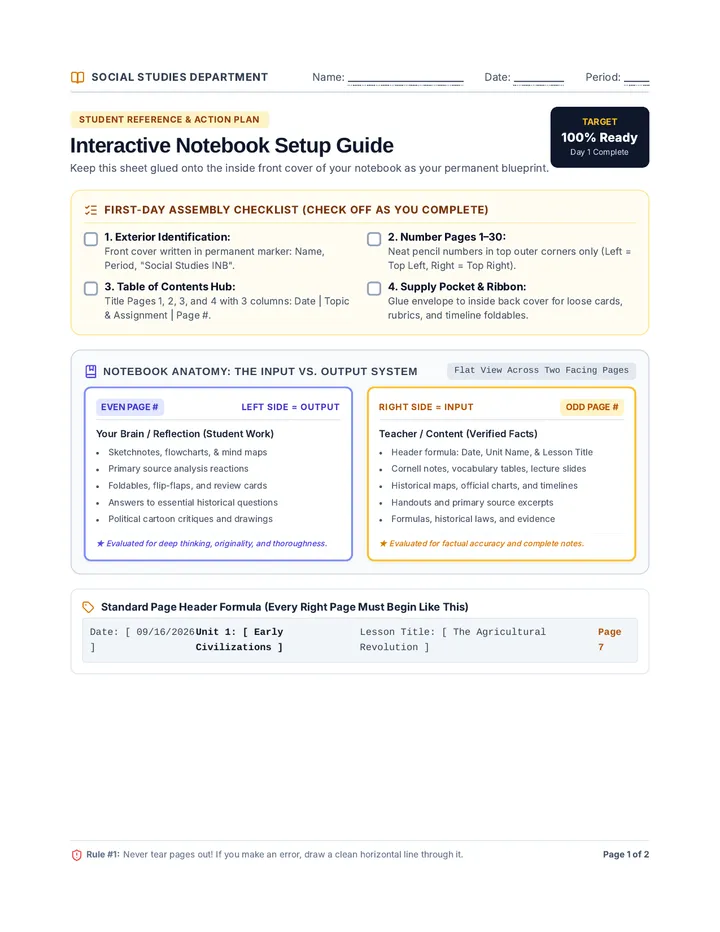
Notebook Setup Reference Guide
Social Studies Department
Name: _______________________ Date: __________ Period: _____
Student Reference & Action Plan
Interactive Notebook Setup Guide
Keep this sheet glued onto the inside front cover of your notebook as your permanent blueprint.
Target
100% Ready
Day 1 Complete
First-Day Assembly Checklist (Check off as you complete)
1. Exterior Identification:
Front cover written in permanent marker: Name, Period, "Social Studies INB".
2. Number Pages 1–30:
Neat pencil numbers in top outer corners only (Left = Top Left, Right = Top Right).
3. Table of Contents Hub:
Title Pages 1, 2, 3, and 4 with 3 columns: Date | Topic & Assignment | Page #.
4. Supply Pocket & Ribbon:
Glue envelope to inside back cover for loose cards, rubrics, and timeline foldables.
Notebook Anatomy: The Input vs. Output System Flat View Across Two Facing Pages
EVEN PAGE # LEFT SIDE = OUTPUT
Your Brain / Reflection (Student Work)
- Sketchnotes, flowcharts, & mind maps
- Primary source analysis reactions
- Foldables, flip-flaps, and review cards
- Answers to essential historical questions
- Political cartoon critiques and drawings
★ Evaluated for deep thinking, originality, and thoroughness.
RIGHT SIDE = INPUT ODD PAGE #
Teacher / Content (Verified Facts)
- Header formula: Date, Unit Name, & Lesson Title
- Cornell notes, vocabulary tables, lecture slides
- Historical maps, official charts, and timelines
- Handouts and primary source excerpts
- Formulas, historical laws, and evidence
★ Evaluated for factual accuracy and complete notes.
Standard Page Header Formula (Every Right Page Must Begin Like This)
Date: [ 09/16/2026 ] Unit 1: [ Early Civilizations ] Lesson Title: [ The Agricultural Revolution ] Page 7
Rule #1: Never tear pages out! If you make an error, draw a clean horizontal line through it. Page 1 of 2
Interactive Methods & Standards
Keep Handy for Every Unit
Social Studies Toolkit & Evaluation Rubric
Master visual note-taking techniques and understand exactly how notebook checks are graded.
First Day Starter Activity
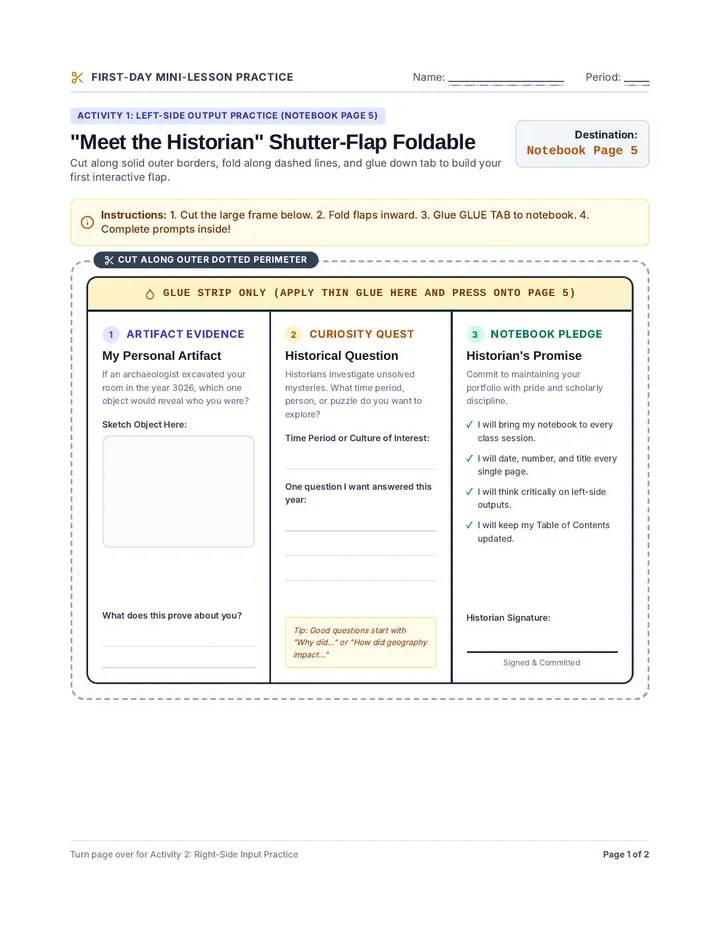
First-Day Mini-Lesson Practice
Name: _______________________ Period: _____
Activity 1: Left-Side Output Practice (Notebook Page 5)
"Meet the Historian" Shutter-Flap Foldable
Cut along solid outer borders, fold along dashed lines, and glue down tab to build your first interactive flap.
Destination:
Notebook Page 5
Instructions: 1. Cut the large frame below. 2. Fold flaps inward. 3. Glue GLUE TAB to notebook. 4. Complete prompts inside!
Cut Along Outer Dotted Perimeter
GLUE STRIP ONLY (Apply thin glue here and press onto Page 5)
1 Artifact Evidence
My Personal Artifact
If an archaeologist excavated your room in the year 3026, which one object would reveal who you were?
Sketch Object Here:
What does this prove about you?
2 Curiosity Quest
Historical Question
Historians investigate unsolved mysteries. What time period, person, or puzzle do you want to explore?
Time Period or Culture of Interest:
One question I want answered this year:
Tip: Good questions start with "Why did..." or "How did geography impact..."
3 Notebook Pledge
Historian's Promise
Commit to maintaining your portfolio with pride and scholarly discipline.
✓ I will bring my notebook to every class session.
✓ I will date, number, and title every single page.
✓ I will think critically on left-side outputs.
✓ I will keep my Table of Contents updated.
Historian Signature:
Signed & Committed
Turn page over for Activity 2: Right-Side Input Practice Page 1 of 2
Right-Side Input Practice
Name: _______________________ Date: __________
Activity 2: Right-Side Input Practice (Notebook Page 6)
Sources of History: Evidence Note Card
Model official right-side note formatting, test source definitions, and practice evidence classification.
Destination:
Notebook Page 6
Date: 09/16/2026 Unit: Foundations of Historical Inquiry Page: 6
📜
Primary Sources
Firsthand, eyewitness accounts created at the actual time an event occurred.
Classic Examples:
• Personal letters, diaries, & journals