Battle After the War Worksheet
The War of 1812 • Lesson 7 Review
History Dispatch
The Battle After the War
Name:
Date:
1
Word Spotlight: Astonished & Truce
astonished (adj.)
feeling surprise or amazement
truce (n.)
an agreement to stop fighting or arguing
A. Complete each sentence using astonished or truce.
1. When the British army saw how well General Jackson’s soldiers defended New Orleans, they were .
2. A British officer stepped forward and offered his sword as a sign of a so the fighting would stop.
B. Read each sentence. Circle whether you would be astonished or not astonished.
1. You see three cats flying a sailboat across the sky.
astonished not astonished
2. It rains outside on a cloudy spring afternoon.
astonished not astonished
C. Write your own sentence using the word astonished or truce.
2
Quick Check: True or False?
Circle True or False for each statement about the lesson.
1. New Orleans was an important port and trading center on the Mississippi River.
True False
2. General Andrew Jackson’s army only included trained soldiers from Europe.
True False
3. A peace treaty had already been signed before the Battle of New Orleans took place.
True False
4. The Battle of New Orleans was the very last battle of the War of 1812.
True False
The Battle After the War — Review Page 2
3
Battle Breakdown
Circle the letter of the best answer for each question.
1. Why did the British want to capture New Orleans and control the Mississippi River?
A. They wanted to stop American trade and block supplies from moving across the country.
B. They wanted to build a new capital city for Great Britain along the river.
C. They wanted to find gold hidden near the port of New Orleans.
2. How did General Andrew Jackson prepare to defend New Orleans?
A. He sailed his ships away to Europe to sign a peace treaty.
B. He built defensive walls called entrenchments and gathered a ragtag army.
C. He asked the British navy to help protect the harbor.
3. Why is the Battle of New Orleans called “the battle after the war”?
A. Both sides forgot that the war had started in 1812.
B. A peace treaty had been signed in Europe, but news traveled slowly and hadn’t reached the soldiers yet.
C. General Jackson wanted to keep fighting even after he read the peace treaty.
4
Big Idea: Write About It
1. During the Battle of New Orleans, what did the British do to show they were surrendering?
Final Reflection
2. Why is the War of 1812 often called “America’s second war for independence”?
Battle After the War Answer Key
Teacher Answer Key • Lesson 7 Review
History Dispatch Key
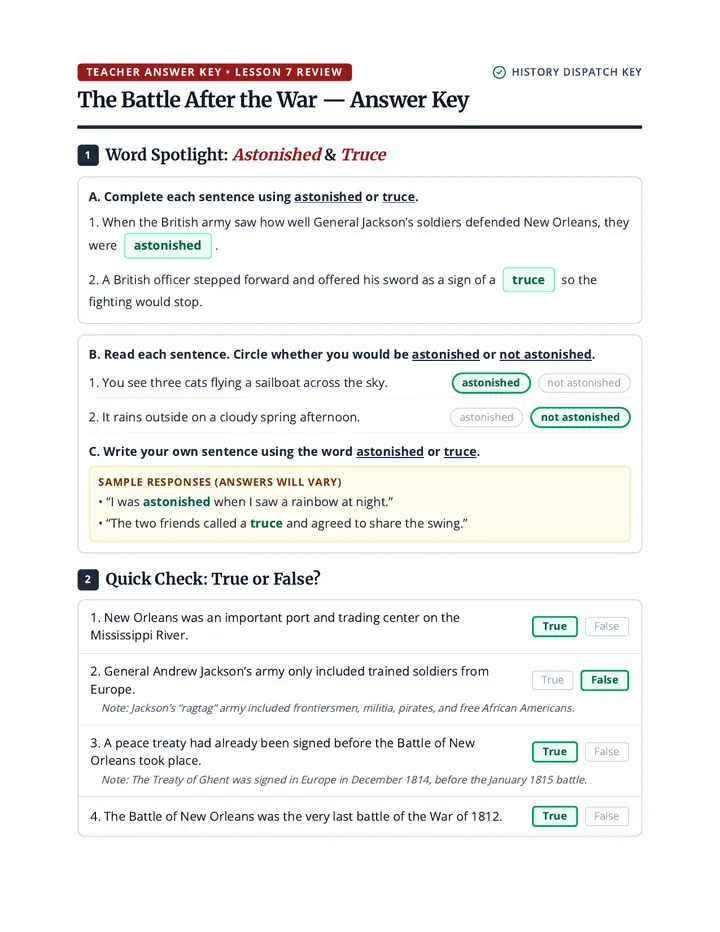
The Battle After the War — Answer Key
1
Word Spotlight: Astonished & Truce
A. Complete each sentence using astonished or truce.
1. When the British army saw how well General Jackson’s soldiers defended New Orleans, they were astonished.
2. A British officer stepped forward and offered his sword as a sign of a truce so the fighting would stop.
B. Read each sentence. Circle whether you would be astonished or not astonished.
1. You see three cats flying a sailboat across the sky.
astonished not astonished
2. It rains outside on a cloudy spring afternoon.
astonished not astonished
C. Write your own sentence using the word astonished or truce.
Sample Responses (Answers will vary)
• “I was astonished when I saw a rainbow at night.”
• “The two friends called a truce and agreed to share the swing.”
2
Quick Check: True or False?
1. New Orleans was an important port and trading center on the Mississippi River.
True False
2. General Andrew Jackson’s army only included trained soldiers from Europe.
True False
Note: Jackson’s “ragtag” army included frontiersmen, militia, pirates, and free African Americans.
3. A peace treaty had already been signed before the Battle of New Orleans took place.
True False
Note: The Treaty of Ghent was signed in Europe in December 1814, before the January 1815 battle.
4. The Battle of New Orleans was the very last battle of the War of 1812.
True False
The Battle After the War — Answer Key Page 2
3
Battle Breakdown
1. Why did the British want to capture New Orleans and control the Mississippi River?
✓ A. They wanted to stop American trade and block supplies from moving across the country.
B. They wanted to build a new capital city for Great Britain along the river.
C. They wanted to find gold hidden near the port of New Orleans.
2. How did General Andrew Jackson prepare to defend New Orleans?
A. He sailed his ships away to Europe to sign a peace treaty.
✓ B. He built defensive walls called entrenchments and gathered a ragtag army.
C. He asked the British navy to help protect the harbor.
3. Why is the Battle of New Orleans called “the battle after the war”?
A. Both sides forgot that the war had started in 1812.
✓ B. A peace treaty had been signed in Europe, but news traveled slowly and hadn’t reached the soldiers yet.
C. General Jackson wanted to keep fighting even after he read the peace treaty.
4
Big Idea: Write About It
1. During the Battle of New Orleans, what did the British do to show they were surrendering?
Sample Answer A British officer stepped forward and offered his sword (or waved a white flag/handkerchief) as a sign of a truce to show they wanted to stop fighting.
Final Reflection
2. Why is the War of 1812 often called “America’s second war for independence”?
Sample Answer The United States proved once again that it could stand up to Great Britain, defend its borders and trade, and remain an independent nation.