Industrial Grit Slides Tennessee Standard US.13
INDUSTRIAL
GRIT
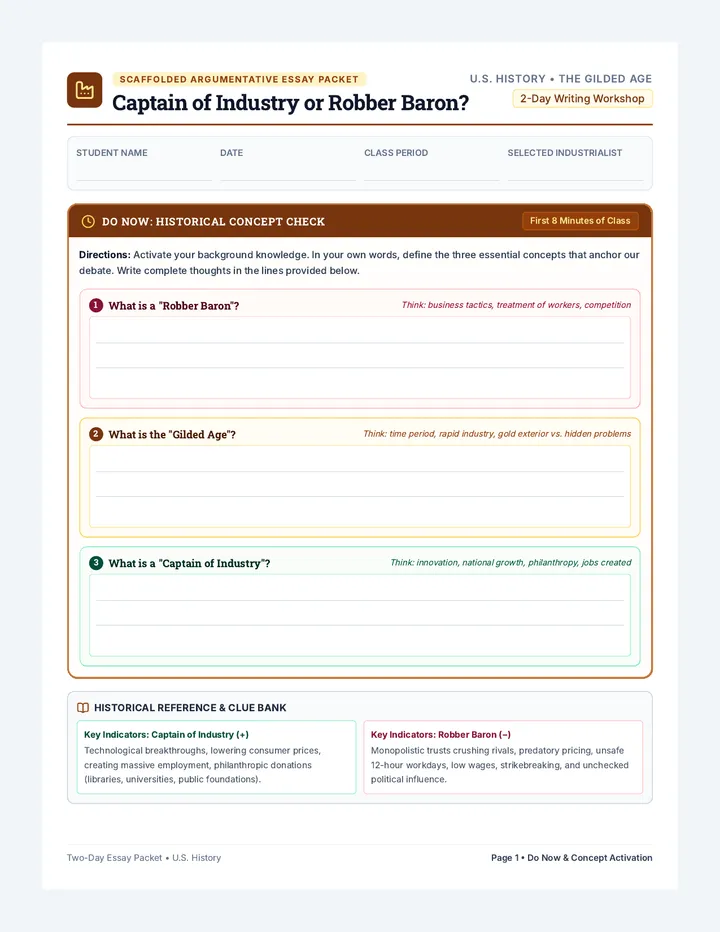
Working Conditions in the Gilded Age
Men
Women
Children
The Big Picture
Economic Drive
Rapid industrialization required a massive, cheap labor force to maximize profits.
The Setting
Factories, steel mills, and coal mines replaced small artisan shops.
Crowded Factory Visual
Source: Jacob Riis / LOC
The Reality of Labor
Brutal Hours
12-14 hour workdays, 6 days a week was standard.
Lethal Safety
Zero regulations. Dust and chemicals were inhaled daily.
Subsistence Pay
Wages kept low to ensure dependence on the company.
Men: Heavy Lifters
Steelworkers Visual
Source: Detroit Publishing / LOC
Primary Industries
Steel, coal mining, and railroads.
Resistance
Led early labor unions (like the Knights of Labor).
Women: New Workforce
Textiles & Garments
Women dominated sewing and weaving mills. Faced fire hazards.
The Wage Gap
Paid roughly 1/2 to 1/3 of a man's wage for same hours.
Mill Girls Visual
Source: National Archives
Child Labor: Lost Youth
Breaker Boys
Sorted coal by hand in filthy, dangerous chutes.
Source: Lewis Hine / LOC
Newsies
Sold papers late at night on city streets.
Why use children?
Small size allowed machine repairs
Easy to manage and intimidate
Paid the absolute lowest wages
Families needed money to survive
Think & Discuss
"If industrialization brought so much wealth to America, why were the people producing it living in such misery?"
Economics vs. Humanity
Industrial Grit Guided Notes Awareness Industrial Grit
Guided Notes: US.13 Gilded Age Labor
Name:
Date:
1. The Industrial Boom
Rapid industrialization required a massive, __________________________ labor force to maximize __________________________ and power the "Gilded Age."
Factories, __________________________, and coal mines became the primary workplaces, replacing small artisan shops.
2. The Reality of Labor
Hours
Standard workdays were ________ to ________ hours, ________ days a week.
Safety
Machines had zero _______________. Workers inhaled dust and _______________ daily.
Pay
Wages were kept _______________ to ensure workers were dependent on the company.
3. Comparing Labor Sources
Men
Worked primarily in heavy industries like __________________________, mining, and __________________________.
Led early resistance by forming __________________________ __________________________ to fight for an 8-hour day.
Women
Dominated the __________________________ and garment industries.
Earned significantly less than men, roughly ________ to ________ of a man's wage.
Children
Breaker Boys: Hand-sorted __________________________ in filthy chutes.
Why use kids? They were small enough to __________________________ machines and were paid the __________________________ wages.
4. Critical Reflection
Think about the term "Gilded Age" (gold on the outside, cheap on the inside). How do these working conditions prove that name to be accurate?
Tennessee US.13 Curriculum Resource Culture • Economics • History
Primary Sources: Library of Congress (NCLC/Hine), National Archives. See Teacher Guide for full links.
Industrial Grit Teacher Guide Teacher Guide: Industrial Grit
20 MIN LESSON
Standard US.13: Industrial Working Conditions (Gilded Age)
20-Minute Pacing Guide
0:00 - 0:03
The Big Picture
Hook students with the title slide. Define the need for "cheap labor" to fuel the Gilded Age economy.
0:03 - 0:10
Men & General
Discuss the 12-hour day and safety issues. Note men's roles in mining/steel and the rise of unions.
0:10 - 0:15
Women & Children
Highlight textiles/garment shops. Explain child labor roles (breaker boys) and the "Why" behind using kids.
0:15 - 0:20
Discussion & Wrap
Facilitate the "Think & Discuss" prompt. Allow students to finish the reflection on their notes.
Instructional Scripting
"Think about the name 'Gilded Age.' Something gilded is covered in gold but cheap on the inside. How does the factory worker's life represent the 'cheap' inside of America's golden industrial growth?"
"Why would a family allow their 8-year-old to work in a coal mine? (Guide students toward economic desperation—it wasn't always a choice; it was survival.)"
Guided Notes Answer Key
1. THE INDUSTRIAL BOOM
Cheap labor force
Maximize profits
Steel mills / Railroads / Factories
2. THE REALITY OF LABOR
12 to 14 hours
6 days a week
Zero safety guards / safety regulations
Wages kept low (dependence)
3. MEN IN INDUSTRY
Steel, coal mining, railroads
Labor Unions (Knights of Labor)
4. WOMEN & CHILDREN
Textile / garment mills
1/2 to 1/3 of a man's wage
Breaker Boys: sorted coal
Why? Fix machines, easy to manage, lowest wages
Primary Source Appendix
The following sources were used for historical accuracy and are recommended for use as visual aids in the accompanying slides.
Source 1: Lewis Hine Child Labor Collection
Breaker boys working in the Ewen Breaker, Pennsylvania (1911).
Library of Congress: LOC.gov/resource/nclc.01083
Source 2: Jacob Riis Photographs
"How the Other Half Lives" - Sweatshop in a Ludlow Street tenement (1889).
Library of Congress: LOC.gov/item/01016140