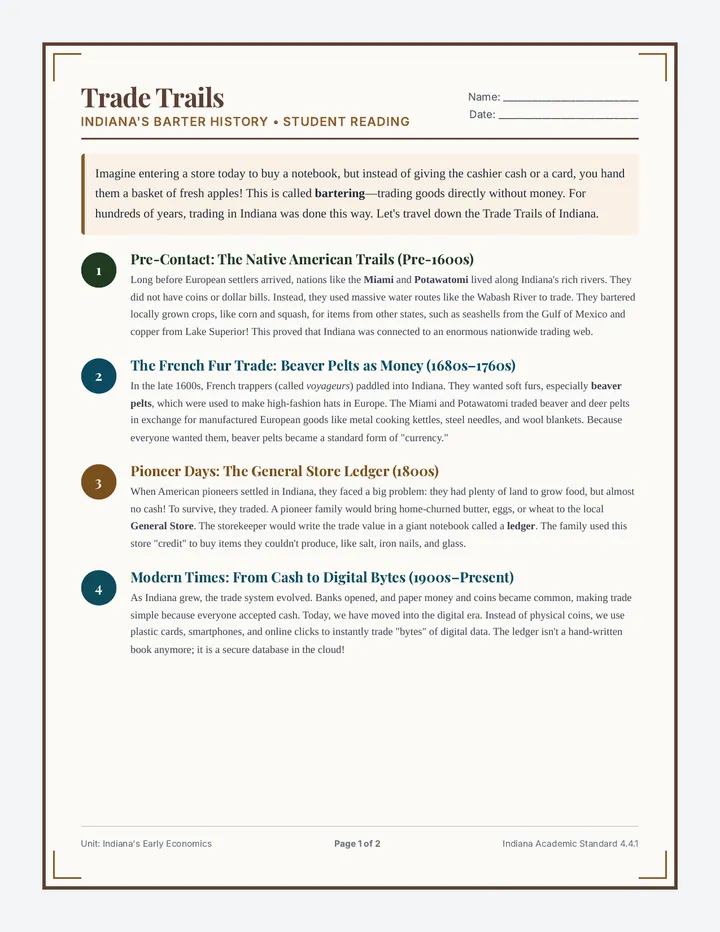
A comprehensive 4th-grade social studies lesson exploring the history of trade and barter in Indiana. Students journey from pre-contact Miami and Potawatomi trade, through the French fur trade, pioneer-era bartering, and the shift to early currency, ending with modern digital transactions.
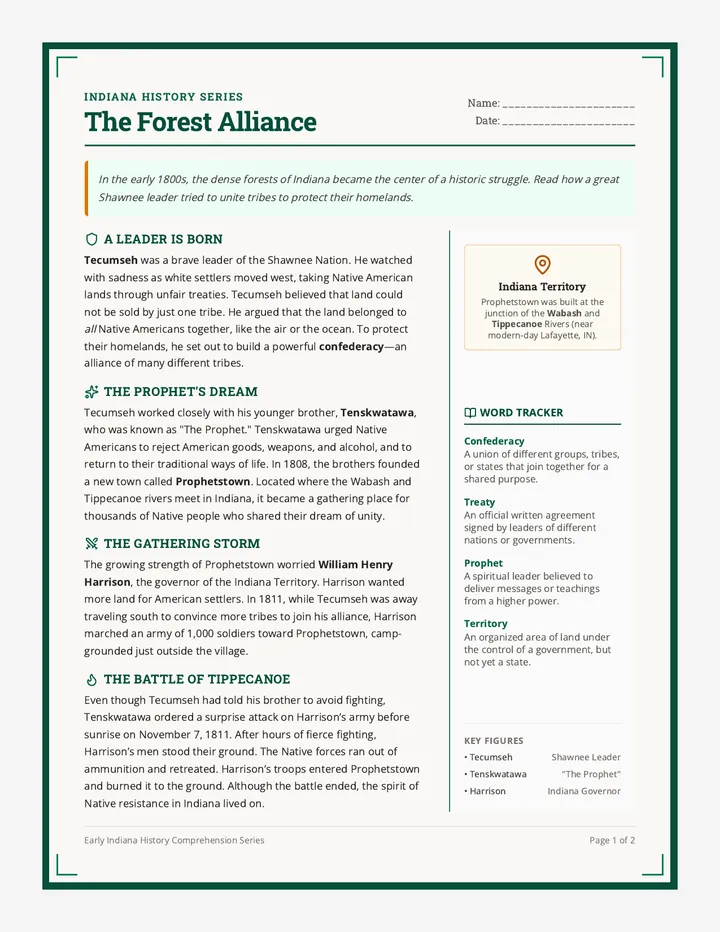
1. Why did early Indiana Native Americans trade with people from faraway states like Florida?
A They wanted items they couldn't find locally. B They had coins they needed to spend. C They were forced to travel south for food. D They wanted to get rid of extra gold.
2. What did French Voyageurs want most from the Native Americans in Indiana?
A Corn, squash, and maple sugar. B Beaver pelts and animal furs. C Metal cooking pots and blankets. D Paper bills and gold coins.
Part 2: Pioneer General Store Barter Math
Solve the barter puzzles using the trade values listed in a pioneer store ledger in 1845:
🥚 1 Dozen Eggs = 2 credits
🧈 1 lb Butter = 3 credits
🌽 1 Basket Corn = 5 credits
A. If Farmer Miller brings in 2 Dozen Eggs and 1 lb of Butter, how many credits will the storekeeper write in his ledger?
B. A bag of iron nails costs 11 credits. Can Farmer Miller buy the nails with his trades from Question A? Explain why or why not.
Part 3: From Pelts to Bytes Reflection
Explain one major advantage of using modern digital swipes or paper currency to get things you need, compared to the pioneer system of bartering crops and ledger bookkeeping.
Unit: Indiana's Early Economics Page 2 of 2 Indiana Academic Standard 4.4.1
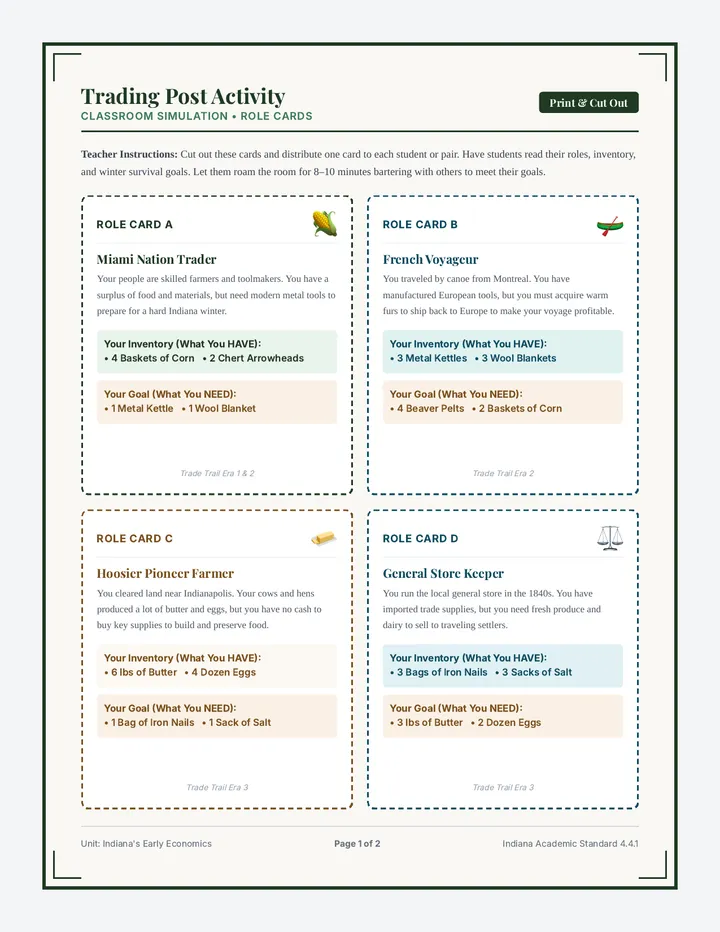
My Starting Inventory:
My Target Goal Items:
Transaction Log
Trade #
Items I GAVE Away
Items I RECEIVED
Traded With (Partner Name)
Trade 1
Trade 2
Trade 3
Trade 4
Post-Game Reflections
1. Did you successfully complete your goal? Why or why not?
2. What was the hardest part of bartering directly with other players?
3. How would using a universal currency (like store credit or coins) have made this game easier?
Unit: Indiana's Early Economics Page 2 of 2 Indiana Academic Standard 4.4.1
French Alliances: The French Voyageurs were not conquerors; they were business partners. Their trade relations relied heavily on building kinship with Miami families to maintain access to trapping routes.
Pioneer Ledgers: Many pioneer children never saw actual paper money or gold coins. Stores functioned as informal banks, using store credit in ledgers as a highly localized monetary substitute.
Common Student Misconceptions
Misconception: Bartering was "easy" and primitive. Correction: Bartering requires complex social negotiations and active calculation of value ratios without standardized price tags.
Misconception: Digital money isn't "real" money. Correction: Money is an agreement of value. Whether represented by a beaver skin, paper, or digital bytes on a screen, its function remains exactly the same.
Trade Trails Answer Key
Part 1: Reading Check
1. Correct Answer: A (They wanted items they couldn't find locally.)
2. Correct Answer: B (Beaver pelts and animal furs.)
Question B:No, he cannot. He only has 7 credits, but the bag of iron nails costs 11 credits. He is short by 4 credits.
He would need to bring in more eggs (2 more dozen) or butter (2 more lbs), or trade corn.
Part 3: From Pelts to Bytes Reflection (Sample Response)
"Modern digital currency is much better than pioneer bartering because it does not require a double coincidence of wants. With barter, if the storekeeper doesn't want my fresh butter, I cannot get the iron nails I need. Modern money is accepted by everyone, and I don't have to carry heavy baskets of crops or tubs of butter with me every time I want to make a trade."
Unit: Indiana's Early Economics Page 2 of 2 Teacher Support Document