Honor Bound Teacher Guide BUSHIDO
7th Grade Historical Analysis
Honor Bound
Deciphering the Samurai Bushido Code in Feudal Japan
Lesson Focus
Students analyze the ethical code of Bushido ("Way of the Warrior") that governed samurai life. By evaluating the seven core virtues and comparing historic and modern expressions of duty, honor, and loyalty, students understand how moral frameworks shape identity and maintain social structure.
Essential Questions
How does a society's ethical code influence individual behavior and social structure?
In what ways do feudal codes of honor like Bushido persist in modern culture?
Lesson Specs
Duration: 60-75 Mins
Format: Mixed Media
Subjects: World History
Core Skill: Source Analysis
Required Materials:
• Honor Bound Slide Deck
• Discussion Cards (1 set / group)
• Journal Worksheet (1 per student)
Learning Objectives
Explain: Trace the historical origin of the Bushido code and identify its seven primary virtues in feudal Japan.
Analyze: Evaluate primary/secondary sources to see how Bushido enforced social order and defined the warrior's identity.
Instructional Sequence
10 Mins
Hook & Concept Spark: The Weight of a Promise
Introduce the idea of personal and institutional codes. Ask: "If you had to pick one rule that you would never break, no matter what, what would it be?" Brief student sharing to map early concepts of "honor".
20 Mins
Direct Instruction: Code of the Samurai (Slides 1-6)
Walk through the background of feudal Japan. Introduce the 7 virtues (Rectitude, Courage, Benevolence, Respect, Honesty, Honor, Loyalty). Connect the Samurai's militaristic dominance with their self-governed ethical expectations.
20 Mins
Collaborative Inquiry: Discussion Cards (Slides 7-8)
Students form small groups (3-4). Distribute the Discussion Cards . Groups select and debate scenarios: the clash of family vs. lord, the limit of absolute obedience, and Bushido's modern-day counterparts.
15 Mins
Independent Reflection: The Journal Sheet (Slide 9)
Students work individually on the Honor Bound Journal Sheet , comparing historical sources with modern applications. They synthesize their stance on whether codes of honor unite or divide people.
Page 1 of 2
Pedagogical Framework
Facilitation Notes & Teacher Support Materials
Facilitating the Discussion Cards
The discussion cards are designed to test students' comprehension of absolute vs. relative loyalty. Advise groups to avoid simple "yes" or "no" answers. For example, in Card 1 (The Dilemma of Loyalty) , prompt them to think: How does a samurai resolve the contradiction between protecting family and obeying a lord who commands an unjust tax? Encourage reference back to the virtues of Gi (Rectitude) and Chugi (Loyalty) .
Common Misconceptions to Address
"Bushido was always written down in a strict handbook." "Samurai only valued combat and fighting."
Differentiated Instruction
Support / Scaffolding
Provide students with a "Virtues Crib Sheet" mapping English definitions to Japanese counterparts. For the final essay/journal entry, let students use bullet points or draw a quick comic showing a virtue conflict instead of writing multi-paragraph essays.
Extension / Challenge
Challenge advanced students to analyze how the concept of "Meiyo" (Honor) explains the historical practice of Seppuku (ritual suicide). Ask them to write a defense or critique of this practice using the 7 virtues.
Success Criteria & Assessment
Monitor group talk and grade journal worksheets using these metrics:
Historical Accuracy Accurately links samurai actions to specific Bushido virtues.
Critical Analysis Evaluates tension and conflict within the ethical system.
Modern Connections Expresses original arguments on how moral codes persist.
Page 2 of 2
Honor Bound Slides BUSHIDO
Feudal Japanese History
Honor Bound
Deciphering the Samurai Bushido Code
Grade 7 History • Unit 3 Slide 1 of 8
Rise of the Samurai Class
Feudal Japan (1185–1868)
In a society fractured by civil warfare, decentralized power fell to local military lords called Daimyo .
To protect their territory and consolidate dominance, daimyo hired elite warrior-vassals: the Samurai .
Social Hierarchy
Samurai stood at the top of the social system, commanding absolute authority and high cultural respect.
Double Practice
They practiced both military arts (bu ) and literary/scholarly accomplishments (bun ).
The Way of the Warrior Slide 2 of 8
What is Bushido?
"The Way of the Warrior"
Bushido was a strict ethical code that regulated every aspect of a samurai's life, from combat maneuvers to dinner customs.
"Unwritten and unspoken, the code was an invisible web that bound the heart of every warrior."
Key Sources
• Zen Buddhism: Mental control, focus, and fearlessness in death.
• Shintoism: Loyalty to the Emperor, ancestors, and country.
• Confucianism: Respect for hierarchy and familial duty.
Philosophical Origins Slide 3 of 8
The Seven Virtues • Part I
義
Gi
Rectitude
Being completely honest and just in all dealings. Knowing right from wrong.
勇
Yuu
Courage
Heroic bravery. Rising above the crowd to take bold, ethical action.
仁
Jin
Benevolence
Love, sympathy, and compassion toward all. Power used to defend, not destroy.
礼
Rei
Respect
Politeness and courtesy. Showing high regard for enemy and ally alike.
The Seven Virtues (1-4) Slide 4 of 8
The Seven Virtues • Part II
誠
Makoto
Honesty
Absolute integrity. Speaking and performing actions in perfect unison. A warrior's word is law.
名誉
Meiyo
Honor
Deep-seated self-respect. Protecting one's reputation from any staining or disgrace.
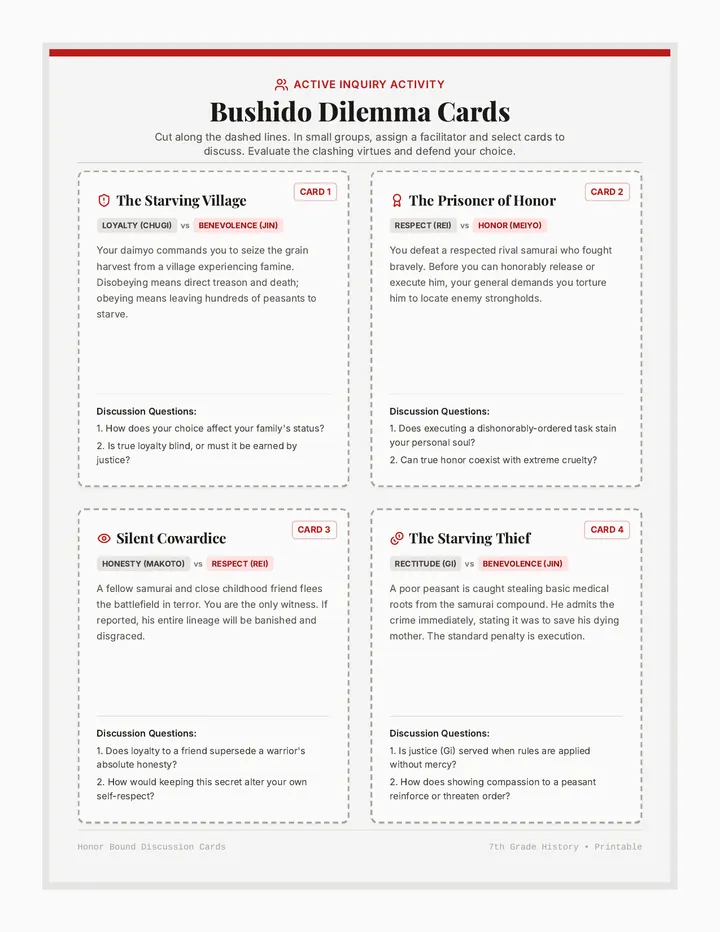
Honor Bound Discussion Cards Active Inquiry Activity
Bushido Dilemma Cards
Cut along the dashed lines. In small groups, assign a facilitator and select cards to discuss. Evaluate the clashing virtues and defend your choice.
CARD 1
The Starving Village
Loyalty (Chugi) vs Benevolence (Jin)
Your daimyo commands you to seize the grain harvest from a village experiencing famine. Disobeying means direct treason and death; obeying means leaving hundreds of peasants to starve.
Discussion Questions:
1. How does your choice affect your family's status?
2. Is true loyalty blind, or must it be earned by justice?
CARD 2
The Prisoner of Honor
Respect (Rei) vs Honor (Meiyo)
You defeat a respected rival samurai who fought bravely. Before you can honorably release or execute him, your general demands you torture him to locate enemy strongholds.
Discussion Questions:
1. Does executing a dishonorably-ordered task stain your personal soul?
2. Can true honor coexist with extreme cruelty?
CARD 3
Silent Cowardice
Honesty (Makoto) vs Respect (Rei)
A fellow samurai and close childhood friend flees the battlefield in terror. You are the only witness. If reported, his entire lineage will be banished and disgraced.
Discussion Questions:
1. Does loyalty to a friend supersede a warrior's absolute honesty?
2. How would keeping this secret alter your own self-respect?
CARD 4
The Starving Thief
Rectitude (Gi) vs Benevolence (Jin)
A poor peasant is caught stealing basic medical roots from the samurai compound. He admits the crime immediately, stating it was to save his dying mother. The standard penalty is execution.
Discussion Questions:
1. Is justice (Gi) served when rules are applied without mercy?
2. How does showing compassion to a peasant reinforce or threaten order?
Honor Bound Discussion Cards 7th Grade History • Printable
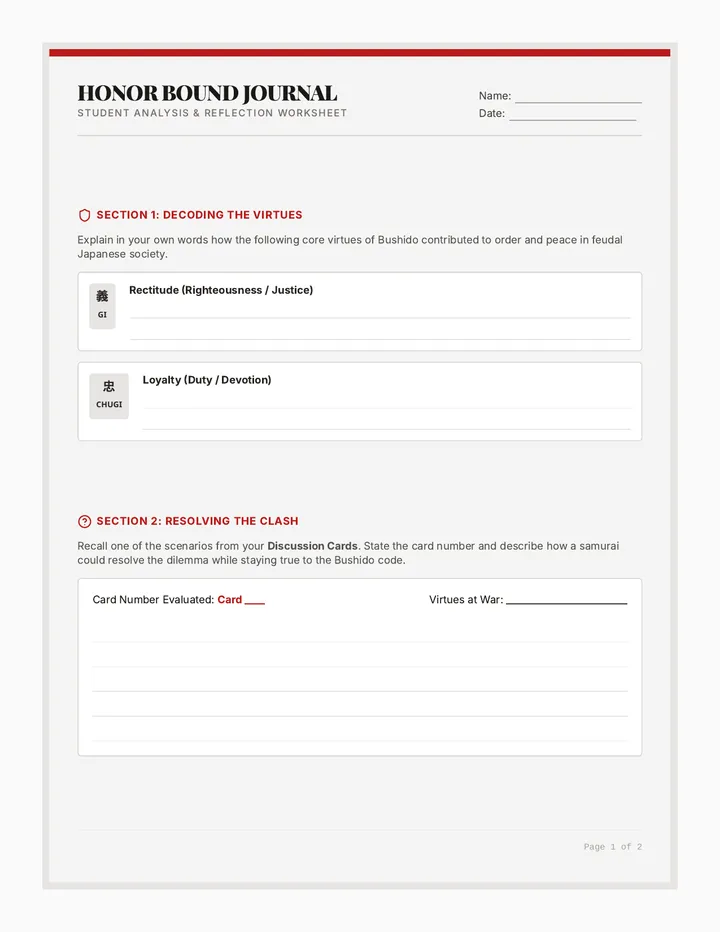
Honor Bound Journal Sheet HONOR BOUND JOURNAL
Student Analysis & Reflection Worksheet
Name:
Date:
Section 1: Decoding the Virtues
Explain in your own words how the following core virtues of Bushido contributed to order and peace in feudal Japanese society.
義Gi
Rectitude (Righteousness / Justice)
忠Chugi
Loyalty (Duty / Devotion)
Section 2: Resolving the Clash
Recall one of the scenarios from your Discussion Cards . State the card number and describe how a samurai could resolve the dilemma while staying true to the Bushido code.
Card Number Evaluated: Card ____ Virtues at War: ________________________
Page 1 of 2
Section 3: Bushido's Modern Footprint
While the samurai class was abolished in 1868, their code of honor survived. Evaluate how principles like Respect (Rei) or Honesty (Makoto) manifest in modern areas (such as sportsmanship, school rules, martial arts, or business partnerships).
Section 4: Your Personal Code
Now, design your own personal code of honor. List two values that you live by, and write a one-sentence commitment statement for each.
Value 1:
Value 2:
Synthesis Reflection
In conclusion: Do strict codes of honor do more to bring a society together, or do they build walls that tear them apart? Defend your perspective.
Honor Bound Journal Sheet Page 2 of 2