Golden Pharaoh Reading Passage
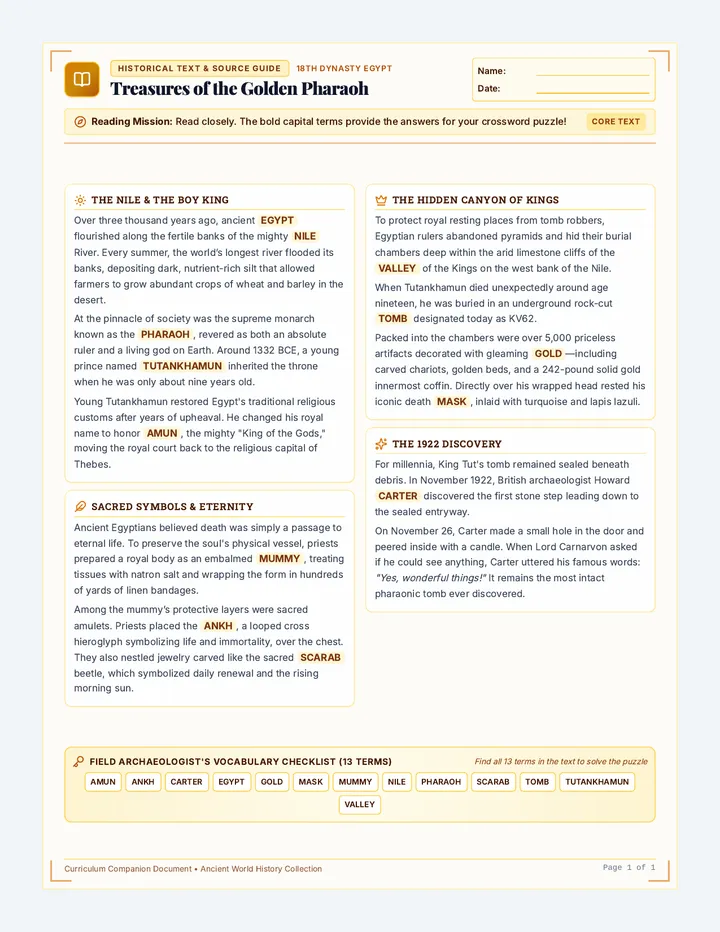
Historical Text & Source Guide 18th Dynasty Egypt
Treasures of the Golden Pharaoh
Name:
Date:
Reading Mission: Read closely. The bold capital terms provide the answers for your crossword puzzle!
Core Text
The Nile & the Boy King
Over three thousand years ago, ancient EGYPT flourished along the fertile banks of the mighty NILE River. Every summer, the world’s longest river flooded its banks, depositing dark, nutrient-rich silt that allowed farmers to grow abundant crops of wheat and barley in the desert.
At the pinnacle of society was the supreme monarch known as the PHARAOH, revered as both an absolute ruler and a living god on Earth. Around 1332 BCE, a young prince named TUTANKHAMUN inherited the throne when he was only about nine years old.
Young Tutankhamun restored Egypt's traditional religious customs after years of upheaval. He changed his royal name to honor AMUN, the mighty "King of the Gods," moving the royal court back to the religious capital of Thebes.
Sacred Symbols & Eternity
Ancient Egyptians believed death was simply a passage to eternal life. To preserve the soul's physical vessel, priests prepared a royal body as an embalmed MUMMY, treating tissues with natron salt and wrapping the form in hundreds of yards of linen bandages.
Among the mummy’s protective layers were sacred amulets. Priests placed the ANKH, a looped cross hieroglyph symbolizing life and immortality, over the chest. They also nestled jewelry carved like the sacred SCARAB beetle, which symbolized daily renewal and the rising morning sun.
The Hidden Canyon of Kings
To protect royal resting places from tomb robbers, Egyptian rulers abandoned pyramids and hid their burial chambers deep within the arid limestone cliffs of the VALLEY of the Kings on the west bank of the Nile.
When Tutankhamun died unexpectedly around age nineteen, he was buried in an underground rock-cut TOMB designated today as KV62.
Packed into the chambers were over 5,000 priceless artifacts decorated with gleaming GOLD—including carved chariots, golden beds, and a 242-pound solid gold innermost coffin. Directly over his wrapped head rested his iconic death MASK, inlaid with turquoise and lapis lazuli.
The 1922 Discovery
For millennia, King Tut's tomb remained sealed beneath debris. In November 1922, British archaeologist Howard CARTER discovered the first stone step leading down to the sealed entryway.
On November 26, Carter made a small hole in the door and peered inside with a candle. When Lord Carnarvon asked if he could see anything, Carter uttered his famous words: "Yes, wonderful things!" It remains the most intact pharaonic tomb ever discovered.
Field Archaeologist's Vocabulary Checklist (13 Terms)
Find all 13 terms in the text to solve the puzzle
AMUN ANKH CARTER EGYPT GOLD MASK MUMMY NILE PHARAOH SCARAB TOMB TUTANKHAMUN VALLEY
Curriculum Companion Document • Ancient World History Collection Page 1 of 1
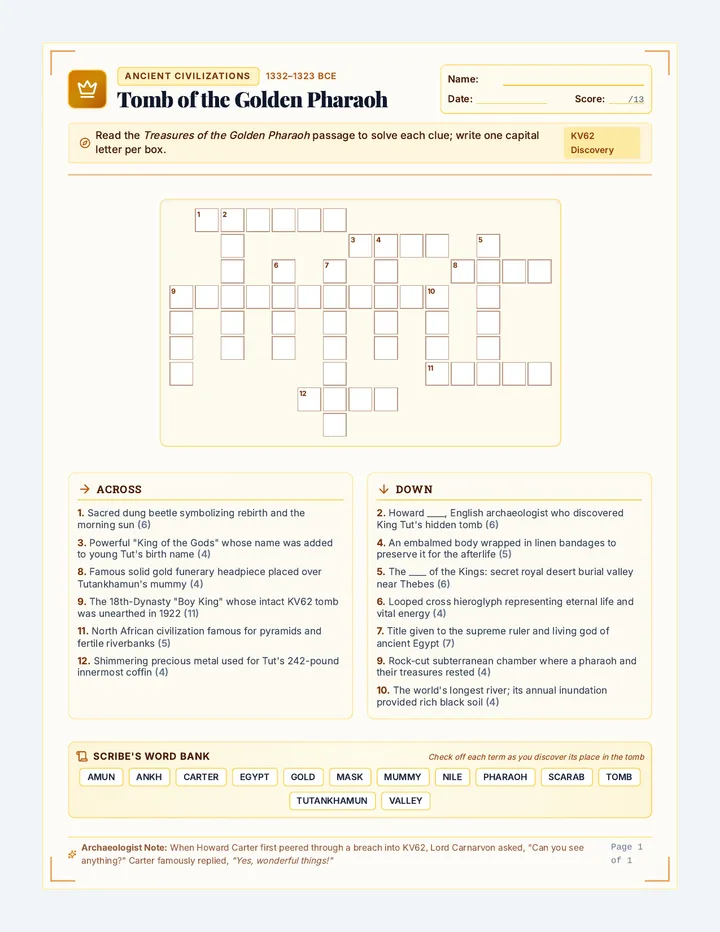
King Tut Crossword Worksheet
Ancient Civilizations 1332–1323 BCE
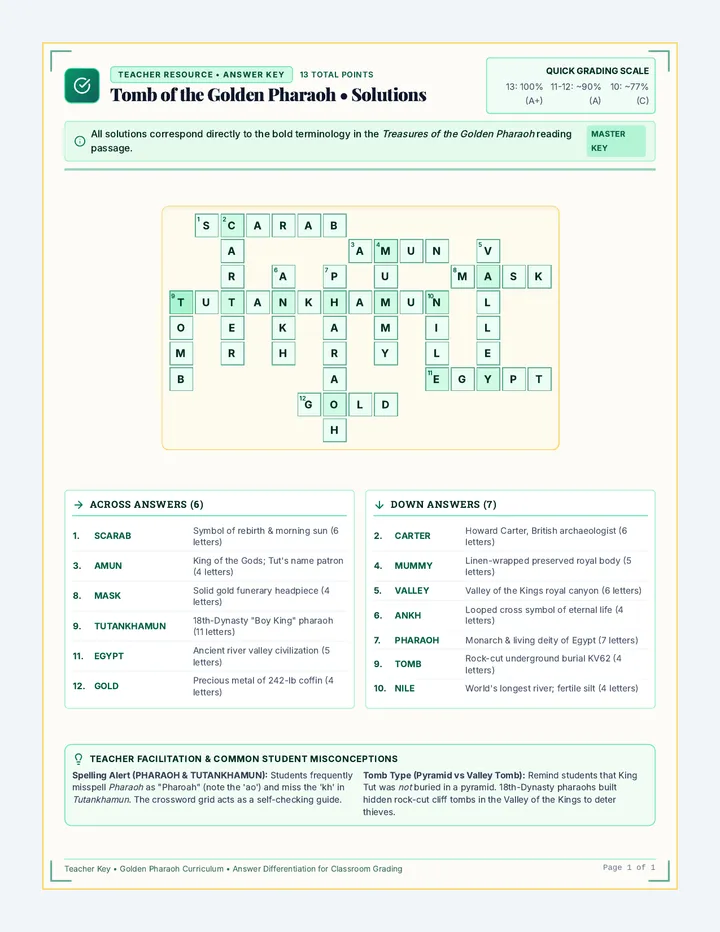
Tomb of the Golden Pharaoh
Name:
Date:
Score: /13
Read the Treasures of the Golden Pharaoh passage to solve each clue; write one capital letter per box.
KV62 Discovery
1
2
3
4
5
6
7
8
9
10
11
12
Across
-
Sacred dung beetle symbolizing rebirth and the morning sun (6)
-
Powerful "King of the Gods" whose name was added to young Tut's birth name (4)
-
Famous solid gold funerary headpiece placed over Tutankhamun's mummy (4)
-
The 18th-Dynasty "Boy King" whose intact KV62 tomb was unearthed in 1922 (11)
-
North African civilization famous for pyramids and fertile riverbanks (5)
-
Shimmering precious metal used for Tut's 242-pound innermost coffin (4)
Down
-
Howard ____, English archaeologist who discovered King Tut's hidden tomb (6)
-
An embalmed body wrapped in linen bandages to preserve it for the afterlife (5)
-
The ____ of the Kings: secret royal desert burial valley near Thebes (6)
-
Looped cross hieroglyph representing eternal life and vital energy (4)
-
Title given to the supreme ruler and living god of ancient Egypt (7)
-
Rock-cut subterranean chamber where a pharaoh and their treasures rested (4)
-
The world's longest river; its annual inundation provided rich black soil (4)
Scribe's Word Bank
Check off each term as you discover its place in the tomb
AMUN ANKH CARTER EGYPT GOLD MASK MUMMY NILE PHARAOH SCARAB TOMB TUTANKHAMUN VALLEY
Archaeologist Note: When Howard Carter first peered through a breach into KV62, Lord Carnarvon asked, "Can you see anything?" Carter famously replied, "Yes, wonderful things!"
Page 1 of 1