Carrier Lab Teacher Guide
Carrier Secrets
Teacher Facilitation Guide
Biology: Genetics
Lesson: Genetic Carriers
Lesson Objective
Students will identify and explain the concept of genetic "carriers" (heterozygous genotypes) by analyzing pedigree patterns and simulating the inheritance of recessive traits in fruit flies (Drosophila).
Duration
45-50 Minutes
Activity Prep
Prepare these materials before the 'Carrier Simulation' activity.
- Plastic Eggs (or cups): 1 per student.
- Allele Tokens: 2 beads/slips of paper per student.
• Red (W): Wild-type allele
• White (w): Vestigial allele
- Distribution: Fill 100% of eggs with 1 Red and 1 White bead. This ensures every student starts as a Carrier (Ww).
Instructional Sequence
5 min The Hook: Silent Carriers
10 min Video Analysis: Pedigree #2
25 min Activity: Carrier Simulation
5 min Reflect: Journal Prompt
Discussion Anchors
[Video 9:30]
"How can two healthy parents produce a child with a genetic disorder?"
Focus: Parents must be heterozygous (Carriers). They possess the trait but don't show it. The offspring inherited the recessive allele from both parents.
[Activity Wrap-up]
"Why didn't we see any vestigial flies in the parent generation?"
Focus: All parents were carriers. Carriers look "normal" (Wild-type) but can pass on the mutation to the next generation.
Background & Key Concepts
The Model: Drosophila Melanogaster
Fruit flies are used because they are inexpensive, reproduce rapidly, and have a simple genome (4 pairs of chromosomes) that is easy to map. This makes tracking "Vestigial Wings" (recessive) easy for students to visualize.
Genotypes
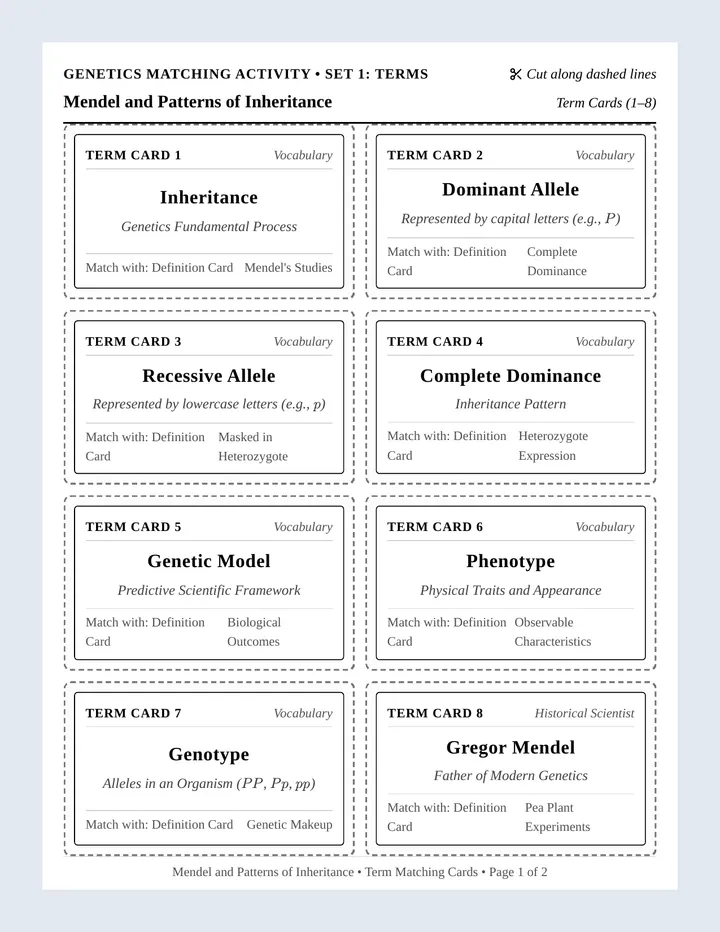
- WW: Homozygous Dominant (Wild-type)
- Ww: Heterozygous (Carrier - Wild-type)
- ww: Homozygous Recessive (Vestigial)
Phenotypes
- Wild-type: Normal long wings.
- Vestigial: Short, stubby, non-functional wings.
Common Misconceptions
Misconception:
"If a trait is recessive, it will eventually disappear from the population."
The Reality:
Recessive alleles can persist indefinitely by "hiding" in carriers. They only express when two carriers mate, producing homozygous recessive offspring.
Vocabulary Matrix
| Term | Definition |
|---|
| Wild-type | The naturally occurring, most common phenotype in a population. |
| Vestigial | A remnant structure that has lost its original function (e.g., flight). |
| Carrier | A heterozygous individual who carries a recessive allele but displays the dominant phenotype. |
| Autosomal | Genes located on non-sex chromosomes (pairs 1-22 in humans). |
Carrier Secrets Slides
Carrier Secrets
The Biology of Hidden Traits
Biology • Genetics Unit
The Hook
5 Minutes
What is a "Silent Carrier"?
An individual who has the allele for a recessive trait but does not express it.
Genotype: Heterozygous (Ww)
Phenotype: Normal (Wild-type)
Investigation
10 Minutes
Embedded media
Focus: Pedigree #2 — Vestigial Wings (Recessive)
"How can two healthy parents produce a child with a genetic mutation?"
The parents must be Heterozygous Carriers masking the recessive trait.
The Fly Lab
25 Minutes
Your Objective
Act as a population of fruit flies. Exchange genetic information (alleles) and track the results of your "offspring."
Population Alert:
Everyone starts as a Carrier (Ww).
Red Bead = Wild-type (W)
White Bead = Vestigial (w)
Genotype Results:
- WW or Ww = Normal Wings
- ww = Vestigial Wings
Reflection
5 Minutes
"Why is it dangerous for a harmful mutation to be Recessive?"
Hint: Think about "hiding" in the population...
Fly Lab Activity
The Fly Lab
Carrier Simulation Activity
Name:
Date:
Your Identity: Drosophila Melanogaster (Fruit Fly)
You are a healthy fly, but you carry a hidden secret in your DNA.
Instructions
-
1 Each student has one Egg containing two alleles (beads). Everyone starts as a Carrier (Ww).
-
2 Find a partner. Without looking, both partners pull one bead from their own egg.
-
3 These two beads combined represent your Offspring's Genotype. Record the result in your Data Table.
-
4 Return the beads to your eggs and find a new partner.
-
5 Repeat for a total of 8 rounds (8 offspring).
Offspring Data Table
| Round | Partner Name | Alleles Drawn (e.g., Ww) | Phenotype (Normal or Vestigial) |
|---|
| 1 | | | |
| 2 | | | |
| 3 | | | |
| 4 | | | |
| 5 | | | |
| 6 | | | |
| 7 | | | |
| 8 | | | |
Lab Analysis
1. How many of your offspring had Vestigial wings (ww)? Why did this happen even though both you and your partner appeared "normal"?
2. In this population, 100% of the parents were carriers. Did 100% of your offspring become carriers? Explain using your data.
Mutation Map Journal
Mutation Map
Reflection Journal
Name:
Lesson: Carrier Secrets
"Why is it dangerous for a harmful genetic mutation to be recessive?"
Initial Thoughts
Connection to Carriers
Think about how the "Fly Lab" simulation showed the mutation moving through the population even when no one looked different.
Vocabulary Checklist: Did you use these terms?
Carrier
Heterozygous
Phenotype
Recessive Allele