Federal Bureaucracy L2 Dyslexia Worksheet The Federal Bureaucracy
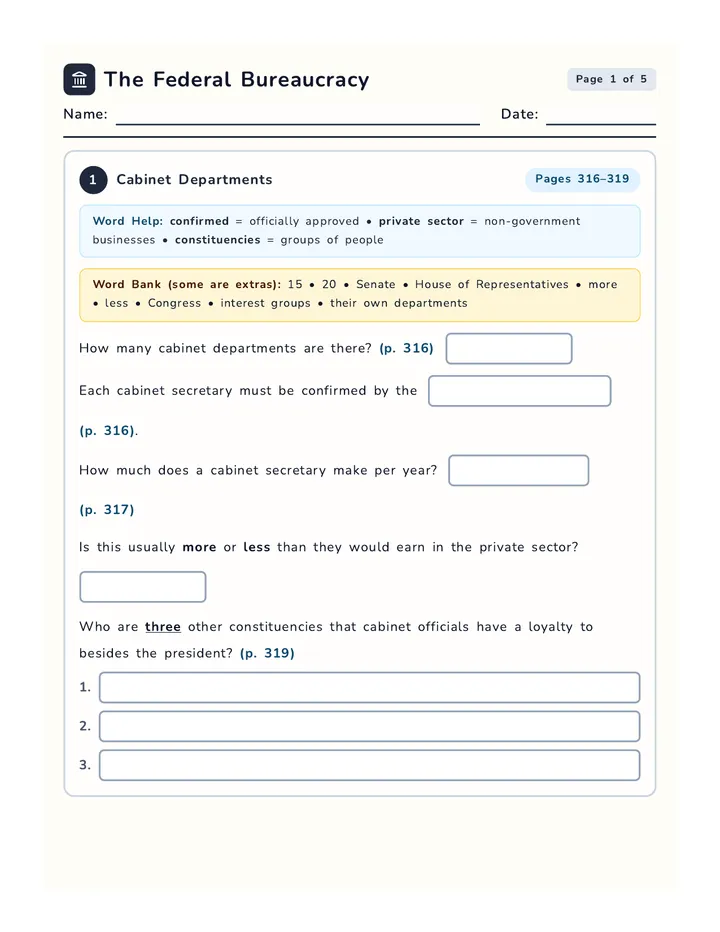
Page 1 of 5
Name:
Date:
1 Cabinet Departments
Pages 316–319
Word Help: confirmed = officially approved • private sector = non-government businesses • constituencies = groups of people
Word Bank (some are extras): 15 • 20 • Senate • House of Representatives • more • less • Congress • interest groups • their own departments
How many cabinet departments are there? (p. 316)
Each cabinet secretary must be confirmed by the
(p. 316).
How much does a cabinet secretary make per year?
(p. 317)
Is this usually more or less than they would earn in the private sector?
Who are three other constituencies that cabinet officials have a loyalty to besides the president? (p. 319)
The Federal Bureaucracy Page 2 of 5
Word Bank for Questions 2–3 (some are extras): Executive Office of the President • Chief of Staff • Press Secretary • Vice President • OMB • NSC • CEA • White House Office • Federal Reserve
2 Executive Office of the President (EOP)
Pages 319–322
In addition to the cabinet, the president has the EOP. What does this stand for? (p. 319)
How many full-time employees are in the EOP? (p. 319)
Name four agencies within the EOP. (p. 320–322)
3 White House Staff
Page 323
Word Help: oversees = manages or watches over | regulates = controls
Who is the president's most trusted advisor (the person who oversees White House operations and regulates access to the president)? (p. 323)
Who handles all the communications between the White House and the press? (p. 323)
The Federal Bureaucracy Page 3 of 5
Word Bank for Questions 4–5: confidential • private • information • Congress • courts • Yes • No
4 Executive Privilege
Page 323
What is executive privilege? (p. 323)
Sentence Starter: Executive privilege means that the president can...
5 Growth of Federal Agencies
Page 325
Word Help: anticipate = expect or plan ahead for
Did the Founders of the US anticipate the need for creating federal agencies to carry out the day-to-day business of government? (p. 325)
How many people work for the federal government today? (p. 325)
How many buildings does the federal government own? (p. 325)
The Federal Bureaucracy Page 4 of 5
6 Exploring the 15 Cabinet Departments
Pages 326–329
The 15 cabinet departments are described on p. 326–329. Skim over them. Which department would you most like to work for? Why?
Sentence Starter: I would most like to work for the Department of __________ because...
7 Department Budgets
Page 327
Study the departments budgets chart on p. 327. Which three departments get the most money?
Which 3 departments do you think should get the most money?
Sentence Starter: I think __________, __________, and __________ should get the most money.
8 Other Parts of the Bureaucracy
Pages 329–330
Word Bank (match to the right type): NASA • CIA • U.S. Postal Service • Amtrak • FCC • EPA • SEC
In addition to the cabinet departments, there are other parts of the federal bureaucracy. Give an example of each of the following. (p. 329–330)
• Independent agency:
• Government corporation:
• Regulatory commission:
The Federal Bureaucracy Page 5 of 5
Helpful Words for Questions 9–11: merit • civil service exams • spoils system • population growth • national crises • paperwork • delays • efficiency
9 The Pendleton Act of 1883
Page 333 (Chart)
Word Help: provisions = specific rules or parts of a law
List at least 2 provisions of The Pendleton Act of 1883. (chart on p. 333)
10 Size of the Federal Government
Pages 340–343
What are two reasons why the size of the federal government has grown over time? (p. 340–342)
List one effort made in the past to reduce the size of the federal bureaucracy. (p. 342–343)
Sentence Starter: One effort to reduce the bureaucracy was...
11 Red Tape
Page 345
What does the term "red tape" mean? (p. 345)
Sentence Starter: The term "red tape" means...
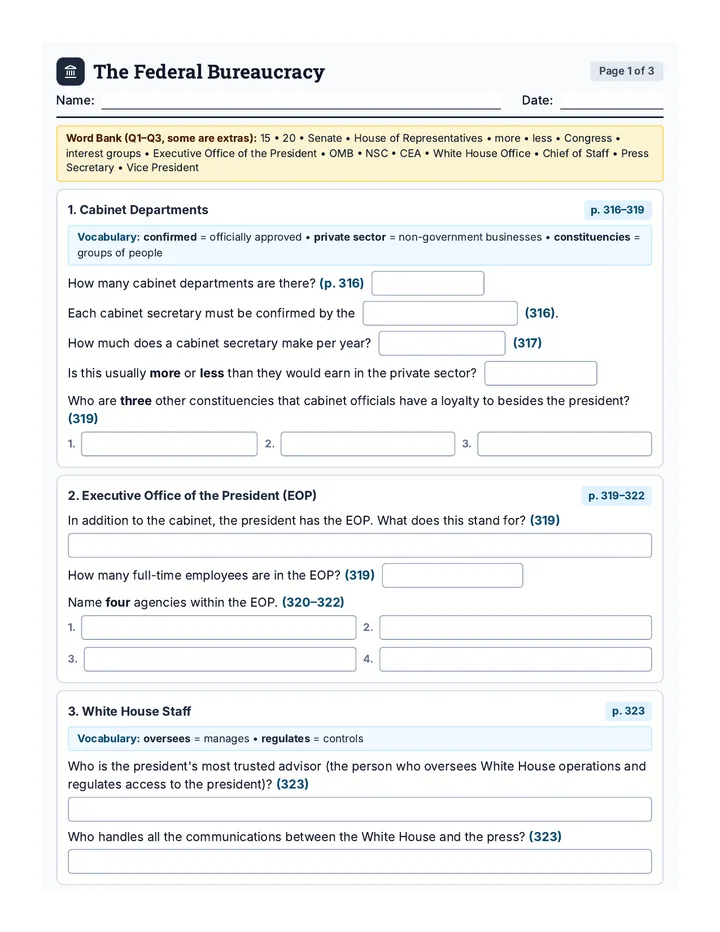
Federal Bureaucracy Level 2 Worksheet The Federal Bureaucracy
Page 1 of 3
Name:
Date:
Word Bank (Q1–Q3, some are extras): 15 • 20 • Senate • House of Representatives • more • less • Congress • interest groups • Executive Office of the President • OMB • NSC • CEA • White House Office • Chief of Staff • Press Secretary • Vice President
1. Cabinet Departments p. 316–319
Vocabulary: confirmed = officially approved • private sector = non-government businesses • constituencies = groups of people
How many cabinet departments are there? (p. 316)
Each cabinet secretary must be confirmed by the
(316) .
How much does a cabinet secretary make per year?
(317)
Is this usually more or less than they would earn in the private sector?
Who are three other constituencies that cabinet officials have a loyalty to besides the president? (319)
2. Executive Office of the President (EOP) p. 319–322
In addition to the cabinet, the president has the EOP. What does this stand for? (319)
How many full-time employees are in the EOP? (319)
Name four agencies within the EOP. (320–322)
3. White House Staff p. 323
Vocabulary: oversees = manages • regulates = controls
Who is the president's most trusted advisor (the person who oversees White House operations and regulates access to the president)? (323)
Who handles all the communications between the White House and the press? (323)
The Federal Bureaucracy Page 2 of 3
Word Bank (Q4–Q5): confidential • private • information • Congress • courts • Yes • No
4. Executive Privilege p. 323
What is executive privilege ? (323)
Sentence Frame: Executive privilege means that the president can...
5. Growth of Federal Agencies p. 325
Vocabulary: anticipate = expect or plan ahead for
Did the Founders of the US anticipate the need for creating federal agencies to carry out the day-to-day business of government? (325)
How many people work for the federal government today? (325)
How many buildings does the federal government own? (325)
6. Cabinet Departments p. 326–329
The 15 cabinet departments are described on p. 326–329 . Skim over them. Which department would you most like to work for? Why?
Sentence Frame: I would most like to work for the Department of __________ because...
7. Department Budgets p. 327
Study the departments budgets chart on p. 327 . Which three departments get the most money?
Which 3 departments do you think should get the most money?
Sentence Frame: I think __________, __________, and __________ should get the most money.
The Federal Bureaucracy Page 3 of 3
8. Other Parts of the Bureaucracy p. 329–330
Word Bank (match to the right type): NASA • CIA • U.S. Postal Service • Amtrak • FCC • EPA • SEC
In addition to the cabinet departments, there are other parts of the federal bureaucracy. Give an example of each of the following. (329–330)
• Independent agency:
• Government corporation:
• Regulatory commission:
Helpful Words (Q9–Q11): merit • civil service exams • spoils system • population growth • national crises • paperwork • delays • efficiency
9. The Pendleton Act of 1883 Chart on p. 333
Vocabulary: provisions = specific rules or parts of a law
List at least 2 provisions of The Pendleton Act of 1883. (chart on p. 333)
10. Size of the Federal Government p. 340–343
What are two reasons why the size of the federal government has grown over time? (340–342)
List one effort made in the past to reduce the size of the federal bureaucracy. (342–343)
Sentence Frame: One effort to reduce the bureaucracy was...
11. Red Tape p. 345
What does the term red tape mean? (345)
Sentence Frame: The term red tape means...
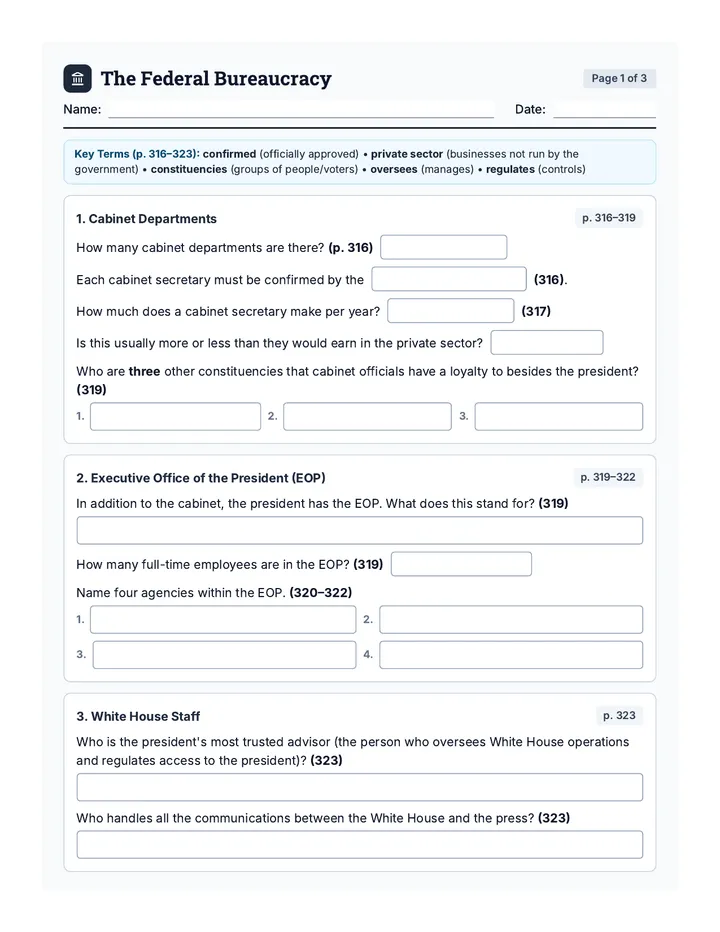
Federal Bureaucracy L3 L4 Worksheet The Federal Bureaucracy
Page 1 of 3
Name:
Date:
Key Terms (p. 316–323): confirmed (officially approved) • private sector (businesses not run by the government) • constituencies (groups of people/voters) • oversees (manages) • regulates (controls)
1. Cabinet Departments p. 316–319
How many cabinet departments are there? (p. 316)
Each cabinet secretary must be confirmed by the
(316) .
How much does a cabinet secretary make per year?
(317)
Is this usually more or less than they would earn in the private sector?
Who are three other constituencies that cabinet officials have a loyalty to besides the president? (319)
2. Executive Office of the President (EOP) p. 319–322
In addition to the cabinet, the president has the EOP. What does this stand for? (319)
How many full-time employees are in the EOP? (319)
Name four agencies within the EOP. (320–322)
3. White House Staff p. 323
Who is the president's most trusted advisor (the person who oversees White House operations and regulates access to the president)? (323)
Who handles all the communications between the White House and the press? (323)
The Federal Bureaucracy Page 2 of 3
Key Terms (p. 323–329): executive privilege (president's right to keep certain information private) • anticipate (expect or plan ahead for) • skim (read quickly for main ideas)
4. Executive Privilege p. 323
What is executive privilege? (323) (Define in a complete sentence.)
5. Growth of Federal Agencies p. 325
Did the Founders of the US anticipate the need for creating federal agencies to carry out the day-to-day business of government? (325)
How many people work for the federal government today? (325)
How many buildings does the federal government own? (325)
6. Cabinet Departments p. 326–329
The 15 cabinet departments are described on p. 326–329 . Skim over them. Which department would you most like to work for? Why? (Use "because" to explain your choice.)
7. Department Budgets p. 327
Study the departments budgets chart on p. 327 . Which three departments get the most money?
Which 3 departments do you think should get the most money?
The Federal Bureaucracy Page 3 of 3
Key Terms (p. 329–345): provisions (specific rules or parts of a law) • reduce (make smaller) • red tape (excessive or complicated rules that slow things down)
8. Other Parts of the Bureaucracy p. 329–330
In addition to the cabinet departments, there are other parts of the federal bureaucracy. Give an example of each of the following. (329–330)
• Independent agency -
• Government corporation -
• Regulatory commission -
9. The Pendleton Act of 1883 Chart on p. 333
List at least 2 provisions of The Pendleton Act of 1883. (chart on p. 333)
10. Size of the Federal Government p. 340–343
What are two reasons why the size of the federal government has grown over time? (340–342)
List one effort made in the past to reduce the size of the federal bureaucracy. (342–343)
11. Red Tape p. 345
What does the term red tape mean? (345)