Empire Builders Vocabulary Worksheet
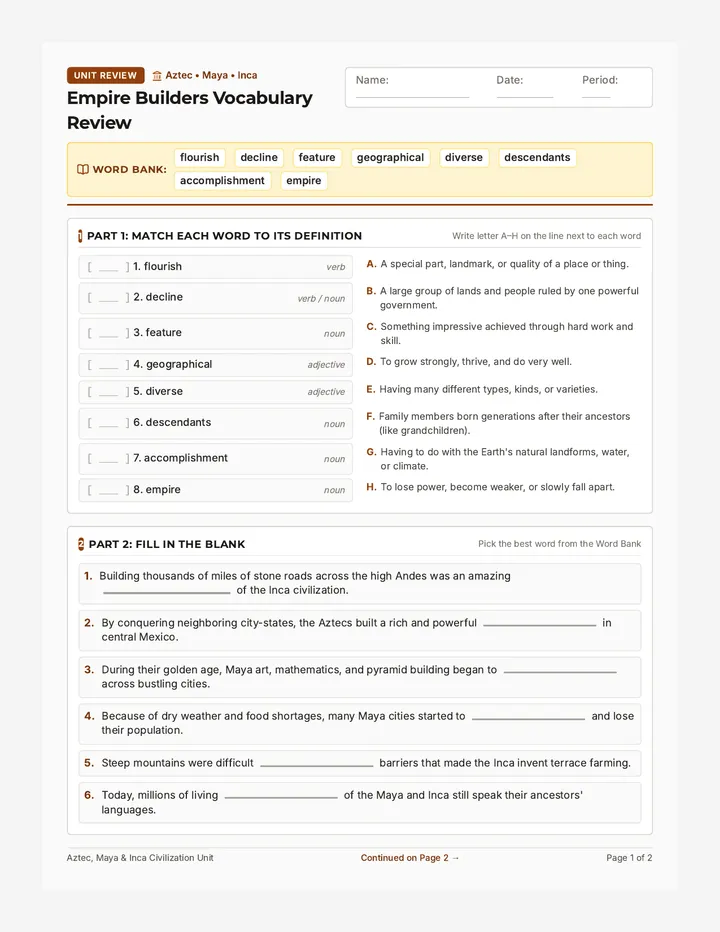
Unit Review Aztec • Maya • Inca
Empire Builders Vocabulary Review
Name:
Date:
Period:
Word Bank:
flourish decline feature geographical diverse descendants accomplishment empire
1
Part 1: Match Each Word to its Definition
Write letter A–H on the line next to each word
[ ___ ] 1. flourish verb
A. A special part, landmark, or quality of a place or thing.
[ ___ ] 2. decline verb / noun
B. A large group of lands and people ruled by one powerful government.
[ ___ ] 3. feature noun
C. Something impressive achieved through hard work and skill.
[ ___ ] 4. geographical adjective
D. To grow strongly, thrive, and do very well.
[ ___ ] 5. diverse adjective
E. Having many different types, kinds, or varieties.
[ ___ ] 6. descendants noun
F. Family members born generations after their ancestors (like grandchildren).
[ ___ ] 7. accomplishment noun
G. Having to do with the Earth's natural landforms, water, or climate.
[ ___ ] 8. empire noun
H. To lose power, become weaker, or slowly fall apart.
2
Part 2: Fill in the Blank
Pick the best word from the Word Bank
Building thousands of miles of stone roads across the high Andes was an amazing of the Inca civilization.
By conquering neighboring city-states, the Aztecs built a rich and powerful in central Mexico.
During their golden age, Maya art, mathematics, and pyramid building began to across bustling cities.
Because of dry weather and food shortages, many Maya cities started to and lose their population.
Steep mountains were difficult barriers that made the Inca invent terrace farming.
Today, millions of living of the Maya and Inca still speak their ancestors' languages.
Aztec, Maya & Inca Civilization Unit Continued on Page 2 → Page 1 of 2
Part 3 & Part 4 Application
Understanding Civilizations & Writing
Name: Page 2
3
Part 3: Short Answer Questions
Answer each question using the words in bold
1. The Aztec Island City Use: feature • geographical
The Aztecs built their city on a lake. Name one man-made feature (like floating gardens or bridges) that helped them live in this geographical area, and explain how it helped.
One feature they built was:
It helped them because:
2. The Inca Environment Use: diverse • empire
The Inca empire covered deserts, mountains, and rainforests. Why did having such a diverse land help provide different kinds of foods and resources for their people?
Having diverse lands helped the empire because:
Different areas gave them:
3. The Maya Today Use: decline • descendants
Many old Maya cities suffered a decline and were left empty, but the Maya people did not disappear. How do their modern descendants keep their culture alive today?
Modern descendants keep culture alive by:
An example of this is:
4
Part 4: Sentence Builder
Write one clear sentence using both words
1. Pair: accomplishment + flourish
Tip: Write about Maya pyramids, Inca road systems, or Aztec farming.
2. Pair: empire + decline
Tip: Write about what caused a powerful civilization or kingdom to lose strength.
Student Check: How confident do you feel about these 8 words?
Need Help Getting There I Got It!
Aztec, Maya & Inca Civilization Unit Vocabulary Review Assessment Page 2 of 2
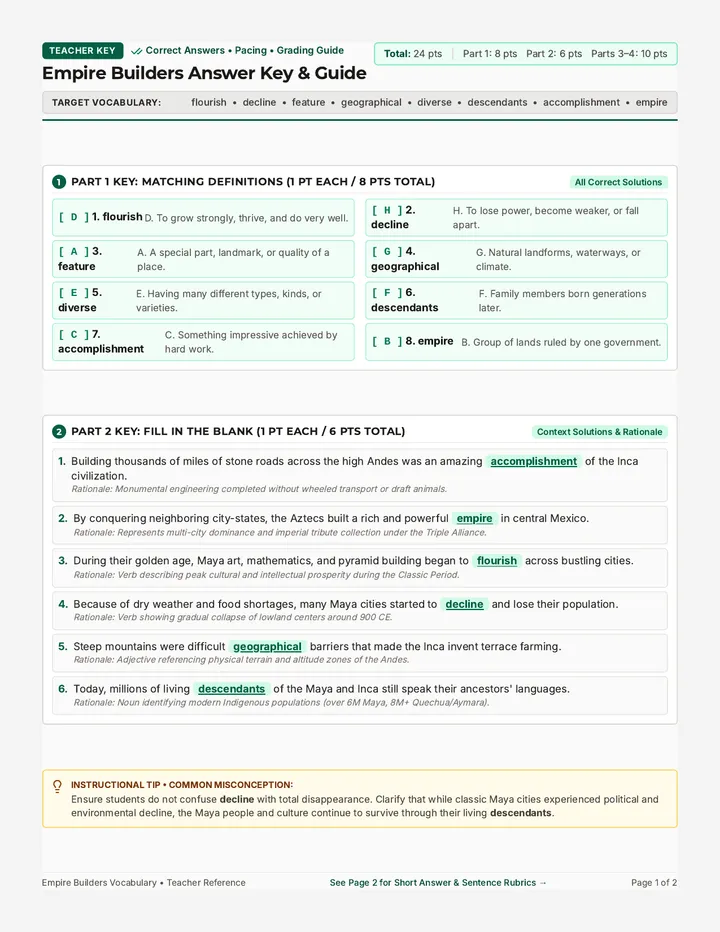
Empire Builders Answer Key
Teacher Key Correct Answers • Pacing • Grading Guide
Empire Builders Answer Key & Guide
Total: 24 pts
|
Part 1: 8 pts
Part 2: 6 pts
Parts 3–4: 10 pts
Target Vocabulary:
flourish • decline • feature • geographical • diverse • descendants • accomplishment • empire
1
Part 1 Key: Matching Definitions (1 pt each / 8 pts total)
All Correct Solutions
[ D ] 1. flourish D. To grow strongly, thrive, and do very well.
[ H ] 2. decline H. To lose power, become weaker, or fall apart.
[ A ] 3. feature A. A special part, landmark, or quality of a place.
[ G ] 4. geographical G. Natural landforms, waterways, or climate.
[ E ] 5. diverse E. Having many different types, kinds, or varieties.
[ F ] 6. descendants F. Family members born generations later.
[ C ] 7. accomplishment C. Something impressive achieved by hard work.
[ B ] 8. empire B. Group of lands ruled by one government.
2
Part 2 Key: Fill in the Blank (1 pt each / 6 pts total)
Context Solutions & Rationale
Building thousands of miles of stone roads across the high Andes was an amazing accomplishment of the Inca civilization. Rationale: Monumental engineering completed without wheeled transport or draft animals.
By conquering neighboring city-states, the Aztecs built a rich and powerful empire in central Mexico. Rationale: Represents multi-city dominance and imperial tribute collection under the Triple Alliance.
During their golden age, Maya art, mathematics, and pyramid building began to flourish across bustling cities. Rationale: Verb describing peak cultural and intellectual prosperity during the Classic Period.
Because of dry weather and food shortages, many Maya cities started to decline and lose their population. Rationale: Verb showing gradual collapse of lowland centers around 900 CE.
Steep mountains were difficult geographical barriers that made the Inca invent terrace farming. Rationale: Adjective referencing physical terrain and altitude zones of the Andes.
Today, millions of living descendants of the Maya and Inca still speak their ancestors' languages. Rationale: Noun identifying modern Indigenous populations (over 6M Maya, 8M+ Quechua/Aymara).
Instructional Tip • Common Misconception:
Ensure students do not confuse decline with total disappearance. Clarify that while classic Maya cities experienced political and environmental decline, the Maya people and culture continue to survive through their living descendants.
Empire Builders Vocabulary • Teacher Reference See Page 2 for Short Answer & Sentence Rubrics → Page 1 of 2
Teacher Key • Parts 3 & 4
Constructed Responses & Scoring Rubrics
Scoring Guide: 10 Points Total
3
Part 3: Short Answer Exemplars (2 pts each / 6 pts total)
Award 1 pt for accurate feature/concept + 1 pt for clear explanation
1. Aztec Island City (Terms: feature, geographical) Max: 2 pts
Exemplar Answer: "One feature they built was chinampas (floating gardens). It helped them because it allowed them to grow corn and beans on swampy lake water where regular farmland did not exist."
Also accept: Causeways (raised stone roads to mainland) or stone aqueducts (fresh drinking water pipes).
2. Inca Environment (Terms: diverse, empire) Max: 2 pts
Exemplar Answer: "Having diverse lands helped the empire because different elevations produced different crops. Different areas gave them potatoes from high mountains, corn from valleys, and cotton or fish from the coast."
Key Concept: "Vertical archipelagos" — Inca storehouses redistributed supplies across distinct microclimates.
3. Maya Today (Terms: decline, descendants) Max: 2 pts
Exemplar Answer: "Modern descendants keep culture alive by practicing traditional weaving, farming, and community festivals. An example of this is speaking Mayan languages like K'iche' and wearing traditional huipil clothing."
Key Concept: Proves understanding that city abandonment did not mean extinction of the Maya people.
4
Part 4: Sentence Builder Exemplars (2 pts each / 4 pts total)
1 pt for using both words correctly + 1 pt for historical accuracy
Prompt 1: accomplishment + flourish Max: 2 pts
Model 1: "During the Classic Period, Maya arts began to flourish, leading to the accomplishment of creating accurate solar calendars."
Model 2: "Building Machu Picchu in the high Andes was a great Incan accomplishment that allowed their royal estate to flourish."
Prompt 2: empire + decline Max: 2 pts
Model 1: "The Aztec empire began to decline and collapse after Spanish conquistadors and rival tribes attacked Tenochtitlan."
Model 2: "Internal civil war weakened the Incan empire, causing it to rapidly decline when invaders arrived."
Grading Scale: 22–24 pts: Advanced Mastery (A) 19–21 pts: Proficient (B) 16–18 pts: Basic (C) <16 pts: Needs Intervention
Empire Builders Vocabulary • Teacher Reference Scoring Rubric & Answer Keys Complete Page 2 of 2