Divided Sovereignty Teacher Guide
AP Government & Civics • High School
Divided Sovereignty
Weaving Fluency Instruction into the Content of Federalism
Pedagogical Tool Teacher Guide
Instructional Philosophy
Advanced reading fluency is not a remedial skill. In high school, complex 18th-century syntactic structures (like those in the Federalist Papers) often block comprehension. By explicitly teaching rhetorical prosody, semantic phrasing, and repeated oral reading, we provide students with the decoding tools needed to unlock deep political theories of dual and cooperative sovereignty.
Lesson Specifications
- Duration: 60–75 Minutes
- Grouping: Whole Group & Structured Partners
- Key Texts: Federalist No. 51 (Madison), US Constitution (Tenth Amendment), Federalist No. 45
- Materials Needed: Divided Sovereignty Reading Packet, Classroom Slides
Learning Objectives
- Civics: Differentiate between dual and cooperative sovereignty; analyze federal vs. state power.
- Fluency: Use expression, pause markings, and emphasis to chunk complex 18th-century sentences into meaningful semantic units.
Target Common Core & AP Standards
CCSS.ELA-LITERACY.CCRA.R.4
Interpret words and phrases as they are used in a text, including determining technical, connotative, and figurative meanings.
CCSS.ELA-LITERACY.RF.11-12.4
Read with sufficient accuracy and fluency to support comprehension, utilizing appropriate rate, expression, and phrasing.
Key Fluency Concepts to Teach
1. Rhetorical Prosody
The rhythm, melody, and expressive intonation of spoken language that reflects the structure and meaning of complex legal arguments.
2. Semantic Phrasing
Chunking long, multi-clause clauses into "breath groups" or "sense groups" to prevent cognitive overload during reading.
3. Repeated Reading
Re-reading selected historical passages orally up to three times with increasing emphasis on persuasive delivery and logic.
Divided Sovereignty • Teacher Guide Page 1 of 3
Step-by-Step Delivery
Instructional Sequence
Estimated Time: 60–75 Minutes
1
Warm-Up: The Architecture of Federalism (10 mins)
Begin with a brief schema activator. Ask students: "Why did the Framers divide power between the federal government and individual states instead of choosing one supreme central authority?" Quickly sketch or display dual federalism (layer cake) versus cooperative federalism (marble cake) using the classroom slides. Introduce the lesson's central question: How does dividing power protect liberty, and how do we decode the complex arguments written to defend it?
2
Direct Instruction: Modeling Semantic Phrasing (15 mins)
Distribute the Divided Sovereignty Reading Packet. Project the Federalist No. 51 excerpt. Note that James Madison wrote sentences exceeding 50 words with multiple sub-clauses. Explain that high-level readers chunk these sentences into meaningful blocks.
Teacher Modeling Script: "Watch how I read Madison’s words. I will pause slightly at single slashes (/) for minor breaks (commas, semi-colons), and stop longer at double slashes (//) for periods. I will also stress the words underlined to convey the logical flow."
3
Guided Practice: Marking the Pulse of the Tenth Amendment (15 mins)
Guide the class to collaboratively mark Section 1 (The Tenth Amendment) on page 1 of their Student Packet. Read the amendment aloud as a whole group first, then prompt students to suggest where pauses and emphases should go. Underline keywords together (e.g., "not delegated", "reserved", "to the States respectively"). Practice reading the marked passage in choral unison to build group prosody and confidence.
4
Partner Repeated Reading Protocol (20 mins)
Pair students strategically (mix a fluent reader with a striving reader where possible). Students take turns as Reader and Coach.
Step A: First Read & Track
Partner A reads the assigned Text (A or B) aloud. Partner B tracks with a finger, noting pacing, words missed, or awkward pauses.
Step B: Analyze & Re-Read
Partner B offers feedback using the Expression Rubric. Partner A immediately re-reads the same text, focusing on correcting phrasing and applying vocal emphasis.
5
Synthesis & Assessment (10 mins)
Instruct partners to work individually to complete the analysis and comprehension questions in their student packets. End the class with a brief group discussion where selected students read their favorite sentences aloud with polished expression.
Divided Sovereignty • Teacher Guide Page 2 of 3
Reference & Differentiation
Answer Key & Teacher Prompts
Instructional Aids
Sample Student Responses (Comprehension Questions)
Q1: Based on Federalist No. 51, explain how Madison argues that "ambition must be made to counteract ambition."
"Madison is arguing that the primary check on power is human nature itself. By giving leaders in different branches and different levels of government (federalism) the necessary constitutional means and personal motives to resist encroachments from other sectors, power is naturally kept in check. No single entity can easily accumulate control because other ambitious leaders will defend their own spheres of influence."
Q2: How does the Tenth Amendment draw a clear boundary between dual sovereignty and cooperative sovereignty?
"The Tenth Amendment sets up dual sovereignty (layer cake) by declaring that all powers not specifically delegated to the federal government by the Constitution are strictly reserved to the states or the people. This draws a clean, sharp boundary line. However, in modern cooperative federalism (marble cake), these boundaries blur as federal funding and shared regulations force states and the federal government to collaborate on policy areas like education or healthcare."
Strategic Socratic Prompts
- On Prosody: "When you read Federalist No. 51 with strong emphasis on words like 'essential' and 'usurpations', how does that change how you understand Madison’s urgency? What was he afraid of?"
- On Modern Relevance: "Does our system still operate as 'divided' power, or has the federal government accumulated too much control over state matters? Which text supports your view?"
Scaffold & Extend (Differentiation Guide)
Support for Striving Readers
Provide students with a pre-highlighted version of the text highlighting the main subject and verb of Madison’s long sentences. Encourage them to master just two sentences during the partner repeated reading rather than the entire block. Focus strictly on correct pausing at single and double slashes.
Extension for Advanced Students
Challenge advanced students to write an original 3-sentence editorial arguments in the style of Madison or Hamilton using parallel phrasing and structured pauses. Have them exchange with a peer who must correctly map the rhetorical pauses and read it aloud.
Divided Sovereignty • Teacher Guide Page 3 of 3
Divided Sovereignty Reading Packet
Student Workbook
Divided Sovereignty
Federalism & The Art of Rhetorical Reading
Name:
Date:
Why Read Historical Documents Out Aloud?
The authors of the Constitution and the Federalist Papers were masters of rhetoric—the art of persuasive speaking and writing. They wrote complex, multi-layered sentences designed to be heard and debated. To truly understand their arguments about federalism, we must decode their sentence structures by mastering semantic phrasing (chunking clauses) and rhetorical prosody (reading with expressive rhythm).
The Fluency Markings System
To read with the voice of a constitutional lawyer, we will map three simple markup codes to guide our speech:
1. Short Pause ( / )
Place a single slash to indicate a brief breath break, usually at commas, semi-colons, or transition words.
2. Logical Stop ( // )
Place a double slash to indicate a strong, brief pause at the end of a primary thought or period.
3. Vocal Emphasis (Word)
Underline core keywords or contrasts that carry the essential logical argument of the sentence.
Classroom Modeling: The Tenth Amendment
Observe how your teacher models this amendment, then practice reading it with your class in choral unison.
The powers / not delegated to the United States by the Constitution, / nor prohibited by it to the States, / are reserved to the States respectively, / or to the people. //
💡 Focus Point: The Power Boundary
Notice how the brief pause after "States" separates the national government's limitations from the powers guaranteed to the state governments.
🔊 Reading Goal: Dual Sovereignty
By emphasizing "reserved", you are audibly drawing the legal line that defines dual sovereignty—power is partitioned strictly.
Divided Sovereignty • Student Reading Packet Page 1 of 3
Partner Reading Protocol
Historical Voices of Sovereignty
Active Partner Activity
Directions: Pair up. One person is Reader A (Focusing on Madison's Federalist 51) and the other is Reader B (Focusing on Federalist 45). Follow the three-read repeated reading protocol. Record your times and complete the partner tracking sheet.
Text A: Federalist No. 51 (James Madison) Reader A Focus
In a single republic, / all the power surrendered by the people / is submitted to the administration of a single government; / and the usurpations are guarded against / by a division of the government into distinct and separate departments. // In the compound republic of America, / the power surrendered by the people / is first divided between two distinct governments, / and then the portion allotted to each / subdivided among distinct and separate departments. // Hence a double security arises / to the rights of the people. // The different governments / will control each other, / at the same time / that each will be controlled by itself. //
Divided Sovereignty Slides
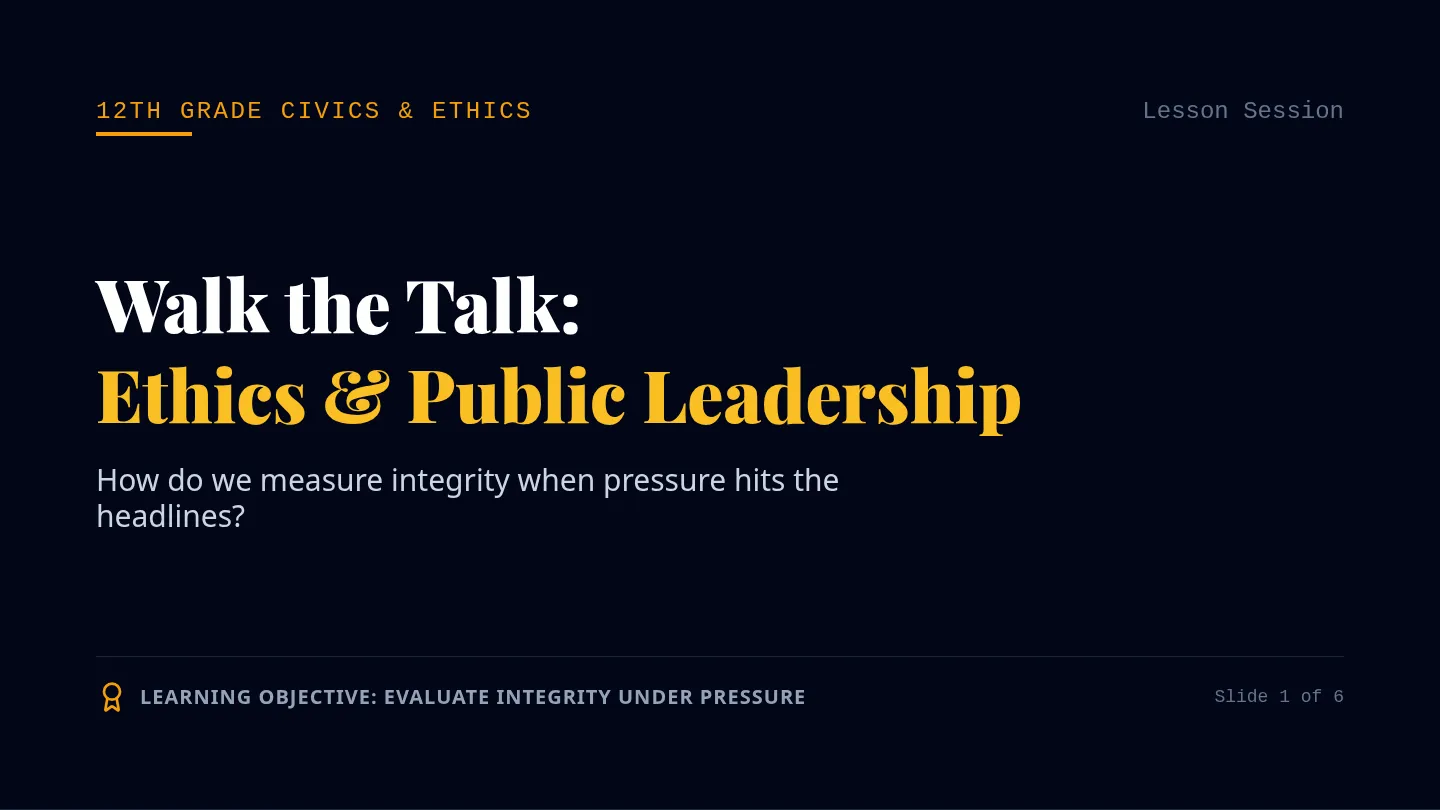
AP U.S. Government & Politics The Rhetoric of Sovereignty
Advanced Literacy & Civics Lesson
Divided Sovereignty
Decoding Federalism through Rhetorical Prosody & Advanced Fluency Instruction
Target: 18th-Century Text Comprehension
Slide 1 of 6
Core Content
What is Federalism?
Dual Sovereignty
Often called "Layer Cake Federalism." A system where national and state governments operate in strictly delineated spheres.
Example: The Tenth Amendment's strict reservation of powers.
Cooperative Sovereignty
Often called "Marble Cake Federalism." National and state authorities overlap, share costs, and administration responsibilities.
Example: Federal education grants combined with state administration.
How did the Framers argue for these divisions in writing?
Slide 2 of 6
Pedagogical Strategy
Why Fluency in AP Civics?
01
Rhetorical Prosody
Reading with natural rhythm, speed, and melodic expression. High prosody directly correlates with high historical comprehension.
Audible Logic
02
Semantic Phrasing
Breaking down massive 18th-century syntactic structures into "breath chunks." It acts as a mental translator of archaic English.
Structural Decodes
03
Repeated Oral Reading
Re-reading a selected text up to three times. Reduces cognitive burden, moving the student's brain from word-decoding to deep political analysis.
Deeper Insight
Complex syntax obscures meaning. Fluent delivery uncovers it.
Slide 3 of 6
Guided Modeling
Modeling Federalist No. 51
Listen to the teacher read Madison's words. Notice the marked pauses (/) and key word emphasis underlined.
"Hence a double security arises / to the rights of the people. // The different governments / will control each other, / at the same time / that each / will be controlled by itself." //
The Division Pause ( / ): Gives your listener's working memory exactly enough time to link the two distinct governments.
The Full Stop ( // ): Marks the completion of the core theoretical concept of federal check-and-balance.
Next, we will transition to the Partner Reading Protocol.
Slide 4 of 6