Crown Control Jot Sheets
CROWN & CONTROL
Active Jotting Sheet • Episode I: Divine Sovereigns
Name: ___________________________
Date: _________ Period: _________
How Did Ancient Monarchs Keep Their Crowns?
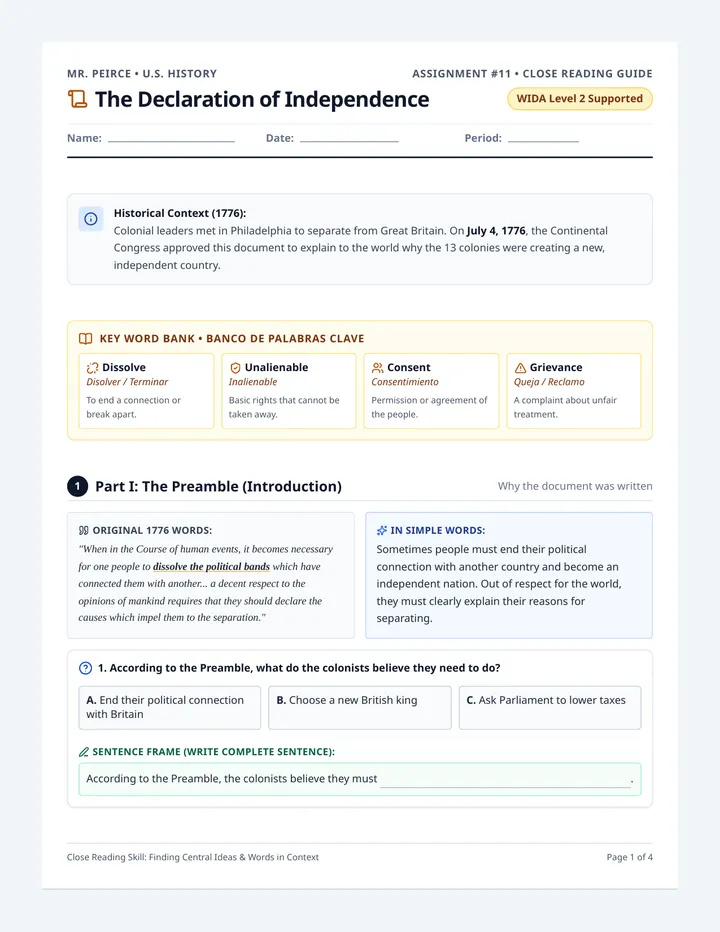
Before modern constitutions, rulers relied on three core pillars of power: Religion (divine rights), Monuments (overwhelming visual scale), and Military (armed enforcement). Use this sheet to track how ancient empires projected authority.
🇨🇳
ANCIENT CHINA: THE CELESTIAL DYNASTIES
Religion: The Mandate
The Emperor was the "Son of Heaven." If they ruled justly, Heaven blessed them. If they failed, natural disasters struck.
Jot: signs mandate is lost...
Monuments: Great Walls
Massive defensive barriers and the Terracotta Army buried with Emperor Qin Shi Huang to guard him in death.
Jot: psychological effect...
Military: Chariots & Iron
Dynasties enforced conscription and developed advanced iron metallurgy to outgun regional warlords.
Jot: how force was used...
🇪🇬
ANCIENT EGYPT: THE PHARAOH'S DIVINE REALM
Religion: Horus & Ma'at
Pharaohs were living embodiments of Horus, responsible for preserving cosmic order (Ma'at) and flooding the Nile.
Jot: why people obeyed...
Monuments: Pyramids
Colossal stone tombs like Giza demonstrated unmatched logistical power and a ticket to eternal order.
Jot: message of pyramid...
Military: Charioteers
The New Kingdom army expanded borders to capture raw wealth, using professional archery and swift-moving chariots.
Jot: securing borders...
The "Wow" Factor: Comparative Brainstorming
Monarchs didn't just rule by fear—they ruled by awe. Contrast how a Chinese peasant looking at a solar eclipse vs. an Egyptian citizen looking at the Great Pyramid would react to their monarch's apparent connection to the cosmic world.
My Analysis notes on the "wow" factor:
UNIT: CROWN AND CONTROL PAGE 1 OF 3
CROWN & CONTROL
Active Jotting Sheet • Episode II: Iron & Ironclad Laws
Name: ___________________________
Date: _________ Period: _________
🏛️
ROME: FROM EMPERORS TO DEIFIED KINGS
Rome started as a small kingdom, overthrew its kings to form a Republic, but collapsed back into monarchy under the Emperors. They took the title Augustus and declared themselves gods (Imperial Cult) to unite a massive, fractured territory.
Bread and Circuses (Monuments)
Coliseums, triumphal arches, and aqueducts kept citizens entertained, clean, and constantly reminded of imperial generosity.
Jot: political purpose of circuses...
The Iron Praetorians (Military)
The ultimate military force of Rome. But emperors became hostage to their own army—the guard could assassinate a weak monarch.
Jot: danger of relying on army...
📜
THE CRACK IN THE SHIELD: MAGNA CARTA
Primary Source Excerpt (Clause 12 & 39)
"No scutage [tax] shall be imposed on our kingdom except by common counsel... No free man shall be seized or imprisoned... except by the lawful judgment of his equals or by the law of the land."
King John of England was forced by rebellious barons to sign this document, dealing a massive blow to absolute divine rule.
How did this alter the King's absolute control?
Jot: Power over taxes/laws...
Who gained power from this document?
Jot: Barons vs. Common people...
The Sovereignty Shift
Compare a Roman Emperor (who could execute someone on a whim) to King John post-1215. What is the fundamental difference in how they can exercise military force?
My synthesis on legal constraints of military:
UNIT: CROWN AND CONTROL PAGE 2 OF 3
CROWN & CONTROL
Active Jotting Sheet • Episode III: The Modern Horizon
Name: ___________________________
Date: _________ Period: _________
DO MONARCHIES STILL EXIST TODAY?
Yes! Modern monarchies fall into two distinct buckets: Absolute Monarchies (rulers maintain total power over government) and Constitutional Monarchies (rulers are ceremonial figureheads bound by constitution).
Absolute Monarchy (e.g., Saudi Arabia, Vatican City)
- • Monarch directs all laws, treaties, and domestic policies.
- • No parliament can override the monarch's direct decrees.
- • Power projects through oil wealth or religious structure.
Jot: How they maintain control...
Constitutional (e.g., UK, Japan, Spain)
- • Monarch functions as the ceremonial Head of State.
- • Prime Minister and elected Parliament run the actual government.
- • The Crown's main role is diplomacy, unity, and tradition.
Jot: Why keep a ceremonial king?
Master Power Projection Matrix
| Civilization / Era | Their primary source of "Awe" | How did they handle Rebellion? |
|---|
| Ancient Egypt | | |
| | |
|
| Imperial Rome |
|
|
| Modern Constitutional |
|
|
The Ultimate Verdict
If you had to live under one of these ancient systems of absolute rule, which one would you choose, and what is its greatest flaw? Explain using religion, monuments, or military in your reasoning.
My final verdict and reasoning:
UNIT: CROWN AND CONTROL PAGE 3 OF 3
Crown Control Slides
👑 ROYAL POWER OVER TIME MODULE I
CROWN & CONTROL
How monarchs used religion, monuments, and military force to project absolute authority across millennia.
Prepare your Jot Sheets for Episode I
Use arrow keys to advance
🇨🇳 Ancient China: Celestial Mandate
Episode I
The Mandate
The Emperor is the "Son of Heaven." Just rule brings cosmic harmony. Injustice triggers natural disaster and immediate rebellion.
Religion
Terracotta Army
Qin Shi Huang buried 8,000 clay warriors. Massive defensive fortifications projected an image of absolute security and infinite labor control.
Monuments
Iron Might
Imperial state monopoly on iron weapon production and vast conscription pipelines kept border tribes at bay and local rebellion crushed.
Military
Jot Session Check: How did a solar eclipse prove a King was losing the Mandate?
🇪🇬 Ancient Egypt: Sovereigns of Nile
Episode I
The Living God
Pharaoh is Horus on earth. Obeying the crown is keeping cosmic balance (Ma'at). If the Nile floods, the King's divinity is reaffirmed.
Religion
Royal Tombs
Giza Pyramids and massive obelisks. Scaling rock to the sky broadcasted unlimited wealth, supreme mastery of engineering, and power over life.
Monuments
Chariot Armies
Composite bows and swift military chariots. Imperial expansion secured copper and gold mines, solidifying physical and monetary control.
Military
Jot Session Check: Why would building a giant pyramid keep citizens quiet during the harvest off-season?
🏛️ Imperial Rome: Cult of the Emperor
Episode II
Bread & Circuses (Monuments)
Romans built stadiums like the Colosseum and Circus Maximus to provide free food and blood sports to citizens.
- Neutralized civic unrest in urban slums
- Broadcasted royal generosity and global conquest
Praetorian Guard (Military)
The elite bodyguard of the Emperor. They guarded his bed chamber and crushed conspiracies in the Senate—but held the true crown.
- Demanded massive financial bribes to keep allegiance
- Assassinated 15+ emperors they deemed "unprofitable"
When a monarch relies entirely on military mercenaries, the army, not the crown, rules the throne.
Ruling the Classroom Teacher Guide
Teacher Facilitation Guide
Crown & Control • Instructional Blueprint & Answer Key
PREP TIME: 5 MINS
CLASS DURATION: 60 MINS
Instructional Objective
Students will analyze how monarchs historically consolidated power using the three methods of control (Religion, Monuments, Military). By the end of this session, they will trace the historical dilution of absolute crown power from antiquity, through the signing of the Magna Carta in 1215, to modern constitutional and absolute systems.
Pacing Blueprint & Classroom Prompts
Part I: Ancient Awe (20m)
Slides 1-3. Distribute Student Jot Sheets. Have students describe how monarchs claimed divine authority. Highlight the Nile's flooding in Egypt and solar eclipses in China as physical "proofs" of divine right.
Part II: Iron & Law (20m)
Slides 4-5. Contrast Rome's Bread/Circuses with the military dominance of the Praetorian Guard. Walk through the Magna Carta excerpt. Guide students to see how limiting tax power broke absolute rule.
Part III: Modernity (20m)
Slides 6-7. Categorize current governments. Prompt critical thinking: "Why do countries like the UK or Japan spend millions of dollars keeping a symbolic royal family with zero actual legal power?"
Exemplar Answer Key & Grading Benchmarks
Page 1: China & Egypt Notes
- Mandate Loss: Floods, massive earthquakes, pestilence, corruption, and successful peasant revolts indicate Heaven has abandoned the Emperor.
- Monuments / Pyramids: Projected absolute cosmic control and mastery of resources. Keeps off-season farmers busy, preventing civic uprisings.
Page 2: Rome & Magna Carta Notes
- Bread and Circuses: Entertainment (games, gladiators) distracted the masses from hyper-inflation, loss of freedom, and political elite corruption.
- Praetorian Guard: A double-edged sword. Kept the Emperor safe, but also made the Emperor hostage to military payouts. If pay was low, assassination followed.
- Magna Carta (1215): Smashed absolute rule. The King must ask a Council (Parliament) before taxing, and cannot imprison citizens without peer trial.
Page 3: Absolute vs. Constitutional systems
- Absolute (e.g. Saudi Arabia): Royal family commands 100% of wealth (oil reserves) and direct laws; political opposition is forbidden.
- Constitutional (e.g. UK): Kept as symbols of national heritage, stable transitions, tourism, and non-partisan diplomatic diplomats.
Sovereignty Showdown Activity
Sovereignty Showdown
Activity Packet • Analyzing Crown Assets & Vulnerabilities
Name: ___________________________
Date: _________ Period: _________
The Double-Edged Crown: Power vs. Fragility
Every monarchy is a system of balance. Power projection (Religion, Monuments, Military) can create incredible domestic stability, but over-reliance on a single method creates critical, fatal vulnerabilities. Analyze the profile cards below.
🇨🇳 CELESTIAL EMPIRE (CHINA)
Strength
The Bureaucracy of Heaven: Standardized legal systems and merit-based exams kept governors loyal.
Vulnerability
The Mandate Clause: Natural disasters legally justified immediate, violent peasant rebellion.
How to overthrow?
🇪🇬 DIVINE PHARAOHDOM (EGYPT)
Strength
Cosmic Monopoly: Pharaohs were considered living gods on earth, ensuring total spiritual loyalty.
Vulnerability
Rigidity: Over-reliance on isolation and the Nile's seasonal cycles left them exposed to foreign changes.
How to overthrow?
🏛️ CEASARIAN IMPERIUM (ROME)
Strength
Military & Bread: Constant conquests paid for grain and games to satisfy urban masses.
Vulnerability
No Succession Rule: Death of an Emperor triggered immediate civil wars and military coup d'états.
How to overthrow?
🏰 FEUDAL KINGDOM (ENGLAND)
Strength
Decentralized Power: Shared rule with high barons spread the burden of military and regional defense.
Vulnerability
Financial Dependency: The King depended on noble taxes; overtaxing triggered barons' armed rebellions.
How to overthrow?
The Balancing Act
Observe how the strengths and weaknesses of these states operate. If a country relies only on military force, what is the trade-off for its internal civic trust? Summarize in your own words.
Write your trade-off analysis here:
UNIT: CROWN AND CONTROL PAGE 1 OF 2
Sovereignty Showdown
Activity Packet • The Crucible Crisis Simulator
Name: ___________________________
Date: _________ Period: _________
Simulation Rules
How do these monarchical structures hold up during unexpected disasters? Read each real-world historical crisis scenario below. Use your on Page 1 to explain which system would survive, which would implode, and why.