Standard Candles Teacher Guide
Standard Candles
Teacher Facilitation Guide
Objective
Students will apply the Brightness Equation to determine stellar distances by treating fictional stars as "Standard Candles" with known luminosities.
Pacing
45-50 Minutes
1. Warm-up: The Distance Problem (5 min)
Prompt: "How do we know how far away stars are? We can't use a tape measure, and even Proxima Centauri is 4.2 light years away."
- Accept all answers (parallax, color/temperature, brightness).
- Focus on the concept that "dimmer" usually means "farther," but clarify that intrinsic power matters.
2. Video Viewing: The Science of Smearing (10 min)
Watch the video "The Brightness of Light". Focus points:
- The Sphere Analogy: Light isn't lost; it's "smeared out" over a surface area of \(4\pi r^2\).
- Brightness (\(B\)): Power per unit area (\(W/m^2\)).
- The Equation: \[B = \frac{P}{4\pi r^2}\]
3. Activity: Stellar Detective (25 min)
Students use the rearranged distance formula: \[r = \sqrt{\frac{P}{4\pi B}}\]
Key Facilitation Tips
- The "Standard Candle" Concept: Explain that for this math to work, we must assume we know the Star's Power (\(P\)). In real astronomy, we find these "Standard Candles" using specific types of stars (like Cepheid Variables).
- Calculator Check: Ensure students use parentheses for the denominator: \(\sqrt{(P / (4 \times \pi \times B))}\).
4. Closure (5 min)
Discuss: "Why is knowing the 'Power' of a star the hardest part?" (Stars don't come with labels. We have to use physics models to estimate their true wattage before we can find their distance).
Misconceptions to Address
Misconception: Light "runs out of energy" or gets "tired" as it travels.
Reality: Total energy is conserved. It's just spread over a larger sphere as distance increases.
Stellar Detective Worksheet
Stellar Detective
Mission: Determining Cosmic Distances
NAME:
DATE:
Case File Reference
Distance Formula
\[r = \sqrt{\frac{P}{4\pi B}}\]
Conversion Factor
1 Light Year (ly) =
\(9.46 \times 10^{15}\) meters
The Objective
In astronomy, we use **Standard Candles**—objects with a known Power (Luminosity). By measuring how bright they appear on Earth, we can calculate their distance. Use the data below to locate five mysterious stars.
| Star Designation | Power (P) (Watts) | Brightness (B) (W/m²) |
|---|
| Nova Alpha | \(3.8 \times 10^{26}\) | \(4.0 \times 10^{-10}\) |
| Dwarf Beta | \(1.2 \times 10^{24}\) | \(2.5 \times 10^{-12}\) |
| Supergiant Gamma | \(5.6 \times 10^{30}\) | \(1.8 \times 10^{-9}\) |
| Pulsar Delta | \(8.4 \times 10^{28}\) | \(5.1 \times 10^{-11}\) |
| Flare Epsilon | \(2.1 \times 10^{25}\) | \(8.9 \times 10^{-13}\) |
1. Star: Nova Alpha
Step 1: Distance in Meters
Step 2: Distance in Light Years
2. Star: Dwarf Beta
Step 1: Distance (m)
Step 2: Distance (ly)
Calculations continue on next page
3. Star: Supergiant Gamma
Step 1: Distance (m)
Step 2: Distance (ly)
4. Star: Pulsar Delta
Step 1: Distance (m)
Step 2: Distance (ly)
5. Star: Flare Epsilon
Step 1: Distance (m)
Step 2: Distance (ly)
Debrief: The Astronomer's Challenge
In this activity, you were given the exact Power (P) of each star. In real astronomy, stars don't come with labels. Why is knowing the "Power" of a star the hardest part of measuring distance?
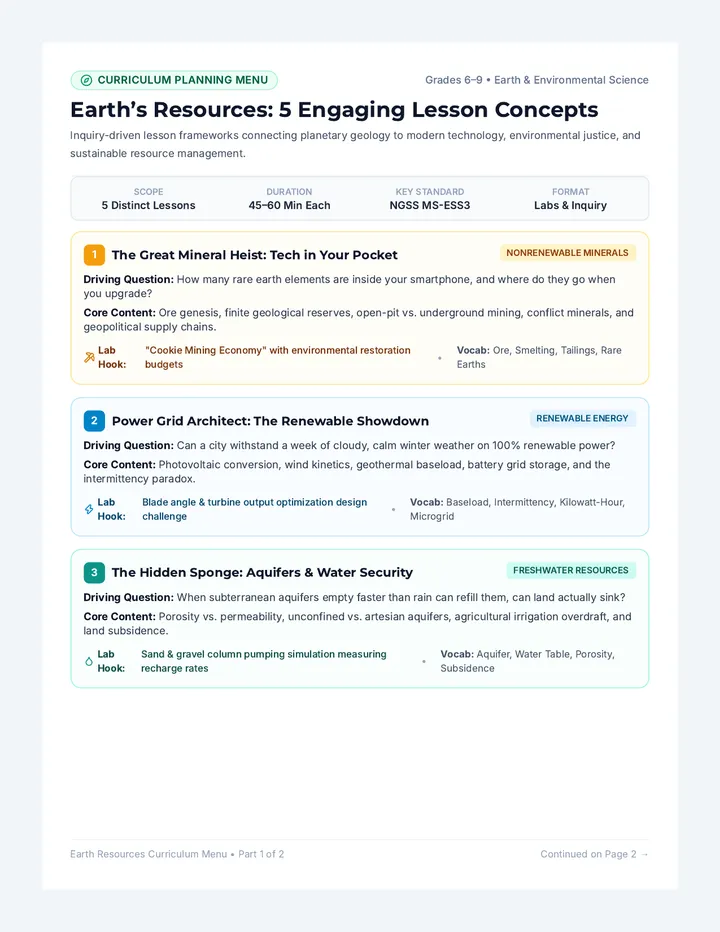
Cosmic Yardsticks Presentation Slides
Cosmic
Yardsticks
Measuring the Distance to the Stars
Astronomy Unit 4
Warm Up
The closest star (besides the Sun) is Proxima Centauri.
It is 40,000,000,000,000,000 meters away.
"How do we know how far away stars are if we can't travel there to measure?"
Video Discovery
The Brightness of Light: Power and Distance
Embedded media
1
The "Smearing" Concept
2
The Brightness Equation
3
Algebraic Manipulation
Geometric Dimming
Total Energy is Constant
Light doesn't "disappear" or "run out" as it travels. It simply spreads out.
The Sphere Rule
As distance (\(r\)) increases, light spreads over a surface area of \(4\pi r^2\).
Distance r
Distance 2r (4x Area)
The Brightness Equation
\[B = \frac{P}{4\pi r^2}\]
B
Brightness
Measured in \(W/m^2\)
P
Power
Luminosity in Watts
r
Distance
Radius in Meters
Solving for Distance
To find how far away a star is, we need to rearrange the formula for \(r\).
\[r = \sqrt{\frac{P}{4\pi B}}\]
- Divide Power by Surface Area factor
- Account for the Inverse Square
Calculation Tip
Always use parentheses for your denominator in your calculator!
√( P / ( 4 * π * B ) )
Standard Candles
Known Intrinsic Power
A Standard Candle is an object whose exact power (Luminosity) is known.
By comparing its Known Power to its Measured Brightness on Earth, we unlock its distance.
Common Standard Candles: Type Ia Supernovae, Cepheid Variable Stars.
Mission Briefing
Stellar Detective Activity
IDENTIFY
Review the Power (P) and Brightness (B) for 5 mysterious stars.
CALCULATE
Determine distance in meters, then convert to light years.
VERIFY
Compare with peers to see which stars are our closest neighbors.