Carrot Mummies Lesson Plan Carrot Mummies
A Salty Secret
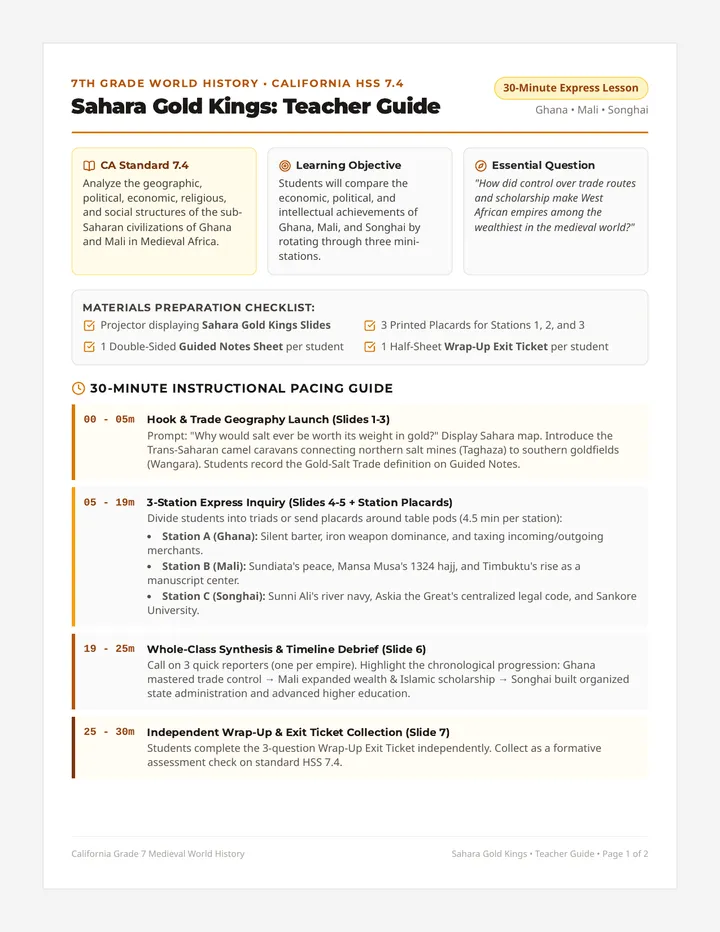
Grade: 7th Grade
Time: 30 Minutes
Subject: World History / Science
Why This Lesson?
This lesson makes abstract historical and scientific concepts tangible and memorable. By simulating mummification with everyday materials, students will gain a deeper understanding of ancient Egyptian practices and the science of preservation through dehydration.
Learning Objective
Students will be able to describe the key steps of ancient Egyptian mummification and explain the scientific principles of preservation through dehydration by observing a hands-on carrot mummification model.
Materials Needed
One large carrot per group
Salt (iodized or non-iodized)
Baking soda
Measuring cups and spoons
Plastic containers or zip-top bags
Labels or masking tape
Carrot Mummification Activity Sheets
Mummified Carrot Cool-Down Sheets
Prep Checklist
Time Required: 20 minutes
Review Materials: Familiarize yourself with the slide deck, script, and activity sheets.Carrot Prep: Purchase and slice large carrots (1-inch thick) for each group.Station Setup: Organize salt, baking soda, and measuring tools at group stations.Tech Check: Ensure slide deck and projector are ready.
Lesson Sequence
5 min
Introduction & Hook
Engage students by asking what they know about ancient Egypt, pyramids, and mummies. Use the slide deck to introduce the topic.
"What can a carrot teach us about ancient Egypt and the science of preservation?"
5 min
Why Mummify?
Discuss the Egyptian belief in the afterlife and the necessity of body preservation for the soul (Ka and Ba). Explain the 70-day ritual and the use of natron salt.
5 min
Our Model: Carrots!
Explain why carrots are a good model (water content, accessibility). Introduce the salt and baking soda mixture as our "natron."
10 min
Hands-On Activity
Students work in groups to measure their mix, record initial observations of their carrot slice, and "bury" it in the container. Emphasize the goal of complete dehydration.
5 min
Cool-Down & Review
Students complete the reflection sheet. Remind them they will check results in a few days.
💡 Follow-Up Note
In 3-7 days, have students revisit their containers. They should remove the carrots, brush off the salt mixture, and re-observe. Discuss the loss of volume, color changes, and hardness as indicators of successful dehydration.
Carrot Mummies Slides Carrot Mummies
A Salty Secret
7th Grade Ancient History
Welcome students. Ask what they know about Ancient Egypt - steer towards pyramids and mummies.
Ancient Egypt
1 Who were they?
A civilization along the Nile River, known for pharaohs, pyramids, and unique beliefs.
2 What is Mummification?
The process of preserving a deceased body to prevent decay.
Why Mummify?
The Afterlife
Egyptians believed the body was needed for the soul (Ka and Ba) to live on.
Eternal Existence
Preventing decay ensured the soul's journey would never end.
70-Day Ritual
It wasn't a quick process; it was a long, complex, and sacred ritual.
The Ancient Process
1
Organ Removal: Internal organs were removed (except the heart).
2
Drying with Natron: The body was covered in salt to remove moisture.
3
Wrapping: The dried body was wrapped in linen bandages.
4
Rituals & Burial: Placed in a sarcophagus with grave goods.
🥕
Why Carrots?
High water content (just like us!)
Safe and easy to observe
Shows dehydration clearly
Our "Natron" Mix:
SALT
BAKING SODA
Your Mission
Work in groups to prepare a carrot slice and bury it in our dehydration mix.
The Goal:
To remove all the water!
Observe and record changes over the next few days.
Let's Get Mummifying!
1
Initial Observations
Record how it looks, feels, and smells.
2
Prepare "Natron" Mix
Measure salt and baking soda carefully.
3
Bury the Carrot
Ensure it is fully covered by the mix.
Don't Forget!
Label your container with your group name and the date.
What did we learn?
1. Ancient Egyptians preserved bodies for the afterlife.
2. Dehydration was the key step.
3. Our carrot models this ancient science.
We'll check on our mummies soon!
Carrot Mummies Script Teacher Script
Carrot Mummies: A Salty Secret
Intro & Hook Slide 1
"Good morning/afternoon class! Take a look at our title slide today. It says, 'Carrot Mummies: A Salty Secret.' What comes to mind when you hear 'mummies'? Where in the world might we find mummies?"
Pause for student responses, guiding towards Ancient Egypt.
"Excellent! Many of you are thinking about Ancient Egypt, and you're absolutely right. Ancient Egypt was a fascinating civilization, known for many things, but perhaps one of the most intriguing is their practice of mummification. But... what does a carrot have to do with any of this? That's our secret for today!"
Why Mummify? Slides 2-4
Slide 3 Transition:
"So, why did the ancient Egyptians go through such an elaborate and lengthy process to preserve their dead? It all comes down to their beliefs about the afterlife. They believed that for a person's soul to continue its journey in the afterlife, the body needed to be preserved. It was literally their ticket to eternity."
Slide 4 Transition:
"The process itself was quite complex, taking up to 70 days! In a very simplified way, it involved removing internal organs (except the heart), drying the body out using a special salt called natron, and then carefully wrapping it in linen bandages. The goal was to remove all moisture from the body, because moisture leads to decay."
Activity Intro Slides 5-6
"Now, we won't be using any ancient pharaohs for our experiment, but we can learn a lot from a carrot! Carrots, like all living things, contain a lot of water. Our goal, just like the ancient Egyptians, will be to remove that water. We'll be using a mixture of salt and baking soda as our modern-day 'natron' to dehydrate our carrot slices."
Hands-On Activity Slide 7
"You each have an Activity sheet. Please follow the instructions carefully within your groups. Each group should have a pre-sliced carrot, some salt, baking soda, a container, and a label."
"First, on your activity sheet, make some initial observations about your carrot slice. What does it look, feel, and smell like?"
"Next, you will create your 'natron' mixture. Measure out the salt and baking soda as instructed on your sheet. Remember, accuracy is important in science!"
"Once your mixture is ready, you will 'bury' your carrot slice. Make sure it's completely covered. The more contact with the drying mixture, the better our mummification will work!"
Cool-Down Slide 8
"Fantastic work, everyone! You've just begun a scientific experiment that mirrors a historical practice. For our cool-down today, please take out your reflection sheet. What do you predict will happen to your carrot? Remember, the key to mummification is dehydration – removing the water. We'll explore the results of our experiment soon. Great job today!"
Carrot Mummies Activity Sheet Field Notes: Carrot Mummification
Name: ____________________________
Group: ____________________________
Date: ____________
Expedition Overview
Today, we are acting as ancient Egyptian embalmers! Ancient Egyptians used a special salt called natron to dry out bodies and preserve them for the afterlife. Our experiment uses a mixture of salt and baking soda to see how effectively we can remove water from a carrot, mirroring this ancient process of dehydration .
1 Initial Observations
Examine your carrot slice carefully before starting the mummification process.
Appearance (Color, Texture, Blemishes):
Dimensions (Length, Width, Thickness):
Feel (Firm, Soft, Wet, Dry):
Smell (Does it have a distinct scent?):
2 Prepare "Natron" Mix
Measure 1/2 cup of Salt .
Measure 1/2 cup of Baking Soda .
Mix thoroughly in your container.
3 Bury Your Carrot
Place a layer of mix at the bottom.
Place the carrot slice inside.
Completely cover the carrot with mix.
Researcher Prediction
Based on what you know about ancient Egypt and dehydration, what do you predict will happen to your carrot slice over the next few days? Why?
Keep your container sealed and labeled. We will revisit these specimens in a few days.
Carrot Mummies Cool Down Cool Down
Reflections on Ancient Preservation
Name: ____________________________
Date: ____________
What was the main purpose of ancient Egyptian mummification, according to their beliefs about the soul and the afterlife?
What was the most important scientific step in the mummification process, both for humans in ancient Egypt and for our carrots? (Hint: Think about water!)
How does our carrot mummification experiment help you understand the ancient Egyptian process better than just reading about it?
What is one question you still have about ancient Egyptian mummification or our experiment?