Ancient Echoes Lesson Plan Ancient Echoes
Expedition Lesson Plan
TIME: 15 Minutes
AUDIENCE: 7th Grade
The Mission
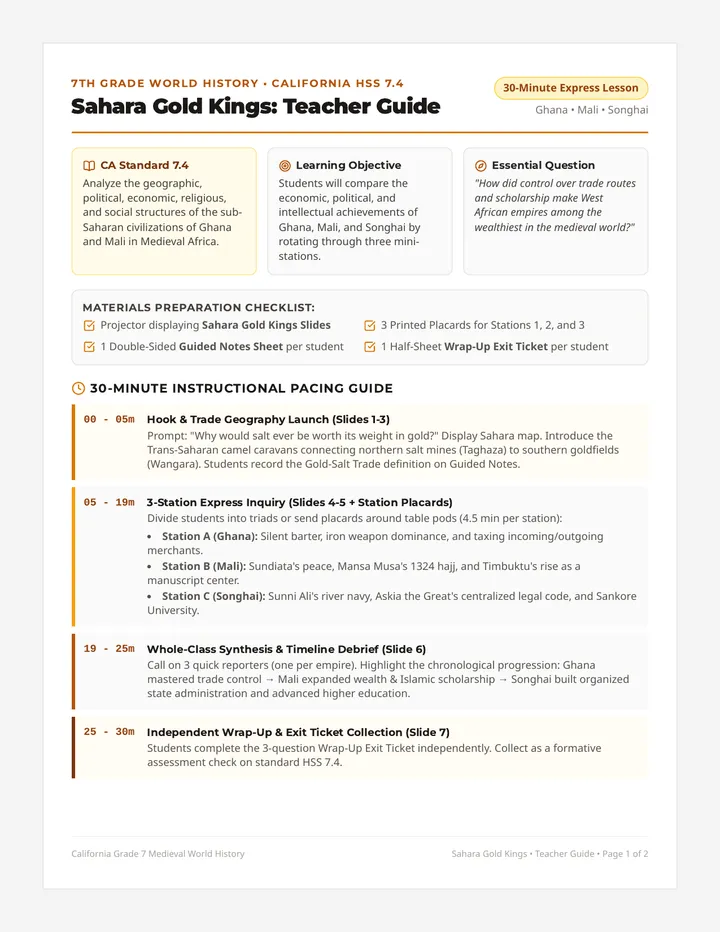
Students will explore the history and culture of ancient Egypt and Mesopotamia through selected texts to enhance reading skills and historical snapshot knowledge.
Objective
Understand the foundational contributions and cultural contexts of ancient civilizations.
The Cache
Ancient Echoes Reading Text
Cradle of Culture Slides
Civilization Talk Guide
History Pulse Quiz & Key
Intro Video (Provided Link)
Expedition Phases Pacing: 15 Minutes
Introduction & Video
Introduce Egypt and Mesopotamia as "cradles of civilization."
Show the "Who Am I?" video to spark thought on identity and change.
Distribute Ancient Echoes Reading ; have students skim for key historical points.
|
| 5 MINS |
Deep Dive Discussion
Use the Civilization Talk Guide to facilitate class discussion.
Focus on contributions to modern society (architecture, writing, law).
Encourage immediate insights from the reading.
|
| 3 MINS |
History Pulse Quiz
Distribute the quiz for individual completion. This is a quick pulse-check on comprehension.
|
| 2 MINS |
Closure & Debrief
Review key points. Address any "burning questions" and provide instant feedback on quiz answers using the key.
|
Facilitation Tip
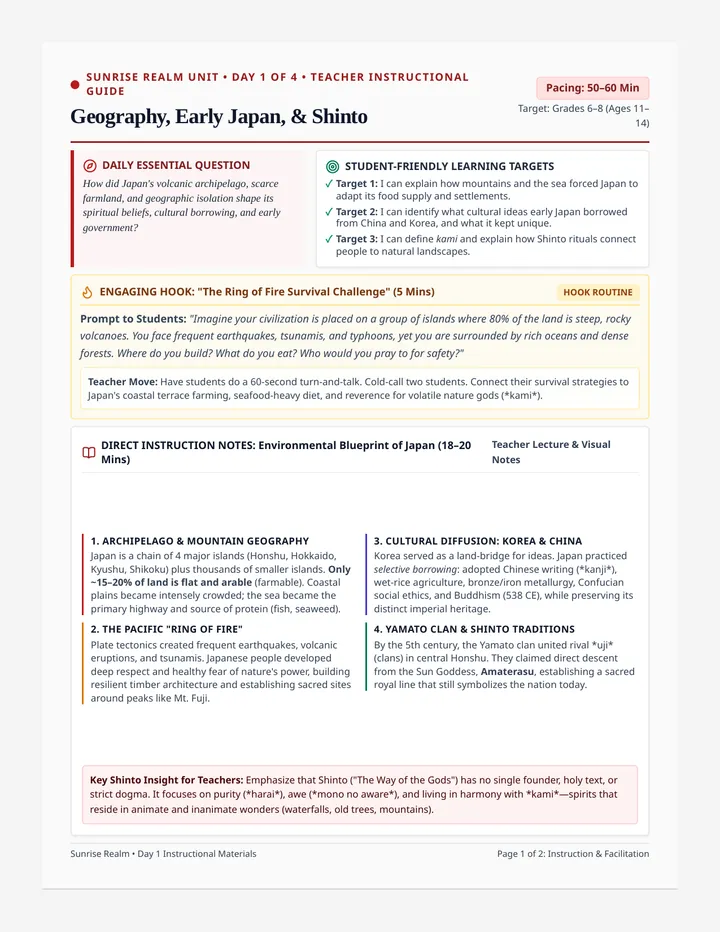
Since this is a high-speed lesson, keep the energy high! Use the "Skim and Scan" technique for the reading to ensure students find key facts quickly without getting bogged down in every word.
Ancient Echoes Reading Document Ancient Echoes
A Field Guide to the Cradles of Civilization
Mesopotamia
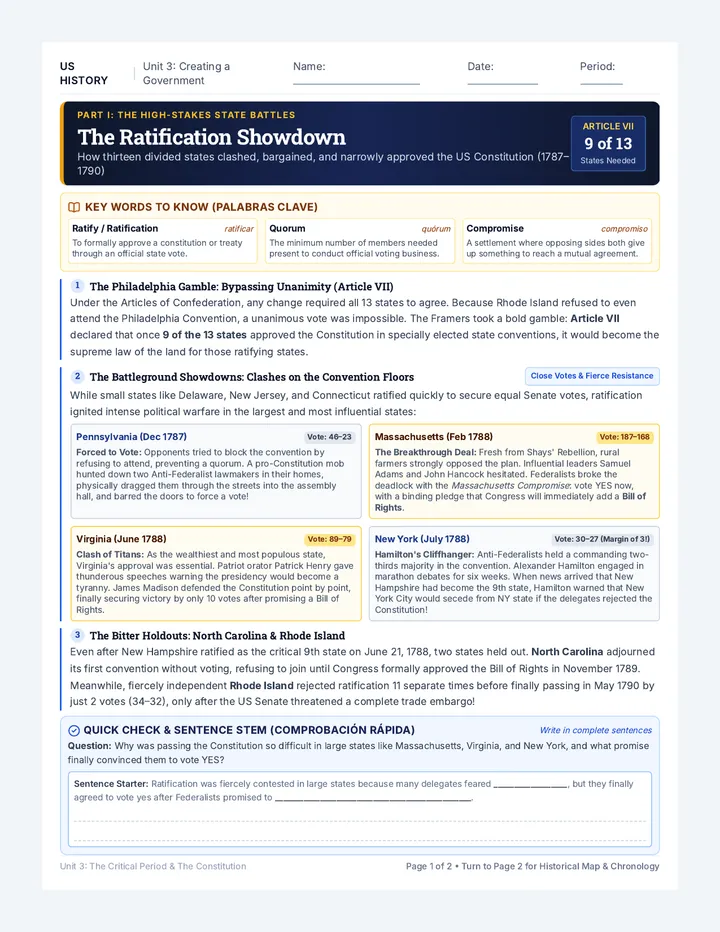
Nestled between the Tigris and Euphrates rivers, Mesopotamia is often called the "Cradle of Civilization." This region, located in modern-day Iraq, saw the rise of the world's first cities.
Writing the Future
The Sumerians developed cuneiform—one of the earliest writing systems. Using wedge-shaped marks on clay tablets, they recorded laws, stories, and trade.
Skyward Temples
At the heart of their cities stood Ziggurats, massive tiered structures that served as religious centers. These "mountains of the gods" dominated the flat landscape.
Ancient Egypt
While Mesopotamia grew in the river valleys, Egypt flourished along the banks of the Nile. The river provided life-giving water and fertile soil in the middle of a vast desert.
Stone Sentinels
The Egyptians were master architects. They built the Pyramids as grand tombs for their Pharaohs, demonstrating incredible knowledge of math and engineering.
Sacred Signs
Instead of clay, Egyptians used hieroglyphics—a complex system of symbols and pictures—often carved into stone or written on papyrus made from river reeds.
Field Vocabulary
Civilization
A complex society with cities, government, and specialized workers.
Irrigation
A system for supplying water to crops to help them grow.
Pharaoh
The title used for the powerful rulers of ancient Egypt.
Archival Record No. 2026-AE — For Educational Use Only
Ancient Echoes Slides Presentation Ancient Echoes
Exploring the Cradles of Civilization: Egypt & Mesopotamia
Who Am I?
Before we look back thousands of years, think about identity.
"How do civilizations define themselves? Does their identity change over time, or do certain 'echoes' remain forever?"
Video Presentation
A Philosophical Inquiry
Teacher: Play the linked video from your lesson plan here.
Mesopotamia
"The Land Between Rivers"
Cuneiform
The world's first writing system. Wedge-shaped marks on clay tablets.
Ziggurats
Massive temples built to bridge the gap between earth and the gods.
Urban Centers
The birth of organized city-states with complex laws and trade.
Ancient Egypt
"Gift of the Nile"
Monumental Architecture
The Pyramids: Eternal tombs for Pharaohs, built with precision engineering.
Hieroglyphics
A sacred system of writing using symbols and pictograms.
Why the Nile?
Every year, the Nile flooded predictably, leaving behind rich silt that allowed a surplus of food and the growth of an empire.
Ready to explore?
1. Skim the Reading Document
2. Prepare for the Discussion
3. Take the History Pulse Quiz
Civilization Talk Guide Civilization Talk Guide
Facilitator's Script & Discussion Prompts
Material ID: CTG-01
Time Check: 5 Minutes
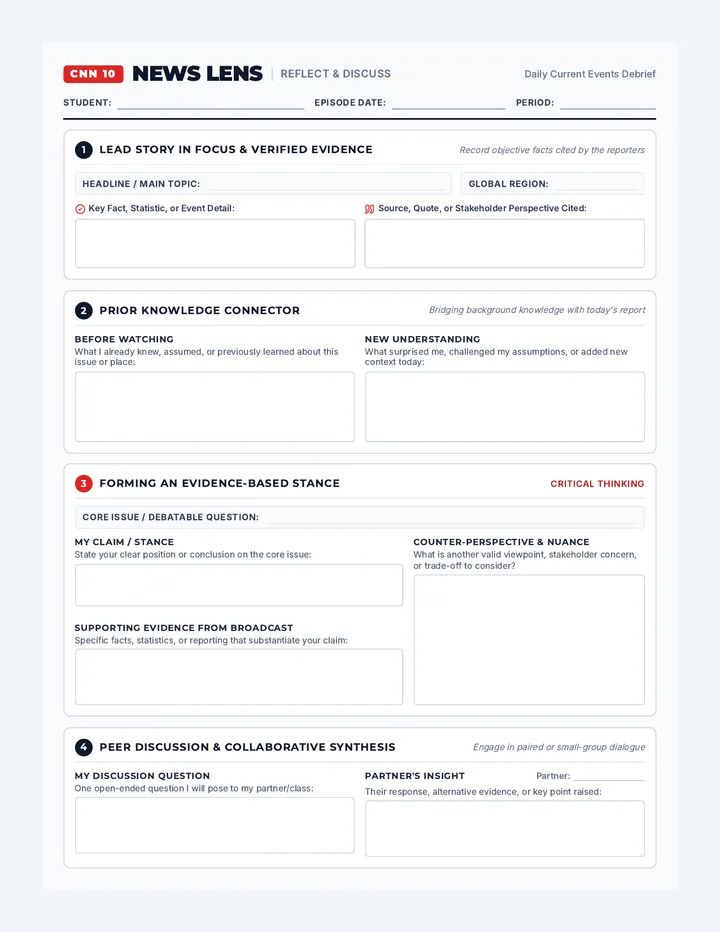
This discussion is designed to be a rapid-fire exploration of student insights following their skimming of the "Ancient Echoes" reading document.
1
What are some key contributions of ancient Egypt to modern society?
Architecture Massive scale, geometry, engineering precision (Pyramids).
Writing Systems Hieroglyphics, recording history, religious texts.
Governance Centralized power (Pharaohs), bureaucracy, religious integration.
Teacher Notes / Observations
2
In what ways did the geography of Mesopotamia (the "Land Between Rivers") influence its development compared to Egypt?
• Mesopotamia: Unpredictable flooding led to a focus on irrigation and wall-building; city-states were often at war.
• Egypt: Predictable Nile floods created a sense of order and stability; desert borders provided natural protection.
Teacher Notes / Observations
Facilitation Hacks
THE COLD CALL
Since time is short, don't wait for hands. Ask: "Avery, what was one thing that surprised you about the pyramids?"
THE PIVOT
If students focus only on buildings, pivot to writing: "Architecture is huge, but how did they keep track of who owned what?"
History Pulse Quiz History Pulse Quiz
Ancient Echoes: Egypt & Mesopotamia
Name:
Date:
Select the best answer for each question based on today's reading and discussion.
1. Which civilization is known for the development of cuneiform writing?
Egypt
Mesopotamia
Greece
China
2. What was the primary purpose of a Ziggurat in Mesopotamian cities?
A marketplace for trading grain and livestock
A massive tomb built to protect the Pharaoh's body
A tiered religious structure serving as a temple
A defensive wall to keep out invading armies
3. Which geographic feature was most essential to the survival and stability of Ancient Egypt?
The Sahara Desert
The Nile River
The Taurus Mountains
The Persian Gulf
4. Briefly describe one way these ancient civilizations have influenced the modern world.
Ancient Echoes Module — Expedition Assessment
History Pulse Answer Key Answer Key
History Pulse Quiz: Ancient Echoes
Teacher Copy
Assessment Overview
Total Points: 10 Points
Questions 1-3: 2 points each
Question 4: 4 points
Difficulty: Tier 1 (Foundational)
Focus: Basic recall and conceptual connection from reading and discussion.
1
Which civilization is known for the development of cuneiform writing?
Mesopotamia
Note: Sumerians specifically developed this system in the Mesopotamian region.
2
What was the primary purpose of a Ziggurat in Mesopotamian cities?
A tiered religious structure serving as a temple
Note: Distinguish from pyramids, which were primarily tombs.
3
Which geographic feature was most essential to the survival and stability of Ancient Egypt?
The Nile River
Note: Students should connect the predictable flooding to agricultural surplus.
4
Briefly describe one way these ancient civilizations have influenced the modern world.
Acceptable Responses include:
Writing Systems: The shift from oral to recorded history/law.Engineering: Foundational math and architectural techniques used in large structures.Urbanization: The concept of organized cities and centralized government.Irrigation: Managing water resources for large-scale agriculture.
Internal Resource — Do Not Distribute to Students