Lenny.com
Explore
Create
ActivitiesNewMathEnglish Language ArtsScience & EngineeringSocial StudiesGlobal LanguagesHealth & Physical EducationSpecial EducationCounseling & Life SkillsArts & CreativityESL
Lenny.com
Lenny.com
Explore
Create
ActivitiesNewMathEnglish Language ArtsScience & EngineeringSocial StudiesGlobal LanguagesHealth & Physical EducationSpecial EducationCounseling & Life SkillsArts & CreativityESL
Lenny.com
Social StudiesSocial Studies PracticesLocation WordsMapsOrder EventsChronology and CausationEvaluating SourcesHistorical ThinkingGeography, Humans, & the EnvironmentAmerican Symbols and LandmarksCitiesStatesState CapitalsRegions of the United StatesGeographic SkillsPhysical GeographyHuman GeographyRegional GeographyGeography of AfricaGeography of AsiaGeography of EuropeGeography of OceaniaGeography of the AmericasSociety and Environment of EuropeSociety and Environment of AsiaSociety and Environment of The AmericasSociety and Environment of the Middle EastSociety and Environment of AfricaHistoryPrehistoryComparing Ancient River CivilizationsAncient MesopotamiaAncient Egypt and KushAncient South AsiaEarly ChinaGreeceRome and the Byzantine EmpireAncient World HistoryNative Peoples of North AmericaNative Peoples of Mesoamerica and South AmericaAfrican EmpiresMedieval AsiaMedieval EuropeThe Silk RoadMedieval HistoryIslamic EmpiresWorld ReligionsRenaissance PeriodAge of ExplorationThe Thirteen ColoniesThe American RevolutionUS History Early RepublicFounding of the United StatesUS History AntebellumUS Civil WarReconstruction PeriodThe Gilded AgeUS ImperialismWorld ImperialismWorld War IUS History 1920sGreat DepressionWorld War IIThe Cold WarUS History 1950-60sUS History 1960s-70sWorld History 20th CenturyContemporary US HistoryContemporary World HistoryHolidaysCivics and GovernmentCitizenshipGovernment FoundationsThe ConstitutionUS ConstitutionExecutive BranchLegislative BranchJudicial BranchState and LocalPolitical ParticipationPublic PolicyPolitical SystemsPower and AuthoritySocial MovementsDefining DevianceTheories of DevianceCrime and Criminal JusticeEconomicsBasic Economic PrinciplesSupply and DemandWhat is MoneyEconomic FundamentalsMicroeconomicsMacroeconomicsBanking and FinanceEconomic SystemsGlobal EconomicsCorporations and PowerThe Changing WorkplaceUnemployment and LaborClass and InequalitySocial MobilityGlobal InequalityPsychologyHistory of PsychologyPsychology as a ScienceBrain and Nervous SystemNeuroscience and BehaviorGenetics and BehaviorSleep and ConsciousnessSensory ProcessesPerceptual OrganizationClassical ConditioningOperant ConditioningObservational LearningCognitive LearningMemory ProcessesThinking and Problem SolvingLanguage and CognitionTheories of MotivationStress and CopingPrenatal and Infant DevelopmentChildhood DevelopmentAdolescent DevelopmentAdulthood and AgingSelf and IdentitySocial CognitionSocial InfluenceAttraction and RelationshipsGroup BehaviorPrejudice and DiscriminationAnxiety and Mood DisordersClinical PsychologyForensic PsychologyPhilosophy & EthicsIntroduction to PhilosophyMajor Philosophers & IdeasMind and Body ProblemFree Will vs DeterminismEthics & MoralityReligion & PhilosophyPolitical Philosophy
Lenny.com

Solutions

Lenny for EducatorsLenny for SchoolsLenny for Districts

Product

ExploreSign inCreateSupportAbout

Resources

Getting startedMTSS Acceleration Program

© 2026 Lenny Learning Inc.

TermsPrivacyAccessibility
LinkedInInstagramX
Lenny

Public Policy

Processes of identifying societal problems, formulating solutions, and implementing legislative frameworks. Analyzes the influence of interest groups, public opinion, and research on local and national decision-making.

Videos

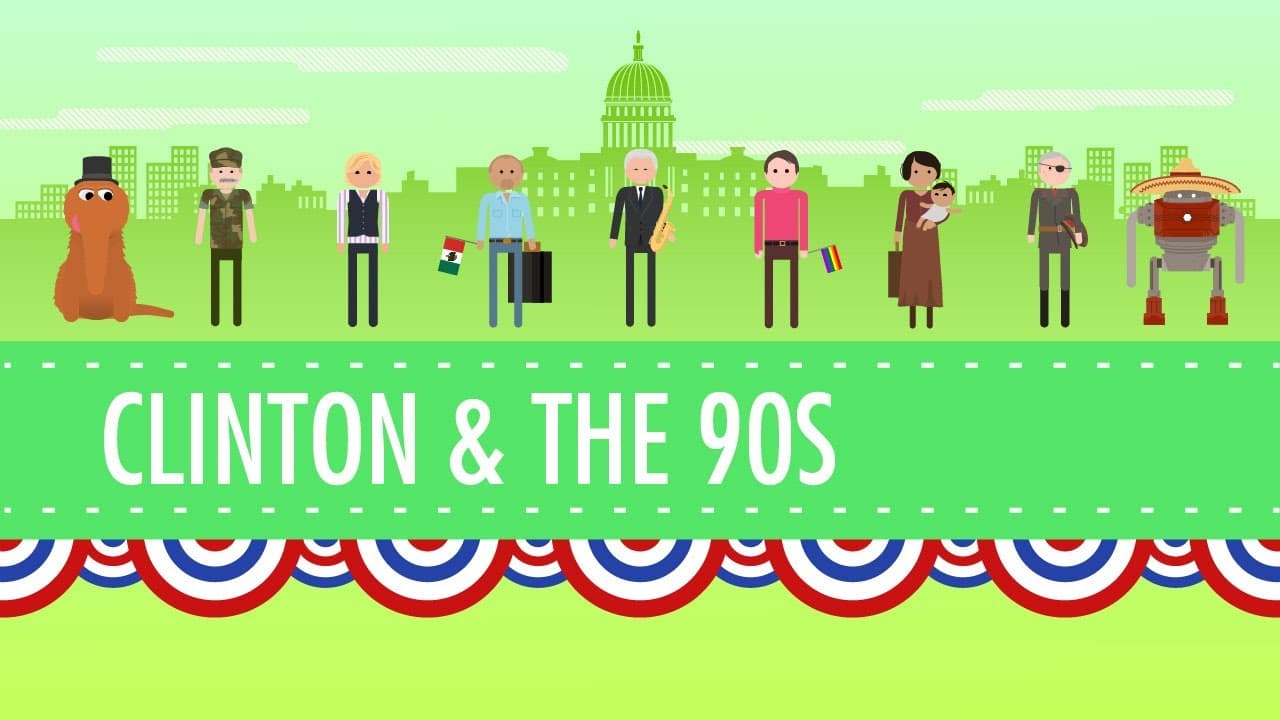
Exploring the Clinton Presidency and the 1990s

Exploring the Clinton Presidency and the 1990s

In this episode of Crash Course US History, John Green explores the 1990s and the presidency of Bill Clinton. The video covers the complex domestic and foreign landscape of the decade, from the booming economy fueled by the tech revolution and the internet to the dark failures of international intervention in Rwanda and the Balkans. It examines Clinton's political strategy of 'triangulation,' his battles with a Republican-led Congress under Newt Gingrich, and the eventual scandal and impeachment that marred his second term. The content delves into key themes such as globalization, the rise of the 'New Democrat,' and the intensifying culture wars of the late 20th century. It breaks down significant policy shifts like welfare reform, the 'Don't Ask, Don't Tell' military policy, and the controversial 1994 Crime Bill that led to mass incarceration. The video also highlights the demographic shifts in America due to immigration reform and the widening economic gap despite overall prosperity. For educators, this video serves as an excellent synthesis of modern American history, connecting political decisions to long-term societal trends. It provides opportunities to discuss the role of the US in post-Cold War geopolitics, the impact of technology on the economy, and the polarization of American politics. The video handles sensitive topics like the Monica Lewinsky scandal and the Rwandan genocide with historical context, making it a robust resource for high school US History and Civics classrooms.

CrashCourseCrashCourse

15mins 38s

Course Preview: Intellectual Property and Economics

Course Preview: Intellectual Property and Economics

In this channel update and course preview, host John Green announces the conclusion of the World History series and introduces two upcoming courses: Intellectual Property and Economics. The video serves as a transition point for the channel, explaining the shift in hosts and topics for the coming season. The video outlines the scope of the new series. First, it introduces a mini-series on Intellectual Property and Copyright Law hosted by Stan Muller, emphasizing its relevance to creators and internet users. Second, it previews Crash Course Economics, hosted by Adriene Hill and Jacob Clifford, with Green humorously highlighting the complexity of discussing capitalism's pros and cons. Finally, Green discusses his temporary departure to focus on writing a book. While primarily an announcement, this video acts as an excellent 'hook' or syllabus introduction for teachers starting units on Economics, Civics, or Media Literacy. It helps set expectations for students, introduces the new instructors, and briefly touches on the 'why' behind studying intellectual property and economic systems, sparking initial curiosity.

CrashCourseCrashCourse

1min 56s

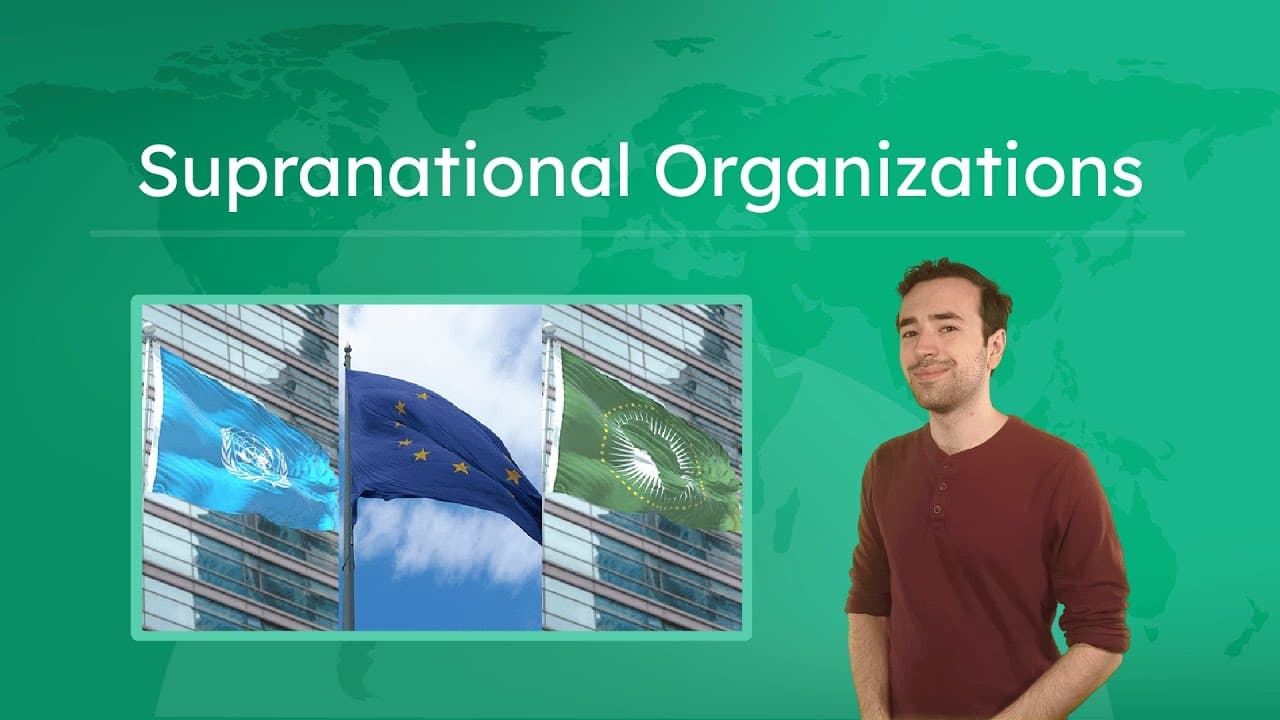
Global Teamwork: Exploring Supranational Organizations

Global Teamwork: Exploring Supranational Organizations

This educational video provides a comprehensive introduction to supranational organizations, exploring how and why independent states choose to cooperate on a global scale. Hosted by a narrator named Justin, the video takes students on a virtual "tour" of three major organizations: the United Nations (UN), the European Union (EU), and the African Union (AU). It defines what a supranational organization is and examines the three primary types of cooperation fostered by these groups: political, economic, and environmental. The video delves into complex geopolitical concepts such as national sovereignty, diplomacy, and the long-term impacts of colonialism. It uses specific real-world examples to illustrate abstract ideas, including the Paris Agreement for environmental standards, the Schengen Agreement for open borders in Europe, the Euro as a common currency, and the AU's peacekeeping mission in Somalia. The narrative critically examines the trade-offs of membership, specifically why states surrender some of their sovereignty to gain the benefits of collective security and economic strength. For educators, this video serves as an excellent anchor for units on World Geography, Civics, or Global Studies. It simplifies high-level political science concepts into accessible terms using clear visuals and maps. The content naturally leads to classroom discussions about current events, the balance between national independence and global interdependence, and the challenges nations face when trying to solve problems that cross borders, such as climate change and war.
Miacademy & MiaPrep Learning ChannelMiacademy & MiaPrep Learning Channel

11mins 28s

What Are Public Goods and Why Do We Need Them?

What Are Public Goods and Why Do We Need Them?

This video provides a clear and engaging introduction to the economic concept of public goods, using the fictional town of Marketville to illustrate the challenges of market failures. Through the example of missing streetlights, the narrator explains the two defining characteristics of public goods: non-excludability and non-rivalry. The video breaks down these complex terms with relatable examples, demonstrating why private markets often fail to provide these essential services and why governments typically step in to fill the gap. The content explores both the benefits and drawbacks of public goods. It highlights positive externalities like public health, environmental protection, and community building, while also addressing challenges such as funding through unpopular taxes, the potential for overuse (Tragedy of the Commons), and maintenance issues. The narrator encourages viewers to think critically about how political decisions and budget cuts affect the availability of these resources in their own communities. Ideal for high school economics and civics classrooms, this video addresses the "Free Rider Problem" and the concept of underprovision. It serves as an excellent foundation for lessons on government spending, tax policy, and civic responsibility, helping students understand the balance between individual costs and collective benefits in a society.

Miacademy & MiaPrep Learning ChannelMiacademy & MiaPrep Learning Channel

10mins 48s

How Lobbying Influences Government and Laws

How Lobbying Influences Government and Laws

This educational video explores the complex world of lobbying in the United States government, breaking down how individuals and groups legally attempt to influence laws and public policy. It begins with the historical anecdote of Ulysses S. Grant in the Willard Hotel lobby to explain the term's origin before diving into the mechanics of modern influence. The narrator defines key concepts such as bribery, conflicts of interest, and the various organizational structures used to sway legislators, including Political Action Committees (PACs), advocacy groups, and special interest groups. A significant portion of the video is dedicated to the ethical gray areas surrounding money in politics. It introduces critical terms like "astroturfing"—the practice of masking the sponsors of a message to make it appear as a grassroots movement—and distinguishes between legitimate advocacy and potential corruption. The content contrasts the legal rights of groups to petition the government with the potential for financial resources to overshadow the will of ordinary constituents. For educators, this video serves as a vital tool for Civics and Government curricula. It encourages critical thinking by repeatedly pausing to ask students to evaluate the ethics of specific practices, such as whether elected officials should accept gifts or if PACs should be legal. It connects abstract political concepts to concrete examples like the ADL, AARP, and the Sierra Club, helping students understand the diverse ecosystem of political influence beyond just the ballot box.

Miacademy & MiaPrep Learning ChannelMiacademy & MiaPrep Learning Channel

12mins 21s

From Isolation to Intervention: How US Foreign Policy Changed After WWII

From Isolation to Intervention: How US Foreign Policy Changed After WWII

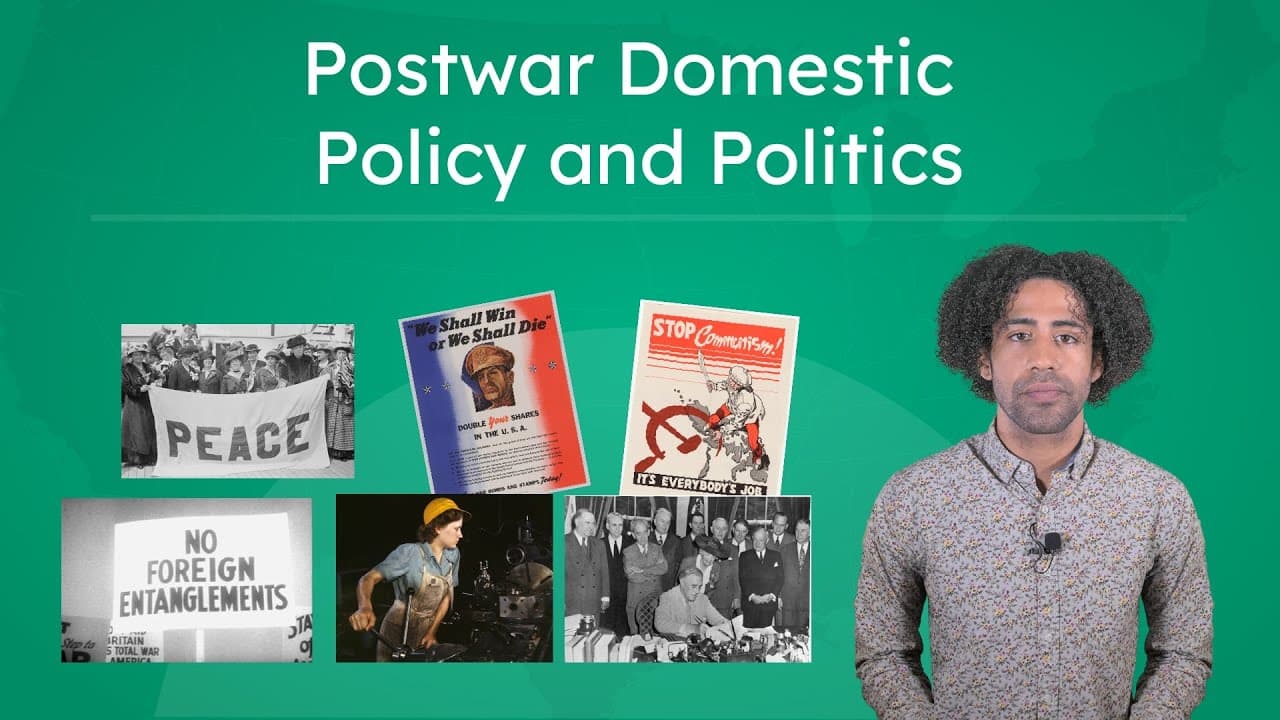
This educational video provides a comprehensive overview of the dramatic shift in United States domestic and foreign policy from the post-World War I era through the Cold War. It explores how the United States transitioned from a nation favoring isolationism and a small peacetime military to a global superpower with an interventionist foreign policy and a large standing army. The narrator explains the historical context behind these changes, highlighting how public opinion evolved due to the devastation of global wars, the rise of communism, and the threat of nuclear annihilation.

Miacademy & MiaPrep Learning ChannelMiacademy & MiaPrep Learning Channel

10mins 59s

Materials

Policy Blueprint Graphic Organizer

Policy Blueprint Graphic Organizer

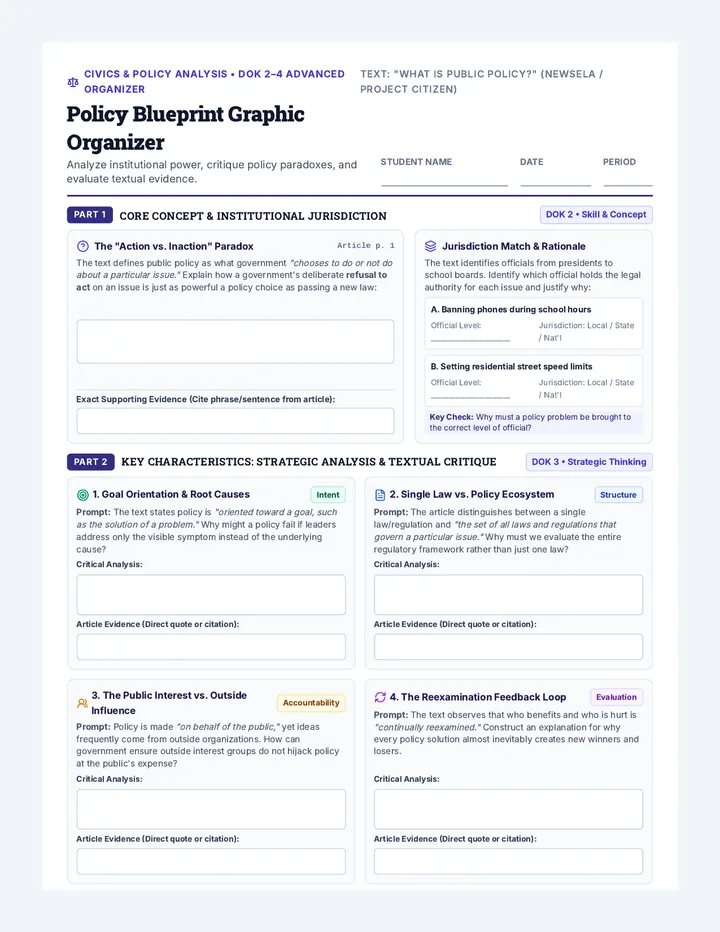
An elevated Depth-of-Knowledge (DOK 2-4) two-page graphic organizer for the Newsela public policy text, featuring jurisdiction analysis, critical policy paradoxes, stakeholder impact matrices, threshold evaluations, and strategic class deliberation prompts.

MQ

Melanie Quick

Democracy Design Project Guide

Democracy Design Project Guide

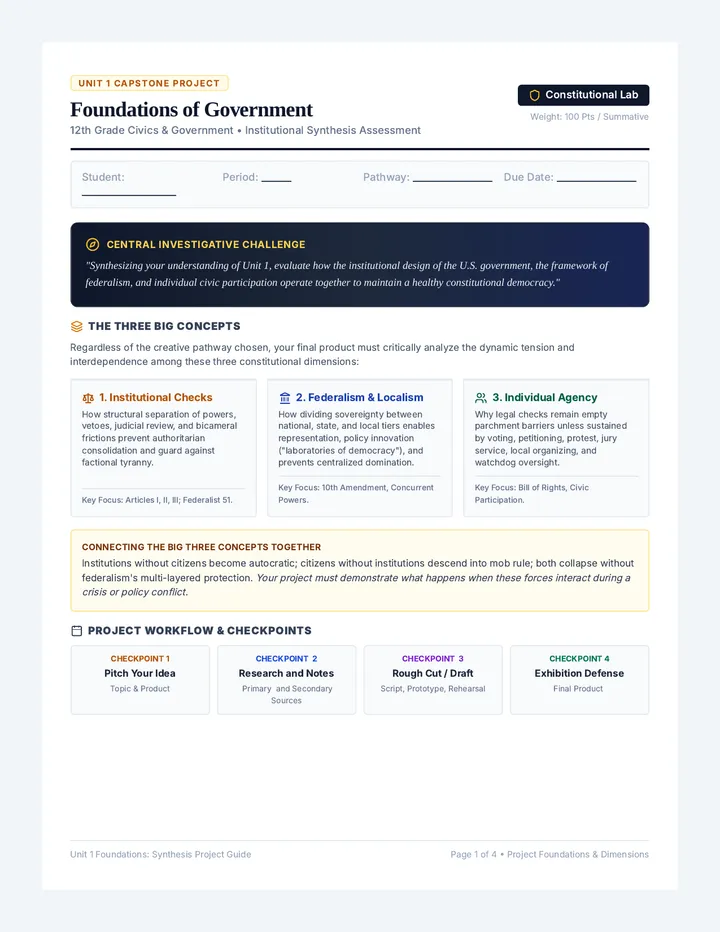
A comprehensive 4-page student project assignment guide for 12th-grade Civics and Government, detailing 5 creative project pathways (podcast, documentary, interview simulation, reader's theater drama, and board/card game), an analytical rubric across the three core constitutional dimensions, and a student planning blueprint.

JG

Joshua Griffith

Market Economy Seminar Ledger

Market Economy Seminar Ledger

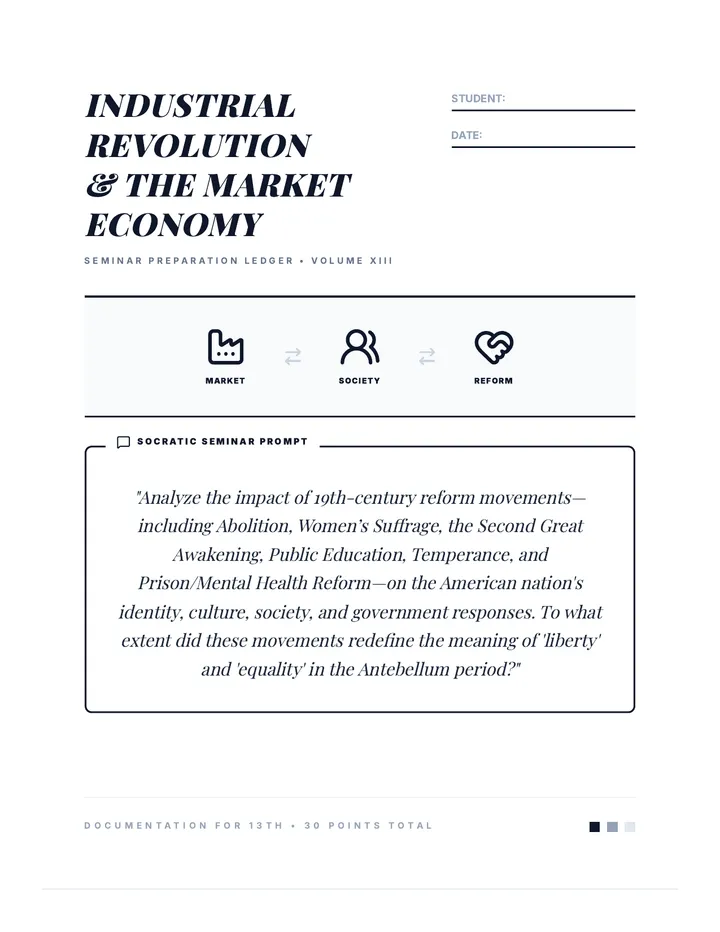
A detailed 5-page seminar preparation ledger for the Industrial Revolution and Market Economy lesson. Features a dedicated cover page with relevant historical icons and a prominent Socratic prompt, three separate article analysis pages, and a final synthesis evaluation. Writing lines are darkened for optimal print quality.

JG

Joshua Griffith

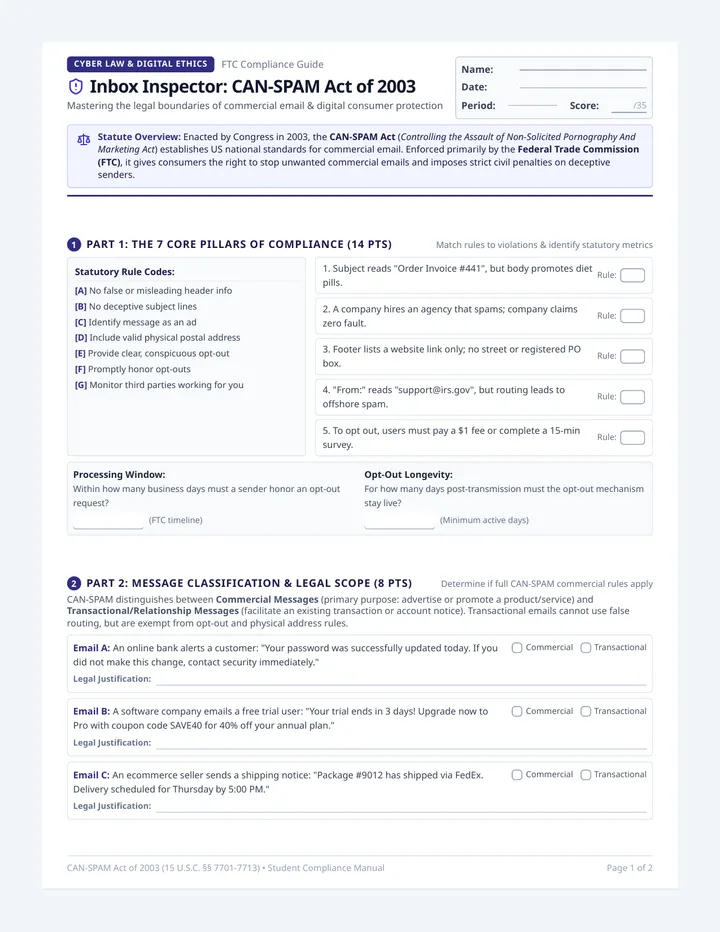
Inbox Inspector Worksheet

Inbox Inspector Worksheet

A comprehensive, print-ready 2-page worksheet on the CAN-SPAM Act of 2003. Covers the 7 core pillars of compliance, commercial vs. transactional message classification, an 'Inbox Inspector' email auditing activity, and an affiliate liability case study.

BM

Bruce Marshall

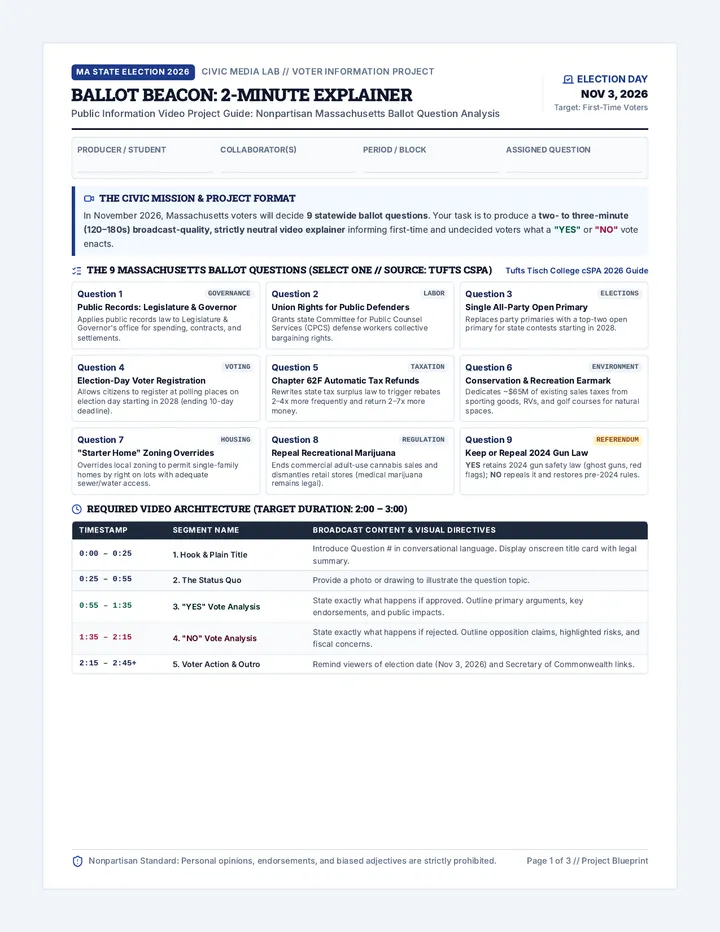
Ballot Beacon Project Guide

Ballot Beacon Project Guide

A comprehensive three-page guide for a Massachusetts 2026 ballot question explainer video project, fully updated with the official 9 ballot questions from the Tufts University Tisch College Center for State Policy Analysis (cSPA) 2026 guide. Includes directions, question menu, timed script blueprint, milestones, nonpartisan standards, submission checklist, and rubric.

K

kpitcher

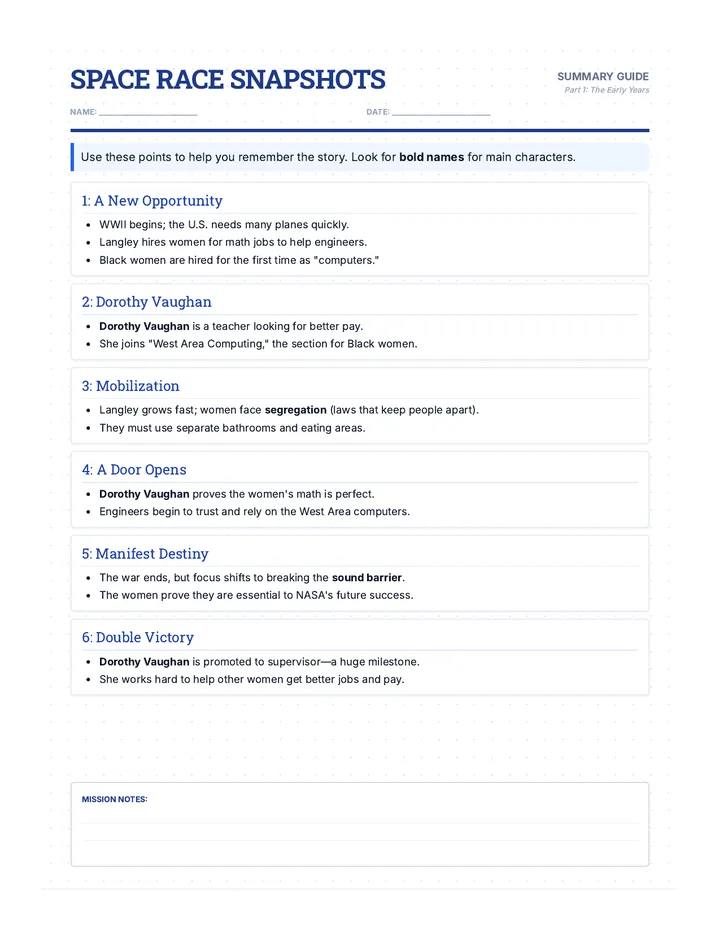
Space Race Snapshots Summary Guide

Space Race Snapshots Summary Guide

A four-page chapter-by-chapter summary guide for "Hidden Figures" (Young Readers Edition), designed specifically for struggling readers. It features bulleted main points, bolded character names, and a clean, high-contrast NASA-inspired layout to support comprehension and tracking of the narrative.

M

mattiea

Sequences

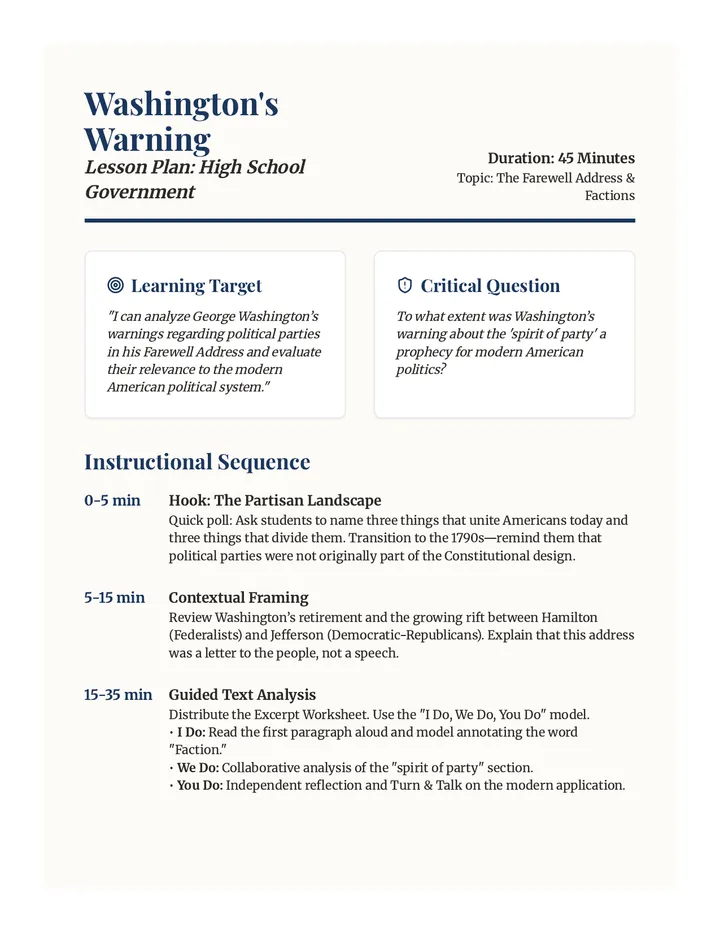
Washingtons Warning Lesson Plan

Washington's Farewell Legacy

A two-part sequence that takes students from a deep-dive analysis of George Washington's Farewell Address to a modern-day evaluation of his warnings regarding political parties, media bias, and national unity.

CE

Chelsea Elliott

24
Conflict Cards Activity

Century Crossroads

A comprehensive assessment sequence covering the pivotal moments of 20th-century US history, from the build-up to World War II through the height of the Cold War and the diverse Civil Rights movements.

AH

Ashley Hopf

16
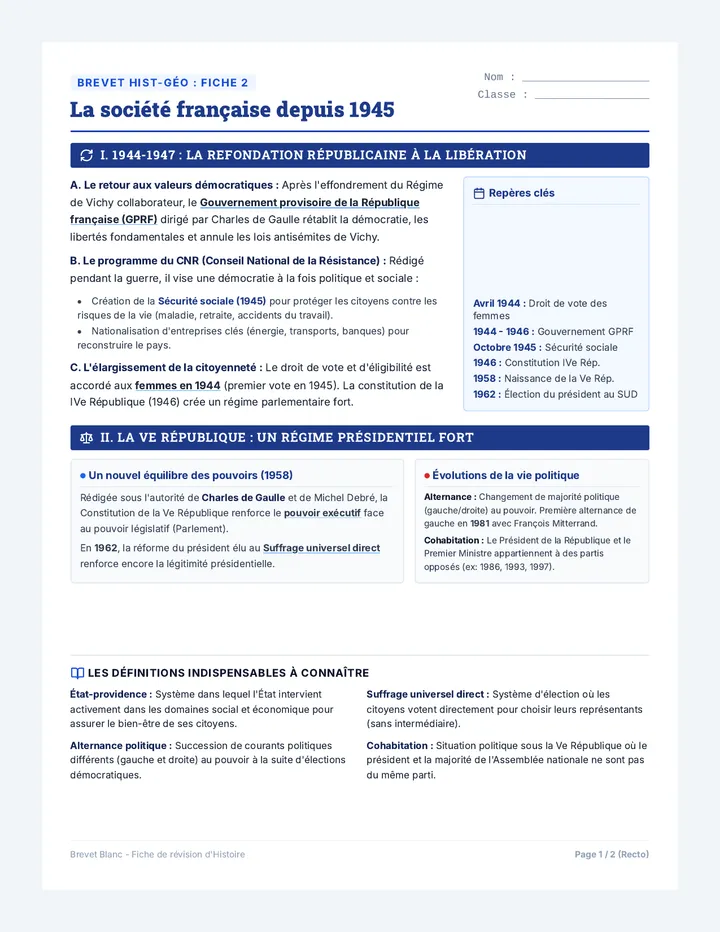
Societe Francaise Depuis 1945 Fiche

Brevet Fiches : Hist-Géo, EMC & Physique-Chimie

Une collection complète de fiches de révision classiques (recto-verso A4) très ciblées pour préparer les élèves de Troisième aux épreuves d'Histoire, de Géographie, d'EMC et de Physique-Chimie du DNB. Chaque fiche traite d'une leçon précise des programmes officiels.

MW

Myriam Wb

16
Reconstruction Reckoning Worksheet

Modern America

A comprehensive journey through United States history from the aftermath of the Civil War to the contemporary era, exploring the social, political, and economic shifts that shaped the modern nation.

DP

Darren Polamalu

18
Mobilization Intro Slides

Global Conflict WWII

A comprehensive 2-day unit covering World War II for 11th Grade US History, aligned with TEKS. It focuses on the transition from isolationism to total war, the home front experience, major turning points in both the European and Pacific theaters, and the strategic decisions that ended the conflict.

BB

Bridgette Burdick

17
Era of Crisis Study Guide

Superpowers and Scandals

A comprehensive unit covering United States history from 1960 to 1980, focusing on the Cold War, domestic policy, and political scandals.

AH

Ashley Hopf

5

Lessons

History Sprint Pacing Guide

STAAR History Sprint

A comprehensive pacing guide and activity resource designed to cover the remaining 11th Grade US History TEKS before the STAAR test on April 16th. This lesson provides a day-by-day calendar for A/B block schedules and high-engagement activities for each remaining historical era.

BB

Bridgette Burdick

51
Modern Era Reader Part 1

The Modern Ledger

A comprehensive exploration of the 1990s through the modern day, covering technological shifts, political milestones, military conflicts, and cultural evolution in the United States.

CE

Chelsea Elliott

20
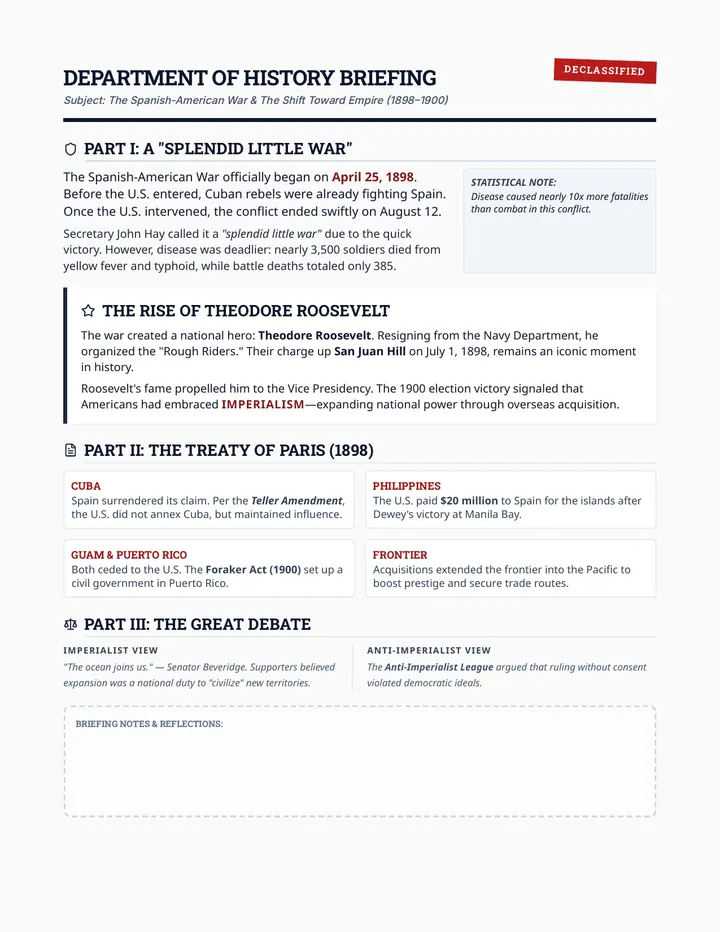
Imperial Shift Briefing Handout

Splendid Little War

This lesson explores the Spanish-American War, focusing on Theodore Roosevelt's rise, the Treaty of Paris, and the United States' transition from isolationism to an imperial power. Students will analyze the motives and arguments surrounding the annexation of the Philippines and other territories.

GE

Genevieve Eubanks

12
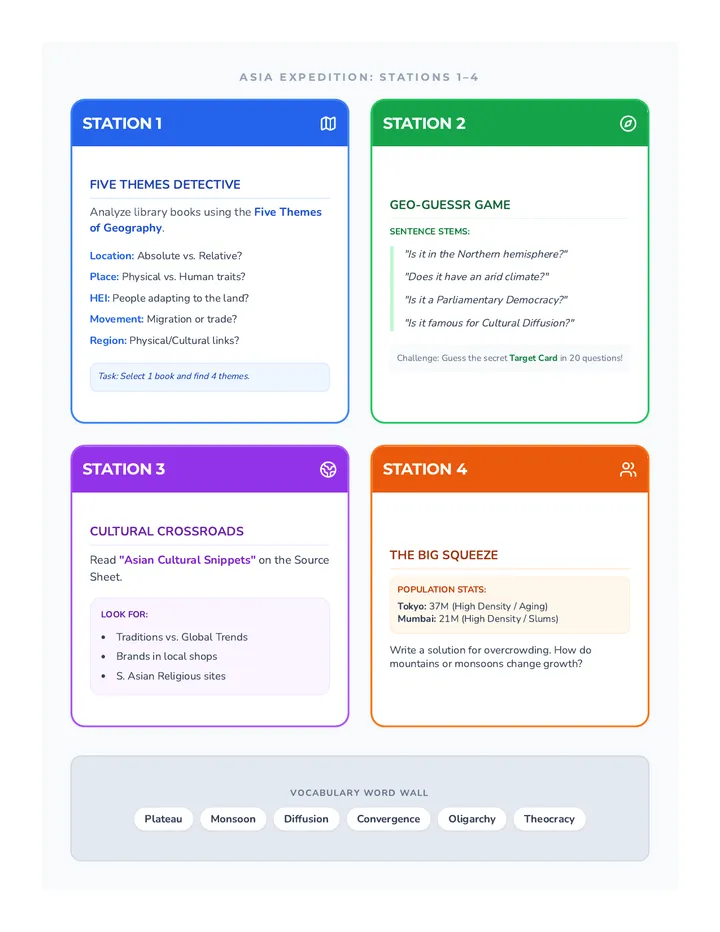
Asia Expedition Task Cards Resource

Asia Expedition Stations

A set of five interactive learning stations focused on the physical and cultural geography of Asia, including population challenges, globalization, and natural disasters. Students practice reading, writing, listening, and speaking skills while analyzing the five themes of geography.

JR

Jessica Ross

4
Choice Board Evaluation Key

Removal Rhetoric Analysis

A comprehensive analysis of Andrew Jackson's 1830 speech to Congress, focusing on how his perspective and purpose shaped the rhetoric used to justify the Indian Removal Act. Students will evaluate primary source excerpts through Think-Pair-Share and a Quiz Bee competition.

V

vivianbelarmino

7
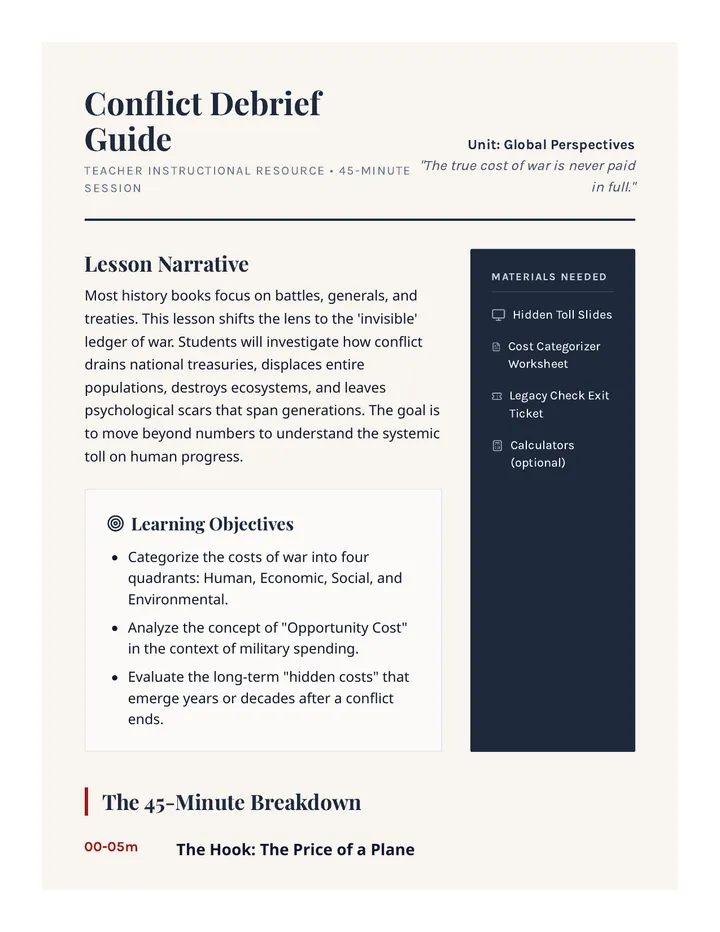
Conflict Debrief Guide

Price of Conflict

A comprehensive 45-minute exploration into the multifaceted impacts of armed conflict, covering human, economic, social, and environmental costs that persist long after the fighting stops.

KJ

Katia Jones

4