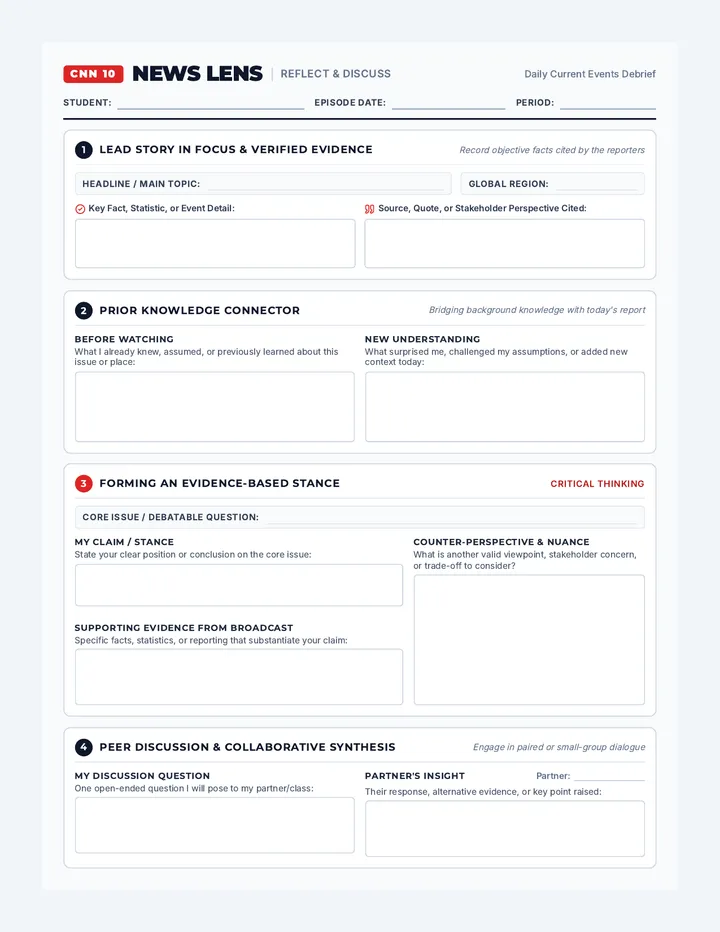
Policy Blueprint Graphic Organizer
Civics & Policy Analysis • DOK 2–4 Advanced Organizer Text: "What is public policy?" (Newsela / Project Citizen)
Policy Blueprint Graphic Organizer
Analyze institutional power, critique policy paradoxes, and evaluate textual evidence.
Student Name
Date
Period
Part 1
Core Concept & Institutional Jurisdiction
DOK 2 • Skill & Concept
The "Action vs. Inaction" Paradox Article p. 1
The text defines public policy as what government "chooses to do or not do about a particular issue." Explain how a government's deliberate refusal to act on an issue is just as powerful a policy choice as passing a new law:
Exact Supporting Evidence (Cite phrase/sentence from article):
Jurisdiction Match & Rationale
The text identifies officials from presidents to school boards. Identify which official holds the legal authority for each issue and justify why:
A. Banning phones during school hours
Official Level: ______________________ Jurisdiction: Local / State / Nat'l
B. Setting residential street speed limits
Official Level: ______________________ Jurisdiction: Local / State / Nat'l
Key Check: Why must a policy problem be brought to the correct level of official?
Part 2
Key Characteristics: Strategic Analysis & Textual Critique
DOK 3 • Strategic Thinking
1. Goal Orientation & Root Causes Intent
Prompt: The text states policy is "oriented toward a goal, such as the solution of a problem." Why might a policy fail if leaders address only the visible symptom instead of the underlying cause?
Critical Analysis:
Article Evidence (Direct quote or citation):
2. Single Law vs. Policy Ecosystem Structure
Prompt: The article distinguishes between a single law/regulation and "the set of all laws and regulations that govern a particular issue." Why must we evaluate the entire regulatory framework rather than just one law?
Critical Analysis:
Article Evidence (Direct quote or citation):
3. The Public Interest vs. Outside Influence Accountability
Prompt: Policy is made "on behalf of the public," yet ideas frequently come from outside organizations. How can government ensure outside interest groups do not hijack policy at the public's expense?
Critical Analysis:
Article Evidence (Direct quote or citation):
4. The Reexamination Feedback Loop Evaluation
Prompt: The text observes that who benefits and who is hurt is "continually reexamined." Construct an explanation for why every policy solution almost inevitably creates new winners and losers.
Critical Analysis:
Article Evidence (Direct quote or citation):
Page 1 of 2: High-Level Concepts & Textual Evidence Turn over for Threshold Evaluation & Whole-Class Deliberation →
Evaluative Thinking & Civic Deliberation Policy Blueprint Organizer • Page 2
Problem Thresholds & Deliberative Policy Inquiries
Part 3
The Public Policy Threshold Test
DOK 3 • Categorize & Justify
1 Private / Family Voluntary
Issues resolved through household negotiation, personal budget, or individual choices.
Boundary Condition:
Why should government NOT intervene in these issues?
2 Civic / NGO Community
Issues addressed by mutual aid, food banks, clubs, sports leagues, or charities.
Capacity Limit:
What limits do non-profits face when tackling large crises?
3 Public Policy Enforceable
Issues that must be resolved by binding laws, police powers, or state regulations.
The Threshold Criteria:
What makes legal enforcement necessary?
Case Classification Youth Hunger in Town Food pantry runs out of supplies every weekend.
At what point does this move from Level 2 (NGO) to Level 3 (Public Policy)? Justify:
Part 4
Whole-Class Deliberative Inquiries
DOK 3 • Strategic Reasoning & Argumentation
1
Dilemma of Intentional Inaction Text link: "chooses to do or not do"
When a city council chooses NOT to regulate artificial intelligence, e-bikes, or youth curfews, is inaction a sign of legislative failure, or can deliberate inaction protect citizen freedom? Formulate your argument with reasoning:
2
The Outside Pressure Pathway Text link: "ideas come from outside government"
Since government officials hold the formal voting power, what specific methods (e.g., ballot initiatives, student protests, coalition building) are most effective for youth or community members to force an issue onto the public agenda?
3
The "Zero-Sum" Policy Calculus Text link: "who will benefit... and who will be hurt"
The article states policymaking has no clear end because impacts are continually reexamined. Identify a real policy (e.g., plastic bag ban or zoning rules) and analyze: Who directly benefits? Who bears the burden? How should it be revised?
Part 5 DOK 4 • Extended Synthesis
The Policymaker's Litmus Test
Synthesize what you learned into one universal test: What 2 essential conditions must be met before government should pass a new regulation instead of letting private citizens solve it?
Page 2 of 2: Deliberative Inquiries & Extended Synthesis Prepare evidence-backed rebuttals for whole-class deliberation