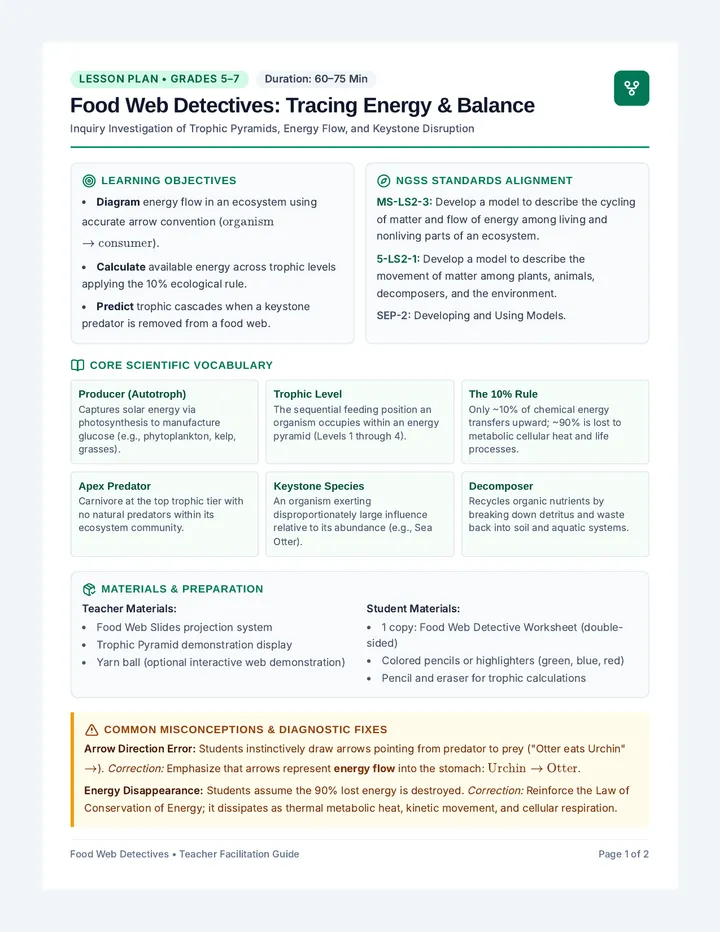
As a keystone predator, sea otters keep herbivorous sea urchin populations under control. In their absence, urchins undergo exponential growth and overconsume the giant kelp holdfasts. Because kelp serves as the primary producer and provides structural shelter, its loss eliminates habitats and food for dozens of other species, destroying the biodiversity of the entire ecosystem.
RECON GRADING INSTRUCTIONS
Assign 1 point per segment. To obtain the full reasoning score, students must outline the domino effect: predator loss → herbivore increase → producer overgrazing/destruction → complex habitat loss for other marine life.
Which biological factor acts as a **density-dependent** limiting factor on sea urchins inside an urchin barren?
CORRECT: (1) Intense competition for remaining kelp holdfasts
Rationale: As the urchin population expands and kelp resources plummet, the lack of food becomes a critical density-dependent limitation. Competition for scarce resources directly reduces individual growth and birth rates while increasing death rates.
DRILL B KEY TOPIC: MUTATION & NATURAL SELECTION
In colder Pacific waters, sea otters with a genetic mutation causing exceptionally dense, double-layered underfur are selected for... Explain how this environmental pressure drives natural selection:
EXEMPLARY RESPONSE:
The freezing water temperature acts as an environmental selection pressure. Otters with the dense fur mutation possess an adaptive advantage that lets them retain body heat and survive. These individuals are more likely to reach reproductive maturity and pass the adaptive fur genes to offspring, increasing the gene's frequency over generations.
Adaptation: The entire population gradually shifts to showcase these robust traits.
ECOLOGICAL SELECTION PRESSURE SLIDE 4 OF 4
SCORE:
Day 11
Blood Glucose Maintenance
Insulin & Glucagon
Map pancreatic hormones, glucose uptake, and glycogen pathways.
SCORE:
Day 12
Thermoregulation
Heat Balance
Analyze vasodilation, sweating, shivering, and hypothalamus signals.
SCORE:
Day 13
Endocrine & Nervous System Coordination
Signal Paths
Trace swift electrochemical vs. systemic chemical paths under stress.
SCORE:
Day 14
Feedback Systems Mock Drill
CRITICAL
Master body feedback graphs and complete practice sheet problems.
SCORE:
PHASE 4: EXPERIMENTAL DESIGN & SYSTEM TRADE-OFFS
DAYS 15 - 19
Day 15
Criteria vs. Constraints
Design Rules
Identify goals (criteria) vs. operational/budget limits (constraints).
SCORE:
Day 16
Variable Isolation & Control Setups
Valid Testing
Differentiate IV, DV, control groups, and constant factors.
SCORE:
Day 17
Biological & Environmental Trade-offs
Compromises
Evaluate positive impacts of solutions vs. negative environmental costs.
SCORE:
Day 18
Engineering Solution Appraisals
Appraisal Matrix
Analyze systematic data matrices to select and justify solutions.
SCORE:
Day 19
Simulated Exam
SIMULATION
A complete high-impact simulated exam covering all key domains.
SCORE:
8TH GRADE RECON SUPPORT: HOW TO CONQUER COMPLEX WORDING
1. Break Down the Words: Don't panic at big words like "vasoconstriction." Look at the root: vaso (vessel/tube) + constriction (squeezing tight). It just means blood tubes squeezing tight to stay warm! 2. Receptors & Shapes: Hormones are keys, receptors are locks. They MUST fit together to work. If a hormone is the wrong shape, the cell won't do anything!
REGENTS RECON // SECTION 1 PAGE 2 OF 2
3. REASONING (1 Pt - Must link biological processes): EXEMPLARY RESPONSE
The fire destroys photosynthetic leaves and foliage, severely reducing the rate of photosynthesis (which captures carbon). At the same time, decomposers (aerobic bacteria and fungi) consume the massive amount of dead organic carbon/wood left by the fire, undergoing cellular respiration and releasing carbon dioxide back into the atmosphere.
RECON GRADING INSTRUCTIONS
Assign 1 point for each complete section. Do not award points for restating the prompt. To earn the reasoning point, students must refer to both the reduction in carbon dioxide absorption due to plant loss (photosynthesis decrease) and the release of CO2 by decomposers (cellular respiration increase).
Rationale: The triple covalent bond between nitrogen atoms is one of the strongest in nature. Plants lack the genetic capacity and enzymes to disrupt this bond and must rely on nitrogen-fixing bacteria (such as Rhizobium or cyanobacteria) to convert it to ammonia/nitrates first.
DRILL B KEY TOPIC: ENERGY LAWS
If 15,000 kJ of solar energy is captured by corn crops, how much energy is expected to be available to primary consumers?
CORRECT: 1,500 kJ
Rationale: According to the 10% Rule of ecological energy transfer, only approximately 10% of the energy stored at one trophic level is transferred to the next. 90% is lost as metabolic heat or cellular waste. Therefore, \(15,000 \text{ kJ} \times 0.10 = 1,500 \text{ kJ}\).
How to Grade Your Page 2 CER (Regents Style Standards)
Claim Check (1 Pt): Did you identify the forest as a Carbon Source immediately after? (Net CO2 absorbed is below zero).
Evidence Check (1 Pt): Did you explicitly cite that the Net CO2 flux is in negative coordinates or drops to the lowest point below the zero-line immediately after?
Reasoning Check (1 Pt): Did you explain that fire destroyed photosynthetic foliage (reducing CO2 intake) while decomposers consume charred organic materials, releasing high CO2 via aerobic respiration?
INDEPENDENT QUICK-FIRE PROBLEMS
DRILL A TOPIC: NITROGEN BACTERIA
Which statement best explains why plants cannot directly assimilate nitrogen gas (N2) from the air?
(1) Strong triple bonds in N2 require bacterial enzyme breakdown (2) Plant stomates are too small for N2 diffusion
DRILL B TOPIC: ENERGY LAWS
If 15,000 kJ of solar energy is captured by corn crops, how much energy is expected to be available to primary consumers?
Your Answer:
SESSION 2 PERFORMANCE SUMMARY
Page 1 MC
___ / 1 pt
Page 2 CER
___ / 3 pts
Quick Drills
___ / 2 pts
REGENTS RECON // MATTER CYCLES PAGE 3 OF 3
Connect evidence back to biological science.
"Fire kills plants, stopping photosynthesis, while decomposers release CO2."
⚠️ KEY INSIGHT: Regents graders require explicit biological explanations for why carbon is entering or leaving the system!
CER MASTERCLASS SLIDE 4 OF 4
REGENTS RECON // HOMEOSTASIS PAGE 2 OF 3
RECON COUNTER-MEASURES: SELF-GRADING WORK
How to Grade Your Page 2 CER (Regents Style Standards)
Claim Check (1 Pt): Did you state that temperature control is a Negative Feedback Loop? (The deviation was reversed back to the setpoint).
Evidence Check (1 Pt): Did you state that internal temp dipped down to about 35.5°C in cold exposure, but then rose back up to stabilize near the 37°C setpoint?
Reasoning Check (1 Pt): Did you detail the mechanisms? Hypothalamus detects drop → signals effector muscles to shiver → muscle cellular respiration releases heat energy → reverses the drop to restore homeostatic setpoint.
INDEPENDENT QUICK-FIRE PROBLEMS
DRILL A TOPIC: COORDINATION SYSTEMS
Which statement best compares the communication speeds and transmission paths of the nervous vs. endocrine systems?
(1) Nervous is fast via electrochemical neurons; Endocrine is slow via blood vessels (2) Nervous relies on circulating hormones; Endocrine uses swift action potentials
DRILL B TOPIC: HORMONE RESPONSIVENESS
Explain why testosterone hormone molecules do not elicit a biological response inside salivary gland cells:
Your Answer:
SESSION 3 PERFORMANCE SUMMARY
Page 1 MC
___ / 1 pt
Page 2 CER
___ / 3 pts
Quick Drills
___ / 2 pts
REGENTS RECON // HOMEOSTASIS PAGE 3 OF 3
Negative feedback loops work to reverse a change to bring the system back to homeostasis. When temperature receptors detect a drop in core temperature, they signal the hypothalamus. The hypothalamus triggers blood vessels near the skin to constrict (reducing heat loss) and muscles to shiver, releasing heat as a metabolic byproduct of cellular respiration. This heat reverses the drop and restores normal setpoint.
RECON GRADING INSTRUCTIONS
Evaluate for accurate vocabulary. To earn the reasoning point, students must explain that shivering releases heat from cellular respiration, and this heat directly works to reverse the initial temperature drop.
REGENTS RECON // HOMEOSTASIS ANSWER KEY PAGE 2 OF 3
INDEPENDENT DRILLS ANSWER SHEET
DRILL A KEY TOPIC: COORDINATION SYSTEMS
Which statement best compares the communication speeds and transmission paths of the nervous vs. endocrine systems?
CORRECT: (1) Nervous is fast via electrochemical neurons; Endocrine is slow via blood vessels
Rationale: The nervous system relies on electrical impulses and neurotransmitters across synaptic gaps for rapid, localized communication. The endocrine system secretes chemical hormones into the bloodstream, resulting in slower, longer-lasting, and more widespread systemic effects.
DRILL B KEY TOPIC: HORMONE RESPONSIVENESS
Explain why testosterone hormone molecules do not elicit a biological response inside salivary gland cells:
EXEMPLARY RESPONSE:
Salivary gland cells do not contain the specific, complementary-shaped cell receptors needed to bind and respond to testosterone molecules. Without matching receptors, the hormone signal cannot be recognized or processed.
RAPID SCORE CARD FOR TEACHERS
Q1 (MC)
Choice (1)
CER Task
3 Pts Max
Drill A
Choice (1)
Drill B
Graded Rubric
REGENTS RECON // HOMEOSTASIS ANSWER KEY PAGE 3 OF 3
The Endocrine Network
Speed: Slow, gradual systemic release.
Pathway: Travels chemically through blood vessels.
State a claim selecting the **most viable engineering solution** that adheres to all constraints while achieving optimal criteria, then justify it using data evidence and trade-off reasoning.
1. CLAIM (Which solution must the town council adopt?):
2. EVIDENCE (Cite exact cost limits, reduction metrics, and toxic factors from the table):
3. REASONING (Explain why other high-performance options fail constraints or carry unacceptable trade-offs):
REGENTS RECON // DESIGN & SOLUTIONS PAGE 2 OF 3
RECON COUNTER-MEASURES: SELF-GRADING WORK
How to Grade Your Page 2 CER (Regents Style Standards)
Claim Check (1 Pt): Did you state that Solution A (Riparian Buffers) is the only viable option?
Evidence Check (1 Pt): Did you cite that Solution A costs $45,000 (which falls under the $50,000 budget constraint) and achieves a high 82% runoff reduction?
Reasoning Check (1 Pt): Did you explain that while Solution C offers a higher runoff reduction (90%), it costs $75,000 (failing budget constraint) and introduces a dangerous toxic trade-off to benthic organisms? Did you state Solution B has too low efficiency (35%) and costs too much?
INDEPENDENT QUICK-FIRE PROBLEMS
DRILL A TOPIC: CONTROL SETUPS
When testing a new vaccine on laboratory mice, why must both groups receive the exact same diet, cage size, and temperature?
(1) To isolate the vaccine as the sole variable impacting health (2) To increase the overall sample size of the experimental trial
DRILL B TOPIC: DATA VALIDATION
Explain why repeating an experiment 50 times improves the scientific validity of the resulting dataset:
Riparian Buffers represent the only viable design because they satisfy the budget constraint of <$50,000 while maintaining a high runoff reduction. Although Solution C has a higher reduction rate (90%), it fails the budget constraint ($75,000) and carries a severe ecological trade-off of benthic toxicity. Solution B is far too expensive ($120,000) and has poor performance (35%). The land-use trade-off of Solution A is acceptable compared to the financial and toxic failure of the others.
RECON GRADING INSTRUCTIONS
Students must explicitly address the budget constraint ($50,000 limit) to earn full credit. Credit is not awarded for simply stating that Solution A has riparian buffers; students must detail why Solutions B and C are disqualified based on the matrix constraints and severe trade-offs.
When testing a new vaccine on laboratory mice, why must both groups receive the exact same diet, cage size, and temperature?
CORRECT: (1) To isolate the vaccine as the sole variable impacting health
Rationale: Keeping secondary variables (diet, housing, thermal environment) constant prevents confounding factors. This guarantees that any observed change in mouse health can be confidently attributed to the vaccine alone.
DRILL B KEY TOPIC: DATA VALIDATION
Explain why repeating an experiment 50 times improves the scientific validity of the resulting dataset:
EXEMPLARY RESPONSE:
Repeating the experiment multiple times minimizes the impact of random errors, experimental anomalies, and outlying events. A larger sample size of trials produces a highly reliable, representative, and consistent average dataset.