Land and Lives Slides Land and Lives
How Humans Connect with the Earth
Introduction to HEI
The Big Question
"How does the environment influence the way people live, build, and work?"
Mystery Design
Look at this house. It is built on tall wooden legs called stilts.
"Why did the builder decide to put legs on this house?"
[Image: Traditional Stilt House on Water]
Human-Environment Interaction
Adaptation
People change themselves to fit the environment.
Example: Wearing a heavy coat in the cold.
Modification
People change the environment to fit their needs.
Example: Building a bridge over a river.
Quick Challenge
What is it?
1
Building a dam on a river
Is this adaptation or modification?
2
Wearing sunglasses in the desert
Is this adaptation or modification?
3
Building a road through mountains
Is this adaptation or modification?
Which one changes the earth? Which one changes how we act?
Explorers, Gear Up!
In our next lessons, we will visit the Arctic, the Andes, and the Amazon to see how people adapt to some of the most amazing places on Earth.
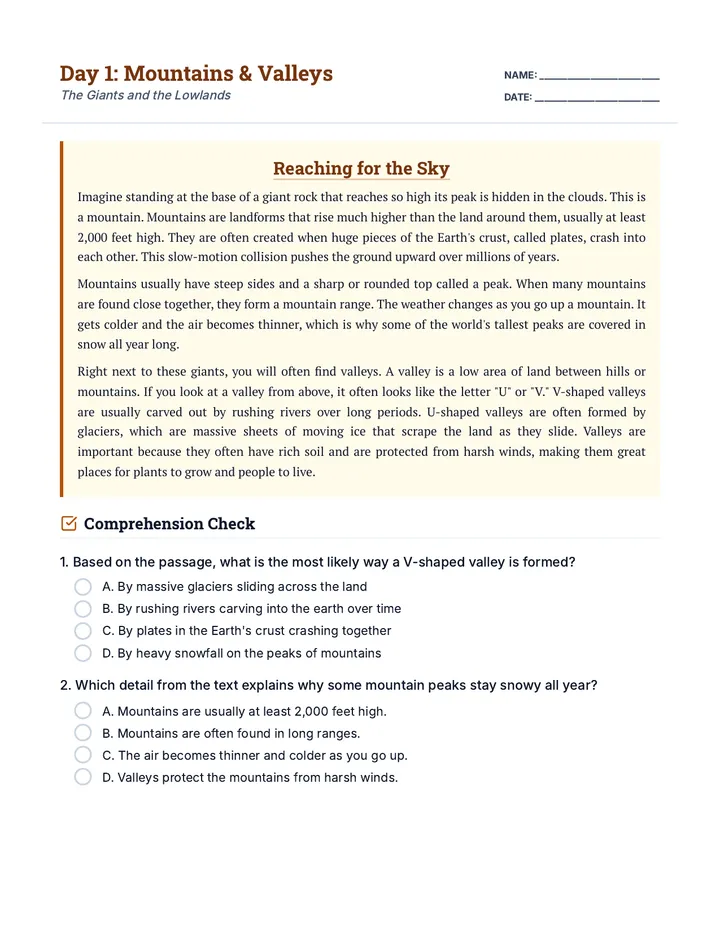
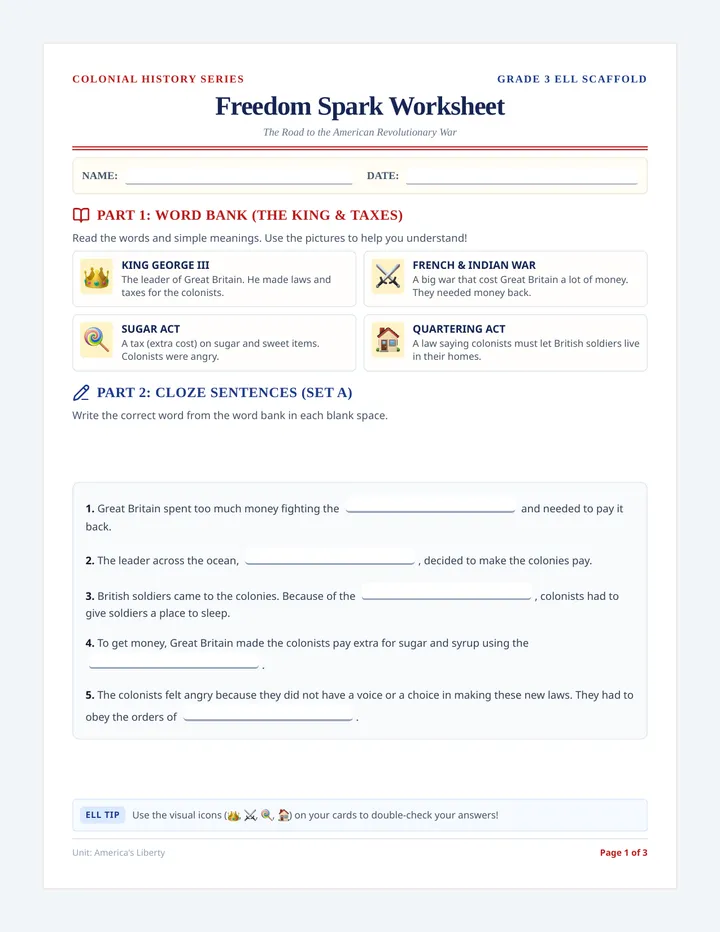
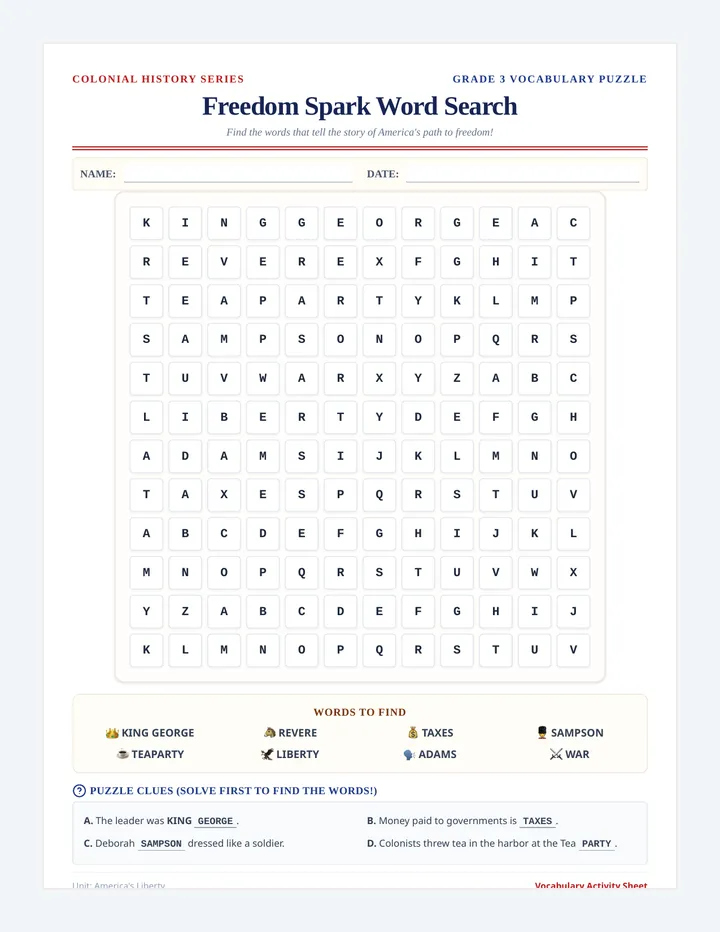
Adapt or Modify Worksheet Adapt or Modify?
Human-Environment Interaction Activity
Name:
Date:
Key Concepts
Adaptation
Changing ourselves or how we live to fit the environment we are in.
Modification
Changing the environment to fit our needs or make life easier.
Part 1: Scenario Sort
Read each action below. Check the box to show if it is an Adaptation or a Modification .
1. Building a house on stilts to stay above flood waters.
Adapt
Modify
2. Digging a canal to bring water to dry farmland.
Adapt
Modify
3. Wearing heavy fur boots to walk in the snow.
Adapt
Modify
4. Cutting down trees to build a new shopping mall.
Adapt
Modify
Part 2: What would you do?
Imagine you live in a very hot, sunny desert. Name one way you could ADAPT to the heat:
Now, name one way people might MODIFY the desert environment to make it easier to live there:
Geography of the Americas • Unit 1
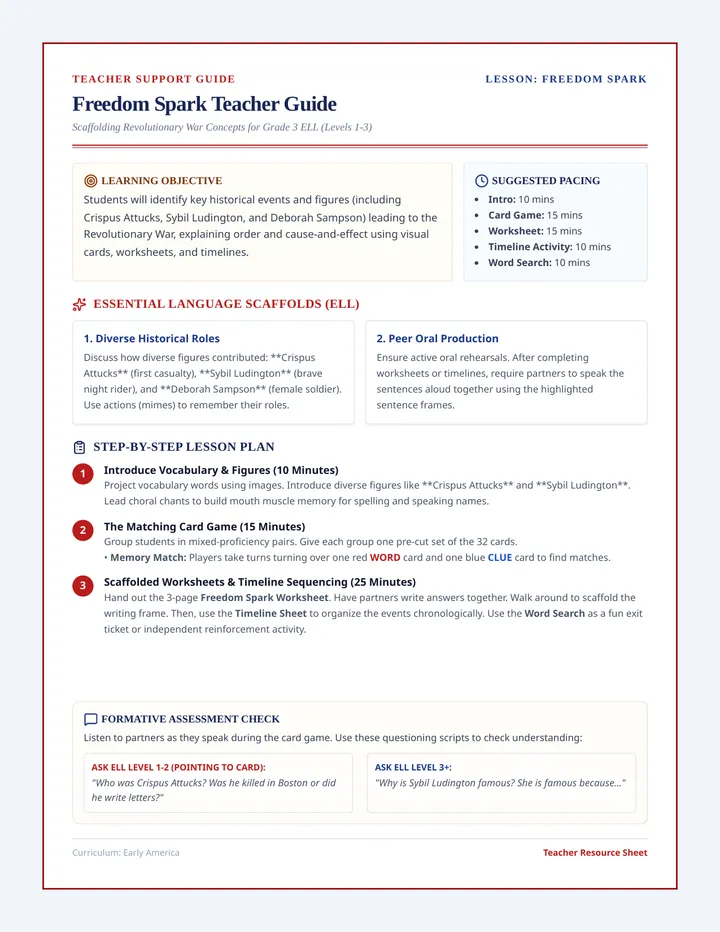
Land and Lives Teacher Guide Teacher Resource Lesson 1 of 5
Land and Lives Intro
Instructional Guide
Time
45 - 60 Minutes
Concept
Human-Environment Interaction
Materials
Slides, Worksheet
Learning Objective
Students will define Human-Environment Interaction and distinguish between adaptation (fitting into the environment) and modification (changing the environment).
Preparation
Prepare the "Land and Lives" slide deck.
Print "Adapt or Modify" worksheets for all students.
Find high-res images of diverse dwellings (optional for extra examples).
Part Activity & Discussion Prompts Time The Hook Mystery Design (Slide 3)
Show the house on stilts. Ask: "Why would someone build this way?"
Guide students to realize the environment (flood risk, damp ground) forced the builder's choice.
| 10m |
| Instruction |
Adapt vs. Modify (Slide 4)
Use the "Heavy Coat vs. Bridge" analogy. Emphasize that Adaptation is changing our habits, clothes, or homes to "fit in." Modification is changing the physical landscape.
| 15m |
| Guided Practice |
Interactive Challenge (Slide 5)
Poll the class on the three scenarios. Ask for justification: "Does this change the person or the land?"
| 10m |
| Independent |
Worksheet Completion
Students complete the "Adapt or Modify" worksheet. Encourage them to think of creative examples for the Desert scenario.
| 15m |
Common Misconception
Students often think building a house is always a modification . Clarify: The act of building might modify the land, but the design of the house (like stilts or extra insulation) is often an adaptation to the climate. Focus on the intent of the action.
Arctic Survival Slides Frozen North Survival
Inuit Life in the North American Arctic
Adaptation Case Study
The Arctic Tundra
What's it like?
Freezing cold temperatures
Frozen ground (Permafrost)
Almost no trees
Long, dark winters
[Image: Arctic Landscape]
Shelter Adaptation
The Igloo
Built from compressed snow. The snow acts as an insulator, trapping body heat inside!
Used during winter hunting trips.
Sod Houses
Built from earth, stone, and whale bone. These were permanent homes that stayed warm.
Used for long-term living.
[Image: Traditional Inuit Clothing]
Dressed for Success
How do you stay warm without cotton or wool? You use what is around you!
Caribou Fur
Hollow hairs trap air to keep heat in.
Seal Skin
Waterproof and perfect for boots (Mukluks).
Experiment Time!
Whales and seals have a thick layer of blubber (fat) under their skin.
Does fat really keep you warm in ice water? Let's find out!
Arctic Resource Map
Marine Life
Whales, Seals, Walrus
Used for: Food, Oil, Tools, Clothing
Land Life
Caribou, Polar Bear, Fox
Used for: Food, Warm Clothing
Frozen Materials
Snow, Ice, Permafrost
Used for: Building Shelters
Arctic Survival Guide Worksheet Arctic Survival Guide
Case Study: Inuit Adaptations
Explorer:
Date:
Part 1: Using What You Have
The Arctic tundra has very few resources. Look at the natural materials below. Match the material to how the Inuit people adapted it for survival.
Natural Material
A. Whale or Seal Blubber (fat)
B. Caribou Hide (skin/fur)
C. Compressed Snow
D. Seal Skin
How it is Used
____
Waterproof boots (Mukluks)
____
Fuel for lamps and body warmth
____
Building temporary winter igloos
____
Warm coats with hollow-hair insulation
Part 2: The Igloo Challenge
Why is an igloo an example of an Adaptation?
Part 3: The Blubber Test
After doing the "Blubber Glove" experiment, answer the question below:
How does a thick layer of fat help animals (and the people who eat them) survive in the freezing Arctic waters?
Arctic Survival Teacher Guide Teacher Resource Lesson 2 of 5
Frozen North Survival
Inuit Case Study Guide
Materials for Blubber Experiment
Bowl of Ice Water
Shortening/Lard
Ziploc Bags (2)
Duct Tape
1
The Hook: Blubber Glove
Before starting the slides, demonstrate how insulation works.
How to make the glove:
Fill one Ziploc bag halfway with shortening.
Turn a second Ziploc bag inside out and place it inside the first bag.
Tape the edges together so the shortening is sealed between the bags.
Have students place one hand in the "blubber glove" and one bare hand in the ice water simultaneously.
2
Guided Inquiry (Slides 1-4)
Walk through the Arctic environment. Focus on the word Permafrost—how does frozen ground make it hard to build or farm?
Discussion: "If you can't grow trees for wood, what else could you use to build a house?"
3
Cultural Context
Explain that the Inuit are not just "surviving"—they are thriving. Their culture is built on deep respect for animals and the land.
Key Vocabulary:
Mukluks: Seal skin boots Ulu: Traditional curved knife
Worksheet Answer Key (Part 1)
A. Whale/Seal Blubber Fuel/Warmth
B. Caribou Hide Warm Coats
C. Compressed Snow Winter Igloos
D. Seal Skin Waterproof Boots
High Andes Slides High Andes Heights
Living on the World's Longest Mountain Range
South American Adaptation
How do you grow a garden here?
[Image: Steep Mountain Slope]
Imagine trying to grow food on the side of a steep, rocky mountain.
No flat land for farms.
Water runs straight down the hill.
Soil washes away in the rain.
Terrace Farming
"Steps" in the Mountain
The Inca and other Andean people built giant stone "steps" into the mountainside.
Flat land for planting
Slows down rain water
Keeps soil in place
[Image: Terrace Farms/Machu Picchu]
Higher = Colder
Bottom
Warm & Tropical
Corn, Fruits
Middle
Cool & Sunny
4,000+ types of POTATOES!
Top
Freezing & Thin Air
Llamas & Alpacas
Living with Llamas
People adapted by raising animals that could handle the high, steep trails.
Transport:
Llamas carry heavy packs across rocky paths.
Wool:
Alpaca wool makes thick, warm ponchos for the cold nights.
[Image: Llama on Andean Trail]
Terrace Architect Worksheet Terrace Architect
Case Study: Andean Mountains
Architect:
Date:
Part 1: Solving the Steep Slope
The mountain below is too steep to plant potatoes. In the box, sketch how you would build terraces (steps) to make this land useful for farming.
Sketch Your Terraces Here
Benefit 1:
How do these steps help with water ?
Benefit 2:
How do they help keep the soil in place?
Part 2: The Elevation Game
As you go higher up a mountain, the climate changes. Draw a line to match the elevation zone to the crop or animal found there.
Top Zone
(Freezing & Snowy)
Llamas & Alpacas
Middle Zone
(Cool & Sunny)
Thousands of Potatoes
Bottom Zone
(Warm & Tropical)
Corn & Fruits
Andean Engineering
Did you know? The Inca built over 18,000 miles of mountain roads!
High Andes Teacher Guide Teacher Resource Lesson 3 of 5
High Andes Heights
Mountain Adaptation Guide
Core Concept: Elevation
In the Andes, the environment changes more by altitude (how high you are) than by latitude (distance from the equator). People adapted by utilizing different levels of the mountain for different needs. This is called "Vertical Climate Zones."
1
The Hook: Gravity vs. Gardens
Ask: "If you try to pour water on a slide, where does it go? What if you wanted to grow a flower on that slide? How would you stop the soil and water from falling?"
Connect this to the steep Andean slopes shown on Slide 2.
2
Teaching Terrace Farming
Explain that terrace farming is an adaptation because people used the natural mountain shape but reshaped it to fit their needs.
Environmental Benefit:
Prevents erosion and conserves water in dry high-altitude air.
Social Benefit:
Allowed the Inca Empire to feed millions of people in a place that looked "unfarmable."
3
Fun Fact: The Potato King
Mention that there are over 4,000 types of potatoes in the Andes! Some are purple, some are lumpy, and some are bitter. People adapted by finding specific types of potatoes that could survive at different heights.
Discussion Prompt
"Look at the animals on Slide 5. Why are llamas better for the Andes than a horse or a cow? (Think about the size of the paths, the rocks, and the temperature)."
Answer Key Guidance: Part 2 of the worksheet is a direct match based on Slide 4. Top = Llamas, Middle = Potatoes, Bottom = Corn/Fruit.
Amazon River Life Slides Amazon River Life
Adapting to the World's Largest Rainforest
Tropical Adaptation
Hot, Wet, and Wild
Climate Facts:
Very hot all year round
Tons of rain (every day!)
Rivers everywhere
"How do you keep your house dry and your food fresh in a giant steam room?"
[Image: Amazon River & Jungle]
Shelter Solutions
Thatched Roofs
Roofs are made of overlapping palm leaves.
Rain slides right off, but air can still get through to keep it cool!
Stilt Houses
Houses are built on stilts or wooden legs.
Keeps the house safe from river floods and away from crawling insects!
[Image: Peque-Peque Boat / Canoe]
The Water Highway
In many parts of the Amazon, there are no roads. Why build a road when you have a river?
Adaptation:
People use canoes and motorboats to go to school, the market, or to visit friends.
Resource:
"Dugout" canoes are made by carving out a single large tree trunk.
Backpack Challenge
"You are going to the Amazon for one week. Your backpack is small."
A Heavy Wool Blanket
A Light Rain Poncho
Hiking Sandals
Thick Fur Boots
Which items would be USELESS in the rainforest? Why?
Rainforest Kit Worksheet Rainforest Survival Kit
Case Study: The Amazon Basin
Survivalist:
Date:
Part 1: Pack Your Bags
It is 95°F and raining heavily in the Amazon. Which of these items would be USEFUL for an Amazonian explorer, and which would be USELESS ? Write the items in the correct columns.
Light Poncho
Wool Sweater
Fur Boots
Breathable Sandals
Bug Spray
Down Jacket
Wide Hat
Heavy Scarf
Useful Items
Useless Items
Part 2: Tropical Architecture
Amazonian houses often have Stilts and Thatched Roofs. Explain why each feature is an adaptation:
1. Stilts (Legs)
How do they help with the environment?
2. Thatched Roofs (Leaves)
How do they help with the climate?
Part 3: The River Highway
In the Amazon, why is a canoe often better than a car?
Rainforest Rhythms • Geography Unit
Amazon River Life Teacher Guide Teacher Resource Lesson 4 of 5
Amazon River Life
Rainforest Adaptation Guide
Core Concept: Biological Abundance
Unlike the resource-scarce Arctic, the Amazon is full of life. Adaptation here isn't just about finding materials, but selecting the right ones to handle the extreme moisture and heat.
1
The Hook: Backpack Challenge
Use Slide 5 to facilitate a quick discussion. Ask students to justify why "Thick Fur Boots" are a bad idea.
Key takeaway: In the Amazon, items that soak up water (like wool or fur) will rot or stay wet forever. Materials must be breathable or waterproof.
2
Architecture of Air (Slide 3)
Focus on the Thatched Roof. It's an engineering marvel!
Explain: Palm leaves are slick (water slides off). But the roof isn't solid like a brick wall—it allows air to circulate. In 100°F weather, you want a house that "breathes."
Compare: Ask students to compare this to an Arctic igloo which is designed to keep air in .
3
Rivers as Roads (Slide 4)
Amazonian communities are often built along riverbanks. The Amazon River and its tributaries are the main transportation network.
Discussion: "If you lived in a village on the river, how would you go to buy groceries?"
Quick Answer Key
Useful: Poncho, Sandals, Bug Spray, Wide Hat
Useless: Wool Sweater, Fur Boots, Down Jacket, Scarf
Stilts: Prevent floods, keep out snakes/bugs.
Thatched: Rain runoff, air cooling.
Teacher Tip:
Remind students that indigenous Amazonians have lived this way for thousands of years, using plants like rubber trees and medicinal vines to adapt to their environment.
Biome Architect Slides Biome Architect Challenge
Apply Your Skills to a Brand New Mystery Habitat!
Final Design Challenge
Your Mission
"You have been dropped in a mystery environment with only natural materials."
Your job is to design a community that is perfectly adapted to survive and thrive!
Choose Your Location
The Ice Flats
Freezing winds, no trees, only snow and marine life.
The Red Peaks
Steep cliffs, thin air, very little flat ground for homes.
The Deep Rain
Daily flooding, extreme heat, and dense tangled vines.
Architect's Checklist
Shelter
What is it made of? How does it handle the weather?
Clothing
What do people wear to stay comfortable?
Food & Water
Where does the food come from? How do they get it?
Transportation
How do people move across the land?
Time to Design!
Use your project template to draw and explain your village. Remember: Every choice must be an adaptation to your environment!
My Adapted Village Design Project Sheet My Adapted Village
Biome Architect Final Project
Architect:
Date:
Step 1: Choose Your Biome
The Ice Flats
The Red Peaks
The Deep Rain
Step 2: Village Map
Sketch your village layout. Show where the homes are, how people move around, and where food is found.
Draw Your Map Here
Step 3: Adaptation Details
1. Shelter Design
What materials are you using? How does this design handle the climate of your biome?
Sketch of Home
2. Daily Clothing
What are people wearing to protect themselves from the heat, cold, or rain?
Sketch of Outfit
3. Food Sources
Where do people get their food? How do they get it?
4. Moving Around
How do people travel? What natural features make travel difficult?
Architect's Statement
Why is your village the perfect adaptation for this environment?
Biome Architect Rubric Teacher Resource Lesson 5 Project
Biome Architect Rubric
Final Assessment Guide
This rubric is designed to assess the student's ability to synthesize geographic concepts (climate, terrain, resources) into a cohesive design. Look for evidence that the student isn't just drawing a generic house, but is using the specific environmental constraints of their chosen biome to justify their architectural and lifestyle choices.
Criteria Exceptional (3) Proficient (2) Developing (1) Environmental Analysis Clearly identifies the key challenges of the biome (e.g., high heat, steep slopes). Identifies basic climate/terrain features but may miss specific challenges. Minimal mention of the environment; design is generic. Shelter & Clothing Adaptations Design features (stilts, insulation, etc.) are clever and use biome-specific natural materials. Designs are appropriate for the climate but might use materials not found in the biome. Shelter or clothing does not protect against the biome's climate. Food & Transport Logic Logical explanation for food sourcing and movement based on biome constraints. Basic ideas for food and travel; explanations are brief but accurate. Food or travel methods conflict with the environment (e.g., cars in the Arctic). Creativity & Visuals Highly detailed sketches; map is clear and incorporates environmental features. Sketches are complete and understandable; map layout is logical. Incomplete sketches or map; lacks detail.
Architect's Statement Tip:
"Encourage students to use the word 'BECAUSE' in their statement. (e.g., 'I built my house on stilts BECAUSE the Amazon floods every day during the rainy season.') This shows mastery of cause and effect."
Total Points: /12
Grading Scale: 10-12=A, 8-9=B, 6-7=C