Evansville Scarcity & Decision Making • Sequence • Lenny.com
Evansville Scarcity & Decision Making
An 8-day introductory economics unit for EVSC high school students. This unit explores scarcity, the factors of production, opportunity cost, and economic systems, heavily integrating Evansville's local industries and development scenarios.
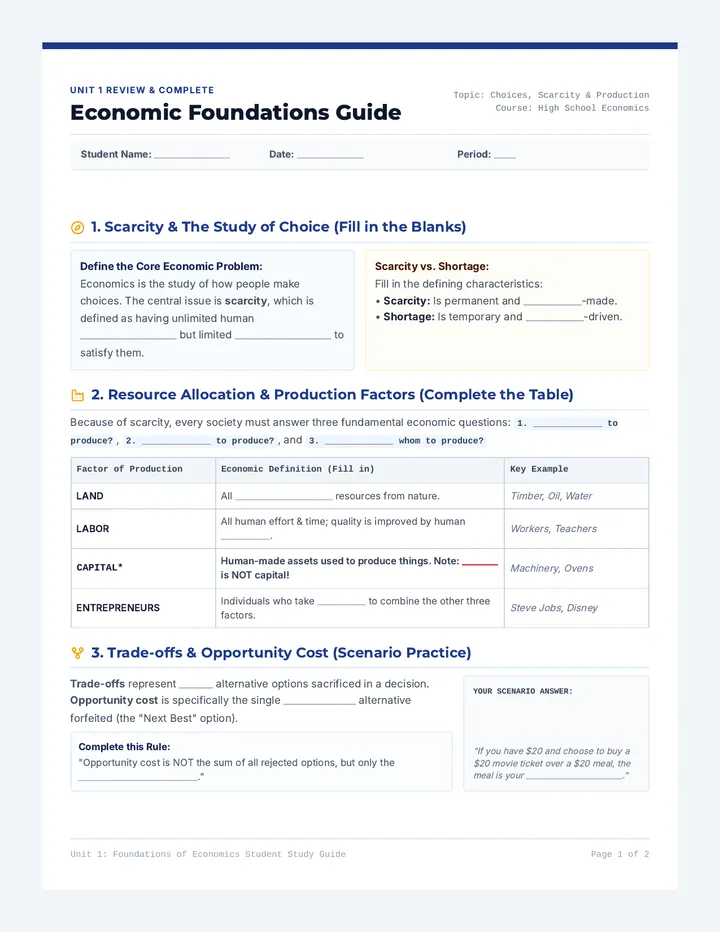
On Page 1 of your worksheet, explain how scarcity forces Berry Global to make production trade-offs.
A through F
50 -
40 -
30 -
20 -
10 -
0 -
0 20 40 60 80 100
Commercial Zones (Acres)
Public Parks (Acres)
3. Underuse of land: Plot a point "Point X" inside the curve (e.g., 40 Parks, 20 Commercial). What does a point inside the PPC signify about the resource utilization along Evansville's Riverfront?
4. Unattainable targets: Plot a point "Point Y" outside the curve (e.g., 80 Parks, 40 Commercial). Why is Evansville unable to establish this combination with its current resources?
5. Shifting the curve: Imagine Evansville is awarded a major federal urban development grant that expands the buildable riverfront area or provides highly innovative landscaping machinery. Explain how this would affect the PPC curve on your graph.
Page 2 of 2 • Unit 1: Scarcity & Decision Making
Option 2: Commercial Zones
Retail shopping, hotel infrastructure, high-density apartment complexes. Generates high city tax revenues and business investments.
GUIDED NOTES OUTLINE:
"In the Evansville riverfront scenario, the trade-off is between green ________ and commercial ________ development."
PPC Interpretation Points & Capacity
On the Curve
Efficient Output
All resources are fully utilized. To gain more parks, we MUST sacrifice some commercial buildings.
Inside the Curve
Inefficiency / Waste
Unemployment or idle land (e.g. empty, abandoned warehouses on the riverfront not being used at all).
Outside the Curve
Unattainable Target
Impossible to reach today. Requires economic growth to expand capacity.
GUIDED NOTES OUTLINE:
"Points directly on the frontier line represent absolute economic ________ of land, labor, and capital."
Economic Growth PPC Shifts
How does a PPC Shift?
An outward shift represents economic growth, allowing the society to produce more of both products.
Increase in quantity/quality of resources (e.g. population growth)
Technological progress (e.g. advanced building techniques)
Summary Challenge
In your Riverfront Activity, what happens if the city gets a federal grant of $10 million specifically for riverfront clearing and reconstruction?
→ The whole curve shifts to the right!
GUIDED NOTES OUTLINE:
"An ________ shift of the PPC represents economic growth, caused by increases in ________ or progress in ________."
Societal Values Economic Goals
What Goals Drive Economic Choices?
Economic Freedom
The freedom to choose career paths, spending, and entrepreneurship.
Economic Equity
Fairness in wealth distribution, opportunities, and social safety nets.
Economic Growth
Increasing productivity to improve national standards of living.
Economic Security
Protection against unemployment, poverty, or emergencies.
Economic Efficiency
Maximizing resource usage to minimize wasted land, labor, and capital.
Price Stability
Keeping inflation under control so purchasing power remains steady.
GUIDED NOTES OUTLINE:
"Economic systems often conflict. For example, promoting absolute economic ________ can sometimes reduce social ________."
Incentives in Action EC.1.6
How Indiana Uses Incentives
An incentive is any reward or cost that motivates people or corporations to make choices.
Low corporate tax rates attract businesses
Tax breaks for historic downtown development
Investments in local EVSC vocational tracks
Local Analysis
In 2024, Toyota expanded its Princeton plant following multi-million dollar state-funded tax credit incentives.
GUIDED NOTES OUTLINE:
"An ________ is any reward or penalty that encourages action. Indiana utilizes ________ credits to attract business."
Economic Policy Scenario
Primary Goal Supported
Goal That Might Be Compromised
Indiana mandates that all factories install multi-million dollar air purifiers.
The local city council completely removes zoning regulations to allow any business to set up anywhere.
The state government institutes an unemployment insurance program for laid-off industrial workers.
5. Defend your choices: Choose one policy from the table above. Why is balancing these two conflicting goals the hardest job of economic policymakers?
Page 2 of 2 • Unit 1: Scarcity & Decision Making
The Primary Social Goal of our Nation:
Official Grading Rubric (50 Points Total)
Criteria
Proficient (9-10 pts)
Developing (6-8 pts)
Emerging (1-5 pts)
Productive Factors
All four factors are comprehensively mapped out with logical real-world assets.
Three factors are described, or some elements are misclassified.
Factors are missing or poorly defined with no clear local logic.
PPC Curve Graph
The PPC curve is accurately graphed, showing clear trade-offs, inside, and outside points.
A curve is plotted but contains errors in trade-offs or point labels.
Graph is incomplete or lacks proper axis labels and coordinates.
Economic System
The 3 core questions are answered logically, explaining how decisions are centralized.
Questions are answered but lack deep justification or system match.
Answers to the three economic questions are incomplete.
Social Goals
Clear societal goals and incentives are integrated with strong logical reasons.
Goals are identified but incentives are weak or non-specific.
Goals and incentives are left blank or show major misconceptions.
Presentation
The team delivers a professional, polished 3-minute pitch to the class.
The pitch is completed but lacks preparation or organization.
No pitch was delivered, or it was completely unorganized.
Pitch Checklist:
□ State Nation Name □ Explain Your System □ Pitch Your Primary Goal □ Show Your PPC Graph
Page 2 of 2 • Create Your Own Economy Project
Part 5: Economic Systems Matrix Review
Fill out this summary grid comparing Systems. This represents a substantial portion of tomorrow's assessment!
System Type
Who Owns Resources?
Primary Social Goal
Major Weakness / Risk
Pure Command
Pure Market
Mixed Economy
Synthesize: Write a 2-sentence summary explaining how a Mixed Economy attempts to balance individual freedom with collective societal security.
Page 2 of 2 • Unit 1: Scarcity & Decision Making
Page 1 of 2 • Unit 1 Exam: Scarcity & Choices
Unit 1 Assessment • Continued
In a pure command economy, who controls the productive resources and answers the key questions?
A. Private consumer demand and market forces B. Central state planners and government committees C. Local small business entrepreneurs D. Hereditary community tribal traditions
The US economic system is best described as a mixed market system because:
A. The government regulates nothing at all B. Private businesses operate alongside government rules and safety nets C. The President determines the retail prices of consumer goods D. Citizens do not pay any federal income taxes
Which societal economic goal is most heavily prioritized in a command economy?
A. Individual economic freedom B. Consumer sovereignty C. High-risk entrepreneurship D. Collective security and central equity
If the State of Indiana lowers its corporate tax rate to attract new businesses, they are utilizing:
A. Negative sanctions B. Market economic incentives C. Command planning quotas D. Traditional barter trade systems
Part 2: Scenario Analysis & Application
Local Evansville Dilemma: The Evansville City Council has an option to lease out a 50-acre riverfront plot to an industrial logistics company (generating 100 private warehouse jobs) or convert it into a beautiful public park (bringing free public access).
13. Identify the opportunity cost if the city council votes to build the public park. Defend why there is always an opportunity cost in this decision, even if the park is free for children to enter.
14. Using the PPC graph model, explain how a massive discovery of new, accessible capital equipment (like highly efficient, automated warehouse loaders) specifically impacts the production frontier for Evansville's logistics industries.
15. How do market incentives (like high potential corporate profits) coordinate the behavior of private companies (like Berry Global or Toyota) without requiring any direct commands from government planners in Washington, D.C.?