A comprehensive 4-week introduction to Archaeology for 9th and 10th graders. It bridges social studies inquiry and Earth science through case studies, stratigraphic analysis, quantitative dating, and archaeological ethics debates.
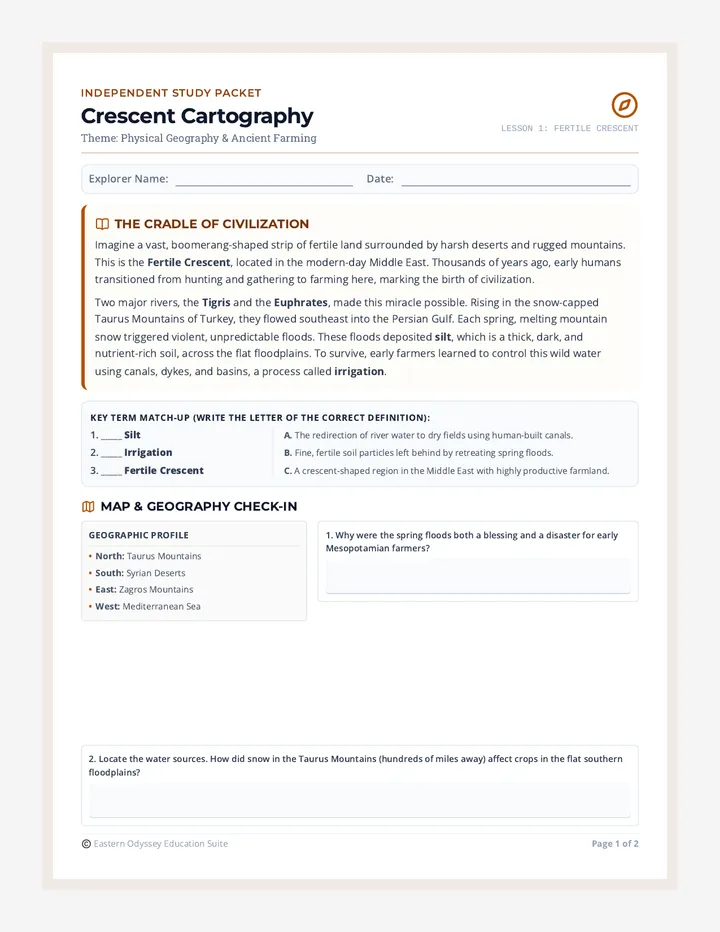
Rivers flood and deposit silt layers, systematically burying agricultural structures and packing artifacts securely in orderly stratigraphic sequences.
"Water is archaeology's greatest friend (anaerobic) or worst enemy (rot)." Slide 4 of 5
The Ethical Spark: Who Owns the Past?
Artifact Repatriation
The Universalist View
Universal Custodianship
Major international museums (London, Paris, Berlin) argue they preserve global human heritage in a centralized location, accessible to millions, with advanced scientific facilities to halt decay.
The Nationalist/Indigenous View
Sovereign Repatriation
Source countries and tribal nations argue ancient artifacts were looted under colonial rule. Return is essential to restore cultural pride, ancestral connections, and regional historical integrity.
Quick Discussion: Should the British Museum return the Elgin Marbles to Greece, or does centralized access justify their location?
Unit Standard: C3 Dimension 4 (Construct arguments & communicate ethical conclusions) Slide 5 of 5
E
Pre-Mound Bedrock
Band A (0–20cm): Sandy humus topsoil. Contains modern beverage can pull-tabs and plastic beads.
Band B (20–60cm): Thick dark-green swamp clay. Waterproof layer deliberately packed to prevent rain erosion.
Band C (60–90cm): Pale yellow loess sand. Contains charcoal fragments and freshwater mussel shells.
Band D (90–140cm): Fine dark river silt. Shows evidence of heavy seasonal alluvial flooding. No structures present.
Band E (140–180cm): Bright red clay floor. Contains post-mold holes indicating ancient wood homes.
1. Analyze Band D (90-140cm). What does the river silt, combined with the lack of structural remains, suggest about the environmental conditions at Cahokia during this specific time period?
2. Band B is a non-local, thick swamp clay. Why would the ancient Cahokians carry baskets of heavy swamp clay from miles away to cover the sand layer (Band C)? Refer back to the goals of site preservation and geomorphology.
3. In what order did the events occur at this site, from oldest to newest?
A Village established (E) → Severe flooding (D) → Mound built with sand (C) → Covered in protective clay (B) → Modern topsoil forms (A)
B Modern topsoil forms (A) → Protective clay packed (B) → Mound built with sand (C) → Severe flooding (D) → Village established (E)
C Mound built with sand (C) → Protective clay packed (B) → Severe flooding (D) → Village established (E) → Modern topsoil forms (A)
Dirt Detectives Student Handout Page 2 of 2
Seriation
Stylistic Pottery Assemblage Frequencies
Assemblage Site Context
Incised Geometrics (%)
Cord-Marked Shell (%)
Plain Burnished (%)
Context Delta (Mound Surface pits)
\(82\%\)
\(5\%\)
\(13\%\)
Context Gamma (Deep base stratum)
\(4\%\)
\(91\%\)
\(5\%\)
Context Epsilon (Mid-mound fill)
\(25\%\)
\(35\%\)
\(40\%\)
Style Battleship Frequency Curves
Draw horizontal shaded bars corresponding to the stylistic percentages of each context to map out the 'battleship curves' and trace the timeline flow.
Incised Geometrics
Surface (Delta)
Mid-Mound (Epsilon)
Base (Gamma)
Cord-Marked Shell
Surface (Delta)
Mid-Mound (Epsilon)
Base (Gamma)
Plain Burnished
Surface (Delta)
Mid-Mound (Epsilon)
Base (Gamma)
1. Arrange the three site contexts (Delta, Gamma, Epsilon) in order from oldest to youngest based on the popularity curve of the Cord-Marked Shell style.
2. Explain how a new, cheap decorative technique like "Incised Geometrics" could spread, peak, and disappear in a community, and why this allows archaeologists to date sites without radiocarbon technology.
Clay Calibration Curve Worksheet Page 2 of 2
Perspective B: Sovereign Claimant
1. STATE YOUR CORE THESIS CLAIM:
State your central argument on who should own your selected artifacts, citing historical context.
2. CITE SPECIFIC EVIDENCE FROM DOSSIER A OR B:
Integrate specific historical quotes, actions, or dates from Page 1 to back up your claim.
3. APPLY INTERNATIONAL LAW (UNESCO 1970 EXCERPT):
Explain how Article 7 supports or does not support your case, and how you resolve the "1970 loophole."
4. ANTICIPATE THE OPPOSING REBUTTAL:
What is the strongest counter-argument from the opposing perspective, and how will your team defeat it?