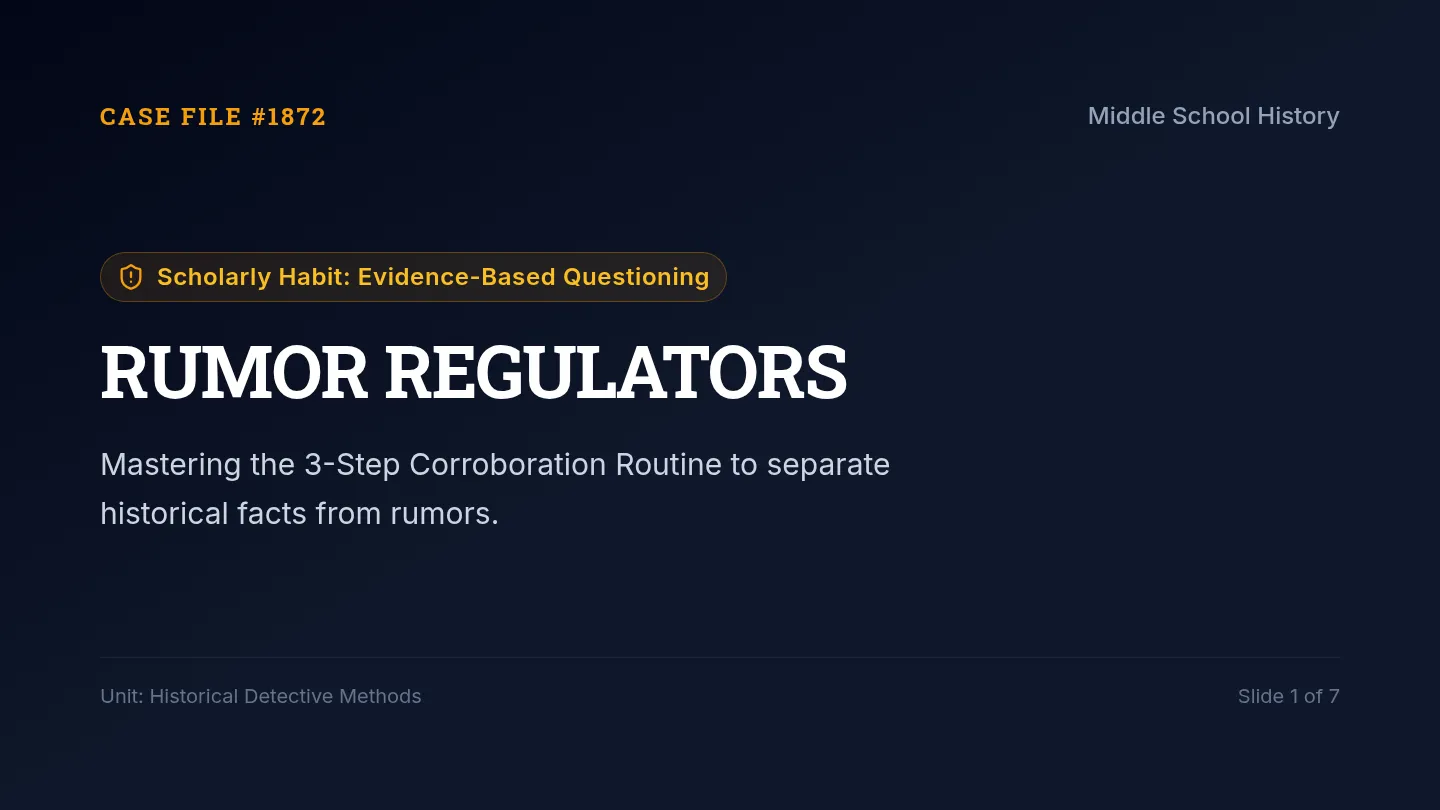
Regional Split Slides The Colonial Ledger Unit 1: Lesson 1
The Regional Split
How geography, weather, and big goals divided the Original 13 Colonies into three distinct worlds.
Social Studies Collaborative Class
Reading Level: 4th-5th Grade Scaffold
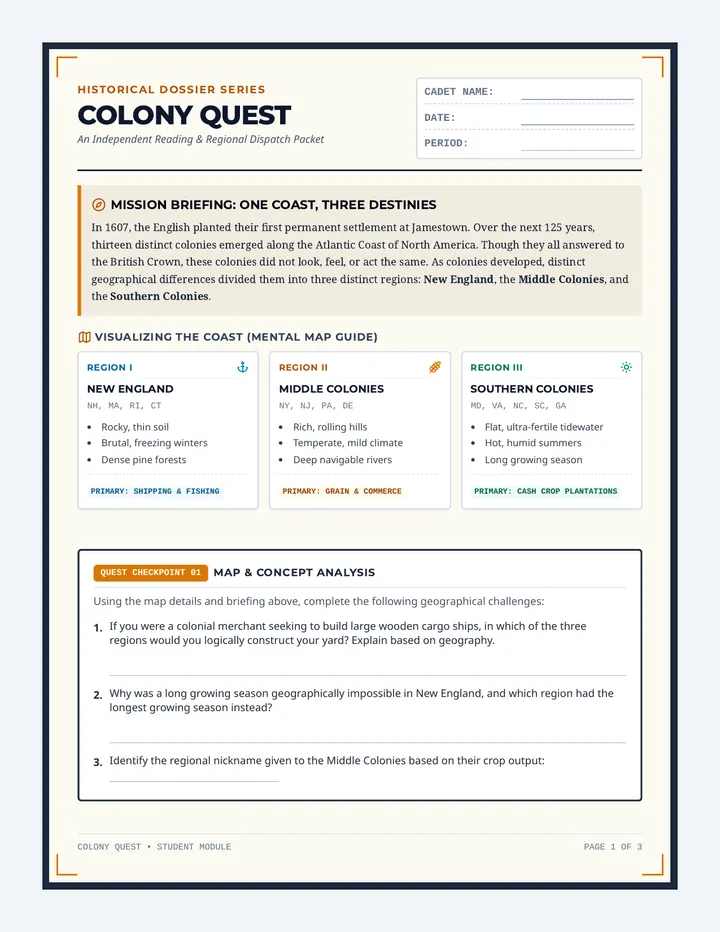
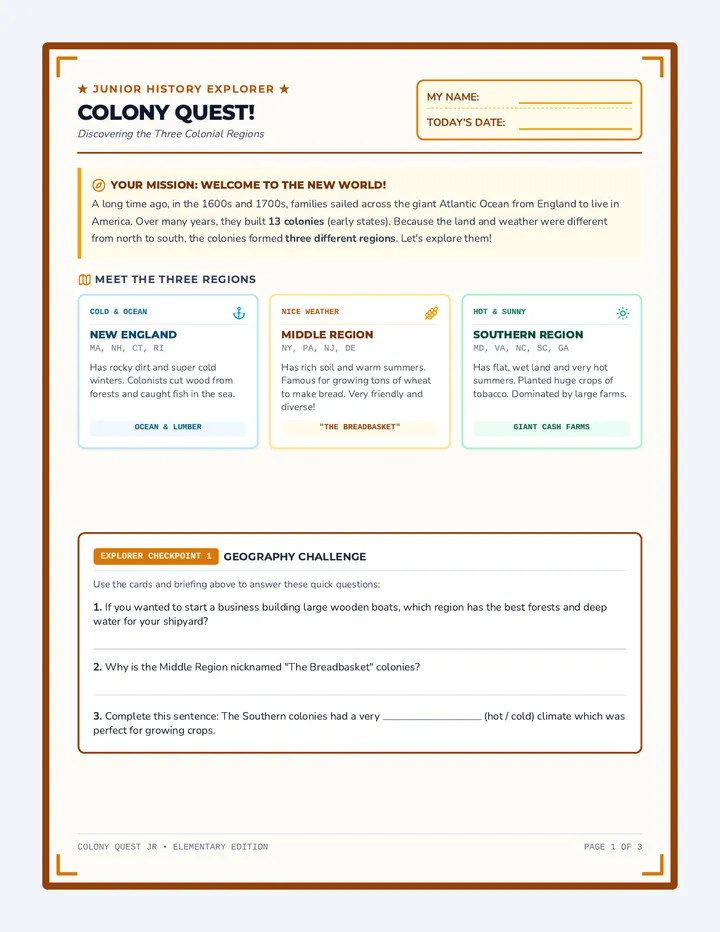
Meet the Three Regions!
Geography Overview
1 New England
Cold weather, rocky soil, and deep ocean bays. Settled mostly by people seeking religious freedom.
Cold & Rocky
2 Middle Colonies
Mild weather, rich dirt, and wide rivers. Known for being welcoming to all kinds of different people.
The Breadbasket
3 Southern Colonies
Hot weather, wet soils, and massive flat plains. Perfect for huge farms and year-round growing.
Hot & Sunny
Quick Question: Which region sounds like the best place to build a farm? Why?
New England: Cold & Rocky
Region 1 Details
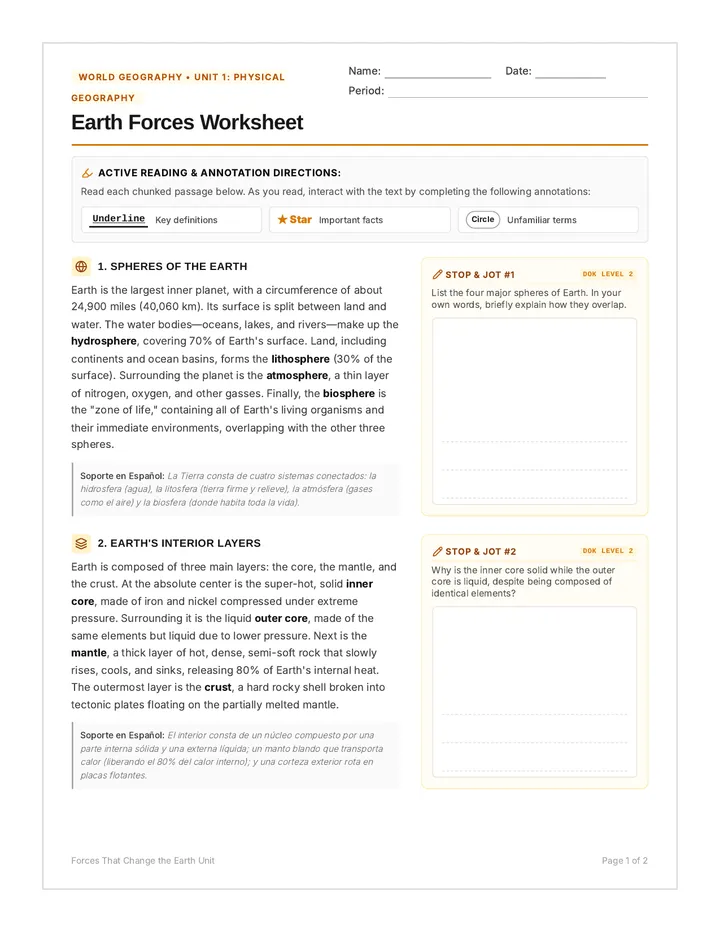
The Land & Climate
Winters were very cold and long . The soil was full of stones and rocks, making it extremely hard to grow crops.
The Motive (The "Why")
The Pilgrims and Puritans sailed here to practice their own religion freely without the King of England interfering.
Thick Forests
Perfect for cutting wood to build sturdy ocean ships.
Deep Harbors
Great for loading fishing boats and trading ocean goods.
Close Towns
Families lived close together around a central church square.
Rocky Soil
Only small "subsistence" gardens to feed just one's family.
Turn and Talk (60 seconds): "If the dirt was too rocky to farm, how did New England families survive?"
The Middle Colonies: The Friendly Breadbasket
Region 2 Details
Mild Weather
Warm summers and regular rain gave a perfect growing season.
Rich Dirt
Super deep, fertile river soil ideal for massive grain farms.
Deep Rivers
The Hudson and Delaware rivers let ships sail far inland.
Diversity
People from many countries and religions lived peacefully.
The Land & Climate
The climate was balanced —not too hot, not too cold. The land had wide rivers and flat valleys covered in rich, black dirt.
The Motive (The "Why")
Led by the Quakers (William Penn), they built a colony where everyone was welcome , including Germans, Dutch, and Swedes!
Vocabulary Spotlight: Breadbasket: A region that grows massive amounts of grain (like wheat and oats) to feed others.
The Southern Colonies: The Hot Plantations
Region 3 Details
The Land & Climate
Hot, humid, and long summers with short, warm winters. The soil was damp, flat, and perfect for growing plants year-round .
The Motive (The "Why")
Settlers came to make money . They built massive farms called plantations to grow crops like tobacco and rice to sell back to Europe.
Cash Crops
Plants grown only to sell for gold, not for families to eat.
Longest Season
A warm climate meant plants grew for up to 9 months a year!
Forced Labor
Large plantations relied heavily on enslaved people from Africa.
Spread Out
Very few towns. Neighbors lived miles apart on giant estates.
Critical Thinking: Why did the Southern colonies have fewer big towns than New England?
Classroom Challenge Quick Game!
Which Region Am I?
Look at the clues below. Work with your partner to match each clue to either New England , Middle , or Southern .
🌾
Clue A
"We grow oats, wheat, and welcome people from all religions."
❄️
Clue B
"We have rocky soils, deep bays, and cut trees to build sailing ships."
☀️
Clue C
"We grow rich tobacco crops on giant flat plantations in hot sun."
Write down your matches on your Cornell Notes worksheet!
Regional Split Cornell Notes COLONIAL EXPLORER JOURNAL
GUIDED CORNELL NOTES
NAME:
DATE:
CLASS:
Essential Question: How did climate, geography, and original motives shape the three colonial regions?
Key Vocabulary
• Geography: The type of land and weather in a place.
• Motives: The goals or reasons why someone does something.
• Puritans: People who wanted to practice their own religion freely.
Write Clues Here:
Write 1-2 words that help you remember New England.
Write 1-2 words that help you remember the Middle Region.
💡 Explorer Tip: Look for bold words on the slides to fill in your blank lines!
A
NEW ENGLAND: THE COLD NORTH
1. The climate of New England was very and the winters were extremely long.
2. The soil was very , which made farming difficult. Families only grew small gardens to feed themselves.
3. People who settled here were called the and Pilgrims. Their main goal was freedom.
B
MIDDLE COLONIES: THE BREADBASKET
1. The weather was and comfortable. They had rich, deep soil that was perfect for growing grains like wheat.
2. Because they grew so much wheat and oats, they were called the colonial .
3. The colony was started by a group called the who believed in treating everyone fairly and welcoming people from different lands.
💬 Discussion Sentence Starter: "New England and the Middle colonies are different because New England had ________ soil, while the Middle colonies had ________ soil."
Unit 1: The Regional Split • Guided Notes Page 1 of 2
COLONIAL EXPLORER JOURNAL
GUIDED CORNELL NOTES
NAME:
DATE:
CLASS:
Essential Question: How did climate, geography, and original motives shape the three colonial regions?
Southern Key terms
• Plantation: A giant farm that grows crops using forced labor.
• Cash Crop: Plants grown to sell for money, not to eat.
• Enslaved: People kept in chains and forced to work for free.
Write Clues Here:
Write 1-2 words that help you remember the Southern region.
🙋 Quick Check: Raise your hand once you complete Section C so your teacher can give you a stamp!
Colonial Foundations Map Activity MAP-MAKER'S BLUEPRINT
MAP ACTIVITY
NAME:
DATE:
CLASS:
🗺️ Instructions: 1) Look at the schematic map of the 13 colonies below. 2) Label the three regions using the Word Bank. 3) Color-code each region using colored pencils (Blue for Cold New England, Yellow for the Breadbasket, Green for the Warm South).
OCEAN
*Map is a simplified schematic for learning
Zone A
Region Name:
Clues: Rocky coastline, thick pine forests, cod fishing.
Zone B
Region Name:
Clues: Wide Hudson river, farming oats and grain.
Zone C
Region Name:
Clues: Flat plains, extremely hot weather, giant farms.
Region Word Bank
Write these exact names in the Zone spaces on the left!
Middle Colonies
New England Colonies
Southern Colonies
Resource Match-up
Write the letter of each resource inside the correct Zone box on the left map!
A Cod Fishing & Timber (Wood)
B Wheat, Grains, & Flour
C Tobacco, Rice, & Indigo Dye
💡 Map Maker Check: Did you color-code your regions? Cold regions are blue, grains are yellow, and sunny cash crops are green!
Collaborative Partner Talk:
"I think Zone A is ________ because the climate there is ________."
Unit 1: The Regional Split • Map Labeling Activity Lesson 1 Handout
Colonial Commerce Slides The Colonial Ledger Unit 1: Lesson 2
Cash and Craft
How colonial families made a living through trade, crafts, big farms, and different kinds of work.
Social Studies Collaborative Class
Reading Level: 4th-5th Grade Scaffold
Three Ways to Make a Living!
Economy Overview
🪓
Wood & Water
People made money by building ocean ships , catching cod fish, and selling wood from dense forests.
The Shipbuilders
🚜
Mills & Markets
People made money by grinding grain at flour mills , trading at busy town markets, and making iron tools.
The Merchants & Millers
🌱
Cash & Crops
People made money by growing massive fields of tobacco and rice to sell across the ocean to England.
The Plantation Owners
Quick Question: What is the difference between a food crop and a cash crop?
New England: Ocean & Timber
Region 1 Economy
Shipbuilding
Since New England had huge, tall pine trees and deep natural harbors, they became world-famous for building strong wooden sailing ships .
Harvesting the Sea
Farming was too hard in rocky soil. Instead, colonists became fishermen and whalers , shipping cod and whale oil to Europe.
Economic Highlights
• Subsistence Farming: Growing just enough to survive, not to sell.
• Timber Trade: Selling wood for ship masts and home-building.
• Atlantic Shipping: Carrying goods across the ocean for a fee.
"The ocean was New England's highway and its grocery store!"
Turn and Talk (60 seconds): "Why was the ocean more valuable than the land in New England?"
The Middle: Flour Mills & Artisans
Region 2 Economy
Crafts and Metals
• Flour Mills: Using rushing rivers to turn waterwheels and grind grain.
• Blacksmiths: Crafting iron tools, plow blades, and horse-shoes.
• Coopers: Making tight wooden barrels to ship grain across the sea.
"The Middle Colonies built the tools and barrels that made trade work!"
Grain Exporting
Farmers grew massive fields of wheat, barley, and oats. They packed flour into barrels and sold it to other colonies and Europe.
Colonial Commerce Notes COLONIAL COMMERCE JOURNAL
GUIDED CORNELL NOTES
NAME:
DATE:
CLASS:
Essential Question: How did each colonial region create its own unique economy to survive and make money?
Econ Vocab
• Economy: The way a group of people makes, buys, and sells things.
• Subsistence: Farming only enough to eat, with none left to sell.
• Artisan: A worker skilled in making craft goods.
Write Clues Here:
Write 2 industries in New England.
Write 2 industries in the Middle colonies.
💡 Explorer Tip: Remember, New Englanders had to turn to the ocean because of their rocky dirt!
A
NEW ENGLAND'S CRAFTS & PORTS
1. Because farming was so difficult, New Englanders built an economy on the .
2. They used tall pine trees from thick forests to build large wooden sailing .
3. Colonists also caught and salted a fish called to ship to other parts of the world.
B
MIDDLE WHEAT & TRADING PORTS
1. Farmers in the Middle Colonies grew massive fields of and barley. They ground these into flour.
2. Busy port cities like New York and became hubs where merchant shops and sailing ships traded goods.
3. Skilled workers called , like blacksmiths and coopers, made useful iron tools and wooden barrels.
💬 Discussion Question: "How did Middle colony rivermills help wheat farmers sell their crops?"
Unit 1: Cash and Craft • Guided Notes Page 1 of 2
COLONIAL COMMERCE JOURNAL
GUIDED CORNELL NOTES
NAME:
DATE:
CLASS:
Essential Question: How did each colonial region create its own unique economy to survive and make money?
Southern Labor
• Plantation: A giant farm that grows crop exports.
• Cash Crops: Tobacco, rice, indigo dye.
• Labor: Tough, hard physical work.
Write Clues Here:
Write 2 cash crops grown in the South.
🙋 Quick Check: Are your handwriting blanks fully colored or filled with notes? Ask a friend to verify before showing the teacher!
C
THE SOUTHERN CASH CROPS
1. The Southern economy was built around massive farms called .
2. Plantation owners made enormous profits by growing crops grown purely to sell, called .
Regional Economy Sorting Activity COLONIAL CARGO DOCK
SORTING ACTIVITY
NAME:
DATE:
CLASS:
📦 Job Briefing: You are a dockworker at a colonial shipping port! Look at the Cargo Item Bank at the bottom of the page. Write the letter of each item inside the correct regional shipping container below based on where that crop or craft was made.
New England Ports
🚢
Shipbuilding & Sea
Drop Letters Here:
Requires tall trees or deep sea waters!
"The cold and rocky land pushed us to find treasures in the deep water."
Breadbasket Mills
🌾
Grains & Iron Crafts
Drop Letters Here:
Requires mild climate & metal crafts!
"Our waterwheels grind the wheat that feeds families across the ocean."
Southern Fields
🌱
Tobacco & Rice Crops
Drop Letters Here:
Requires flat fields & long hot summers!
"Massive crop fields require a huge amount of heavy field work in the sun."
Cargo Item Bank (Select 2 for each container above!)
A
Thick Timber Logs Used to make sturdy ship masts and beams.
B
Dry Wheat & Oats Harvested from massive river-valley crop fields.
C
Big Tobacco Bundles Wealthy plants shipped to merchants in Europe.
D
Salted Cod Fish Packed into ice barrels from deep ocean bays.
E
Iron Plow Blades Crafted by blacksmiths in active town mills.
F
Indigo Blue Dye A hot crop grown in swampy flatlands to dye coats.
Peer Verification:
Explain to your dockworker partner: "I placed Item ________ in New England because..."
Unit 1: Cash and Craft • Regional Sorting Activity Lesson 2 Handout
Colonial Lifestyles Slides The Colonial Ledger Unit 1: Lesson 3
Colonial Lifestyles
How colonial families prayed, learned, and governed themselves in local town squares and assemblies.
Social Studies Collaborative Class
Reading Level: 4th-5th Grade Scaffold
How Did Colonists Live?
Culture Overview
Puritan Rule
Strict religious rules. Whole families gathered inside the central church meetinghouse to vote on local laws.
Church & School
The Quaker Way
Highly welcoming and peaceful. Home to Germans, Swedes, and Quakers, all practicing different religions freely.
Equal & Friendly
Estate Culture
Farms were miles apart. Rich owners hired private tutors, while enslaved workers were kept from learning.
Isolated Estates
Quick Question: Why was it easier to build public schools in New England towns than in the South?
New England: Church and Vote
Region 1 Culture
Town Meetings
Men who owned land gathered at the town meetinghouse to vote on local laws. This was an early form of democracy !
School Laws
New Englanders believed everyone must learn to read the Bible. They built the first public schools in America.
The Mayflower Compact
Before stepping off their ship, the Pilgrims signed a famous contract called the Mayflower Compact .
Key Rule: They agreed to make their own fair laws and work together for the good of the whole town.
Turn and Talk (60 seconds): "Why did Puritans want children to attend school?"
The Middle: Tolerance & Peace
Region 2 Culture
Quaker Beliefs
• Equality: They believed every single person was equal in God's eyes.
• Peace: Quakers refused to fight in wars or carry weapons.
• Tolerance: Welcoming other religions, like Jews and Catholics, with kindness.
Religious Tolerance
The Middle Colonies did not have one single official church. Instead, Germans, Dutch, and British lived together in peace, celebrating different religious traditions.
William Penn's Holy Experiment
William Penn designed Pennsylvania to be a safe haven where native tribes were treated fairly and land was purchased honestly.
Vocabulary Spotlight:
Colonial Lifestyles Notes COLONIAL DAILY CHRONICLE
GUIDED CORNELL NOTES
NAME:
DATE:
CLASS:
Essential Question: How did colonial families organize their daily lives, religious practices, and early local governments?
Gov Vocab
• Democracy: A system where people vote to make laws.
• Compact: An official agreement or contract.
• Tolerance: Treating different beliefs with respect.
Write Clues Here:
Write the name of the ship contract.
Write 2 words about Quaker beliefs.
💡 Explorer Tip: In New England, the church and the government were almost the exact same thing!
A
NEW ENGLAND: CHURCH & TOWN
1. The Pilgrims signed an agreement called the Mayflower promising to vote on fair rules together.
2. Colonists met at local meetings to talk about problems and vote directly on town laws.
3. They wanted everyone to read religious texts. Because of this, they built the very first public in America.
B
THE MIDDLE MIX: QUAKERS & PEACE
1. The Middle Colonies were started with a policy of religious , which meant people from any religion were welcome.
2. A group called the preached that all people were equal and refused to fight in wars.
3. Their leader, William Penn, purchased land from local native tribes fairly and built a city of peace called .
💬 Discussion Question: "Why was Penn's treatment of Native Americans different from other colonial leaders?"
Unit 1: Colonial Lifestyles • Guided Notes Page 1 of 2
COLONIAL DAILY CHRONICLE
GUIDED CORNELL NOTES
NAME:
DATE:
CLASS:
Essential Question: How did colonial families organize their daily lives, religious practices, and early local governments?
Southern Gov
• Assembly: A group of representatives who vote.
• Burgesses: Elected lawmakers in early Virginia.
• Tutors: Private teachers hired to work in homes.
Write Clues Here:
Write the name of the Virginia lawmaking group.
🙋 Peer Check: Show your partner Slide 6's challenge and confirm your answer matches their notes!
C
THE SOUTHERN ASSEMBLY
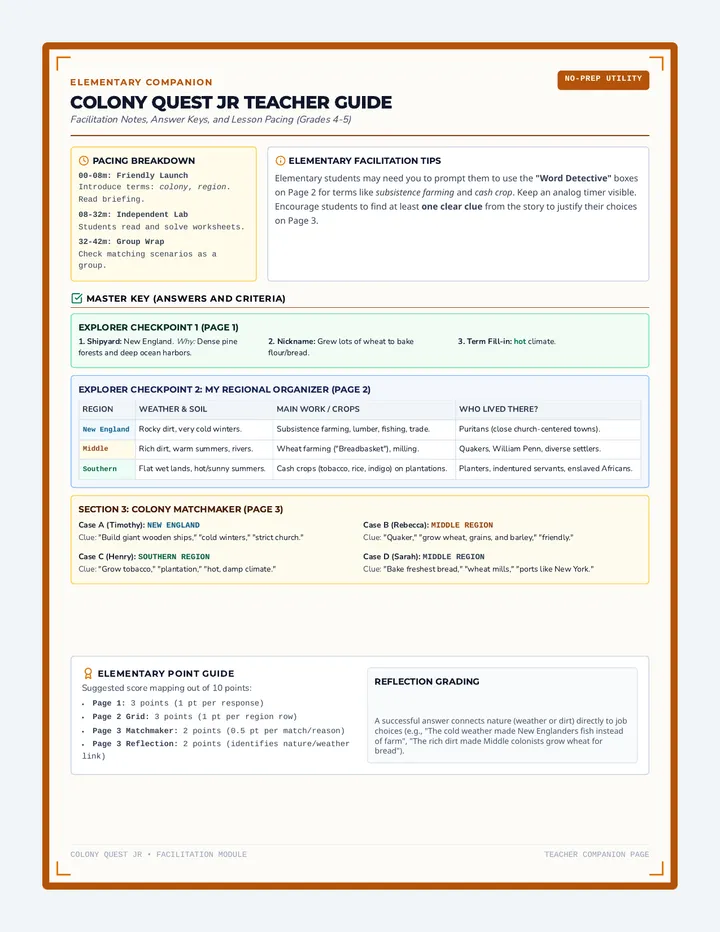
Colonial Ledger Pacing Guide PACING & LESSON PLAN GUIDE
TEACHER RESOURCE
A complete, Day-by-Day pacing plan for a 42-minute class period, optimized for collaborative 8th-grade classes with 4th-5th reading support.
Minutes 0-7 Do-Now & Hook
Minutes 7-22 Interactive Slides
Minutes 22-37 Collaborative Work
Minutes 37-42 Exit Ticket / Check
W1 WEEK 1: REGIONAL GEOGRAPHY & NEW ENGLAND ORIGINS
Day Daily Objective Instructional Activity Collaborative Check Day 1-2 Define geography and identify 3 regions. Introduce slide deck (Slides 1-2). Map out boundaries. Turn and talk: Cold vs hot regions. Day 3 Explore New England geography & soil. Review Slide 3. Define rocky soil and subsistence farming. Notes: Complete Section A (Page 1). Day 4-5 Identify Pilgrim & Puritan religious motives. Deep dive on "freedom to choose religion" and rules. Pair-match: Motive cards activity.
W2 WEEK 2: MIDDLE & SOUTHERN GEOGRAPHY & LABELS
Day Daily Objective Instructional Activity Collaborative Check Day 6-7 Understand the Breadbasket climate and grains. Review Slide 4. Define oats and deep rivers. Notes: Complete Section B (Page 1). Day 8-9 Understand Southern weather & flat plains. Review Slide 5. Discuss long hot summers and mud. Notes: Complete Section C (Page 2). Day 10 Summarize and label 3 regions on a map. Complete "Colonial Foundations Map Activity". Color-code regions. Stamp/Check: Teacher verifies map zones.
W3 WEEK 3: COLONIAL COMMERCE & SHIPBUILDING (LESSON 2)
Day Daily Objective Instructional Activity Collaborative Check Day 11-12 Define economy and compare regional jobs. Introduce "Colonial Commerce Slides" (Slides 1-2). Turn & Talk: Difference in crop goals. Day 13-14 Identify New England shipping and cod trade.
Colonial Ledger Study Guide COLONIAL LEDGER STUDY GUIDE
UNIT REVIEW
NAME:
DATE:
CLASS:
Study Matrix: Use this completed guide to study the differences between the 3 colonial regions!
Regional Feature
New England
Middle Region
Southern Region
🌍 GEOGRAPHY Weather & Soil
• Very cold winters and a short growing season.
• Rocky soil full of stones.
• Deep natural harbors and thick pine forests.
• Mild, balanced weather with regular rain.
• Rich, fertile river soil .
• Wide rivers (Hudson and Delaware).
• Hot, humid, long summers and short winters.
• Flat, damp, wide plains .
• Giant acreage fields.
💰 ECONOMY Trade & Work
• Shipbuilding: Cutting timber to build sailing ships.
• Ocean trade: Salted cod fishing and whaling.
• Subsistence family gardens.
• Breadbasket: Growing oats, wheat, and barley.
• Busy trading cities like Philadelphia & New York .
• Iron crafts (blacksmiths).
• Plantations: Giant cash crop farms.
• Tobacco, Rice, and Indigo dye crops.
• Heavily relied on enslaved Africans .
📜 SOCIETY & GOV Life & Rules
• Mayflower Compact rules.
• Local town meetings for voting.
• Strict Puritan rule; first public schools built.
• Religious Tolerance: Everyone is welcome.
• Quaker Way: Equality and peaceful practices.
• Multi-ethnic German and Dutch melting pot.
• House of Burgesses representative assembly.
• Private home tutors instead of public schools.
• Spread-out neighbor estates, miles apart.
Study Buddy check:
Quiz your partner: "Which region grew grains? Which region grew tobacco? Which built ships?"
Colonial Ledger Sequence • Unit Study Guide Page 1 of 2
COLONIAL LEDGER STUDY GUIDE
UNIT REVIEW
NAME:
Colonial Ledger Unit Assessment COLONIAL LEDGER FINAL EXAM
UNIT ASSESSMENT
NAME:
DATE:
CLASS:
📝 Exam Directions: Read each question carefully. Circle or bubble in the letter of the single best answer. Take your time!
Question 1: Regional Geography
Why was farming crops difficult in the New England colonies?
A The weather was too dry and warm.
B The soil was rocky and winters were cold.
C They had too many flat, damp crop fields.
D The rivers were completely salted.
Question 2: Colonial Economy
Which region was called the "Breadbasket" because of its massive grain fields?
A The Southern Colonies
B The Middle Colonies
C The New England Colonies
D The English Territories
Question 3: Cash Crops
What is a "cash crop" as seen in the Southern plantations?
A A crop grown only for families to eat.
B A crop grown purely to sell across the sea for money.
C A wild flower found in New England forests.
D A type of fish caught in deep ocean ports.
Question 4: Social Rules
Which group started Pennsylvania to practice equal rights and peaceful lifestyles?
A The Puritans
B The Quakers
C The Virginia plantation owners
D The King of England's army
Colonial Ledger Sequence • Unit Assessment Page 1 of 2
COLONIAL LEDGER FINAL EXAM
UNIT ASSESSMENT
NAME:
DATE:
CLASS:
✔ Section B: Key Term Match
Write the letter of the correct meaning next to each vocabulary term!
1. Democracy
2. Plantation
3. Tolerance
4. Compact
A. A giant farm that grows crop exports using forced labor.
B. An official agreement or contract signed by a group.
C. A voting system where people choose their own laws.
D. Treating and respecting different beliefs with equal kindness.
✔ Section C: Short Answer Challenge
Answer the final prompt below in at least two complete sentences . Use the checklist box to verify your work!
"How did geography and climate force New England to build a different economy than the Southern colonies?"
🔍 Student Checklist