Rumor Regulators Teacher Guide Teacher Resource • Confidential
Scholarly Habit: Evidence-Based Questioning
RUMOR REGULATORS
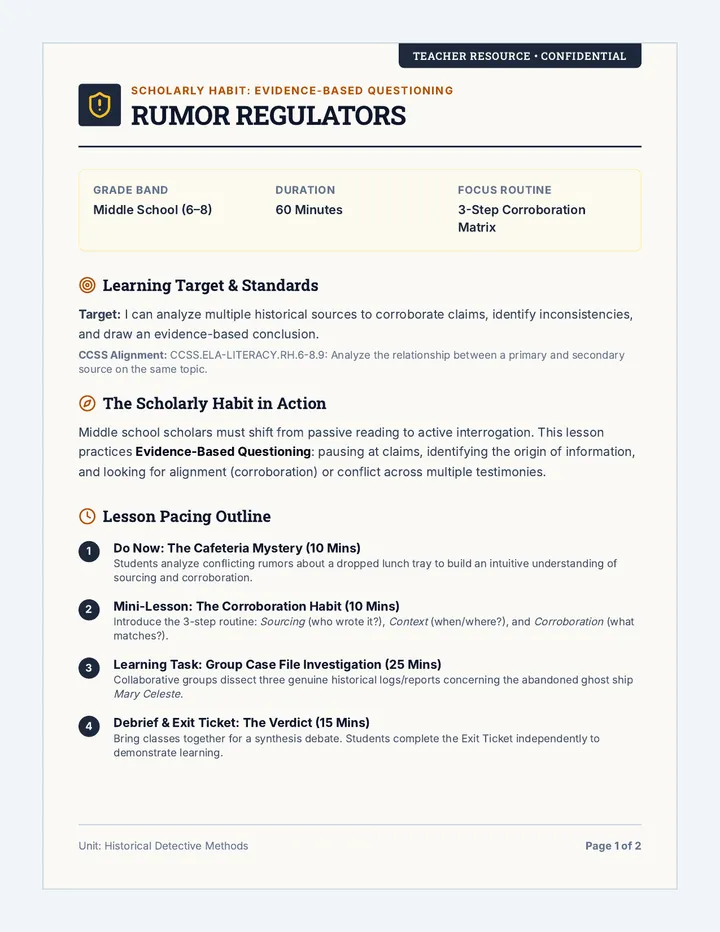
Grade Band Middle School (6–8)
Duration 60 Minutes
Focus Routine 3-Step Corroboration Matrix
Learning Target & Standards
Target: I can analyze multiple historical sources to corroborate claims, identify inconsistencies, and draw an evidence-based conclusion.
CCSS Alignment: CCSS.ELA-LITERACY.RH.6-8.9: Analyze the relationship between a primary and secondary source on the same topic.
The Scholarly Habit in Action
Middle school scholars must shift from passive reading to active interrogation. This lesson practices Evidence-Based Questioning : pausing at claims, identifying the origin of information, and looking for alignment (corroboration) or conflict across multiple testimonies.
Lesson Pacing Outline
1
Do Now: The Cafeteria Mystery (10 Mins)
Students analyze conflicting rumors about a dropped lunch tray to build an intuitive understanding of sourcing and corroboration.
2
Mini-Lesson: The Corroboration Habit (10 Mins)
Introduce the 3-step routine: Sourcing (who wrote it?), Context (when/where?), and Corroboration (what matches?).
3
Learning Task: Group Case File Investigation (25 Mins)
Collaborative groups dissect three genuine historical logs/reports concerning the abandoned ghost ship Mary Celeste .
4
Debrief & Exit Ticket: The Verdict (15 Mins)
Bring classes together for a synthesis debate. Students complete the Exit Ticket independently to demonstrate learning.
Unit: Historical Detective Methods Page 1 of 2
Teacher Resource • Instructional Guide
Step-by-Step Facilitation Guide
Phase 1: The Do Now (10 Mins)
Setup: Have the student worksheets open. Ask students to read the three testimonies regarding "The Cafeteria Collision."Teacher Script: "Class, three different people witnessed the dropped tray, but they are telling very different stories. As scholars, we don't just pick the story we like best. We look at the evidence. Who was closest to the incident? Who has a motive to bend the truth?"
Phase 2: The Core Routine (10 Mins)
Display the 3-Step Corroboration Matrix slides. Guide students to understand that they are looking for points of agreement. If Source A and Source B both saw water on the floor, we can reasonably assume the floor was wet. If only Source C saw a banana peel, that claim is uncorroborated.
Phase 3: The Collaborative Investigation (25 Mins)
Group Setup: Form groups of 3 to 4. Distribute the Case Files (A, B, and C) in the Student Packet.Monitoring Strategy: Walk around to ensure students are actively looking for agreements/disagreements.Guiding Questions: "Why would the Captain of the Dei Gratia (the salvaging ship) have an interest in exaggerating the disarray of the Mary Celeste? How does the official court transcript match or conflict with his story?"
Case Investigation Answer Key
Source A (Sourcing & Bias): Captain Morehouse (Dei Gratia). High bias. He stands to receive a massive salvage award from the court if the vessel was clearly abandoned in extreme, scary conditions.
Source B (Official Logs): Logbook found on ship. High reliability for dates/coordinates, but ends 9 days before discovery.
Source C (Gibraltar Court Inquiry): Marshal Deverell. Objective investigator. Note: He found sword marks and some blood, which was later proven to be simple rust, showing even official sources can make mistakes.
Corroboration: All sources agree the crew was entirely gone, the ship was seaworthy, and the main logbook was left behind. They disagree heavily on the presence of violence (sword marks) and the amount of water in the hold.
Scaffolding & Extension Strategies
Scaffolding (Struggling Readers): Provide a highlighted version of Source A and C, indicating the exact lines that contain description of ship conditions.Extension (Advanced Scholars): Ask students to write a paragraph predicting why the crew abandoned a perfectly seaworthy ship, based only on the corroborated facts.
Unit: Historical Detective Methods Page 2 of 2
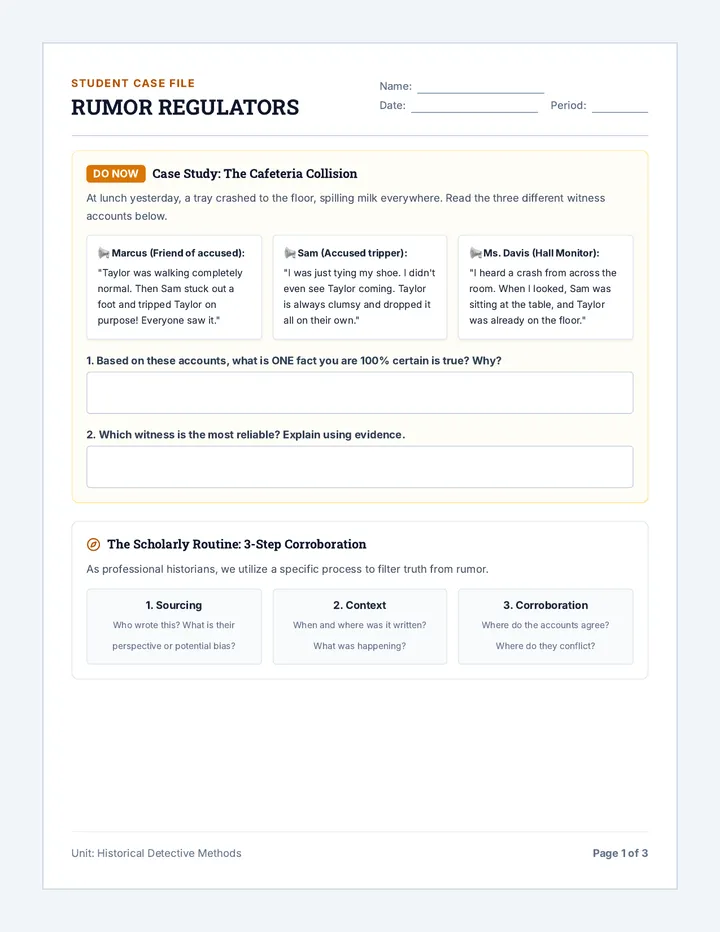
Rumor Regulators Student Packet Student Case File
RUMOR REGULATORS
Name:
Date:
Period:
Do Now
Case Study: The Cafeteria Collision
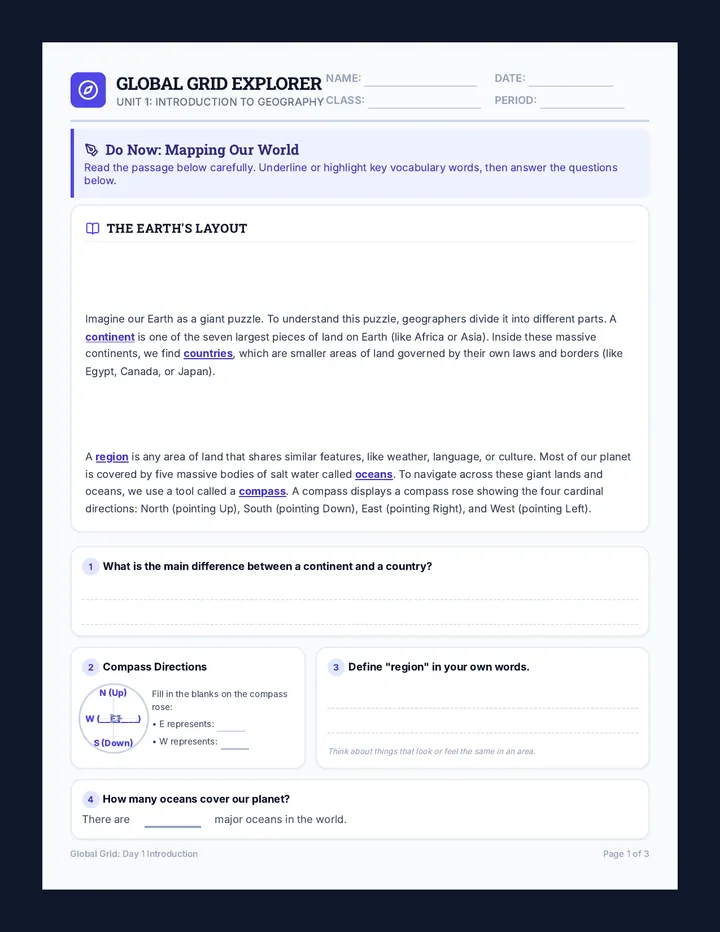
At lunch yesterday, a tray crashed to the floor, spilling milk everywhere. Read the three different witness accounts below.
📢 Marcus (Friend of accused):
"Taylor was walking completely normal. Then Sam stuck out a foot and tripped Taylor on purpose! Everyone saw it."
📢 Sam (Accused tripper):
"I was just tying my shoe. I didn't even see Taylor coming. Taylor is always clumsy and dropped it all on their own."
📢 Ms. Davis (Hall Monitor):
"I heard a crash from across the room. When I looked, Sam was sitting at the table, and Taylor was already on the floor."
1. Based on these accounts, what is ONE fact you are 100% certain is true? Why?
2. Which witness is the most reliable? Explain using evidence.
The Scholarly Routine: 3-Step Corroboration
As professional historians, we utilize a specific process to filter truth from rumor.
1. Sourcing Who wrote this? What is their perspective or potential bias?
2. Context When and where was it written? What was happening?
3. Corroboration Where do the accounts agree? Where do they conflict?
Unit: Historical Detective Methods Page 1 of 3
Case Investigation
The Mystery of the Mary Celeste
In 1872, the cargo ship Mary Celeste was found drifting in the Atlantic. The ship was fully seaworthy, but the crew was entirely gone. Use the three sources to complete the Corroboration Matrix.
📁 Source A: Testimony of Captain Morehouse (Dei Gratia Salvaging Captain)
"We boarded the vessel and found not a soul. The cabin was in complete disarray. Water was up to our knees in the cargo bay. They left in absolute, terrified panic, abandon-ship style. We deserve a high financial reward for saving this broken vessel."
📁 Source B: Official Logbook of the Mary Celeste (Found on board)
"Nov 24: Weather is strong but clear. Cargo is stable. Nov 25 (Last entry): Land sighted on horizon. Pumps working fine. No signs of trouble or disease aboard."
📁 Source C: Gibraltar Court Investigation Report (Written by Marshal Deverell)
"Inspection shows the hull has minor water damage, but pump is functional. Key sails are missing. Odd marks found on the ship’s wooden railing resembling sword scratches. Brown stains found on deck, initially suspected to be blood."
3-Step Corroboration Matrix
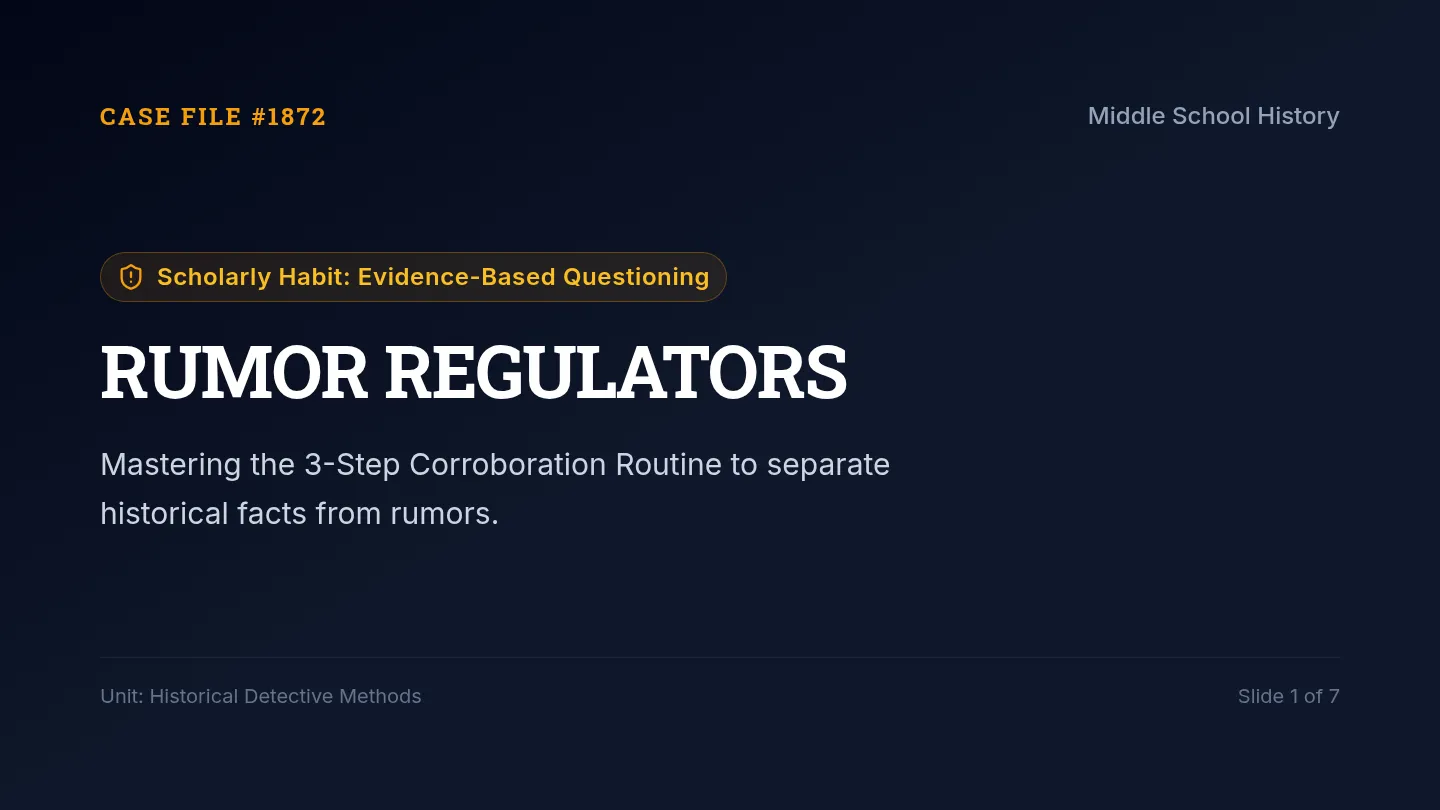
Rumor Regulators Slides Case File #1872 Middle School History
Scholarly Habit: Evidence-Based Questioning
RUMOR REGULATORS
Mastering the 3-Step Corroboration Routine to separate historical facts from rumors.
Unit: Historical Detective Methods Slide 1 of 7
Do Now: The Cafeteria Incident
10 Minutes
A tray crashed. Milk spilled everywhere. Three classmates tell three completely different stories.
How do we know who is telling the truth? Do we just believe the person we like best?
Our Task:
Read all three witness claims.
Identify points where they agree.
Pick the most reliable witness.
Turn & Talk to your partner Slide 2 of 7
The Scholarly Habit
Evidence-Based Questioning
Scholars do not accept information at face value. We practice active skepticism by pausing and asking:
?
Who is speaking?
What is their background? Do they have a personal interest or bias in this case?
📅
When was it said?
Was it recorded immediately as it happened, or weeks/years later after rumors spread?
🔗
Who matches?
Do multiple independent accounts tell the same story, or does this voice stand completely alone?
Be a skeptic, not a passenger Slide 3 of 7
The 3-Step Routine
Our Daily Practice
1
Sourcing
Evaluate who created the document before reading the actual text.
2
Contextualizing
Locate the document in time and place. What else was happening?
3
Corroborating
Compare different testimonies. Find where they align and where they clash.
This is how we investigate history Slide 4 of 7
The Mystery of the Mary Celeste
Historical Briefing
December 1872: A merchant ship is found drifting in the Atlantic Ocean.
The sails are slightly torn, but the ship is perfectly seaworthy. Food and personal items are left behind. Every single crew member has vanished.
The Core Questions:
⚓ Why did they leave a safe ship?
⚓ Was there extreme weather?
⚓ Was there crew violence?
⚓ Or did they abandon ship in a false panic?
Analyze the conflicting claims in your student packet Slide 5 of 7