Atomic Reference Sheet Reference Guide
Atomic Reference Sheet
Unit 02 • The Atom & Periodic Table
Atomic Structure
<table class="w-full text-xs"><tbody><tr class="border-b border-slate-100"><td class="py-1 font-bold w-24">Atomic #:</td><td>Number of Protons</td></tr><tr class="border-b border-slate-100"><td class="py-1 font-bold">Mass #:</td><td>Protons + Neutrons</td></tr><tr class="border-b border-slate-100"><td class="py-1 font-bold">Charge:</td><td>Protons − Electrons</td></tr><tr class="border-b border-slate-100"><td class="py-1 font-bold">Isotope:</td><td>Same P, different N</td></tr><tr class="border-b border-slate-100"><td class="py-1 font-bold">Ion:</td><td>Atom with a charge</td></tr></tbody></table>
Isotope Calculation
\[ \text{Avg. Mass} = \sum (\text{Mass} \times \text{Abund.}) \]
Process:
1. Abundance % → Decimal (move decimal 2 spaces left)
2. (Mass × Abund.) + (Mass × Abund.) + ...
Periodic Table Overview
Rows/Cols
Periods: Rows 1-7
Groups: Cols 1-18
Families
G1: Alkali Metals
G17: Halogens
G18: Noble Gases
Valence e−
Determined by Group # (e.g., G17 = 7 valence)
6
C
12.011
Top #: Atomic Number (Protons)
Letter: Symbol
Bottom #: Average Atomic Mass
Confidential Examination Material • Atomic Mastery Unit • Ref. 2.1
Atomic Mastery Test Atomic Reference Sheet
Resource Guide for Unit 2 Assessment
Atomic Structure
Atomic #:# Protons
Mass #:P + N
Charge:P − E
Calculations
Avg. Mass = (Mass × Abund.) + (Mass × Abund.)
Note: Abundance must be in decimal form (e.g., 20% = 0.20)
Periodic Table
Periods: Horizontal Rows
Groups: Vertical Columns
G1: Alkali Metals
G17: Halogens
G18: Noble Gases (Inert)
Atomic #
X
Avg. Mass
Unit 2 Mastery Test
Atomic Mastery Unit Assessment
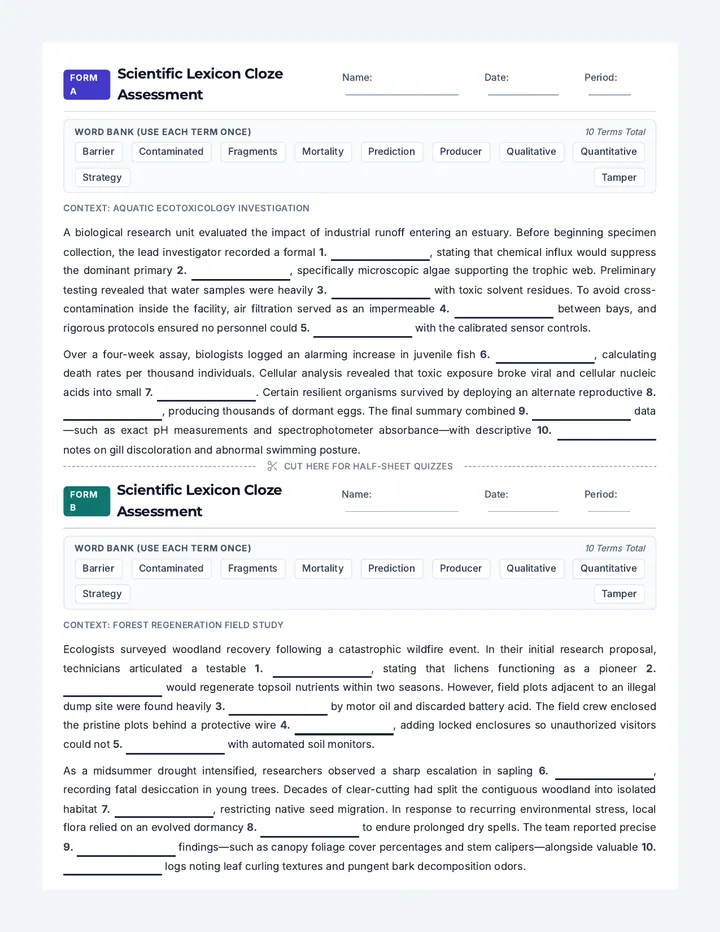
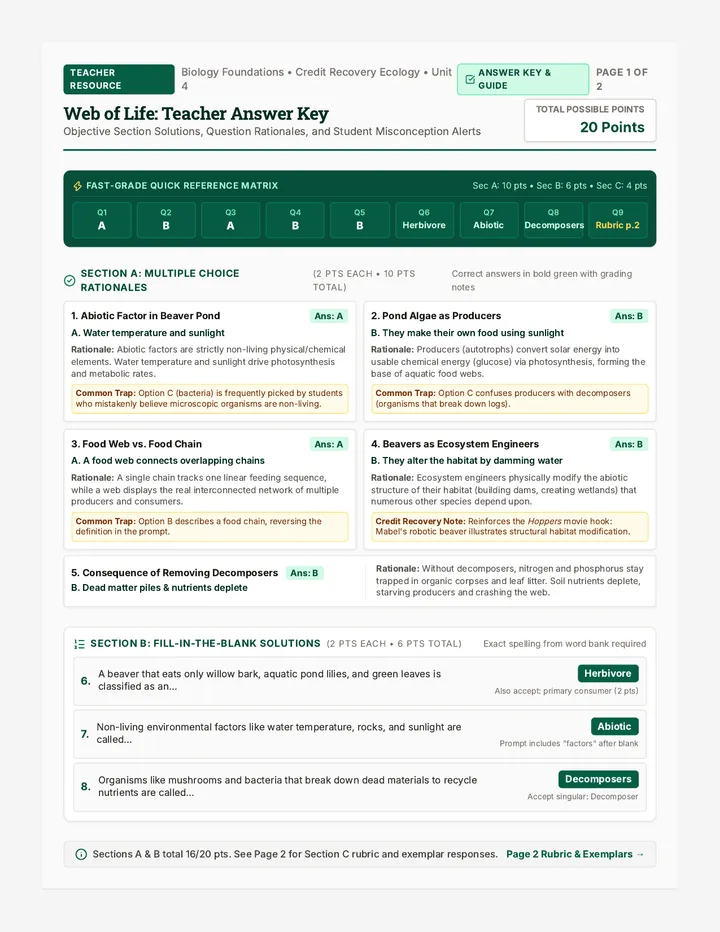
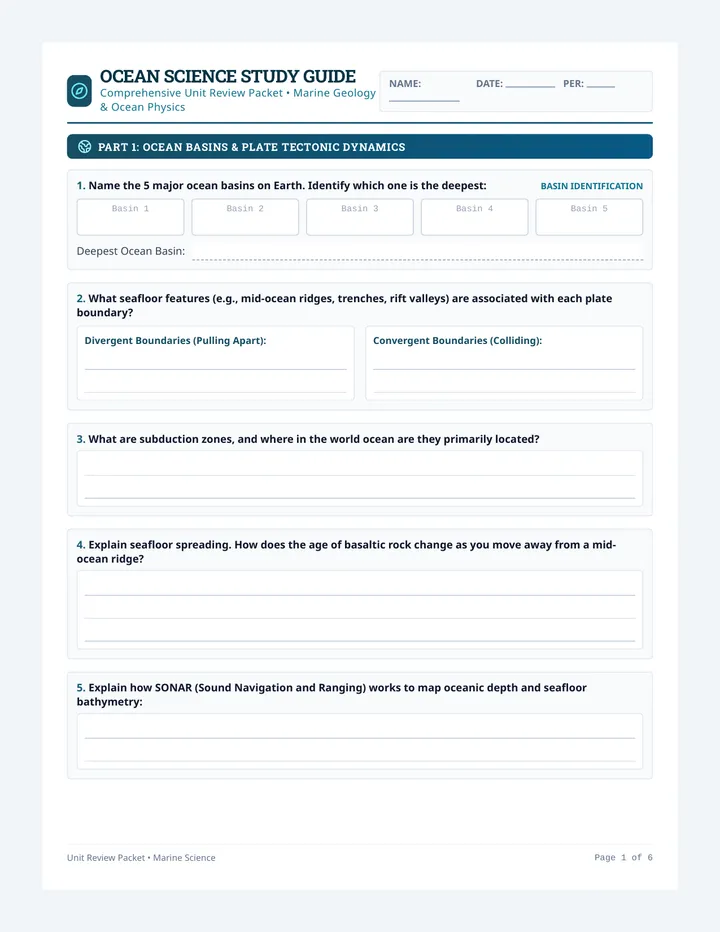
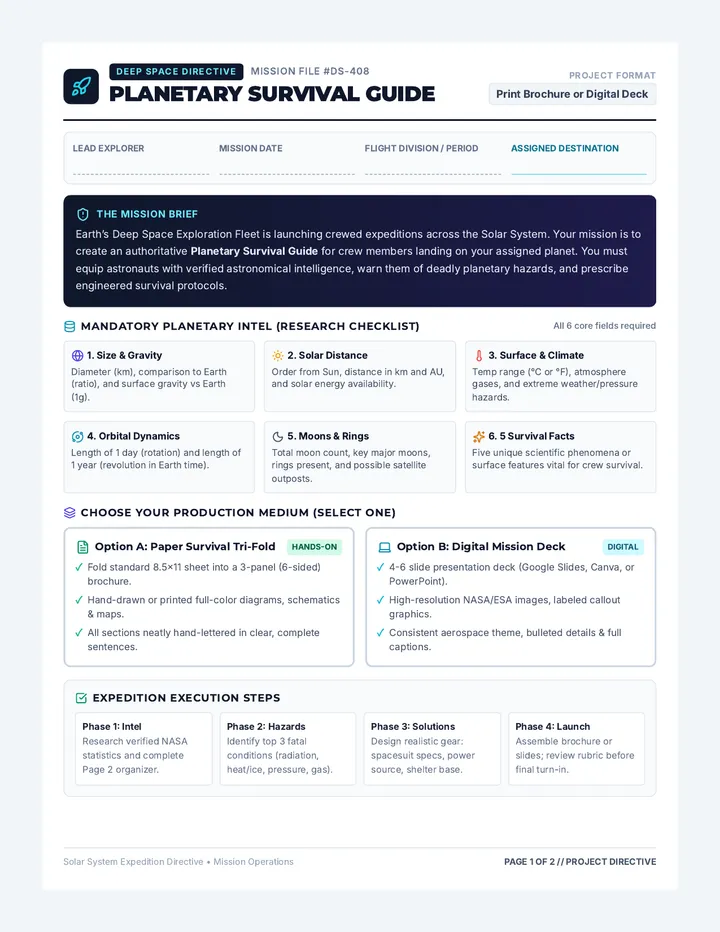
NAME:
DATE:
Part I: Multiple Choice
1. Which subatomic particle determines an atom's identity?
A) ElectronB) NeutronC) ProtonD) Nucleus
2. Isotopes differ in their number of:
A) ProtonsB) NeutronsC) ElectronsD) Bonds
3. A "radioactive" isotope has an unstable:
A) ShellB) ChargeC) NucleusD) Spin
4. An atom of Carbon-13 has how many neutrons? (Atomic # = 6)
A) 6B) 13C) 7D) 19
5. Radioactive isotopes are used in medicine for:
A) CoolingB) ImagingC) SterilizingD) Hydration
6. If an atom loses 1 electron, its charge becomes:
A) +1B) -1C) 0D) +2
7. Average atomic mass is a _______ average of all isotopes.
A) SimpleB) PeriodicC) WeightedD) Random
8. Groups on the periodic table are _______ columns.
A) VerticalB) HorizontalC) DiagonalD) Broken
9. Elements in the same group share the same number of:
A) ProtonsB) NeutronsC) Valence e-D) Orbitals
10. Most reactive metals belong to Group:
A) 18B) 1C) 17D) 2
11. Nonmetals are found on the _______ side of the table.
A) LeftB) MiddleC) RightD) Bottom
12. Argon (Ar) is a member of which family?
A) HalogenB) AlkaliC) Noble GasD) Metalloid
13. Silicon is classified as a:
A) MetalB) NonmetalC) MetalloidD) Gas
14. Group 17 elements have how many valence electrons?
A) 1B) 7C) 17D) 8
15. Magnesium (Mg) is in which family?
A) AlkaliB) Noble GasC) Alkaline EarthD) Halogen
16. Moving across a period, the atomic number _______.
A) IncreasesB) DecreasesC) Stays sameD) Fluctuates
17. Which of the following is a halogen?
A) IronB) ChlorineC) PotassiumD) Neon
18. Electrons in the innermost shells are called _______ electrons.
A) ValenceB) StaticC) ShieldingD) Nuclear
19. Mass number is the sum of _______ and neutrons.
A) ElectronsB) ProtonsC) QuarksD) Neutrinos
20. Metals are typically _______ conductors.
A) PoorB) GoodC) ZeroD) High-res
Part II: Open Ended Response
21. Isotope Math (4 pts)
Isotope A: 10.0 amu (20%); Isotope B: 11.0 amu (80%). Calculate the average atomic mass. Show work.
22. Element Profiles (4 pts)
Compare Sodium (G1, P3) and Chlorine (G17, P3).
A) Metallic character: Which one is a metal? (1 pt)
B) Valence electrons: How many does each have? (1 pt)
C) Ions: What charge will each form and why? (2 pts)
Atomic Test Key Answer Key
Unit 2 Mastery Test: Atomic Mastery
Part I: Multiple Choice
C
B
C
C
B
A
C
A
C
B
C
C
C
B
C
A
B
C
B
B
Part II: Open Ended Response
Q21: Isotope Math (4 pts)
Solution:
1. Convert abundances: 0.20 and 0.80
2. Multiply: \((10.0 \times 0.20) + (11.0 \times 0.80)\)
3. \(2.0 + 8.8 = 10.8\)
Answer: 10.8 amu
Rubric: 1 pt for decimals, 1 pt for setups, 1 pt for math, 1 pt for units.
Q22: Element Profiles (4 pts)
A) Metallic character:
Sodium (Na) is a metal. Chlorine (Cl) is a nonmetal.
B) Valence electrons:
Sodium: 1 valence electron; Chlorine: 7 valence electrons.
C) Ions:
Sodium will form a +1 charge because it loses 1 electron. Chlorine will form a -1 charge because it gains 1 electron to reach 8.
Atomic Review Lesson Plan Teacher Facilitation Guide
Atomic Mastery Review Sprint • 50 Minutes
Lesson ID
U02-REV
Lesson Background
Course: Chemistry
Unit: 02 - The Atom
Objective: SWBAT synthesize knowledge of isotopes, periodic table organization, and ion formation to demonstrate mastery on the unit assessment.
Priority Standards: EK.1.B.1 (Structure), EK.1.D.2 (Trends/Families)
Setup & Materials
• Student Handouts & Homework Packet
• Reference Sheets & Periodic Tables
• Calculators (Essential for Round 1)
• Projector for Review Round Solutions
Key Vocabulary
IsotopeRadioactivity Weighted AverageValence Electrons Noble GasIon (Cation/Anion)
Lesson Timeline
Time Activity Focus 00-05 min Do Now / Entry Routine Recall of P/N/E counts. 05-15 min Round 1: Isotope Math 3-isotope weighted averages. 15-25 min Round 2: Family Scavenger Hunt Properties of G1, G2, G17, G18. 25-40 min Round 3: Ion Training Valence → Charge relationship. 40-50 min Exit Ticket / Recap Check for Mastery.
Facilitation & Scripts
Round 1: The Weighted Average Sprint
Teacher Script
"Eyes on the board. Most common mistake on isotopes? Adding the masses and dividing by two! No! We need a weighted average. If I have 90% of a 20lb weight and only 10% of a 22lb weight, which one should my answer be closer to?"
Look-Fors
Are students moving the decimal point two places left? (e.g., 90% → 0.90)
Are they checking their answers for "reasonableness"? (Between lowest and highest mass)
Round 2: Family Characteristics
Teacher Script
"If an element is in Group 18, it's like a rockstar who doesn't want to hang out with anyone else. Why? They're Noble. They have full valence shells. Check your table: which groups have the 'explosive' elements?"
Look-Fors
Students differentiating between Group (Vertical) and Period (Horizontal).
Connecting "Valence e-" count to specific group numbers (1, 2, 13-18).
Round 3: Ion Charge Prediction
Atomic Review Handout Atomic Mastery: Review Sprint
Unit 2 • Pre-Assessment Practice
Name:
Date:
Do Now (5 min)
Element: Cl-37
Protons: ___
Neutrons: ___
Electrons: 17
Mass #: ___
1. Which subatomic particle determines identity?
2. How many valence electrons are in Group 15?
1
Round 1: Isotope Math
Problem A: Calculate Avg. Atomic Mass (Element X)
Isotope 1: 20.0 amu (90%) | Isotope 2: 22.0 amu (10%)
Problem B: Calculate Avg. Atomic Mass (Silicon)
Si-28: 28.0 amu (92.2%) | Si-29: 29.0 amu (4.7%) | Si-30: 30.0 amu (3.1%)
2
Round 2: Family Tree
Description Family Name
Highly reactive nonmetals; 7 valence electrons:
Inert/Stable; Full outer shell; Group 18:
Explosive in water; 1 valence e-; Group 1:
Reactive metals; 2 valence e-; Group 2:
Middle block; shiny; conductive:
Found along the staircase; semiconductors:
3
Round 3: Ion Training
Element Group Valence e- Lose/Gain? Ion Charge Sodium (Na) 1 Sulfur (S) 16 Calcium (Ca) 2 Fluorine (F) 17 Aluminum (Al) 13
Exit Ticket
1. Element in Group 17, Period 3:
2. Charge of ion (13 P, 10 E):
3. Why are Noble Gases inert? (Explain with valence electrons)
4. Bonus: Write the nuclear symbol for an isotope with 8 P and 10 N.
Atomic Review Homework Packet Review Homework Packet
Atomic Mastery Series • Unit 2 Review
Name:
Due Date:
Part 1: Isotopes & Radioactivity
1. Concept Recall
A. What do isotopes of the same element always have in common?
B. Why do some isotopes decay while others stay stable?
2. Applications
Describe one specific way scientists or doctors use radioactive isotopes in the real world.
3. Weighted Average (Calculation Sprint)
Element Q: Q-100 (90%), Q-102 (8%), Q-105 (2%). Find Avg. Mass. Show all work.
Show Step 1 (Decimals), Step 2 (Multiply), Step 3 (Sum)...
Part 2: PT Scavenger Hunt & Classification
Section A : Identify The Element
1. Group 2, Period 4:
2. The only liquid metal:
3. Group 17, Period 5:
4. 6 valence e-, Period 2:
5. Group 1, Period 1 (nonmetal):
6. Noble gas with 2 e-:
Section B : Classification (M, NM, or ML)
Aluminum
Silicon
Phosphorus
Gold
Arsenic
Bromine
Calcium
Xenon
Part 3: Ion Mastery & Particle Training
Scenario: Oxygen (O)
Group #:
Valence e-:
Lose or Gain?
Final Charge:
Scenario: Lithium (Li)
Group #:
Valence e-:
Lose or Gain?
Final Charge:
The Mystery Particle Grid
Use your knowledge of P, N, E, and Mass # to solve. Be careful of charges!
Atom/Ion Protons Neutrons Electrons Mass # Charge Iron-56 26 26 0 K+ Ion 20 18 39 Br- Ion 35 45 -1 Mystery X 14 10 27 +3
Practice Leads to Mastery • Atomic Mastery Unit • Homework Packet